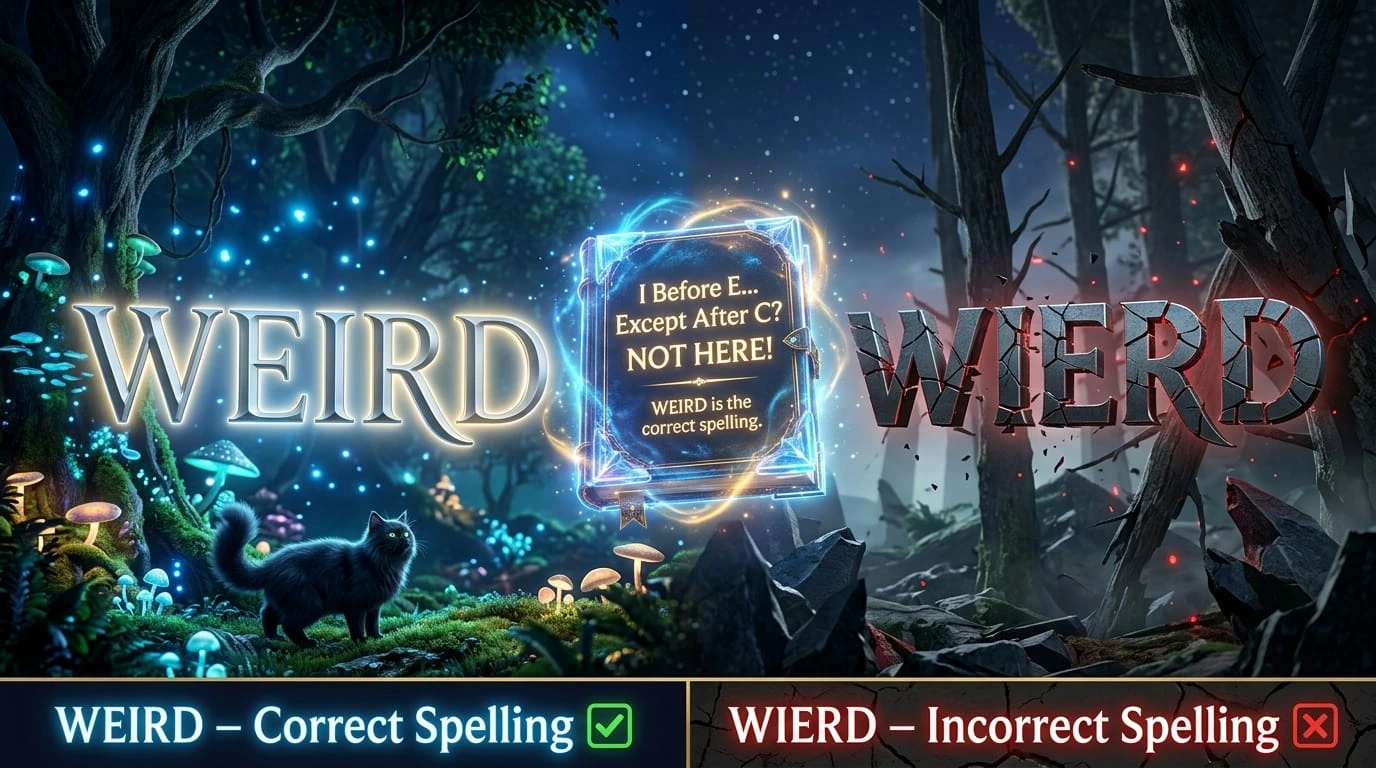
Weird is the correct spelling. Wierd is a common misspelling and should never be used in formal or informal English writing.
I still remember proofreading one of my first blog posts and feeling confident that everything was perfect. Then my spell checker highlighted wierd in bright red. I stared at it for a moment because I had seen that spelling so many times online. Was it really wrong? A quick dictionary check settled the question. The correct spelling was weird, not wierd.
If you’ve ever paused while typing this word, you’re not alone. It is one of the most commonly misspelled words in English. Many people remember the spelling rule “I before E except after C,” but weird breaks that rule. That is exactly why so many students, writers, and English learners search for weird or wierd.
The good news is that the answer is simple. Once you understand why weird is spelled this way and learn an easy memory trick, you’ll probably never make this mistake again.
Weird or Wierd: Quick Answer
The correct spelling is weird.
The spelling wierd is incorrect and is not accepted in standard English. Whether you’re writing an email, an essay, or a social media post, always use weird.
Examples
✅ That was a weird dream.
✅ This weather feels weird today.
❌ That was a wierd dream.
❌ His answer sounded wierd.
If you want accurate English, always choose weird.
The Origin and Background of Weird or Wierd
The word weird has an interesting history. It comes from the Old English word wyrd, which meant fate, destiny, or the power that controls events.
Over time, the meaning changed. People began using weird to describe things that seemed strange, mysterious, or unusual. Today, it usually means something that is odd, unexpected, or different from normal.
The confusion between weird and wierd mostly comes from spelling rules taught in school.
Many people remember:
“I before E except after C.”
However, English has many exceptions.
Words like these also break the rule:
- Weird
- Their
- Foreign
- Seize
- Height
Because weird is one of those exceptions, many writers accidentally reverse the letters and type wierd.
Weird or Wierd Explained: Key Differences
Although the two spellings look very similar, only one is correct.
| Term | Meaning | When to Use | Region/Context |
|---|---|---|---|
| Weird | Strange, unusual, or unexpected | Always | Standard English worldwide |
| Wierd | Misspelling | Never | Incorrect spelling |
What Does Weird Mean?
The adjective weird describes something unusual or different from what you expect.
It can describe:
- People
- Situations
- Sounds
- Dreams
- Feelings
- Events
Examples
- I heard a weird noise outside.
- She had a weird feeling before the interview.
- That’s a weird way to solve the problem.
- The movie had a weird ending.
In every case, weird means strange, odd, or unusual.
Is Wierd Ever Correct?
No.
The spelling wierd is not accepted in:
- School assignments
- College essays
- Business emails
- Books
- Newspapers
- Professional reports
- Online publications
Modern spell checkers automatically replace wierd with weird because wierd is simply a spelling mistake.
Which Version Should You Use?
The answer is easy.
Always use weird.
Here is practical advice for different readers.
| Audience | Best Choice | Reason |
|---|---|---|
| Students | Weird | Correct for homework and exams |
| Teachers | Weird | Standard dictionary spelling |
| Bloggers | Weird | Better readability and SEO |
| Business professionals | Weird | Looks professional |
| English learners | Weird | Correct worldwide |
No matter where you live or write, weird is the only correct spelling.
Common Mistakes with Weird or Wierd
Many writers make similar spelling mistakes.
Here are the most common ones.
| Mistake | Correct |
|---|---|
| wierd | weird |
| Wierd | Weird |
| It looks wierd. | It looks weird. |
| What a wierd story! | What a weird story! |
| This is so wierd. | This is so weird. |
Why Do People Write “Wierd”?
There are several reasons.
- They remember the “I before E” rule.
- They type too quickly.
- They have seen the incorrect spelling online.
- They rely on memory instead of pronunciation.
- They rarely proofread their writing.
Since weird is an exception to the common spelling rule, the mistake is easy to understand.
Defence or Defense: The Complete 2026 Guide 📘
An Easy Trick to Remember Weird
Here’s the trick that helped me stop making this mistake.
Think of the phrase:
“We are weird.”
The first two letters in we are W-E.
So weird also starts with WE.
WE + IRD = WEIRD
Another memory trick is:
Weird starts with “we,” just like “we are.”
Never start it with wi.
After using this trick a few times, the correct spelling becomes much easier to remember.
Words Often Confused with Weird
Many people searching for weird or wierd also confuse it with similar-looking words.
| Word | Meaning |
|---|---|
| Weird | Strange or unusual |
| Odd | Different from normal |
| Strange | Unfamiliar or unusual |
| Unusual | Not common |
| Bizarre | Very strange or surprising |
Although these words have similar meanings, weird is usually used in everyday conversations because it sounds more natural and friendly.
Examples of Weird in Everyday Sentences
Everyday Conversation
- That was a weird phone call.
- My dog is acting weird today.
- I had a weird dream last night.
School
- The science experiment produced a weird result.
- Everyone laughed at the weird answer.
Work
- The computer is making a weird sound.
- Something weird happened during today’s meeting.
Travel
- We found a weird little shop in the old town.
- The weather became weird after sunset.
Entertainment
- The ending of the movie was really weird.
- That TV show has a weird but interesting story.
These examples show how naturally weird fits into everyday English. It is the spelling you should always use in conversations, emails, articles, and professional writing.
Weird or Wierd in Real-World Examples
Seeing a word used in different situations makes it much easier to remember. Here are examples of weird in everyday writing.
Professional Email
Dear Emma,
I noticed a weird error in yesterday’s sales report. I’ve corrected it and attached the updated version for your review.
Best regards,
Daniel
News Headline
Scientists Discover Weird Deep-Sea Creature Near Pacific Coast
Social Media Post
I had the weirdest dream last night. I was flying over my school! 😂
Formal Report
During testing, engineers detected a weird vibration in the machine that required further investigation.
Casual Conversation
“That’s weird. I was just thinking about you!”
Academic Writing
Researchers observed a weird pattern in the initial data, but later experiments explained the results.
These examples show that weird works naturally in both formal and informal writing. The spelling wierd should never be used.
Weird or Wierd: Data, Trends & Usage
The keyword “weird or wierd” is searched by thousands of people every month because it is one of the most commonly misspelled English words.
Here are a few useful insights.
- Search Intent: Informational
- Primary Audience: Students, English learners, writers, bloggers, and professionals
- Most Common Question: “Is wierd a real word?”
- Common Error: Reversing e and i
- Difficulty Level: Beginner
Who Searches This Topic Most?
People looking for this spelling difference often include:
- Students preparing assignments
- English language learners
- Bloggers and content writers
- Teachers and editors
- Professionals writing emails and reports
Why Does This Matter Today?
Good spelling builds trust. A single mistake like wierd can make your writing look careless, especially in school, business, or online publishing. Learning the correct spelling helps you write with more confidence.
Standalone Comparison Table
| Term/Variant | Meaning | Region/Context | Best Used When |
|---|---|---|---|
| Weird | Strange, unusual, or unexpected | Standard English worldwide | Always |
| Wierd | Incorrect spelling | Not accepted | Never |
Quick Tips to Remember the Correct Spelling
If you often mix up weird and wierd, these simple tricks can help.
- Remember that weird starts with “we.”
- Think of the phrase “We are weird.”
- Don’t rely only on the “I before E” rule because weird is an exception.
- Use spell-check while writing important documents.
- Read your writing once before sending or publishing it.
These habits will help you avoid the mistake every time.
Frequently Asked Questions
Q: Which spelling is correct, weird or wierd?
A: Weird is the correct spelling. Wierd is a misspelling and should not be used in any type of English writing.
Q: What does weird mean?
A: Weird means strange, unusual, unexpected, or different from what is normal. It is commonly used to describe people, situations, sounds, feelings, or events.
Q: Why do people spell weird as wierd?
A: Many people remember the spelling rule “I before E except after C” and mistakenly apply it to weird. Since weird is an exception, the letters are often reversed.
Q: Is wierd listed in English dictionaries?
A: No. Standard English dictionaries recognize only weird. The spelling wierd is considered incorrect.
Q: Can I use weird in formal writing?
A: Yes. Weird is a correct English word and can be used in formal writing when it fits the context. In very formal or academic writing, words like unusual, odd, or unexpected may sometimes sound more precise.
Q: Does British English spell weird differently from American English?
A: No. Both British English and American English use the spelling weird. There is no regional difference.
Q: How can I remember the correct spelling of weird?
A: Think of the phrase “We are weird.” Since we starts with W-E, you’ll remember that weird begins with WE, not WI.
Conclusion
If you’ve been wondering whether weird or wierd is correct, the answer is simple. Weird is the only correct spelling in English, while wierd is a common mistake caused by reversing the letters e and i. Even experienced writers make this error because weird breaks the familiar “I before E except after C” rule.
A simple memory trick can make all the difference. Just remember that weird starts with “we,” as in “We are weird.” That small reminder is often enough to stop the mistake before it happens.
Whether you’re writing a school assignment, a business email, a blog post, or a social media update, always choose weird. Correct spelling improves clarity and helps your writing appear more polished and professional.
Weird or wierd explained with correct spelling, meanings, usage, examples, and easy tips to avoid common English spelling mistakes forever.
Finaly or Finally: Which Spelling Is Correct? (2026)

I’m a language enthusiast and content writer. I’m specialized in English grammar, spelling differences, vocabulary explanations, and word comparisons. My goal is to help readers improve their writing skills through clear, accurate, and easy-to-understand language guides.