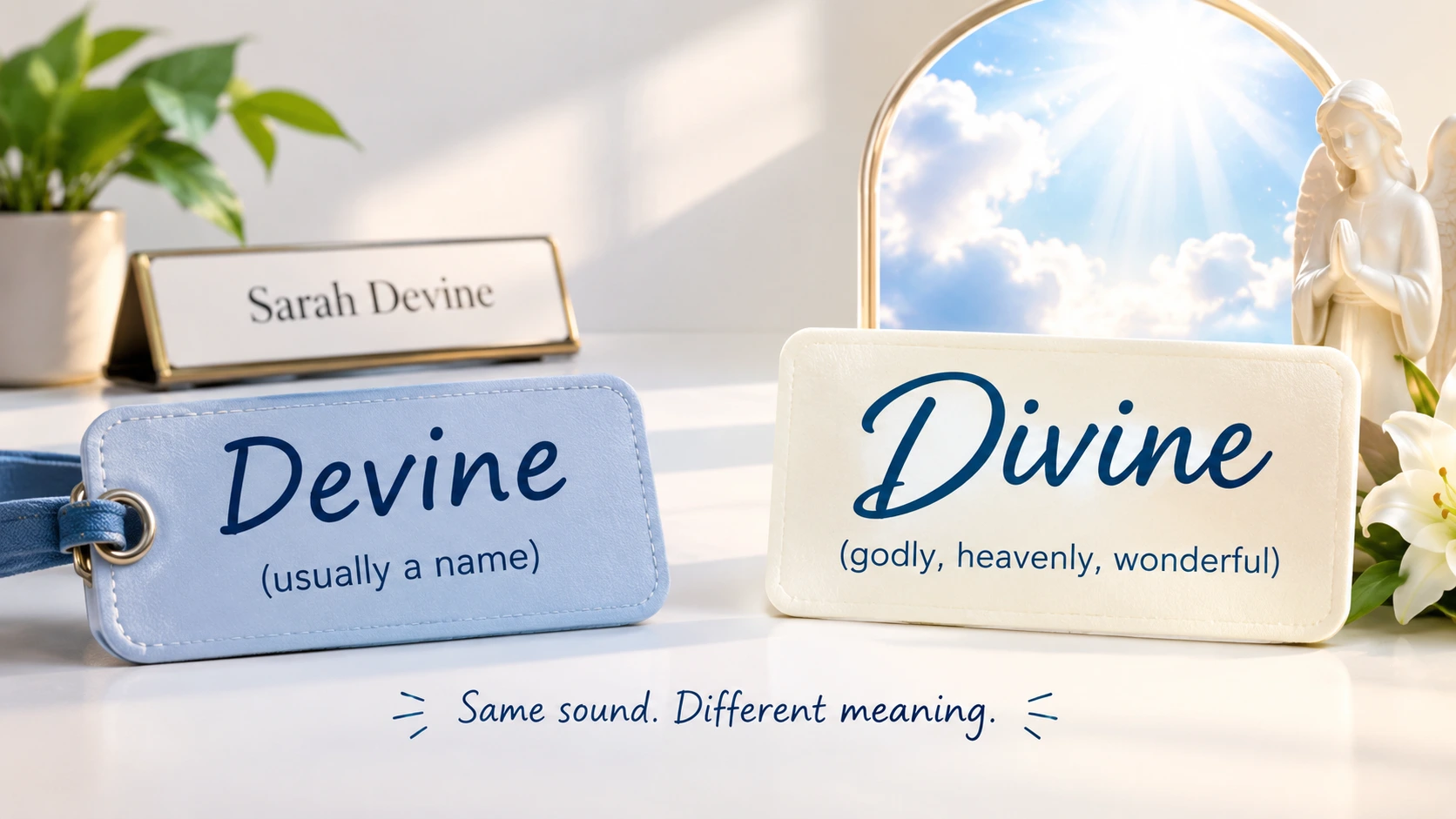
Devine and divine are not interchangeable. Divine is the correct spelling when you mean something related to a god, a deity, or something extremely wonderful. Devine is usually a proper name or surname, not the standard spelling of the adjective.
Have you ever typed a word that looked right, only to stop and wonder if one letter was wrong? Devine or divine is a good example. The two forms look almost identical, but they do not have the same use.
I have seen this kind of spelling mistake often when helping English learners check words in essays, emails, and online writing. The problem is easy to understand. Devine and divine sound very similar, especially when spoken quickly. That makes it easy to write the wrong form.
The good news is that the difference is simple once you know what to look for.
If you are talking about something connected with a god or deity, or describing something heavenly, use divine. The word can also describe something that seems wonderful, beautiful, or perfect.
Devine, on the other hand, is generally used as a proper name or surname. It is not the normal spelling of the English adjective.
Let’s look at the difference, examples, common mistakes, and easy ways to remember the correct spelling.
Devine or Divine: Quick Answer
The correct word for the usual English meaning is divine.
Divine can mean:
- Related to a god or deity
- Heavenly or sacred
- Extremely beautiful or wonderful
- Connected with religion or worship
For example:
The temple was built as a place of divine worship.
You can also use divine in an informal way:
The chocolate cake was divine.
Here, divine means extremely good or delightful.
Devine is different. It can appear as a surname or personal name, so you may see it in the name of a person, family, business, or other proper noun.
For example:
Sarah Devine joined the meeting.
So, when you need the adjective, remember:
Divine = the standard English word.
The Origin and Background of Divine
The word divine has a long history. It comes from Latin divinus, meaning “of a god” or “divine.” It later entered English through French.
This history helps explain why the word has strong links to religion and gods.
Over time, its meaning became broader. English speakers began using divine not only for religious ideas but also for things that seem heavenly, wonderful, or exceptionally beautiful.
For example:
They believed the message came from a divine source.
But:
The dessert was divine.
The first sentence has a religious sense. The second uses the word to express strong praise.
The spelling devine can cause confusion because the letters look natural in English. It is also found as a surname. That makes the form familiar to many readers even though it is not the standard spelling of the adjective.
Devine vs Divine: Key Differences
The easiest way to understand the difference is to look at their roles.
| Term | Meaning | When to Use | Region/Context |
|---|---|---|---|
| divine | Related to a god, sacred, heavenly, or wonderful | Standard English adjective | General English |
| Devine | Usually a surname or proper name | Names and proper nouns | Depends on the person or name |
Divine as an adjective
Divine is the normal word used to describe something connected with a god or religion.
Example:
They believed the event had a divine purpose.
It can also describe something wonderful.
The restaurant served a divine dessert.
Devine as a name
Devine may be someone’s surname.
Example:
Mr. Devine spoke at the event.
Here, changing Devine to divine would change the name.
Names should normally keep their official spelling.
Which Version Should You Use?
The choice becomes easy when you focus on meaning.
For essays and schoolwork
Use divine when you mean something religious, sacred, heavenly, or exceptionally wonderful.
The poem describes a divine presence.
Using devine in this situation would normally be a spelling error.
For professional writing
Use divine when the meaning calls for it.
For example:
The report examines the idea of divine intervention.
If Devine is someone’s actual surname, keep the capital letter and original spelling.
The report was prepared by James Devine.
For casual writing
You can use divine to describe something that tastes or feels extremely good.
This ice cream is divine!
Again, devine is not the normal spelling for this meaning.
For names
Use Devine only when it is the correct spelling of a person’s or organization’s name.
This is an important point. A proper name does not follow the same spelling rule as an ordinary English word.
Common Mistakes With Devine or Divine
These words create a few predictable mistakes.
1. Writing “devine” when you mean “divine”
Wrong:
The king claimed to have devine powers.
Correct:
The king claimed to have divine powers.
The adjective is spelled divine.
2. Assuming the pronunciation tells you the spelling
The two forms can sound very similar. That can make spelling difficult.
Instead of relying only on pronunciation, remember the visual pattern:
di + vine = divine
The middle part begins with di, not de.
3. Treating Devine as a normal adjective
Because Devine appears as a surname, some writers may assume it is another spelling of divine.
Usually, it is not.
The experience was divine.
Not:
The experience was devine.
4. Changing someone’s surname
If someone’s official surname is Devine, do not “correct” it to Divine.
Correct:
Anna Devine submitted the form.
A person’s name should be written according to its official spelling.
5. Forgetting capitalization
A surname normally begins with a capital letter.
Devine = possible surname
divine = ordinary English word
Capitalization can therefore provide another useful clue.
Devine or Divine in Real-World Examples
Seeing the words in context makes the difference much easier to remember.
Professional Email
Dear Mr. Devine,
Thank you for sending the report. We appreciate your detailed work.
Here, Devine is a person’s surname.
News Article
The group discussed the role of divine intervention in ancient beliefs.
Here, divine is an adjective connected with religious belief.
Social Media Post
This dessert is absolutely divine! I would order it again.
Here, divine means extremely delicious or enjoyable.
Formal Document
The text describes a belief in divine guidance.
The spelling is divine because the word describes something related to a god or deity.
Literature
The character believes that the strange event was a divine sign.
Again, divine is the correct adjective.
Devine or Divine: Usage and Search Trends
People usually search for devine or divine because the two spellings look and sound similar. This makes the topic mainly informational.
Readers are often trying to answer one simple question:
“Which spelling should I use?”
The confusion can appear in several settings:
- School assignments
- Religious writing
- Emails
- Essays
- Creative writing
- Social media
- Spelling checks
- Names and surnames
One reason this question continues to appear is that Devine exists as a proper surname. Readers may therefore encounter both forms and assume they are spelling variations of the same word.
The key distinction is context. Divine is the normal English adjective. Devine may be correct when it is a person’s name.
For writers and English learners, this small difference matters because changing one letter can change the role and meaning of the word.
Standalone Comparison: Devine vs Divine
| Term/Variant | Meaning | Region/Context | Best Used When |
|---|---|---|---|
| divine | Sacred, god-related, heavenly, or wonderful | Standard English | Describing a religious or wonderful thing |
| Devine | Usually a surname or proper name | Personal names | Referring to someone whose name is Devine |
A simple rule works in most situations:
If you mean sacred, heavenly, or wonderful, choose “divine.”
If you are writing someone’s name, use Devine if that is the person’s actual spelling.
How to Remember the Correct Spelling
Try this simple memory trick:
DIvine = DIety
Both words begin with DI.
DIvine → DIety
This can help you remember that the religious adjective is spelled divine.
You can also remember the phrase:
Divine = heavenly
Devine = usually a name
This is short enough to remember when you are writing quickly.
FAQs About Devine or Divine
Q: Is “devine” a correct English word?
A: Devine is not the standard spelling of the adjective meaning sacred, heavenly, or wonderful. It can, however, be a correct proper name or surname.
Q: Which is correct, devine or divine?
A: Divine is correct when you mean something related to a god, sacred, heavenly, or extremely wonderful. Devine is generally used as a proper name.
Q: What does divine mean?
A: Divine can mean related to a god or deity. It can also mean sacred, heavenly, or extremely wonderful. For example, “The meal was divine” means the meal was exceptionally good.
Q: How do you use divine in a sentence?
A: You can use divine to describe something sacred or heavenly. For example: “They believed the message had a divine origin.” You can also say, “The dessert was divine.”
Q: Is divine acceptable in formal writing?
A: Yes. Divine is a standard English word and can be used in formal writing when its meaning fits the context. It is common in religious, historical, literary, and academic discussions.
Q: Is Devine a surname?
A: Yes. Devine can be used as a surname. When it refers to a person’s name, its spelling should be kept exactly as officially written.
Q: Does divine always have a religious meaning?
A: No. Divine can have a religious meaning, but it can also be used to describe something exceptionally good, beautiful, or enjoyable. The context tells you which meaning is intended.
Q: How can I remember divine vs devine?
A: Connect divine with deity. Both start with di. If you mean sacred, heavenly, or wonderful, divine is the spelling you usually need.
Final Takeaway
The difference between devine and divine is small, but the correct choice depends on context.
Use divine when you mean:
- Related to a god or deity
- Sacred or heavenly
- Wonderful or exceptionally good
For example:
The ancient people believed the ruler had divine powers.
Or:
The cake was divine.
Use Devine when it is the official spelling of a person’s surname or another proper name.
The easiest memory trick is DIvine = DIety. When you mean something sacred or heavenly, the spelling starts with di.
Once you remember this simple distinction, you will not need to second-guess the word every time you write it. Bookmark this guide and use it whenever devine or divine causes confusion.
Whisky or Whiskey: Which One Is Correct?

I’m an English language researcher and content writer. I am specialized in spelling comparisons, commonly confused words, grammar usage, and vocabulary guides. Through detailed language articles,I am helping readers to understand the differences between similar words and improve their written communication skills.