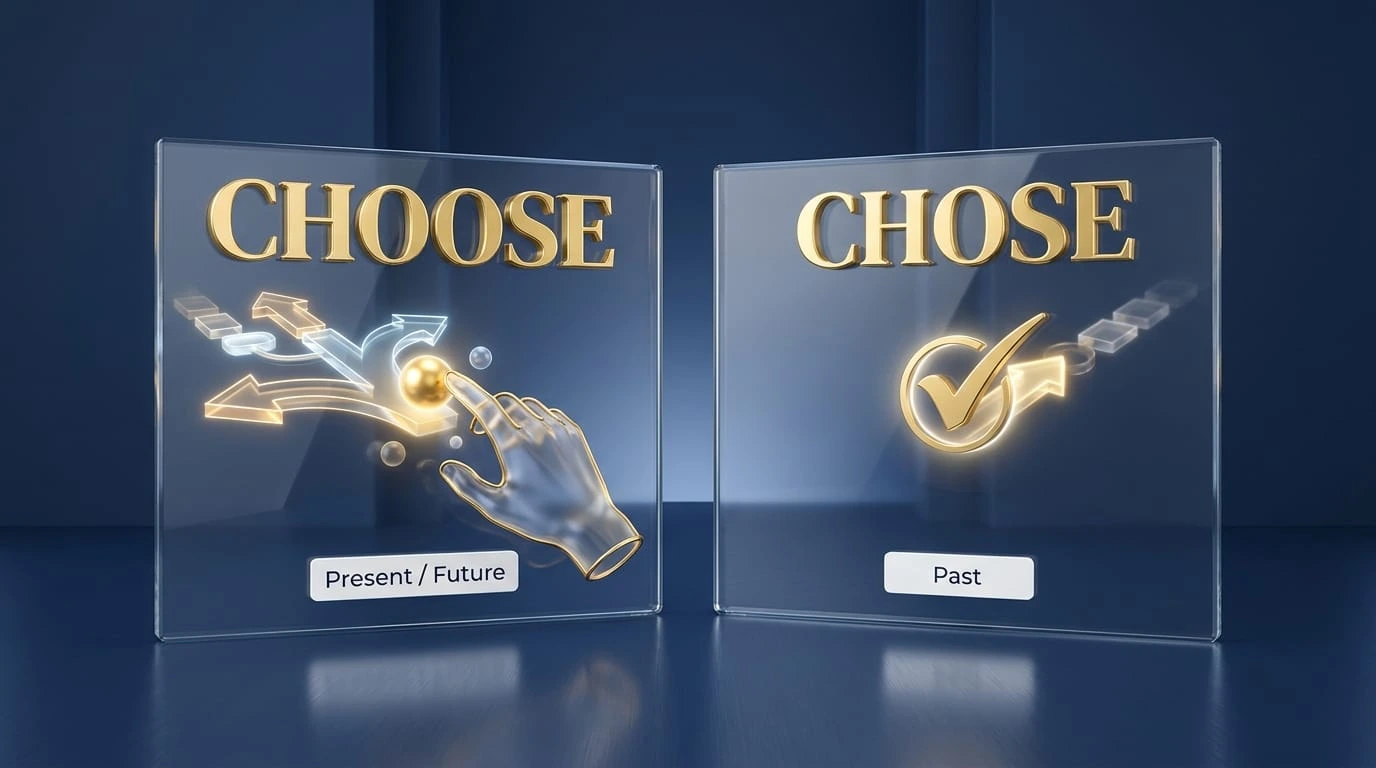
Choose is the present tense of the verb, while chose is its simple past tense. Use choose for a decision you make now or regularly, and chose for a decision you made in the past.
A single vowel can change the time of an action in English. That is exactly what happens with choose and chose. Both words come from the same verb, but they are not interchangeable.
As an English teacher, I often see students use chose when talking about a decision they are making now. Others use choose when describing something that happened yesterday. The meaning may still be clear, but the grammar is not correct.
The good news is that the difference is simple. Choose is used for the present, future, or things you do regularly. Chose is used for a completed action in the past.
There is also a third form that often causes confusion: chosen. It is the past participle of choose and is normally used with helping verbs such as have, has, had, or be.
Once you understand these three forms, you can use them with confidence. Let’s break them down with simple rules, examples, common mistakes, and an easy memory trick.
Choose or Chose: Quick Answer
Choose and chose are different forms of the same verb.
- Choose = present tense
- Chose = simple past tense
- Chosen = past participle
Examples
I choose the blue shirt every time.
This describes a present or regular choice.
I chose the blue shirt yesterday.
This describes a completed choice in the past.
I have chosen the blue shirt.
Here, chosen is used with have.
The easiest rule is:
Choose now. Chose before. Chosen with a helping verb.
Choose or Chose After Helping Verbs
Examples:
- will choose ✅
- can choose ✅
- should choose ✅
- have chosen ✅
- had chosen ✅
- has chosen ✅
- will chose ❌
- have chose ❌
The Origin and Background of Choose and Chose
Choose and chose are not separate verbs. They are different forms of the same English verb.
The verb choose has a long history in English and is related to older Germanic words that carried the idea of selecting or deciding between options.
English has kept different forms of the verb to show time.
The pattern is:
choose → chose → chosen
This type of change is called an irregular verb pattern. The past form does not simply add -ed.
For example:
- walk → walked
- work → worked
- choose → chose
You cannot say choosed in standard English. The correct past form is chose.
The spelling can feel confusing because choose and chose are pronounced differently too.
- choose sounds like “chooz”
- chose sounds like “chohz”
Learning the pronunciation along with the tense can make the difference easier to remember.
Choose vs Chose: Key Difference Explained
The main difference is time.
What Does Choose Mean?
Choose is the present form of the verb. It means to select one person, thing, or option from several possibilities.
Use choose when:
- You are making a decision now.
- You are talking about a future decision.
- You are describing a regular choice.
- You are giving someone instructions.
Examples
I choose tea instead of coffee.
Please choose one answer.
We will choose a new team leader tomorrow.
She usually chooses healthy food.
Notice that chooses is also a present-tense form. We use chooses with he, she, and it.
What Does Chose Mean?
Chose is the simple past form of choose.
Use chose when the selection happened and finished in the past.
Examples
I chose the red dress yesterday.
She chose the wrong answer.
They chose a different hotel last week.
He chose to study English at university.
Words such as yesterday, last week, last year, earlier, and ago often signal that chose may be needed.
What Does Chosen Mean?
Chosen is the past participle of choose.
It is usually used with a helping verb.
Examples:
I have chosen my topic.
She has chosen a new course.
They had chosen their seats before we arrived.
It can also appear in passive structures:
He was chosen as team captain.
So remember:
| Form | Tense/Form | Example |
| Choose | Present/base form | I choose this one. |
| Chooses | Present, third person singular | She chooses this one. |
| Chose | Simple past | I chose this one yesterday. |
| Chosen | Past participle | I have chosen this one. |
Which Version Should You Use?
Choosing the correct form depends on when the action happens.
Use choose for present decisions
If you are deciding now, use choose.
I choose the black shoes.
Which option do you choose?
Use chose for past decisions
If the decision happened in the past, use chose.
I chose the black shoes yesterday.
She chose the second option during the meeting.
Use chosen with helping verbs
Use chosen after words such as have, has, had, or certain forms of be.
We have chosen a winner.
He had chosen his subject before class.
She was chosen for the position.
Quick decision guide
Ask yourself:
Is the decision happening now or in general?
→ Use choose.
Did the decision happen in the past?
→ Use chose.
Is there a helping verb such as have, has, or had?
→ You probably need chosen.
“Choose, Chose, or Chosen?”
| Word | Use | Example |
|---|---|---|
| Choose | Present/base form | I choose the blue one. |
| Chose | Past tense | I chose the blue one yesterday. |
| Chosen | Past participle | I have chosen the blue one. |
Common Mistakes with Choose or Chose
These mistakes are common because the three forms look and sound different.
1. Using “chose” for a present decision
Incorrect:
I chose the blue one.
(when you are choosing it right now)
Correct:
I choose the blue one.
If the decision is happening now, use the present form.
2. Using “choose” for a completed past action
Incorrect:
Yesterday, I choose the red dress.
Correct:
Yesterday, I chose the red dress.
The word yesterday shows that the action happened in the past.
3. Writing “choosed”
Incorrect:
She choosed the best option.
Correct:
She chose the best option.
Choosed is not the standard past tense of choose. Because choose is an irregular verb, its past form is chose.
4. Using “chose” after have or has
Incorrect:
I have chose a new topic.
Correct:
I have chosen a new topic.
After have or has, use the past participle chosen.
5. Confusing “choose” with “choice”
Choose is a verb.
I will choose a book.
Choice is a noun.
That was a good choice.
They are related, but they do different jobs in a sentence.
Choose or Chose in Real-World Examples
Understanding these words in everyday situations makes them easier to use.
Professional Email
After reviewing the available options, we chose the second proposal for the project.
The decision happened in the past, so chose is correct.
For a current decision:
Please choose your preferred meeting time.
News Headline or Article
Voters Choose a New Leader
Here, choose can describe a current or general event.
A report about a completed event might say:
Voters Chose a New Leader
The past form tells readers that the event has already happened.
Social Media Post
I finally chose my favorite photo from the trip!
The choice has already been made, so chose is correct.
For a question:
Which design would you choose?
Here, choose is correct because the person is being asked to decide.
Formal Document or Report
The committee chose the proposal after reviewing all submissions.
The selection happened in the past.
Another example:
The committee will choose the final proposal next week.
The decision is in the future, so choose is used after will.
Choose, Chose, or Chosen? A Simple Comparison
| Term/Variant | Meaning | Region/Context | Best Used When |
| Choose | Select or decide | Standard English | Present or base form |
| Chooses | Selects or decides | Standard English | Present with he, she, or it |
| Chose | Selected or decided | Standard English | Simple past |
| Chosen | Selected or decided | Standard English | Past participle with helping verbs |
| Choice | An act or result of choosing | Standard English | Used as a noun |
Compare these sentences
I choose the blue one.
Present decision.
I chose the blue one yesterday.
Past decision.
I have chosen the blue one.
Present perfect.
She chooses the blue one every time.
Regular or repeated action.
These four examples show how a small spelling change can change the time and structure of a sentence.
Easy Memory Trick for Choose and Chose
Here is a simple way to remember the difference:
Choose = now
Chose = before
You can also remember the vowel change:
Choose → Chose → Chosen
Think of it as a three-step verb family.
Present
I choose.
Past
I chose.
Past participle
I have chosen.
Another useful trick is to connect chose with past-time words:
- yesterday
- last night
- last week
- last year
- two days ago
- earlier
For example:
I chose this book yesterday.
If you see a clear past-time expression, check whether chose is the right form.
Choose or Chose: Data, Trends & Usage
The search intent behind “choose or chose” is mainly informational. People usually search this phrase when they are unsure about the correct verb form in a sentence.
The confusion is especially common among English learners because choose is an irregular verb. Its past form does not follow the familiar -ed pattern used by many English verbs.
Readers may also search related questions such as:
- What is the past tense of choose?
- Is it choose or chose?
- What is the past participle of choose?
- Is “choosed” a word?
- What is the difference between choose and choice?
- Is chosen past tense?
This shows why a useful guide should explain choose, chose, chosen, chooses, and choice together.
The key lesson is simple: do not choose the form based only on spelling. Look at the time of the action and the helping verb in the sentence.
FAQ: Choose or Chose
What is the difference between choose and chose?
Choose is the present or base form of the verb, while chose is the simple past form. For example, “I choose this book” refers to a present choice, while “I chose this book yesterday” refers to a past choice.
Is choose the present tense of chose?
Yes. Choose is the base and present form, while chose is the simple past form. The basic verb pattern is choose → chose → chosen.
When should you use choose?
Use choose when you are making a decision now, talking about a regular choice, or referring to a future decision. For example, “I choose the blue option” or “We will choose a winner tomorrow.”
When should you use chose?
Use chose when the decision was completed in the past. For example, “She chose the red dress yesterday.”
Which is correct: choose or chose?
Both are correct, but they are used for different times. Choose is used for the present or base form, while chose is used for the simple past.
What is the past tense of choose?
The simple past tense of choose is chose. For example, “I chose the best answer.”
What is the past participle of choose?
The past participle of choose is chosen. It is normally used with helping verbs, such as “I have chosen a topic” or “She had chosen a seat.”
Is “choosed” a correct word?
No. Choosed is not the standard past tense of choose. The correct past form is chose.
What is the difference between choose and choice?
Choose is a verb that means to select or decide. Choice is a noun that refers to the act, option, or result of choosing.
Can choose be used for a future decision?
Yes. Choose can be used for future decisions, especially after words such as will, can, may, or should. For example, “We will choose the final design tomorrow.”
Final Takeaways: Choose or Chose
The difference between choose and chose becomes simple when you focus on time.
Remember these key points:
- Choose is the present or base form.
- Chose is the simple past form.
- Chosen is the past participle.
- Choosed is incorrect in standard English.
- Choice is the noun form.
Use choose when the action is happening now, happens regularly, or will happen in the future.
Use chose when the action happened and finished in the past.
When you use have, has, or had, remember chosen:
Either or: How to Use It Correctly✅

I’m an English language researcher and content writer. I am specialized in spelling comparisons, commonly confused words, grammar usage, and vocabulary guides. Through detailed language articles,I am helping readers to understand the differences between similar words and improve their written communication skills.