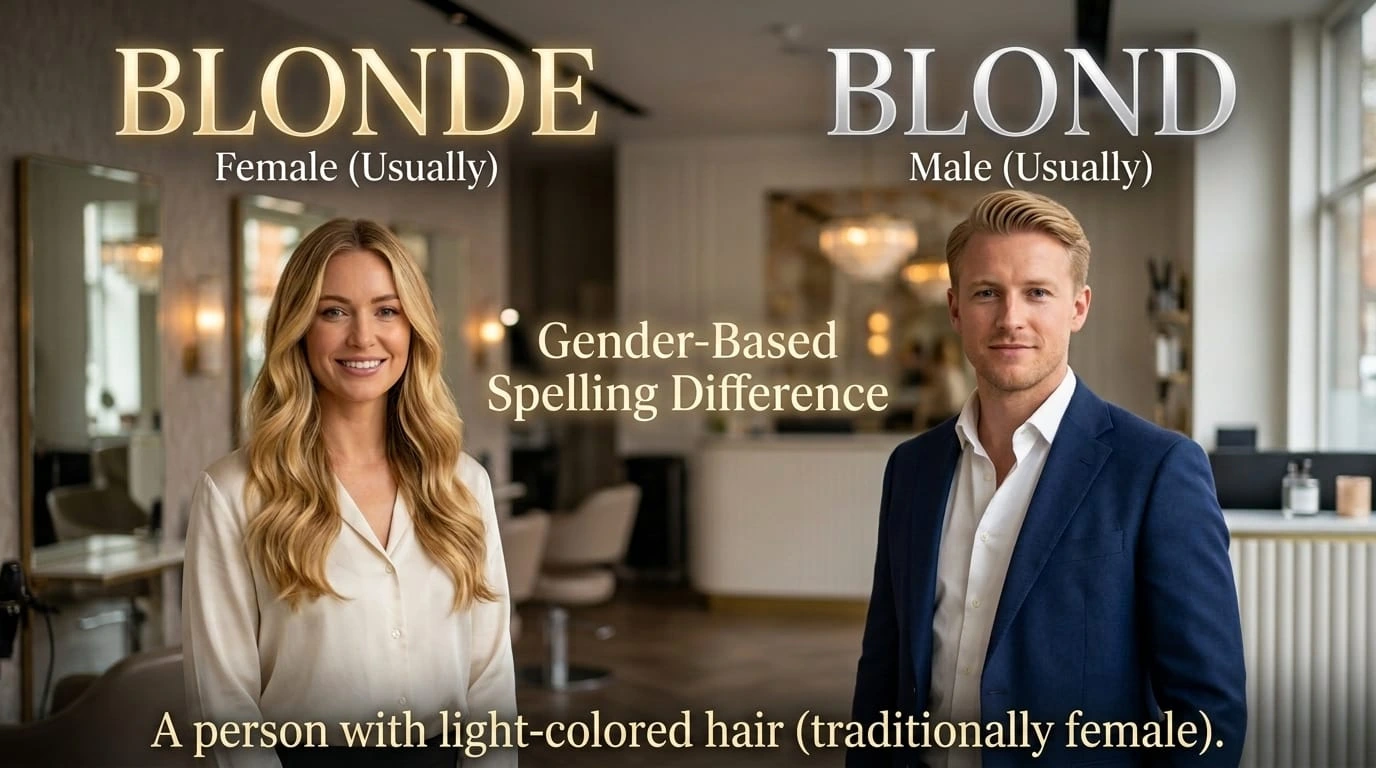
“Blond” and “blonde” both describe light-colored hair. Traditionally, “blond” describes men or is used as a general adjective, while “blonde” describes women. Modern English increasingly uses “blond” for everyone.
I once wrote a short story describing a male character with “blonde hair.” An editor friend flagged it, explaining that “blond” was technically the correct spelling for men. I’d genuinely never thought about it before, I assumed both spellings were interchangeable.
Turns out, this is one of the few English word pairs based on gender, not region or grammar rules. It comes from French, and that origin still shapes how careful writers use it today, even though everyday usage has relaxed quite a bit.
This guide breaks down exactly where this distinction comes from, whether it still matters in modern writing, and how to choose confidently between “blond” and “blonde” in any context.
Blonde or Blond: Quick Answer
Both words describe light or golden-colored hair. The traditional rule is based on gender.
- ✅ Traditional usage: “He has short blond hair.” / “She has long blonde hair.”
- ✅ Modern general usage: “Blond” is increasingly used for everyone, regardless of gender.
The rule to remember: “blond” is the masculine and general-use form, while “blonde” is the feminine form, following a pattern borrowed directly from French.
The Origin of Blonde/Blond
“Blond” and “blonde” come from French, where adjectives change spelling based on the gender of the noun they describe. In French, “blond” describes a man (un homme blond), while “blonde” describes a woman (une femme blonde). English borrowed both spellings directly, along with this gendered distinction, sometime in the 17th century.
This is actually unusual for English, since the language mostly abandoned grammatical gender centuries ago. Few other English words still carry this male-versus-female spelling split, which is exactly why it confuses so many writers who assume English adjectives never change based on gender.
Over the last few decades, English usage has shifted. Many style guides and publications now treat “blond” as the standard, gender-neutral spelling, using it for people of any gender, while reserving “blonde” mainly for describing women in more traditional or fashion-focused writing.
Blonde vs Blond Explained: Key Differences and Variations
| Term | Meaning | When to Use | Context |
|---|---|---|---|
| Blond | Describes light hair (masculine or gender-neutral) | Men, or general/neutral use | Everyday writing, journalism, general style guides |
| Blonde | Describes light hair (feminine) | Women specifically | Fashion writing, traditional or formal style |
| Blonde (noun) | A woman with light-colored hair | Referring to a woman directly | Casual conversation, informal writing |
| Blond (noun) | A man with light-colored hair | Referring to a man directly | Less common, but grammatically correct |
Notice that both words can function as adjectives describing hair color, or as nouns referring to a person, following the same gendered pattern in both roles.
Which Spelling Should You Use?
For general or gender-neutral writing
Use blond. Many modern style guides, including the Associated Press, now recommend this as the default spelling for everyone.
For traditional or formal writing about women specifically
Use blonde. This remains common in fashion, beauty, and lifestyle writing.
For describing men specifically
Use blond. This has always been the grammatically traditional choice.
For global or neutral audiences
Blond is the safer, more modern default, since it avoids any unintended gendered implication and works for all subjects.
Common Mistakes with Blonde/Blond
Mistake 1: Using “blonde” for a man in traditional or formal writing
✅ He has always had blond hair. (traditional usage)
❌ He has always had blonde hair. (inconsistent with the traditional gender rule)
Why it happens: Many writers don’t know the gendered distinction exists, since it’s uncommon in English.
Mistake 2: Assuming the gender rule is a strict, unbreakable law
✅ Modern style guides increasingly accept “blond” for everyone.
❌ Insisting “blonde” is always wrong for men in every context.
Why it happens: Language rules evolve, and this one has shifted significantly toward gender-neutral usage in recent years.
Mistake 3: Mixing spellings within the same document
✅ She has blonde hair, and her brother has blond hair too. (traditional) or Both have blond hair. (modern neutral)
❌ She has blond hair, and her brother has blonde hair. (reversed, incorrect even under the traditional rule)
Why it happens: Writers apply the rule inconsistently or accidentally reverse which spelling matches which gender.
Mistake 4: Overthinking casual, everyday writing
✅ Pick either spelling for casual writing, and stay consistent.
❌ Agonizing over “blond” versus “blonde” in a quick text message or casual post.
Why it happens: Writers assume this distinction carries more weight in casual contexts than it actually does.
Mistake 5: Ignoring your publication’s specific style guide
✅ Check whether your organization prefers gender-neutral “blond” or traditional gendered spelling.
❌ Assuming every publication follows the same rule.
Why it happens: Style guides vary, and not every writer checks before publishing.
Flyer or Flier: Which Spelling Is Correct? (2026)
Blonde/Blond in Real-World Examples
Professional email:
“The photo shoot will feature both blond and blonde models to match the campaign’s diverse styling.”
News headline:
“Study Finds Blond Hair Color Linked to Specific Genetic Variant”
Social media post:
“Finally went blonde for summer, obsessed with this new look. 💛”
Formal document:
“The suspect was described as a tall man with short blond hair.”
Notice how “blond” appears in more neutral, journalistic, or male-specific contexts, while “blonde” leans toward fashion, beauty, and female-specific descriptions.
Blonde/Blond: Data, Trends & Usage
Search interest in “blonde vs blond” is steady, driven largely by writers, editors, and beauty industry professionals confirming correct usage before publishing. This falls into the informational search category, with people wanting clarity on a rule that isn’t widely taught in schools.
Fashion and beauty publications drive significant search volume for “blonde,” since the term appears constantly in hair color marketing aimed at women. Journalism and general style guide searches lean toward “blond,” reflecting the industry-wide shift toward gender-neutral language in professional writing.
Blonde vs Blond: Comparison Table
| Term/Variant | Meaning | Region/Context | Best Used When |
|---|---|---|---|
| Blond | Light hair color (masculine or neutral) | Universal, increasingly gender-neutral | General writing, journalism, describing men |
| Blonde | Light hair color (feminine) | Universal, traditional usage | Fashion, beauty writing, describing women |
| Blonde (noun) | A woman with light hair | Informal, conversational | Casual references to a specific woman |
Frequently Asked Questions
Q: What does “blond” or “blonde” mean?
A: Both words describe light or golden-colored hair. The core meaning is identical, only the spelling traditionally changes based on gender.
Q: How do you use “blond” correctly in a sentence?
A: Use “blond” to describe a man’s hair traditionally, or as a general, gender-neutral term in modern writing, such as “He has blond hair” or “The dog has a blond coat.”
Q: Blonde vs blond, what’s the difference?
A: Traditionally, “blond” describes men and “blonde” describes women, following French grammar rules. Modern English increasingly uses “blond” for everyone.
Q: Is “blonde” acceptable in formal writing?
A: Yes, especially when specifically describing a woman, though many modern style guides now prefer “blond” as the neutral default in journalism and general writing.
Q: Which version is correct, blonde or blond?
A: Both are correct. Traditional usage depends on gender, while modern usage increasingly favors “blond” for everyone.
Q: Where does the word “blond” come from?
A: It comes from French, where adjectives change spelling based on gender, “blond” for men and “blonde” for women. English adopted both forms in the 17th century.
Q: Can “blond” be used to describe a woman?
A: Yes, especially in modern, gender-neutral writing. Many current style guides now recommend “blond” as the standard spelling regardless of gender.
Final Takeaway
Here’s the short version. “Blond” traditionally describes men, or works as the modern, gender-neutral choice. “Blonde” traditionally describes women.
Key points to remember:
- The origin: This gendered spelling comes from French grammar rules, not standard English patterns
- Modern shift: Many style guides now use “blond” for everyone
- Context still matters: Fashion and beauty writing often keeps the traditional “blonde” for women
- Consistency matters: Pick one approach and stay consistent throughout your writing
Once you understand the gendered origin, choosing between “blond” and “blonde” becomes a simple style decision.
Blonde vs blond explained, correct spelling, gendered origin, and modern usage, with clear examples throughout.
Mam or Ma’am: What’s The Difference? (2026)

I am a professional content writer with a strong interest in English spelling and vocabulary. I am interested in creating informative guides on commonly confused words, spelling differences, and language usage to help readers write more accurately and effectively.