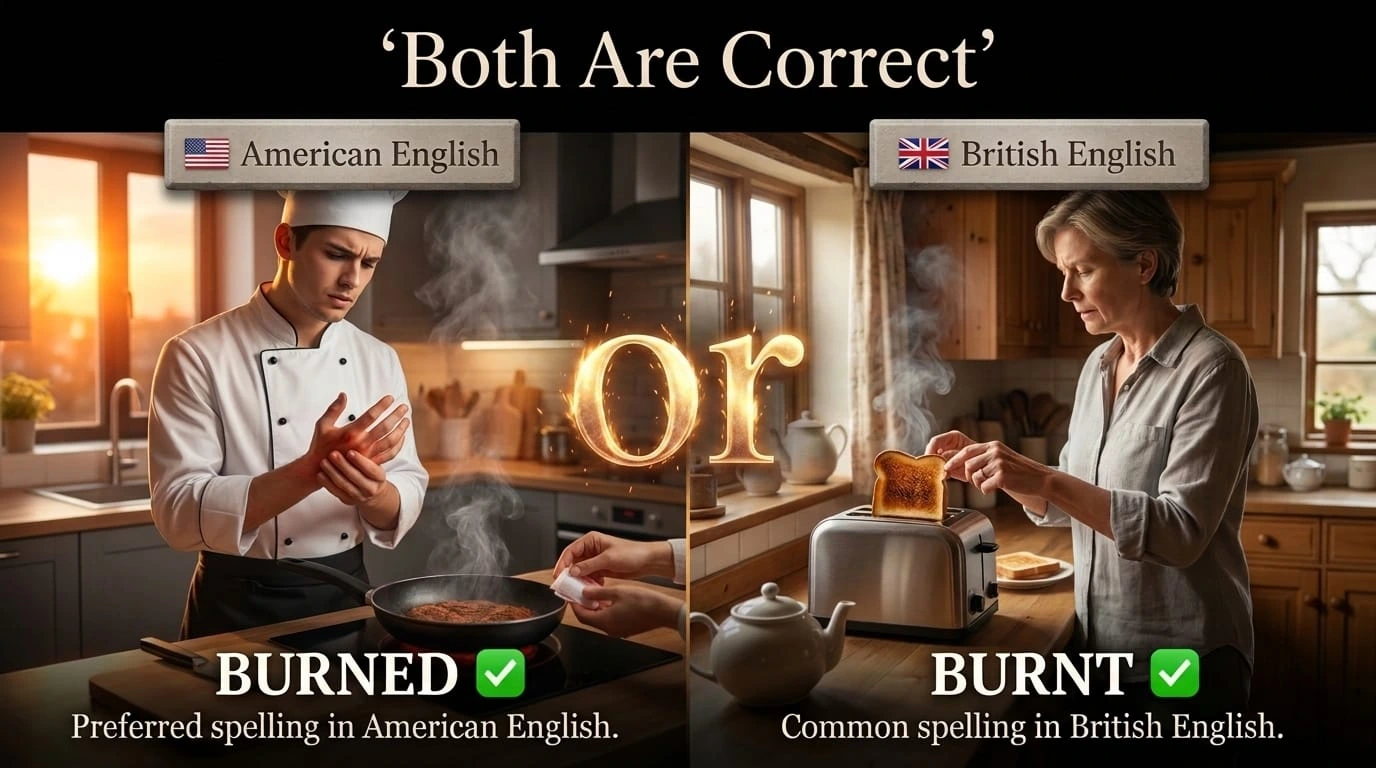
“Burned” or “burnt” means the past tense of “burn,” describing something that was damaged, cooked, or destroyed by fire or heat. Both spellings are correct. “Burned” is more common in American English, while “burnt” is more common in British English.
I once posted on social media about “burnt toast” ruining my morning, and a friend jokingly asked if I’d suddenly picked up a British accent. I hadn’t, I just genuinely thought “burnt” was the only correct spelling.
Turns out, both “burned” and “burnt” are completely correct, and the right choice often depends on region, and sometimes on whether you’re using the word as a verb or an adjective. This is one of those word pairs where dictionaries accept two forms, yet the rule behind it isn’t always obvious.
If you’ve ever paused before typing this word, wondering which ending to use, this guide clears it up completely. You’ll learn exactly when to use “burned,” when “burnt” fits better, and the one small grammar detail that applies in both dialects.
Burned or Burnt: Quick Answer
Both “burned” and “burnt” are correct past-tense forms of “burn.” They describe something damaged, cooked, or destroyed by fire or heat.
- ✅ American English: “She burned the toast this morning.”
- ✅ British English: “She burnt the toast this morning.”
The rule to remember: American English favors “burned,” while British English often favors “burnt,” though both dialects use “burnt” as an adjective describing something already damaged by fire.
The Origin of Burned/Burnt
“Burn” comes from Old English bærnan and biernan, related to fire and combustion. As English verbs settled into their past-tense forms, most regular verbs adopted the standard “-ed” ending. But a smaller group of verbs kept an older, irregular “-t” ending instead, and “burn” sits right at the edge of that group, accepting both forms.
This same “-ed” versus “-t” pattern shows up across several related verbs:
- learn → learned / learnt
- spell → spelled / spelt
- dream → dreamed / dreamt
- burn → burned / burnt
American English gradually standardized on the regular “-ed” ending during the 1800s and 1900s. British English kept the older “-t” endings for many of these words, which is why “burnt,” “learnt,” and “dreamt” remain common across the UK today.
There’s an added wrinkle with “burn” specifically: many British and American writers alike use “burnt” as an adjective, even when they’d use “burned” as the verb, as in “burned toast” versus “burnt toast” both existing, but “the burnt toast” sounding more natural than “the burned toast” to many ears.
Burned vs Burnt Explained: Key Differences and Variations
| Term | Meaning | When to Use | Region/Context |
|---|---|---|---|
| Burned | Past tense of “burn” (verb) | American English (primary) | US writing, also accepted in the UK |
| Burnt | Past tense of “burn” (verb) | British English (primary) | UK, Australia, and Commonwealth writing |
| Burnt | Adjective describing something damaged by fire | Both dialects | “Burnt toast,” “burnt orange” (as a color) |
| Burned | Adjective, less commonly used | Both dialects, less frequent | Occasionally used interchangeably with “burnt” |
Notice that “burnt” often survives as the preferred adjective even in American English, which makes this pair slightly different from other “-ed” versus “-t” verb splits.
Which Spelling Should You Use?
For American audiences
Use burned as the verb. Many Americans still use burnt as the adjective, especially in phrases like “burnt toast” or “burnt orange.”
For British or Commonwealth audiences
Use burnt for both the verb and the adjective. This fits naturally with British spelling conventions.
For global or mixed audiences
Either verb form works, but stay consistent throughout the same piece of writing.
For descriptive or adjective use
Lean toward burnt, regardless of dialect, since it’s widely accepted as the more natural-sounding adjective in both American and British English.
Common Mistakes with Burned/Burnt
Mistake 1: Mixing spellings within the same document
✅ He burned his hand, and the burn left a mark.
❌ He burnt his hand, and the burned left a mark.
Why it happens: Writers switch unconsciously between forms, especially when copy-pasting from different sources.
Mistake 2: Assuming one spelling is simply “wrong”
✅ Both “burned” and “burnt” are correct, depending on region and grammatical role.
❌ “Burnt” is a typo for “burned.”
Why it happens: People assume every spelling pair must have one incorrect option, when this one genuinely allows both.
Mistake 3: Using “burned” for the adjective when “burnt” sounds more natural
✅ The burnt toast smelled awful.
❌ The burned toast smelled awful. (grammatically fine, but less commonly used)
Why it happens: Writers apply the verb rule to the adjective without realizing usage often differs slightly.
Mistake 4: Ignoring house style guides in professional writing
✅ Check your publication’s style guide, then stay consistent.
❌ Randomly switching between “burned” and “burnt” across different articles on the same site.
Why it happens: Writers aren’t always aware their organization has a preferred regional spelling.
Mistake 5: Assuming “burnt” is outdated or incorrect in American English
✅ “Burnt” remains common in American English, especially as an adjective.
❌ Treating “burnt” as strictly British or old-fashioned.
Why it happens: Writers unfamiliar with the adjective exception assume the verb rule applies everywhere.
Gasses or Gases: The Correct Spelling Explained(2026)
Burned/Burnt in Real-World Examples
Professional email:
“Please note the equipment sustained minor burned damage during the incident and requires inspection.”
News headline (UK):
“Firefighters Battle Blaze as Warehouse Burnt to the Ground”
Social media post:
“Nothing like the smell of burnt marshmallows over a campfire. 🔥”
Formal document (US):
“The report confirmed the building burned extensively before crews arrived on scene.”
Notice how “burnt” appears naturally as an adjective in both examples, even though the verb forms differ by region.
Burned/Burnt: Google Trends & Usage Data
Search interest in “burned vs burnt” is steady and mostly informational, driven by writers, cooks, and students confirming which spelling fits their audience or context. American users search “burned” more frequently for the verb form, while UK, Australian, and Indian users show stronger interest in “burnt” for both uses.
This mirrors the same regional pattern seen in “learned/learnt” and “dreamed/dreamt”, confirming this isn’t a random inconsistency, but part of a consistent group of irregular verbs that split differently between American and British English. Food and cooking content drives a notable share of searches, since “burnt” as an adjective appears constantly in recipes and food writing, regardless of the writer’s location.
Burned vs Burnt: Comparison Table
| Term/Variant | Meaning | Region/Context | Best Used When |
|---|---|---|---|
| Burned | Past tense of “burn” (verb) | American English (primary), accepted in the UK | Writing for a US audience |
| Burnt | Past tense of “burn” (verb) | British English (primary) | Writing for UK, Australian, or Commonwealth audiences |
| Burnt | Adjective describing fire damage | Both dialects | Describing burnt food, objects, or the color “burnt orange” |
Frequently Asked Questions
Q: What does “burned” or “burnt” mean?
A: Both words are the past tense of “burn,” describing something damaged, cooked, or destroyed by fire or heat. The meaning is identical, only the spelling changes by region.
Q: How do you use “burned” correctly in a sentence?
A: Use “burned” the same way you’d use “burnt” as a verb, for example, “The candle burned all night” works exactly like “The candle burnt all night.”
Q: Burned vs burnt, what’s the difference?
A: The difference is mostly regional for the verb form, American English favors “burned,” while British English favors “burnt.” Both dialects commonly use “burnt” as an adjective.
Q: Is “burnt” acceptable in formal writing?
A: Yes, especially in British, Australian, or Commonwealth contexts, and as an adjective in nearly any English-speaking context, including American writing.
Q: Which version is correct, burned or burnt?
A: Both are correct. Choose based on your audience’s region for the verb form, and consider “burnt” as the more natural adjective choice in either dialect.
Q: Where does the word “burnt” come from?
A: It comes from the same root as “burn,” following an older irregular English verb pattern that adds “-t” instead of the regular “-ed” ending.
Q: Can “burnt” be used in American English?
A: Yes, especially as an adjective, such as “burnt toast” or “burnt orange.” As a verb, “burned” remains the more standard American choice.
Final Takeaway
Here’s the short version. Both “burned” and “burnt” are correct, the choice depends on your audience and grammatical role, not on right versus wrong.
Key points to remember:
- The rule: American English favors “burned” as the verb; British English favors “burnt”
- The exception: “Burnt” is widely used as an adjective in both dialects
- Part of a bigger family: This split matches “learned/learnt” and “dreamed/dreamt”
- Consistency matters: Pick one style per document and stick with it
Once you know your audience and whether you need a verb or adjective, choosing between “burned” and “burnt” becomes automatic.
Burned vs burnt explained, correct spelling, regional usage, and examples for American and British English writers.
Dreamt or Dreamed: The Correct Spelling (2026)

I am a language content specialist specializing in spelling comparisons, vocabulary usage, and commonly confused English words. I write detailed, informative articles that help readers improve their language skills. I am passionate about helping students, writers, and professionals develop a stronger understanding of the English language.