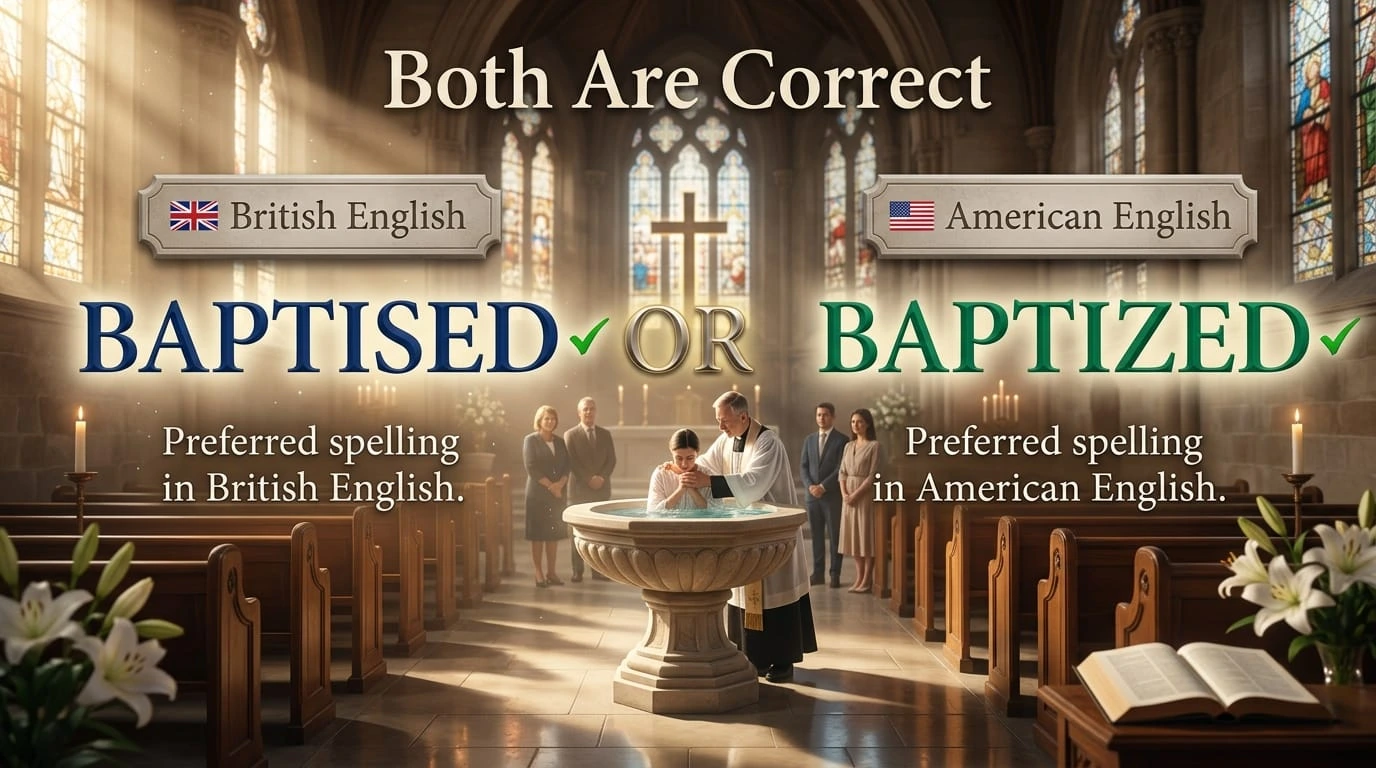
“Baptized” or “baptised” means to perform or receive the religious rite of baptism, symbolizing spiritual cleansing or initiation into the Christian faith. Both spellings are correct. “Baptized” is standard in American English, while “baptised” is standard in British English.
I once helped edit a newsletter for a church with members from both the US and UK. I changed every instance of “baptised” to “baptized,” assuming I was fixing typos throughout the document. A British colleague later explained, kindly, that I’d actually introduced errors into half the newsletter.
Turns out, both spellings are completely correct, and the right one depends entirely on which English dialect you’re writing in. This word follows a much larger spelling pattern that trips up writers constantly, especially in religious, historical, or international writing.
If you’ve ever paused before typing this word, unsure whether to use a z or an s, this guide clears it up completely. You’ll learn exactly when to use “baptized,” when “baptised” fits better, and why this spelling split exists across so many English verbs.
Baptised or Baptized: Quick Answer
Both spellings are correct, and both describe the same religious ritual involving water, symbolizing spiritual cleansing or initiation into Christianity.
- ✅ American English: “The baby was baptized last Sunday.”
- ✅ British English: “The baby was baptised last Sunday.”
The rule to remember: American English consistently uses -ize, while British English typically uses -ise for this whole category of verbs.
The Origin of Baptised/Baptized
“Baptize” comes from Greek baptizein, meaning “to dip” or “to immerse,” passed through Latin baptizare and French baptiser before entering English. The religious ritual it describes dates back to early Christian practice, symbolizing spiritual cleansing and initiation into the faith.
The spelling split has nothing to do with the word’s religious meaning, it comes from a much broader pattern affecting dozens of English verbs. Historically, English inherited many -ize verbs from Greek, where -izein was the original ending. British English later adopted French spelling conventions more heavily, favoring -ise instead, while American English retained the older, more Greek-influenced -ize ending.
This same -ize versus -ise pattern shows up across a huge family of words:
- organize → organise
- realize → realise
- recognize → recognise
- baptize → baptise
Interestingly, Oxford English Dictionary style, despite being British, actually prefers -ize for most of these words, arguing it reflects the original Greek root more accurately. This means even within British English, there’s some flexibility, though -ise remains far more common in everyday UK writing.
Baptized vs Baptised Explained: Key Differences and Variations
| Term | Meaning | When to Use | Region/Context |
|---|---|---|---|
| Baptized | To perform or undergo baptism | American English | US religious, historical, and general writing |
| Baptised | To perform or undergo baptism | British English | UK, Australian, Canadian religious and general writing |
| Baptism | The religious ritual itself (noun) | Universal, no regional split | Both dialects use identical spelling |
Notice that “baptism,” the noun form, doesn’t follow the same regional split, only the verb forms “baptized” and “baptised” change based on dialect.
Which Spelling Should You Use?
For American audiences
Use baptized, with a z. This is standard across all American religious, historical, and general writing.
For British or Commonwealth audiences
Use baptised, with an s. This applies throughout the UK, Australia, Canada, and most Commonwealth countries.
For global or mixed audiences
Either spelling works, but stay consistent throughout the same document or publication.
For religious or historical writing
Check your denomination’s or publisher’s specific style guide, since religious organizations often have an established preference regardless of general regional norms.
Common Mistakes with Baptised/Baptized
Mistake 1: Mixing spellings within the same document
✅ She was baptized as an infant, and that baptized status was recorded in church records.
❌ She was baptised as an infant, and that baptized status was recorded in church records.
Why it happens: Writers switch unconsciously, especially when copy-pasting from different sources or working with multiple contributors.
Mistake 2: Assuming one spelling is simply “wrong”
✅ Both “baptized” and “baptised” are correct, depending on dialect.
❌ “Baptised” is a typo for “baptized.”
Why it happens: People assume American English spelling rules apply universally, when they don’t.
Mistake 3: Applying the wrong regional spelling to related words
✅ Baptism (universal spelling) alongside baptized (US) or baptised (UK)
❌ Assuming “baptism” also changes spelling by region, when it doesn’t.
Why it happens: Writers assume every related word in a family follows the same regional pattern, when only some do.
Mistake 4: Ignoring house style guides in religious publishing
✅ Check your organization’s style guide, then stay consistent.
❌ Randomly switching between “baptized” and “baptised” in the same church bulletin or publication.
Why it happens: Writers aren’t always aware their organization has a preferred spelling, especially in volunteer-run religious newsletters.
Mistake 5: Overcorrecting someone else’s writing
✅ Recognize regional spelling differences before editing someone else’s work.
❌ Changing every “baptised” to “baptized” without checking the intended audience.
Why it happens: Writers assume their own regional spelling is the universal standard.
Leaves or Leafs: The Correct Spelling (2026)
Baptised/Baptized in Real-World Examples
Professional email:
“We are pleased to confirm that your child will be baptized during the 10 a.m. service this Sunday.”
News headline (UK):
“Royal Baby Baptised in Private Ceremony at Windsor Castle”
Social media post:
“So grateful to have been baptized alongside my best friend today. 🙏”
Formal document (UK):
“Church records confirm the child was baptised on the fourteenth of March.”
Notice how both spellings fit naturally into religious and formal writing, the choice simply depends on the audience’s regional expectations.
Baptised/Baptized: Data, Trends & Usage
Search interest in “baptised vs baptized” is steady and mostly informational, driven by church administrators, writers, and genealogy researchers confirming which spelling fits their audience or historical records. American users search “baptized” far more often, while UK, Australian, and Commonwealth users lean toward “baptised.”
This mirrors the exact same regional pattern seen in “organize/organise” and “realize/realise”, confirming this isn’t a random inconsistency, but a predictable spelling system tied to the broader -ize versus -ise split across English. Genealogy and historical research communities also drive notable search interest, since older baptismal records often use regional spelling conventions specific to their time and location.
Baptized vs Baptised: Comparison Table
| Term/Variant | Meaning | Region/Context | Best Used When |
|---|---|---|---|
| Baptized | To perform or undergo baptism | American English | Writing for a US audience |
| Baptised | To perform or undergo baptism | British and Commonwealth English | Writing for UK, Australian, or Canadian audiences |
| Baptism | The religious ritual (noun) | Universal, no regional split | Same spelling in both dialects |
Frequently Asked Questions
Q: What does “baptized” or “baptised” mean?
A: Both words describe performing or undergoing baptism, a religious ritual involving water that symbolizes spiritual cleansing or initiation into Christianity.
Q: How do you use “baptized” correctly in a sentence?
A: Use “baptized” the same way you’d use “baptised,” for example, “He was baptized at the local church” works exactly like “He was baptised at the local church.”
Q: Baptized vs baptised, what’s the difference?
A: The difference is regional, not religious or grammatical. American English uses -ize, while British English typically uses -ise. Both are equally correct.
Q: Is “baptised” acceptable in formal writing?
A: Yes, especially in British, Australian, or Commonwealth contexts. American style guides typically prefer “baptized” instead.
Q: Which version is correct, baptised or baptized?
A: Both are correct. Choose based on your audience’s region, and stay consistent throughout your writing.
Q: Where does the word “baptize” come from?
A: It comes from Greek baptizein, meaning “to dip” or “to immerse,” passed through Latin and French before entering English.
Q: Does “baptism” also change spelling by region?
A: No. “Baptism,” the noun form, stays the same in both American and British English. Only the verb forms “baptized” and “baptised” follow the regional split.
Final Takeaway
Here’s the short version. Both “baptized” and “baptised” are correct, the choice depends on your audience, not on right versus wrong.
Key points to remember:
- The rule: American English uses -ize; British English typically uses -ise
- Part of a bigger pattern: This split matches “organize/organise” and “realize/realise”
- Watch the noun form: “Baptism” stays the same in both dialects
- Consistency matters: Pick one style per document and stick with it
Once you know your audience, choosing between “baptized” and “baptised” becomes automatic.
Baptised vs baptized explained, correct spelling, regional usage, and examples for American and British English writers.
Dreamt or Dreamed: The Correct Spelling (2026)

I’m an English language researcher and content writer. I am specialized in spelling comparisons, commonly confused words, grammar usage, and vocabulary guides. Through detailed language articles,I am helping readers to understand the differences between similar words and improve their written communication skills.