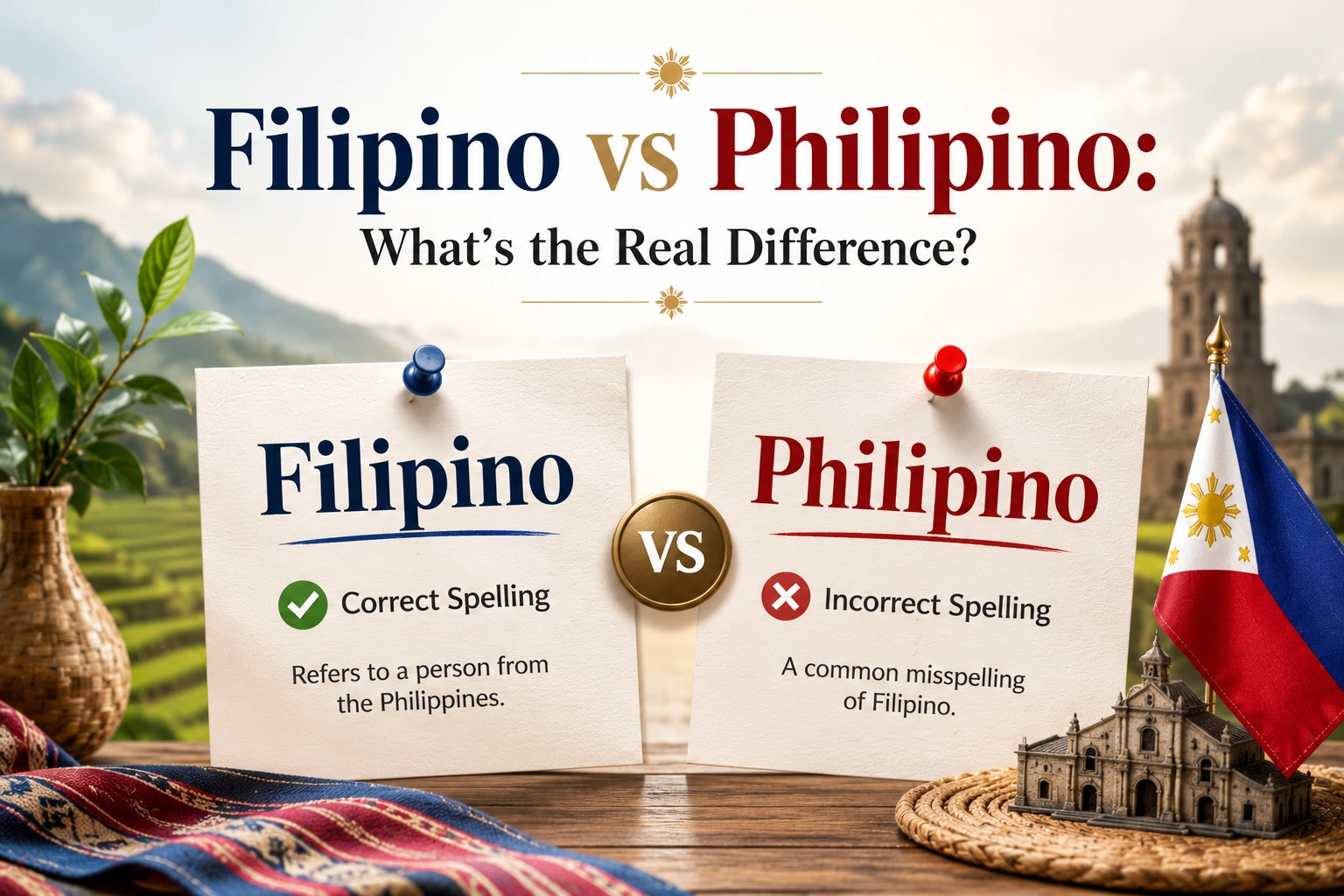
"Filipino" is the correct spelling for referring to people, language, or culture from the Philippines. "Philipino" is a common misspelling and isn't a real word in standard English.
I once drafted a travel blog post about visiting the Philippines and wrote about the “Philipino people” I’d met along the way. A reader from Manila kindly pointed out my mistake, it should have been “Filipino,” not “Philipino.” I was genuinely confused, since the country itself is spelled with a “ph.”
If you’ve ever hit this exact snag, you’re definitely not alone. This is one of the more understandable spelling mix-ups in English, since the logic seems to make perfect sense, until you learn the actual history behind it.
This guide clears up exactly why “Filipino” uses an “F” while “Philippines” uses “Ph,” where this surprising difference comes from, and how to spell both correctly every time.
Filipino or Philipino: Quick Answer
“Filipino” is always correct. “Philipino” is a spelling error, despite seeming logical given the country’s name.
- ✅ She proudly shared her Filipino heritage with the class.
- ❌ She proudly shared her Philipino heritage with the class.
The confusion happens because the country name, “Philippines,” starts with “Ph,” while the word for its people, language, and culture, “Filipino,” starts with “F.” These two related words simply don’t share the same spelling pattern.
The Origin of Filipino
The name “Philippines” comes from King Philip II of Spain, honoring him when Spanish explorer Ruy López de Villalobos named the islands “Las Islas Filipinas” in 1543. The English spelling “Philippines” later adapted the “Ph” spelling common in English words derived from Greek-influenced Latin, similar to “philosophy” or “phone.”
“Filipino,” however, comes directly from Spanish, where the language doesn’t use “Ph” at all, Spanish spells the sound with a simple “F.” When the word “Filipino” entered English to describe the people, language, and culture of the Philippines, it kept its original Spanish spelling intact, rather than adopting the “Ph” pattern used in the country’s English name.
This creates a genuinely unusual situation in English: the country name and the word for its people come from two different spelling traditions, one English-adapted, one directly Spanish, which explains why so many writers assume they should match.
Filipino Explained: Key Differences and Variations
| Word | Correct Spelling | Refers To | Example |
|---|---|---|---|
| Philippines | Philippines | The country itself | She was born in the Philippines. |
| Filipino | Filipino | A person, the language, or culture (masculine/general) | He speaks Filipino fluently. |
| Filipina | Filipina | A woman from the Philippines | She is a proud Filipina. |
| Philipino | Not a real word | N/A | Incorrect in any context. |
Notice that “Filipino” also has a feminine form, “Filipina,” used specifically to refer to women, a distinction inherited from the word’s Spanish origins, where nouns often carry grammatical gender.
Which Spelling Should You Use?
For referring to people, language, or culture
Always use Filipino (or Filipina for women specifically). There’s no context where “Philipino” is correct.
For referring to the country itself
Use Philippines, with the “Ph” spelling, since this refers to the nation, not its people or language.
For students and writers
Remember the distinction clearly: the country keeps “Ph” from its English-adapted spelling, while the people and language keep “F” from their Spanish origin.
For global or neutral use
Filipino is standard across American, British, Australian, and all other English dialects. There’s no regional variation here.
Common Mistakes with Filipino
Mistake 1: Writing “Philipino” instead of “Filipino”
✅ My grandmother taught me traditional Filipino recipes.
❌ My grandmother taught me traditional Philipino recipes.
Why it happens: Writers assume the word should match the “Ph” spelling of “Philippines,” since the two words are so closely related.
Mistake 2: Using “Filipino” when referring to the country
✅ They traveled to the Philippines last summer.
❌ They traveled to Filipino last summer.
Why it happens: Writers occasionally reverse the confusion, applying the people-and-language spelling to the country’s name instead.
Mistake 3: Forgetting the feminine form “Filipina”
✅ She is a talented Filipina artist based in Manila.
❌ She is a talented Filipino artist based in Manila. (grammatically less precise, though widely understood)
Why it happens: Many writers default to “Filipino” for everyone, unaware of the specific feminine form rooted in the word’s Spanish origin.
Mistake 4: Misspelling “Filipino” in cultural or travel writing
✅ Filipino cuisine features a unique blend of Spanish, Chinese, and Southeast Asian influences.
❌ Philipino cuisine features a unique blend of Spanish, Chinese, and Southeast Asian influences.
Why it happens: Travel and cultural writing often moves quickly, increasing the chance of this specific typo slipping through.
Mistake 5: Assuming spellcheck will always catch it
✅ Proofread manually, since “Philipino” sometimes slips past casual spellcheck settings.
❌ Relying only on autocorrect to flag the error.
Why it happens: Depending on the platform and language settings, some spellcheck tools don’t consistently catch this specific mistake.
Filipino in Real-World Examples
Professional email:
“We’re excited to welcome our new Filipino colleagues joining the Manila office next month.”
News headline:
“Filipino Athletes Shine at International Sporting Event”
Social media post:
“So proud to share my Filipino culture through food this weekend. 🇵🇭”
Formal document:
“The report highlights contributions from Filipino communities across Southeast Asia.”
In every case, Filipino is the only correct spelling, regardless of tone or formality.
Persue or Pursue? Only One Is Correct (Most People Get It Wrong)
Filipino: Data, Trends & Usage
Search interest in “Philipino vs Filipino” stays fairly steady, with noticeable spikes around cultural events, travel content, and discussions of Filipino cuisine or heritage. This falls into the informational search category, with writers, students, and travelers checking spelling before publishing content or planning trips.
This mistake appears frequently among writers unfamiliar with the word’s Spanish origin, since the logical assumption, matching “Philippines,” leads directly to the incorrect spelling. Because Filipino culture, cuisine, and communities are increasingly visible in global media, getting this spelling right matters more than ever for accurate, respectful writing.
Philipino vs Filipino: Comparison Table
| Term/Variant | Meaning | Region/Context | Best Used When |
|---|---|---|---|
| Filipino | Person, language, or culture from the Philippines | Universal, all English dialects | Referring to people, language, or culture |
| Philipino | Misspelling, not a real word | None, incorrect everywhere | Never, avoid entirely |
| Philippines | The country itself | Universal | Referring to the nation |
Frequently Asked Questions
Q: What does “Filipino” mean?
A: “Filipino” refers to a person, the language, or the culture associated with the Philippines. It can also serve as an adjective describing anything related to the country’s people or heritage.
Q: How do you use “Filipino” correctly in a sentence?
A: Use “Filipino” when referring to people, language, or culture, such as “She is fluent in Filipino” or “He comes from a Filipino family.”
Q: Filipino vs Philipino, what’s the difference?
A: There’s no real difference in meaning, since “Philipino” isn’t a correct word at all. “Filipino” is the only accepted spelling.
Q: Is “Filipino” acceptable in formal writing?
A: Yes, completely. “Filipino” is standard in academic, journalistic, and professional writing whenever referring to people, language, or culture from the Philippines.
Q: Which version is correct, Philipino or Filipino?
A: “Filipino” is correct. “Philipino” is a spelling error that doesn’t appear in any English dictionary.
Q: Where does the word “Filipino” come from?
A: It comes directly from Spanish, tracing back to the naming of the islands after King Philip II of Spain, though the Spanish spelling itself uses “F” rather than “Ph.”
Q: What’s the difference between “Filipino” and “Filipina”?
A: “Filipino” is generally used as the masculine or gender-neutral form, while “Filipina” specifically refers to a woman from the Philippines, reflecting the word’s Spanish grammatical roots.
Final Takeaway
Here’s the short version. “Filipino” is always correct. “Philipino” is always wrong, despite seeming like a logical match to “Philippines.”
Key points to remember:
- The rule: “Filipino” comes from Spanish and uses “F,” while “Philippines” comes from an English-adapted spelling using “Ph”
- Remember the feminine form: “Filipina” specifically refers to women
- Two words, two origins: The country name and the people’s name simply don’t share the same spelling tradition
- No exceptions: “Filipino” is standard in every English dialect, formal or casual
Once you remember that “Filipino” and “Philippines” come from different spelling traditions, you’ll never write “Philipino” again.
Bookmark this guide so you never second-guess “Filipino” vs “Philipino” again, and share it with anyone writing about Filipino culture, cuisine, or heritage.
Filipino vs Philipino explained, correct spelling, meaning, and examples. Learn the simple rule and avoid this common mistake.
Presentor or Presenter: Which Spelling Is Correct?

I am a professional content writer with a strong interest in English spelling and vocabulary. I am interested in creating informative guides on commonly confused words, spelling differences, and language usage to help readers write more accurately and effectively.