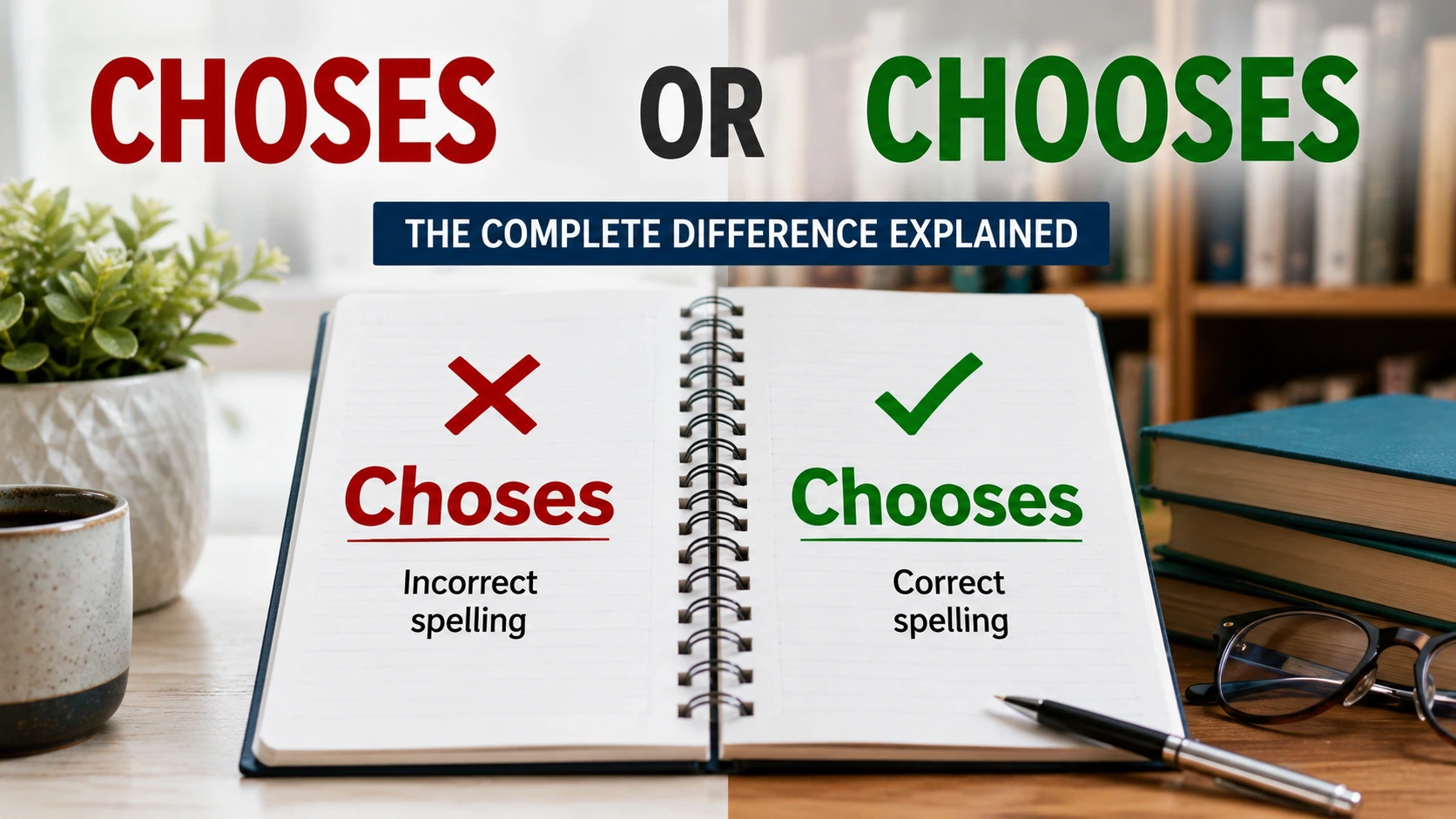
Chooses is the correct present-tense verb meaning selects or picks. Choses is the plural of chose, a French-derived noun meaning things, and it is almost never used in everyday English.
Have you ever typed “she choses the blue dress” and wondered if it looked right? I remember making that exact mistake while editing an article years ago. My spell checker didn’t immediately catch it, and I had to double-check a dictionary. That’s when I realized that one missing “o” completely changes the meaning of the word.
Many English learners search for choses or chooses because the two words look almost identical. They differ by only one letter, yet they belong to different parts of speech and are used in completely different situations. In fact, one of them is rarely used in modern everyday English.
The good news is that this confusion is easy to fix. Once you understand the difference, you’ll never hesitate again. In this guide, you’ll learn the correct spelling, pronunciation, meanings, origins, examples, common mistakes, and an easy memory trick that will help you remember the right word every time.
Pronunciation
choses or chooses (CHOH-ziz or CHOO-ziz)
| Word | Pronunciation | Word Type |
| Chooses | CHOO-ziz | Verb |
| Choses | CHOH-ziz (French-influenced) | Noun (rare) |
Pronunciation Tip
Although the spellings are similar, they are pronounced differently.
- Chooses begins with the “choo” sound, like choose.
- Choses usually has a “shoh” or “choh” sound because it comes from French.
For most English learners, you’ll hear and use chooses far more often than choses.
Choses or Chooses – Quick Answer
The simple answer is:
- Chooses is the correct spelling when someone selects or picks something.
- Choses is a rare plural noun borrowed from French that means things or matters.
Simple Examples
- She chooses healthy food every day. ✅
- He chooses the fastest route to work. ✅
- The designer displayed several decorative choses. (Rare and literary) ✅
In almost every English sentence, chooses is the word you need.
A Quick Memory Trick
Remember this:
- Choose → Chooses
- If you’re talking about picking something, use chooses.
The extra “o” helps you remember the base verb choose.
The Origin of Choses and Chooses
Understanding where these words come from makes their meanings much clearer.
Origin of Chooses
The word chooses comes from the Old English verb ceosan, meaning to select, decide, or prefer. Over hundreds of years, the spelling changed into the modern verb choose.
Today, chooses is the third-person singular present tense of choose.
Examples:
- She chooses her clothes carefully.
- My brother chooses tea instead of coffee.
- Every student chooses one project.
The meaning has stayed almost the same for centuries.
Origin of Choses
The word choses comes from the French noun chose, meaning thing.
In English, it appears mainly in legal phrases and historical writing.
Examples include:
- Choses in action
- Choses in possession
Outside these expressions, the word is rarely used in modern English.
That is why many people mistakenly think choses is simply another spelling of chooses, when it is actually a completely different word.
Choses vs Chooses Explained
These words may look alike, but they have different meanings and different grammatical roles.
Ask yourself one simple question:
Am I talking about selecting something?
- Yes → Use chooses.
- No, I’m referring to the rare legal or French noun “choses.” → Use choses.
Here is a quick comparison.
| Term | Meaning | When to Use | Context |
| Chooses | Selects or picks | Everyday English | Speaking, writing, school, business |
| Choses | Plural of the French noun chose (“things”) | Rare legal or historical writing | Law, literature, French expressions |
When to Use Chooses
Use chooses whenever someone selects, prefers, or decides on something.
Examples:
- Emma chooses a different book every week.
- He chooses honesty over convenience.
- The teacher chooses one student to lead the class.
- My mother chooses fresh vegetables at the market.
This is the word you’ll use in almost every situation.
When to Use Choses
The word choses is uncommon in modern English.
You’ll mostly find it in legal terms such as:
- Choses in action
- Choses in possession
Outside legal or historical contexts, most native English speakers never use choses in daily conversation.
The Easy Memory Trick
Use this simple rule:
- Choose → Chooses
- Pick → Chooses
- Select → Chooses
If you can replace the word with selects, then chooses is correct.
Examples:
- She selects the winner.
- She chooses the winner. ✅
If you’re writing an ordinary sentence, chooses is almost certainly the right choice.
Which Should You Use?
For almost every English sentence, the correct word is chooses.
The word choses is not a spelling variation of chooses. It is a completely different word that appears mainly in legal or historical writing.
Use “Chooses” When Someone Selects Something
Choose chooses when a person, group, or organization makes a decision or picks one option.
This word is common in:
- Everyday conversations
- School assignments
- Business writing
- News articles
- Emails
- Books and blogs
Examples:
- Sarah chooses a new book every month.
- My father chooses healthy meals.
- The company chooses the best candidate.
- He always chooses honesty.
Remember, chooses is the third-person singular present tense of choose.
Use “Choses” Only in Rare Legal or Historical Contexts
The word choses is used almost exclusively in legal English.
You may see it in phrases such as:
- Choses in action
- Choses in possession
Unless you’re reading legal documents or studying legal terminology, you probably won’t need this word.
Recommendations for Different Audiences
| Audience | Best Choice | Why |
| Students | Chooses | It is the correct spelling for school writing and exams. |
| English Learners | Chooses | It is the standard modern English verb. |
| Business Professionals | Chooses | It is appropriate for reports, emails, and presentations. |
| Writers and Bloggers | Chooses | Readers expect the standard spelling. |
| Law Students | Learn both | You may encounter choses in legal terminology. |
A Simple Rule to Remember
Ask yourself:
Is someone making a choice?
- Yes → Chooses
- No, it’s a legal or historical French-derived noun. → Choses
For 99% of English writing, chooses is the correct answer.
Common Mistakes with Choses and Chooses
Since these words differ by only one letter, writers often confuse them.
Here are the most common mistakes.
| ❌ Mistake | ✅ Correct |
| She choses a red dress. | She chooses a red dress. |
| My teacher choses the winners. | My teacher chooses the winners. |
| He always choses wisely. | He always chooses wisely. |
| The manager choses one employee. | The manager chooses one employee. |
| She chooses in action her rights. | She owns choses in action under the law. |
Mistake 1: Dropping the Extra “O”
❌ She choses the blue jacket.
✅ She chooses the blue jacket.
Why?
The verb comes from choose, so it keeps both o letters.
Mistake 2: Thinking “Choses” Is Another English Spelling
Some learners assume choses is simply another spelling of chooses.
It isn’t.
Chooses is the English verb.
Choses is a separate noun borrowed from French.
Mistake 3: Confusing Verb and Noun
❌ He choses the winner.
✅ He chooses the winner.
Why?
The sentence needs a verb, not a rare noun.
Mistake 4: Forgetting the Base Word
Always think of the base verb.
- choose
- chooses
- chose
- chosen
- choosing
If you remember choose, you’ll naturally spell chooses correctly.
Mistake 5: Assuming Spell Check Will Catch It
Some spell-check tools may not immediately flag choses because it is a real word.
Always read your sentence carefully and check whether you mean selects or a legal noun.
Complain or Complaint: The Complete Difference Explained
Choses or Chooses in Real-World Examples
Seeing the words in context makes the difference much easier to remember.
Professional Email
The hiring manager chooses candidates based on experience and qualifications.
Here, the manager is making a decision.
News Headline
School Board Chooses New Principal After Nationwide Search
The board selects one candidate.
Business Report
Our software automatically chooses the fastest delivery route.
The system selects the best option.
Social Media Post
She always chooses kindness, and that’s one of the things I admire most.
The word refers to making a choice.
School Essay
Every student chooses one science project before the semester begins.
The student is selecting a project.
Legal Document
The agreement covers both choses in possession and choses in action.
Here, choses is part of a traditional legal phrase, not the verb choose.
Office Conversation
Manager:
Our team chooses one proposal every Friday.
Employee:
That helps us stay focused on the best ideas.
Daily Conversation
Mother:
My daughter always chooses fruit instead of candy.
This is the type of sentence where chooses is used naturally every day.
Choses or Chooses: Data, Trends & Usage
Many people search for choses or chooses because the words look almost identical. However, they have completely different meanings and are used in very different contexts. One is a common English verb, while the other is a rare legal or French-derived noun.
Who Searches for This Topic Most?
This topic is popular among:
- Students learning English grammar
- English language learners (ESL/EFL)
- Teachers and tutors
- Bloggers and content writers
- Editors and proofreaders
- Professionals who write emails and reports
Search Intent
| Factor | Details |
| Primary Search Intent | Informational |
| Secondary Intent | Improve spelling and grammar accuracy |
| Common Questions | Is it choses or chooses? Which spelling is correct? Is choses a real word? |
| Difficulty Level | Beginner to Intermediate |
Why It Matters Today
Small spelling mistakes can change the meaning of your sentence. Knowing the difference between chooses and choses helps you write clearly and confidently in school, at work, and online.
Standalone Comparison Table
| Term/Variant | Meaning | Region/Context | Best Used When |
| Chooses | Third-person singular form of choose | Standard English worldwide | When someone selects or picks something |
| Choose | Base form of the verb | Everyday English | Giving instructions or talking generally |
| Chose | Past tense of choose | Standard English | Referring to a completed choice |
| Chosen | Past participle of choose | Formal and everyday English | Used with has, have, or had |
| Choses | Plural of the French noun chose | Legal and historical English | Rare legal phrases such as choses in action |
Frequently Asked Questions
Q1. Is it chooses or choses?
In almost every English sentence, chooses is correct. It is the present-tense form of choose. Choses is a rare noun used mainly in legal English.
Q2. Is “choses” a real English word?
Yes. Choses is a real word, but it is uncommon. It appears mostly in legal expressions such as choses in action and choses in possession.
Q3. Why do people confuse choses and chooses?
The two words differ by only one letter. Many people accidentally leave out the second o in chooses, creating choses, which is an entirely different word.
Q4. What is the difference between choose, chose, chosen, and chooses?
- Choose = base verb
- Chooses = present tense (he/she/it)
- Chose = past tense
- Chosen = past participle
Each form has a different grammatical purpose.
Q5. Can I use “choses” instead of “chooses”?
No. They are not interchangeable. Use chooses when someone selects something. Use choses only in its rare legal meaning.
Q6. Which spelling is correct in formal writing?
For almost all business, academic, and professional writing, chooses is the correct spelling when referring to selecting or deciding.
Q7. How can I remember the correct spelling?
Think of the base verb choose. Since choose has two o letters, chooses keeps both of them.
Memory trick:
- Choose → Chooses
- Lose → Loses
Don’t remove the second o from choose.
Conclusion
Although choses and chooses look very similar, they are completely different words. One is a common English verb, while the other is a rare noun that most people will never use outside legal writing.
Remember these key points:
- Chooses is the correct present-tense form of choose.
- Choses is a rare French-derived noun found mainly in legal expressions.
- If someone is selecting, deciding, or picking something, always use chooses.
- Thinking about the base verb choose makes the correct spelling easy to remember.
Mastering small spelling differences like this improves your writing and helps you avoid common mistakes. Whether you’re writing an email, a school assignment, or a professional report, using chooses correctly makes your English look polished and accurate.
Now you know exactly when to use chooses and when choses is appropriate. Bookmark this guide for quick reference, and share it with anyone who has ever been confused by these similar-looking words.

I specialize in spelling comparisons, confusing word pairs, grammar, and vocabulary development. My content helps readers improve their English, avoid common mistakes, and write with confidence. My goal is to provide accurate, reliable, and easy-to-understand language resources