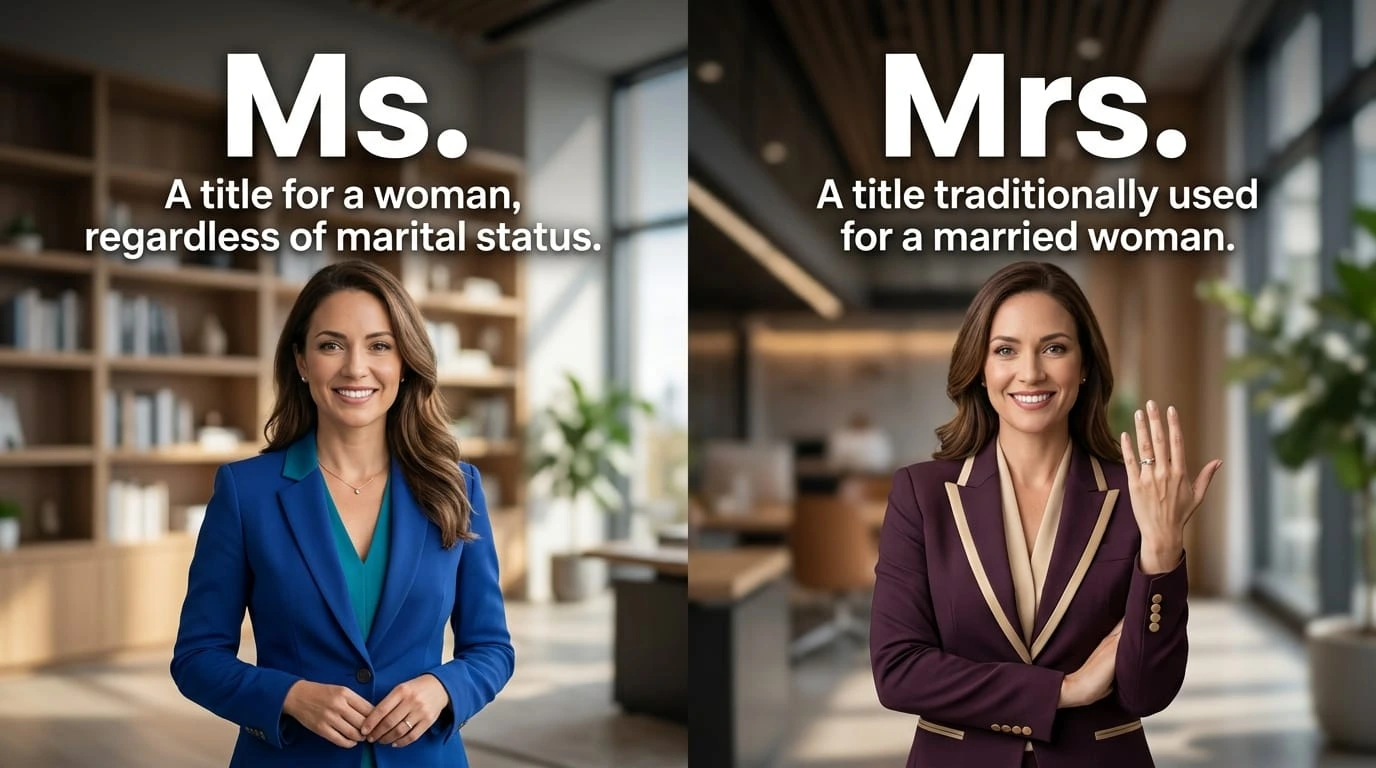
Ms is a neutral title for a woman, whether she is married or unmarried. Mrs is usually used for a married woman.
Have you ever stopped before a name and wondered, “Should I write Ms or Mrs?” You are not alone. This is one of those small English choices that can make a formal email, letter, invitation, or application feel harder than it should.
As an English writer, I have seen this confusion often. People may know that Mrs relates to marriage, but they are less sure about when to use Ms. Some also worry that choosing the wrong title may sound rude or too personal.
The good news is that the difference is simple once you know the basic rule. Ms does not tell the reader whether a woman is married. Mrs normally tells the reader that she is married.
This guide explains the difference in plain English. You will learn what each title means, where the words came from, when to use them, common mistakes, and examples for emails and formal documents.
Ms or Mrs: Quick Answer
Ms and Mrs are titles placed before a woman’s name.
- Ms: used for a woman without referring to her marital status.
- Mr: traditionally used for a married woman.
Simple examples
- Ms Johnson will lead the meeting.
- Mrs Johnson will lead the meeting.
Both can be correct. The right choice depends on the woman’s preferred title and, in the case of Mrs, whether she uses that title.
If you do not know a woman’s marital status or do not need to mention it, Ms is usually the safest choice.
The Origin and Background of Ms and Mrs
The titles Ms and Mrs are connected to the older title Mistress.
Over time, Mistress developed into shorter forms. Mrs became associated with married women, while Miss was commonly used for unmarried women.
Ms developed much later as a title that does not show marital status.
The title Ms became more widely used in the 20th century. It offered women a title that worked in the same general way regardless of whether they were married.
This explains why you may see several titles before women’s names:
- Miss — traditionally an unmarried woman or girl.
- Mrs — traditionally a married woman.
- Ms — does not indicate marital status.
Today, Ms is common in professional and formal communication because you do not need to know someone’s personal relationship status to address them.
Ms vs Mrs: Key Differences
The biggest difference is marital status.
| Term | Meaning | When to Use | Region/Context |
|---|---|---|---|
| Ms | A neutral title for a woman | When marital status is unknown, irrelevant, or the woman prefers Ms | Common in modern English |
| Mrs | A title traditionally used for a married woman | When the woman uses Mrs | Common in British and American English |
| Miss | Traditionally an unmarried woman or girl | When the person prefers Miss or the context calls for it | British and American English |
What does Ms mean?
Ms is a title for a woman that does not reveal whether she is married.
For example:
Ms Taylor will contact you tomorrow.
The sentence gives no information about Taylor’s marital status. That is often exactly what you want.
What does Mrs mean?
Mrs is traditionally used for a married woman.
For example:
Mrs Taylor has confirmed the appointment.
Here, the title suggests that Taylor is married and uses Mrs.
However, marriage does not automatically mean every woman must use Mrs. A woman may choose Ms instead.
Which Should You Use: Ms or Mrs?
The best choice depends on the person and the situation.
If you do not know her marital status
Use Ms.
Dear Ms Carter,
This is a safe and professional choice when you have never met the person.
If she uses Mrs
Use Mrs.
If a woman signs her emails as Mrs Carter, or her official contact details use that title, follow her preference.
For professional communication
Ms is often the best default.
It keeps the message professional without asking about someone’s private life.
For example:
Dear Ms Williams,
Thank you for your email.
This works well for business emails, applications, letters, and customer communication.
If you know she is married
You can use Mrs if she prefers that title.
Knowing someone is married does not mean you should automatically change their title to Mrs. Personal preference matters.
Common Mistakes with Ms and Mrs
These titles look simple, but several mistakes are common.
1. Assuming every married woman uses Mrs
Mistake:
Mrs Adams
Better:
Ms Adams
If you do not know which title she prefers, Ms is usually a safer professional choice.
2. Thinking Ms means unmarried
This is one of the biggest misunderstandings.
Ms does not mean unmarried.
A married woman can use Ms. An unmarried woman can also use Ms.
The title simply does not state marital status.
3. Using Mrs when you do not know the woman’s preference
You may know that a woman is married but still not know whether she uses Mrs.
When the information is unknown, Ms is usually more neutral.
4. Writing Ms. and Mrs. in the wrong style
Punctuation can vary by style guide and region.
In American English, you may commonly see:
- Ms.
- Mrs.
- Miss
In British English, the forms are often written without full stops:
- Ms
- Mrs
- Miss
Both styles can be correct within their own conventions. The key is to stay consistent.
5. Confusing Ms with Miss
These titles are not the same.
Miss traditionally refers to an unmarried woman or girl.
Ms does not state marital status.
So:
Miss Brown = traditionally unmarried
Ms Brown = marital status not stated
Ms or Mrs in Real-World Examples
Knowing the rule is useful. Seeing it in context is even better.
1. Professional email
Dear Ms Patel,
Thank you for contacting our office. We have received your application and will review it shortly.
Here, Ms is a good choice because the writer does not need to mention the person’s marital status.
2. News article
Mrs Khan opened the community center on Monday.
A newspaper may use Mrs when that is the person’s preferred title or the publication’s style requires it.
3. Social media post
We are pleased to welcome Ms Lee as our new marketing manager.
Ms works well in professional announcements.
4. Formal document
Applicant: Ms Sarah Wilson
This is appropriate when the person uses Ms or when marital status is not relevant.
5. Personal invitation
We are delighted to invite Mrs and Mr Ahmed to our wedding.
Here, Mrs may be appropriate if the woman uses that title.
Ms vs Mrs: Standalone Comparison
| Term/Variant | Meaning | Region/Context | Best Used When |
|---|---|---|---|
| Ms | Neutral title for a woman | Modern formal and professional English | You do not know or do not need to state marital status |
| Mrs | Traditionally married woman | British and American English | The woman uses Mrs |
| Miss | Traditionally unmarried woman | British and American English | The person prefers Miss or the context calls for it |
The most useful rule is simple: when in doubt, use Ms unless you know the person prefers another title.
Ms or Mrs in American and British English
The basic meanings are the same in both varieties of English.
| Title | American English | British English |
|---|---|---|
| Ms | Very common | Very common |
| Mrs | Common | Common |
| Miss | Common | Common |
The main difference you may notice is punctuation.
American writing often uses:
Ms. Brown
Mrs. Brown
British writing commonly uses:
Ms Brown
Mrs Brown
Modern style guides may differ, so follow the style used by your school, workplace, publication, or organization.
Why Ms Is Often the Best Default
Imagine you are sending an email to someone you have never met.
You know her name is Sarah Brown and you do not know whether she is married.
You have two choices:
Dear Mrs Brown,
or
Dear Ms Brown,
The second option avoids making an assumption.
That is why Ms is widely used in workplaces, schools, customer service, and official communication.
It is also useful because marital status often has nothing to do with the conversation.
If you are discussing an invoice, job application, meeting, or project, you usually only need the person’s name and professional title.
FAQs About Ms or Mrs
Q: What does Ms mean?
A: Ms is a title used before a woman’s name without showing whether she is married. It is a neutral and widely accepted form of address.
Q: What does Mrs mean?
A: Mrs is traditionally a title used for a married woman. However, a married woman may choose to use Ms instead.
Q: Is Ms for married or unmarried women?
A: Ms can be used for both married and unmarried women. It does not reveal marital status.
Q: Is Mrs only for married women?
A: Traditionally, yes. Mrs is associated with married women. However, the person should still be addressed according to her preferred title.
Q: Is Ms more formal than Mrs?
A: Neither is automatically more formal. Both can be used in formal writing. Ms is simply more neutral because it does not state marital status.
Q: Should I use Ms if I do not know whether a woman is married?
A: Yes. Ms is usually the safest choice when you do not know her marital status or title preference.
Q: Can a married woman use Ms?
A: Yes. A married woman can use Ms. The title is not tied to being married or unmarried.
Q: Should I write Ms or Mrs in a business email?
A: If you know the person’s preferred title, use it. If you do not, Ms is generally a good professional choice.
Conclusion
Choosing between Ms and Mrs does not have to be difficult.
Remember these three simple points:
- Ms is a neutral title and does not show marital status.
- Mrs traditionally refers to a married woman.
- Ms is often the safest professional choice when you do not know someone’s preferred title.
The most important rule is to respect the person’s preference. A married woman may use Mrs, Ms, or another form of address. Her marital status alone does not tell you which title she wants.
For formal emails, business letters, applications, and professional documents, Ms is usually a reliable choice when the preferred title is unknown.
Baloney or Bologna: Which One Is Correct?

I’m a language enthusiast and content writer. I’m specialized in English grammar, spelling differences, vocabulary explanations, and word comparisons. My goal is to help readers improve their writing skills through clear, accurate, and easy-to-understand language guides.