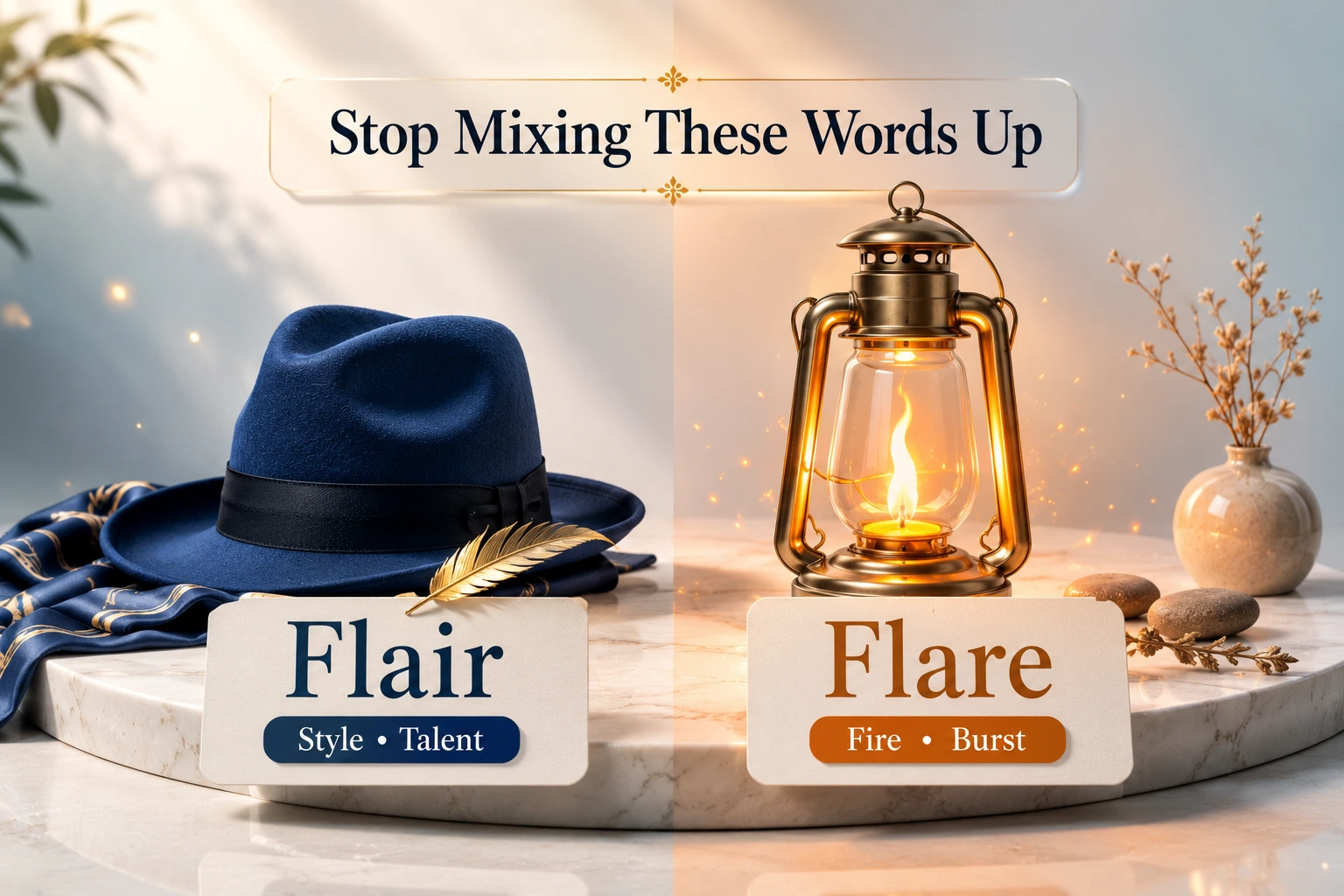
"Flair" means a natural talent or stylish quality, like a flair for design. "Flare" means to burn brightly, widen out, or a signal device that produces bright light. They are two different words, not spelling variants of each other.
I once wrote in a colleague’s performance review that she “has real flare for client presentations.” A manager reviewing the document corrected it to “flair,” explaining that I’d accidentally used a word about fire and light instead of the one about talent and style.
If you’ve ever mixed these two up, you’re definitely not alone. “Flair” and “flare” are true homophones, they sound completely identical when spoken, yet they mean entirely different things and come from entirely different origins.
This guide breaks down exactly what each word means, how to tell them apart instantly, and how to avoid this mix-up for good, whether you’re writing a review, a story, or a quick email.
Flair or Flare: Quick Answer
“Flair” refers to a natural talent, stylish quality, or distinctive flavor.
- ✅ She has a flair for interior design.
“Flare” refers to a sudden burst of light or flame, a widening shape, or a signal device.
- ✅ The road flares warned drivers of the accident ahead.
- ❌ She has a flare for interior design.
A simple trick: if you’re talking about talent or style, use “flair.” If you’re talking about fire, light, or something widening outward, use “flare.”
The Origin of Flair/Flare
“Flair” comes from Old French flairier, meaning “to smell” or “to give off an odor,” originally related to a hunting dog’s sense of smell for tracking scent. Over time, English adapted this meaning metaphorically, someone with “flair” seemed to have an instinctive nose for talent, style, or quality, much like a keen sense of smell for what works.
“Flare” comes from a completely different, less certain origin, possibly related to Old Norse or Scandinavian roots connected to spreading or blazing outward. It initially described a sudden burst of flame or light, and later expanded to include the widening shape sense, like “flared pants” or a skirt that “flares” outward at the bottom.
Because these two words sound identical despite having unrelated histories, they’ve become one of the more persistent homophone mix-ups in English, especially in professional and creative writing.
Flair vs Flare Explained: Key Differences and Variations
| Term | Meaning | When to Use | Context |
|---|---|---|---|
| Flair | Natural talent or stylish quality | Describing skill, style, or personality | Fashion, cooking, creative work, personality traits |
| Flare | A burst of light or flame | Describing fire, signals, or sudden brightness | Emergencies, fireworks, dramatic lighting |
| Flare | A widening shape | Describing clothing or objects that spread outward | Fashion, design, architecture |
| Flare (verb) | To burn brightly, or to widen suddenly | Describing an action | Physical descriptions, emotional outbursts |
Notice that “flare” carries multiple related meanings, all tied to brightness or spreading outward, while “flair” stays consistently focused on talent, taste, or distinctive style.
Which Word Should You Use?
When describing talent, style, or a distinctive quality
Use flair. This applies to skills, fashion sense, creativity, or personality traits that stand out.
When describing fire, light, or a sudden burst
Use flare. This applies to literal flames, emergency signals, or dramatic bursts of brightness.
When describing something that widens outward
Use flare as well, since this shape-related meaning shares the same spelling as the fire-related sense.
For quick self-checks while writing
Ask yourself: am I describing talent or style, or fire and shape? That question alone solves almost every mix-up between these two words.
Common Mistakes with Flair/Flare
Mistake 1: Using “flare” instead of “flair” for talent or style
✅ He decorates every dish with real flair.
❌ He decorates every dish with real flare.
Why it happens: Since the words sound identical, writers sometimes default to whichever spelling feels more familiar without checking the meaning.
Mistake 2: Using “flair” instead of “flare” for fire or light
✅ The emergency flare lit up the night sky.
❌ The emergency flair lit up the night sky.
Why it happens: Writers occasionally reverse the mix-up, applying the talent-related spelling to a fire-related context.
Mistake 3: Misusing “flare” for widening shapes
✅ The skirt flares out beautifully at the bottom.
❌ The skirt flairs out beautifully at the bottom.
Why it happens: The shape-related meaning of “flare” is less commonly discussed, so writers sometimes forget it falls under the same spelling as the fire-related sense.
Mistake 4: Assuming spellcheck will catch the error
✅ Proofread carefully, since “flair” and “flare” are both real words and won’t get flagged.
❌ Assuming spellcheck will catch every instance of the wrong word choice.
Why it happens: Because both words are spelled correctly on their own, spellcheck tools don’t flag the swap.
Mistake 5: Confusing “flair” with “flare-up” in medical or emotional contexts
✅ Her arthritis symptoms flare up in cold weather.
❌ Her arthritis symptoms flair up in cold weather.
Why it happens: The phrase “flare-up,” meaning a sudden worsening of symptoms or emotions, uses the fire-related “flare,” which writers sometimes misspell as “flair.”
Presentor or Presenter: Which Spelling Is Correct?
Flair/Flare in Real-World Examples
Professional email:
“Her flair for creative problem-solving made her the perfect choice for this project.”
News headline:
“Emergency Crews Respond After Gas Flare Ignites Near Refinery”
Social media post:
“Obsessed with these new flare jeans, so retro and cute. 👖”
Formal document:
“The chef’s signature flair brought a unique twist to every dish on the menu.”
Notice how “flair” consistently relates to talent or style, while “flare” covers fire, light, and widening shapes across very different contexts.
Flair/Flare: Data, Trends & Usage
Search interest in “flair vs flare” stays fairly steady, driven largely by writers, students, and professionals double-checking word choice before publishing content. This falls into the informational search category, with people wanting a quick, clear answer rather than a long grammar lesson.
This mix-up appears frequently in performance reviews, fashion writing, and creative content, where both meanings might plausibly fit depending on context. Because both words are common and grammatically valid on their own, this remains one of the more persistent homophone errors in professional and casual writing alike.
Flair vs Flare: Comparison Table
| Term/Variant | Meaning | Region/Context | Best Used When |
|---|---|---|---|
| Flair | Natural talent or stylish quality | Universal, all English dialects | Describing skill, style, or personality |
| Flare | A burst of light, flame, or widening shape | Universal, all English dialects | Describing fire, signals, or spreading shapes |
| Flare-up | A sudden worsening of symptoms or emotions | Universal, all English dialects | Medical, emotional, or situational contexts |
Frequently Asked Questions
Q: What does “flair” mean?
A: “Flair” refers to a natural talent, stylish quality, or distinctive flavor, such as having a flair for writing, cooking, or fashion.
Q: How do you use “flare” correctly in a sentence?
A: Use “flare” to describe a burst of light or flame, or something widening outward, such as “The flare lit up the sky” or “The dress flares at the hem.”
Q: Flair vs flare, what’s the difference?
A: “Flair” refers to talent or style, while “flare” refers to fire, light, or widening shapes. They’re unrelated in meaning despite sounding identical.
Q: Is “flare” acceptable in formal writing?
A: Yes, completely. “Flare” is standard in formal, technical, and emergency-related writing whenever describing light, fire, or shape.
Q: Which version is correct, flair or flare?
A: Both are correct, but they mean entirely different things. Choose “flair” for talent or style, and “flare” for fire, light, or shape.
Q: Where does the word “flair” come from?
A: It comes from Old French flairier, meaning “to smell,” originally related to a hunting dog’s scent-tracking ability, later adapted to mean an instinctive talent or style.
Q: Can “flair” and “flare” ever be used interchangeably?
A: No. They serve completely different purposes, and swapping one for the other always changes or breaks the meaning of the sentence.
Final Takeaway
Here’s the short version. “Flair” is about talent or style. “Flare” is about fire, light, or widening shapes. They aren’t variant spellings, they’re entirely different words that simply sound the same.
Key points to remember:
- The test: If you’re describing talent or style, use “flair.” If you’re describing fire, light, or shape, use “flare”
- Watch “flare-up” closely: This phrase always uses the fire-related spelling, even in emotional or medical contexts
- True homophones: These words sound identical, which is exactly why mix-ups happen so often
- No shortcuts: Spellcheck won’t catch this mix-up, since both words are spelled correctly
Once you separate talent from fire and shape, you’ll never confuse “flair” and “flare” again.
Bookmark this guide so you never second-guess “flair” vs “flare” again, and share it with anyone who’s made the same mix-up in a review or caption.
Flair vs flare explained, correct meaning, usage, and examples. Learn the simple trick to never mix them up again.
Pled or Pleaded: Which Past Tense Is Correct?

I’m a language enthusiast and content writer. I’m specialized in English grammar, spelling differences, vocabulary explanations, and word comparisons. My goal is to help readers improve their writing skills through clear, accurate, and easy-to-understand language guides.