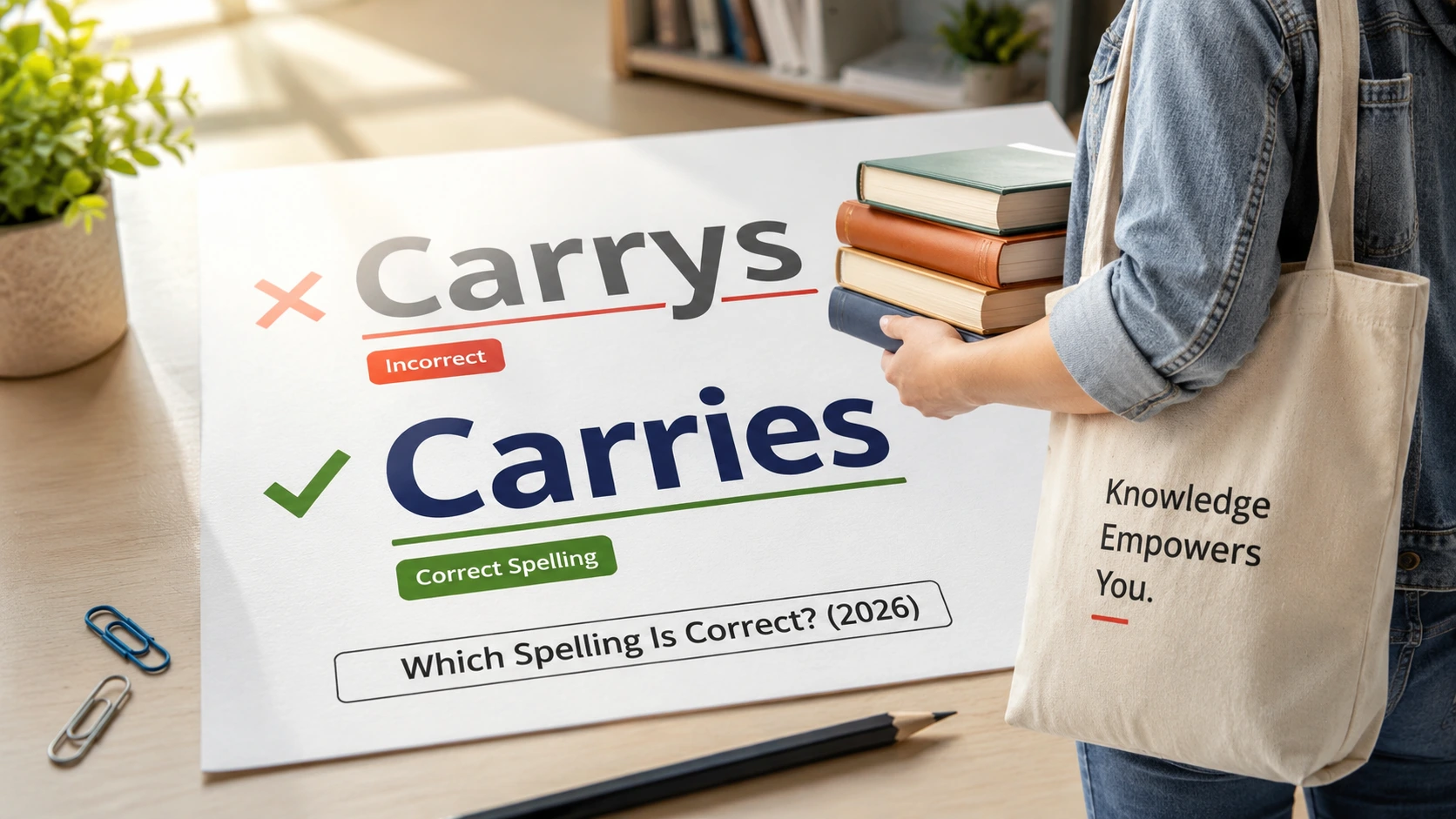
Carries is the correct spelling. Carrys is not a standard English word and should be avoided in both formal and informal writing.
Have you ever typed “carrys” and noticed the red underline appear? I remember making this exact mistake while editing a school worksheet. The sentence was “She carrys a heavy bag every day.” It looked almost right, so I had to stop and check.
This confusion is very common because many English verbs simply add -s in the third person: runs, walks, plays. But carry follows a different spelling rule. When a verb ends in consonant + y, the y changes to i before adding -es.
That is why carry → carries.
In this guide, you will learn the correct spelling, how to pronounce it, why carrys is wrong, common mistakes to avoid, and real examples you can use confidently in everyday writing.
Carries or Carrys: Quick Answer
The correct word is carries.
- Correct: She carries her books to school.
- Incorrect: She carrys her books to school.
Use carries when talking about he, she, it, or a singular noun in the present simple tense.
Simple Examples
- The truck carries fresh vegetables.
- My sister carries a small notebook.
- The river carries water to nearby farms.
A quick memory trick:
Consonant + y → change y to i + es
- carry → carries
- study → studies
- worry → worries
How to Pronounce “Carries”
Many spelling mistakes happen because English pronunciation does not always match the written form.
Pronunciation
carries → /ˈkær.iːz/
It sounds like:
KAR-eez
Break It Into Parts
- car → like car
- ries → like reez
Say it slowly:
car + reez = carries
Listen for the Ending
Notice that the ending sounds like “eez”, not “ys”. This is another clue that carries is correct and carrys is not.
The Origin and Spelling Rule
The verb carry comes from Old Northern French *carier, meaning *to transport or convey. Over time it became the modern English verb **carry.
The important part is not the history itself, but the spelling rule English developed for verbs ending in -y.
The Rule
When a verb ends with:
- a consonant + y, change y → i and add -es.
- a vowel + y, simply add -s.
Examples
| Verb | Correct Form |
|---|---|
| carry | carries |
| study | studies |
| worry | worries |
| play | plays |
| enjoy | enjoys |
Because carry ends with rr + y (a consonant before y), the correct form is carries.
Carries Explained: Why “Carrys” Is Wrong?
Let’s compare the two spellings directly.
| Term | Meaning |
|---|---|
| carries | Correct third-person singular form of carry |
| carrys | Incorrect spelling; not accepted in standard English |
Why People Write “Carrys”
Writers often think:
- walk → walks
- jump → jumps
- carry → carrys
The pattern seems logical, but English treats -y verbs differently.
Correct Comparison
- I carry
- You carry
- We carry
- They carry
- He/She/It carries
Only the third-person singular changes to carries.
Which Version Should You Use?
For Students
Use carries in:
- homework
- essays
- exams
- classroom writing
Teachers will mark carrys as a spelling error.
For Professional Writing
Always choose carries in:
- emails
- reports
- business documents
- academic papers
For Everyday Use
Whether you are texting, posting on social media, or writing a note, carries is the natural and correct choice.
Best recommendation: Use “carries” every time.
Common Mistakes with Carries
These errors appear frequently in student writing.
Mistake 1
❌ She carrys a purse.
✅ She carries a purse.
Mistake 2
❌ The bus carrys many passengers.
✅ The bus carries many passengers.
Mistake 3
❌ He carry’s his laptop everywhere.
✅ He carries his laptop everywhere.
Why? The apostrophe (’s) shows possession or contraction, not a verb ending.
Mistake 4
❌ The company carry several products.
✅ The company carries several products.
A singular subject needs carries.
Mistake 5
❌ My brother carrys groceries home.
✅ My brother carries groceries home.
Carries in Real-World Examples
Seeing the word in context makes the rule easier to remember.
Professional Email
Subject: Delivery Update
The new courier carries packages to all regional offices every morning.
News Headline
Local Train Carries Thousands of Commuters Daily
Social Media Post
My backpack carries way too many books today 😅
Formal Report
The pipeline carries water from the storage reservoir to nearby agricultural areas.
School Assignment
A camel carries heavy loads across the desert.
Notice that every example uses a singular subject with carries.
Carries: Data, Trends & Usage
Search Intent
People searching “carrys or carries” usually want to know:
- which spelling is correct,
- why carrys is wrong,
- how to use carries in a sentence,
- and what grammar rule applies.
This is mainly informational search intent.
Who Searches for It Most?
The query is especially common among:
- English learners
- school students
- exam candidates
- content writers
- professionals who write in English regularly
Why This Matters
Spell-check tools catch carrys, but understanding why it is wrong helps you avoid similar mistakes with words like studies, tries, copies, and worries.
Learning one rule improves dozens of other spellings.
Quick Comparison Table
| Term/Variant | Meaning | Region/Context | Best Used When |
|---|---|---|---|
| carry | Base verb | All English varieties | With I, you, we, they |
| carries | Third-person singular verb | All English varieties | With he, she, it, or singular nouns |
| carrys | Incorrect spelling | None | Never |
Frequently Asked Questions
Q: What does “carries” mean?
A: Carries means transports, holds, supports, or takes something from one place to another. It is the third-person singular form of carry.
Q: Is “carrys” ever correct?
A: No. Carrys is considered a spelling mistake in standard English and should not be used in formal or informal writing.
Q: How do you use “carries” correctly?
A: Use it with he, she, it, or a singular noun:
- She carries water.
- The machine carries materials upstairs.
Q: Carries vs. carry; what’s the difference?
A: Carry is the base form used with I, you, we, and they. Carries is used with he, she, it, or singular nouns.
Q: Is “carries” acceptable in formal writing?
A: Yes. Carries is completely correct for academic, business, legal, and professional writing.
Q: Why does “carry” become “carries”?
A: Because English changes consonant + y to i + es in the third-person singular present tense.
Q: Can I use “carries” in a formal report?
A: Absolutely. Example:
“The conveyor system carries raw materials to the processing unit.”
That is grammatically correct and appropriate for formal documents.
Final Thoughts
The confusion between carrys and carries is easy to understand. English has many verbs that simply add -s, so carrys looks plausible at first glance.
The key rule is simple:
- carry → carries
- study → studies
- worry → worries
Whenever a verb ends in consonant + y, change the y to i and add -es.
So remember these three takeaways:
- Carries is the only correct spelling.
- Carrys is always an error.
- Use carries with he, she, it, or any singular noun.
Now you know exactly how to use carries with confidence. Bookmark this guide so you never second-guess “carrys or carries” again.
Carrys or carries explained clearly. Learn the correct spelling, grammar rule, pronunciation, examples, and avoid common writing mistakes.
Reckless or Wreckless: Which Spelling Is Correct?

I’m a language enthusiast and content writer. I’m specialized in English grammar, spelling differences, vocabulary explanations, and word comparisons. My goal is to help readers improve their writing skills through clear, accurate, and easy-to-understand language guides.