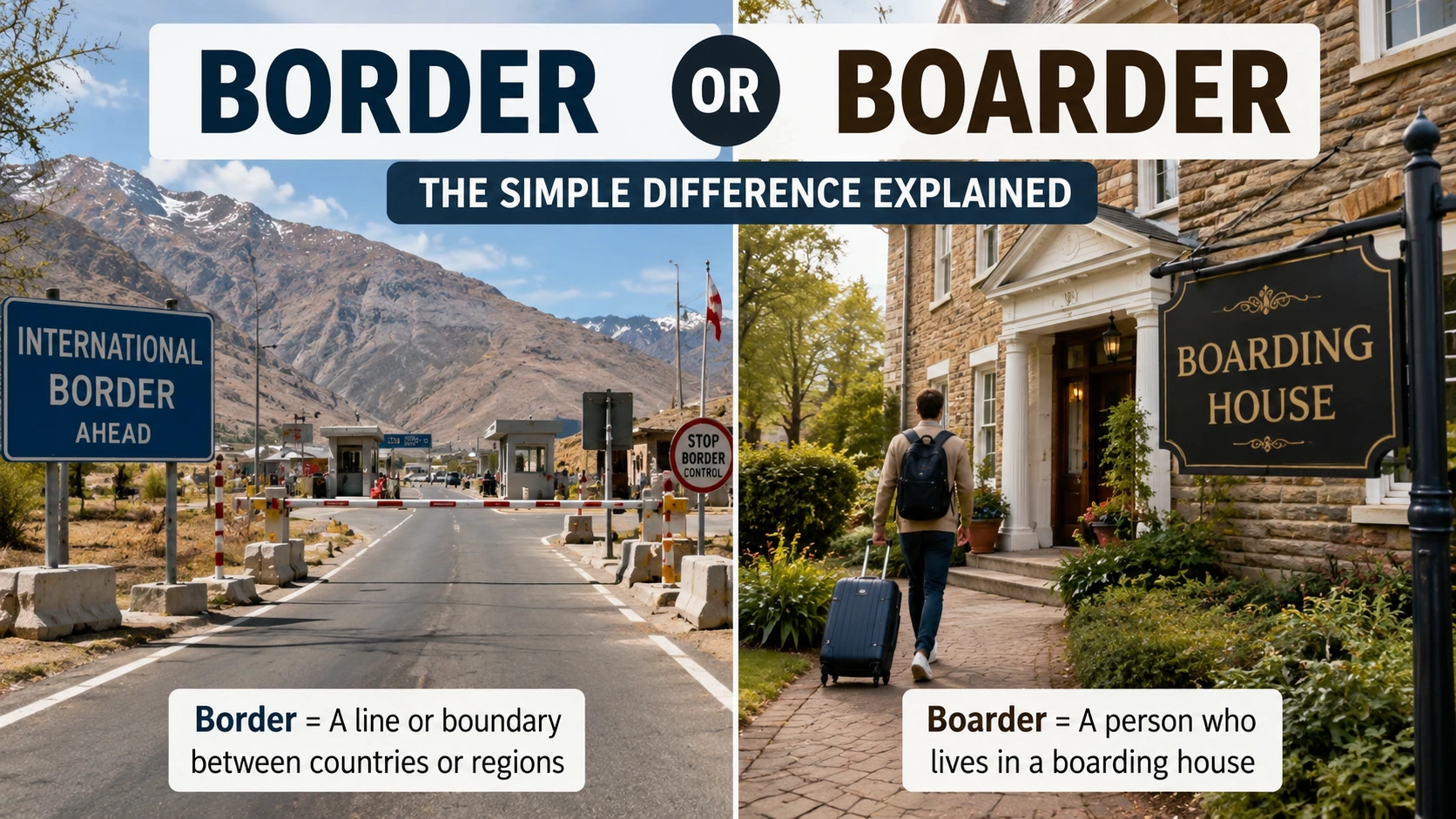
Border means the edge or boundary of something, such as the line between two countries. Boarder means a person who pays to live or eat in someone else's home, a boarding house, or a boarding school.
Have you ever paused while writing and wondered, “Should I use border or boarder?” You’re not alone. These two words sound almost the same, which makes them easy to mix up. Even native English speakers sometimes use the wrong one.
As an English teacher, I’ve seen this mistake in school assignments, emails, and even online posts. Most people know the words, but they forget which spelling matches which meaning. A single extra letter can completely change what you are trying to say.
The good news is that learning the difference is much easier than you might think. Once you understand what each word means and see them in real-life examples, you’ll remember them for good.
In this guide, you’ll learn the meaning of border and boarder, see clear examples, discover simple memory tricks, and find out exactly when to use each word with confidence.
Border or Boarder: Quick Answer
Although border and boarder sound alike, they have completely different meanings.
- Border refers to the edge, boundary, or line around a place or object.
- Boarder refers to a person who pays to live or eat somewhere, such as in a boarding house or boarding school.
Simple Examples
- Pakistan shares a border with India.
- The teacher drew a blue border around the certificate.
- My cousin is a boarder at a boarding school.
- The family rented a room to a boarder.
Quick Tip: If you’re talking about a place, a line, or an edge, use border. If you’re talking about a person who stays somewhere and pays for it, use boarder.
What Does Border Mean?
The word border means the outer edge or boundary of something. It can describe the line between two countries, the edge of a page, or even a decorative design around a picture.
Border can be used as both a noun and a verb.
Border as a Noun
As a noun, border means the line or edge that separates one area from another.
Examples
- Canada and the United States share a long border.
- The garden has a colorful flower border.
- Please leave a one-inch border on every page.
- Soldiers guarded the border throughout the night.
Border as a Verb
As a verb, border means to form a boundary with or to be next to something.
Examples
- Mexico borders the United States.
- The river borders the small village.
- Several countries border the Mediterranean Sea.
Common Uses of Border
You will often see border in these situations:
- Country borders – the line between two nations
- Page borders – decorative lines around documents
- Garden borders – rows of flowers or plants
- Picture borders – frames around photos
- Clothing borders – decorative edges on dresses or scarves
- Map borders – boundaries shown on maps
Everyday Sentences
- We crossed the border early in the morning.
- Add a gold border to the invitation card.
- The fence marks the border of the property.
- Police increased security at the national border.
- She planted roses along the garden border.
Remember This
Think of border whenever you think about boundaries, edges, or lines. Whether it’s a country, a page, or a garden, border is always about marking where something begins or ends.
What Does Boarder Mean?
The word boarder refers to a person who pays to live, eat, or both in someone else’s home or another place. It comes from the word board, which originally meant receiving meals and lodging.
Today, boarder is less common than border, but it is still used in schools, hostels, boarding houses, and rental homes.
Examples of Boarder
- My nephew is a boarder at a boarding school.
- The old woman rented a room to a boarder.
- Every boarder must follow the hostel rules.
- The new boarder arrived with two suitcases.
Common Places Where You Hear Boarder
1. Boarding School
A boarder is a student who lives at school during the term.
Example:
- Sarah became a boarder when she started high school.
2. Boarding House
A boarder rents a room and may also receive meals.
Example:
- The boarding house welcomed a new boarder every month.
3. Hostel or Dormitory
Some hostels describe long-term residents as boarders.
Example:
- Each boarder received a room key and a meal schedule.
Everyday Sentences
- Every boarder has access to the study room.
- The boarders enjoyed dinner together.
- The school organized a weekend trip for its boarders.
- She worked as a cook for the boarders in the hostel.
- A friendly boarder helped the new student settle in.
Remember This
A boarder is always a person.
If you’re talking about someone who lives at a boarding school, hostel, or boarding house and pays for accommodation or meals, boarder is the correct spelling.
Border vs. Boarder: Key Differences
At first glance, border and boarder look very similar. They also sound almost the same. That is why many English learners confuse them. However, their meanings are completely different.
The easiest way to remember them is this:
- Border = boundary or edge
- Boarder = person who boards (lives or stays somewhere)
Comparison Table
| Word | Meaning | Part of Speech | Example | Easy Memory Trick |
|---|---|---|---|---|
| Border | The edge or boundary of a place or object | Noun, Verb | The river forms the border between the two countries. | Border = Boundary (Both begin with B.) |
| Boarder | A person who pays to live or eat somewhere | Noun | The new boarder moved into the hostel yesterday. | Boarder = Person (Think of a student at a boarding school.) |
The Biggest Differences
| Feature | Border | Boarder |
|---|---|---|
| Refers to | A place or boundary | A person |
| Common Topics | Countries, maps, gardens, pages | Schools, hostels, boarding houses |
| Part of Speech | Noun or Verb | Noun only |
| Frequency | Very common | Less common |
Side-by-Side Examples
✔ The soldiers guarded the border.
✔ The new boarder arrived at the hostel.
Notice how border is never a person, while boarder is always a person.
The Origin of Border and Boarde
Knowing where these words come from can make them easier to remember.
Where Does Border Come From?
The word border comes from an old French word meaning edge or boundary.
Over time, English speakers began using it for:
- country boundaries
- property lines
- page decorations
- garden edges
Today, border still carries the same basic idea: the edge of something.
Where Does Boarder Come From?
The word boarder comes from the word board.
Many years ago, the phrase room and board meant a place to sleep and meals to eat.
Someone who paid for room and board became known as a boarder.
That meaning is still used today.
Examples include:
- boarding schools
- boarding houses
- hostels
- guest houses
Why Are These Words Confusing?
There are three main reasons.
1. They Sound Almost the Same
When spoken quickly, border and boarder have nearly identical pronunciation.
Many people cannot hear the difference.
2. Only One Letter Is Different
Compare them:
- border
- boarder
The extra a changes the meaning completely.
3. Both Are Common English Words
Unlike many spelling mistakes, both words are correct.
The problem is choosing the right one.
Which Word Should You Use?
The answer depends on what you are talking about.
For Students
Use border when writing about:
- geography
- maps
- countries
- page design
- art
Use boarder when writing about:
- boarding schools
- hostels
- dormitories
- paying guests
For Academic Writing
Choose border if your topic includes:
- international relations
- geography
- politics
- maps
- environmental studies
Choose boarder only when discussing:
- education
- housing
- boarding schools
- accommodation
For Business Writing
Most business documents use border.
Examples include:
- page borders
- design borders
- international borders
- border security
Use boarder only if your business deals with:
- hotels
- hostels
- boarding houses
- schools
For Everyday English
Ask yourself one simple question.
Am I talking about a place or a person?
If it is a place, use border.
If it is a person, use boarder.
That simple question will help you choose the correct spelling almost every time.
Common Mistakes with Border and Boarder
These mistakes appear in school assignments, emails, and even newspapers.
Here are the most common ones.
Mistake 1
❌ We crossed the boarder yesterday.
✅ We crossed the border yesterday.
Why?
You cross a country border, not a person.
Mistake 2
❌ Every border must follow the hostel rules.
✅ Every boarder must follow the hostel rules.
Why?
The sentence talks about people living in a hostel.
Mistake 3
❌ She became a border at the boarding school.
✅ She became a boarder at the boarding school.
Why?
A student living at school is called a boarder.
Mistake 4
❌ Add a blue boarder around the page.
✅ Add a blue border around the page.
Why?
The edge of a page is called a border.
Mistake 5
❌ The two countries share a boarder.
✅ The two countries share a border.
Why?
Countries share boundaries, not people.
Border or Boarder in Real-World Examples
Seeing these words in everyday situations is one of the best ways to remember them.
1. Professional Email
Subject: Business Trip Update
Dear Team,
We crossed the border without any delays and arrived safely at our destination.
Best regards,
Ahmed
Here, border refers to the boundary between two countries.
2. News Headline
Government Increases Security Along the Northern Border
The headline uses border because it is discussing a country’s boundary.
3. Social Media Post
My younger brother is now a boarder at his new boarding school. Wishing him the best! 🎉
Here, boarder refers to a student who lives at the school.
4. Formal Report
The company expanded its operations near the international border to improve trade opportunities.
Again, border means a geographical boundary.
5. Everyday Conversation
Ali: Where is your cousin studying?
Sara: She’s a boarder at a boarding school in Lahore.
In this conversation, boarder refers to a student living at school.
Easy Memory Tricks
If you often confuse these words, these simple tricks can help.
Trick 1: Border = Boundary
Both Border and Boundary start with the letter B.
Think:
Border = Boundary
Trick 2: Boarder = Boarding Schoo
A boarder lives at a boarding school.
Both words contain board.
Trick 3: Place vs. Person
Ask yourself:
Am I talking about a place or a person?
- Place → Border
- Person → Boarder
Trick 4: Extra “A” = A Person
The extra A in boarder can remind you of A person.
Trick 5: Remember “Room and Board”
The phrase room and board means accommodation and meals.
Someone who pays for room and board is a boarder.
Complain or Complaint: The Complete Difference Explained
Border or Boarder: Usage and Search Trends
Many English learners search for border or boarder because these words are homophones. They sound almost the same but have different meanings and spellings.
Who Searches This Topic?
Common searchers include:
- English learners
- School and university students
- Teachers
- Writers and bloggers
- Job applicants
- People preparing for English exams
Search Intent
This keyword has an informational search intent. People want to understand the difference between the two words and learn how to use them correctly.
Why This Matters
Using the wrong word can change the meaning of a sentence. Understanding the difference helps you write more clearly and confidently in school, at work, and in everyday communication.
Quick Comparison Table
| Word | Meaning | Region/Context | Best Used When |
|---|---|---|---|
| Border | Edge or boundary of a place or object | Geography, design, maps, documents | Talking about boundaries or edges |
| Boarder | A person who pays to live or eat somewhere | Boarding schools, hostels, boarding houses | Talking about a resident or paying guest |
Frequently Asked Questions (FAQs)
Q1: What does border mean?
A: Border means the edge or boundary of a place or object. It can describe the line between countries, the edge of a page, or a decorative frame.
Q2: What does boarder mean?
A: A boarder is a person who pays to live or eat somewhere, such as in a boarding school, hostel, or boarding house.
Q3: What is the difference between border and boarder?
A: Border refers to a boundary or edge, while boarder refers to a person who stays somewhere and pays for accommodation or meals.
Q4: Which spelling is correct: border or boarder?
A: Both spellings are correct, but they have different meanings. Choose border for boundaries and boarder for people who board.
Q5: Is boarder a real English word?
A: Yes. Boarder is a correct English noun. It describes someone who lives in a boarding school, boarding house, hostel, or similar accommodation.
Q6: Can border be both a noun and a verb?
A: Yes. As a noun, border means a boundary. As a verb, it means to form a boundary with or lie next to something.
Q7: How can I remember the difference forever?
A: Think of this simple rule:
- Border = Boundary
- Boarder = Boarding school student or paying guest
This memory trick works in almost every situation.
Conclusion
Now you know the difference between border and boarder. Although these words sound alike, they have very different meanings. Border refers to the edge or boundary of a place, object, or country. Boarder, on the other hand, refers to a person who pays to live or eat somewhere, such as at a boarding school or boarding house.
A simple way to remember them is to think about place versus person. If you’re talking about a boundary, choose border. If you’re talking about someone staying somewhere, choose boarder.
Learning this small spelling difference can make your writing clearer and help you avoid a common English mistake. Whether you’re writing an essay, an email, or a social media post, using the correct word shows attention to detail and improves communication.

I am a language content specialist specializing in spelling comparisons, vocabulary usage, and commonly confused English words. I write detailed, informative articles that help readers improve their language skills. I am passionate about helping students, writers, and professionals develop a stronger understanding of the English language.