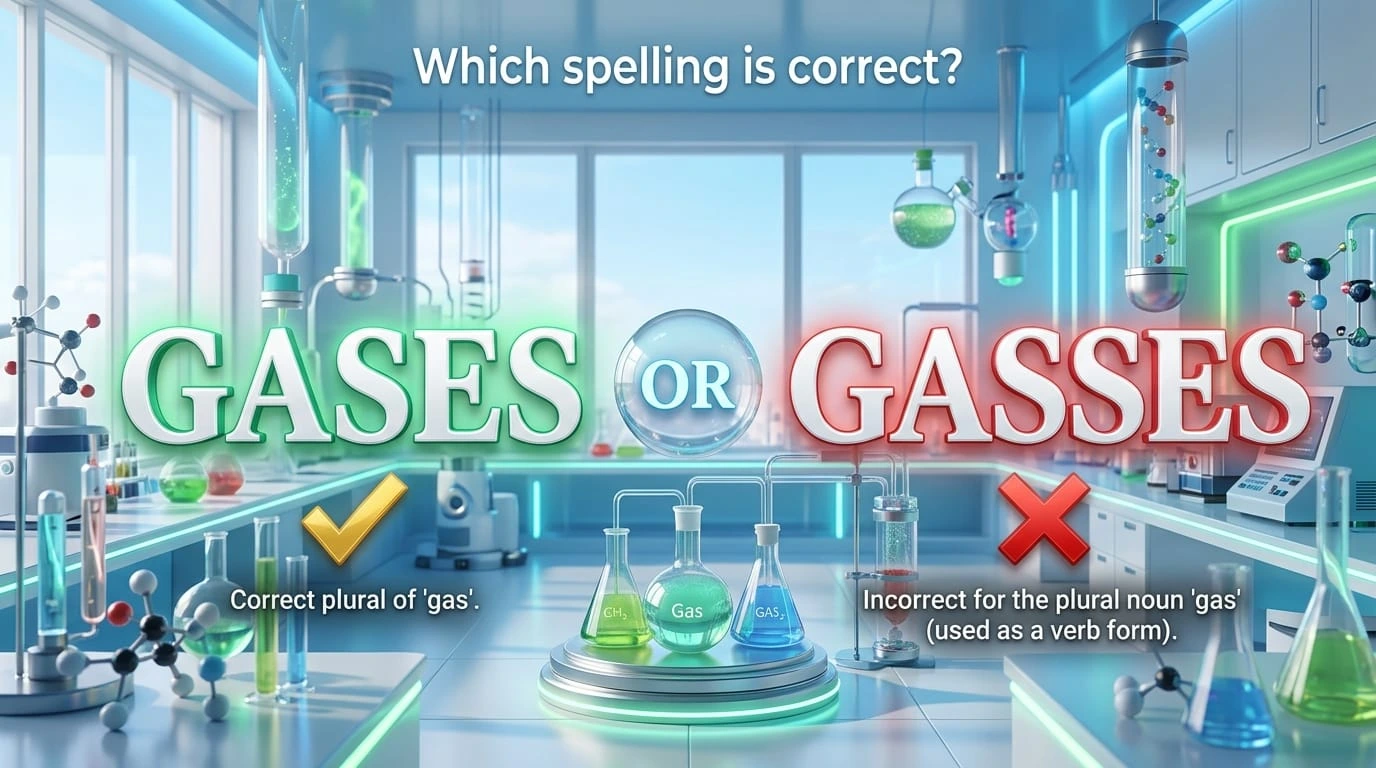
“Gases” is the correct plural of the noun “gas” (as in oxygen, nitrogen, or greenhouse gases). “Gasses” is a verb form, used when someone “gasses” something — like refueling a car or releasing gas.
A few years ago, I submitted a science summary for work and wrote “greenhouse gasses are rising.” My editor sent it back with one word circled: “gases.” I was confused; I’d seen “gasses” written plenty of times before.
That’s when I learned something most people never get taught directly: “gases” and “gasses” aren’t interchangeable spellings of the same word. They’re actually two different parts of speech.
If you’ve ever typed one and wondered whether it should have one s or two, this guide clears it up for good; no more guessing when you’re writing a science report, an email, or a quick text.
Gasses or Gases: Quick Answer
“Gases” is the plural noun. Use it whenever you’re talking about more than one gas.
- ✅ Nitrogen and oxygen are common gases in the atmosphere.
“Gasses” is a verb. Use it when someone or something performs the action of gassing.
- ✅ He gasses up the car every Friday.
Mixing these up is one of the most common science-writing errors, especially in reports, essays, and news articles about climate and chemistry.
The Origin of Gasses/Gases
The word “gas” was coined in the 1600s by Flemish chemist Jan Baptist van Helmont, who based it loosely on the Greek word chaos. As English absorbed the word, it needed a plural form, and English typically pluralizes words ending in a single s by adding -es, similar to “bus” → “buses” or “glass” → “glasses.”
That gave English the noun plural “gases.”
Later, “gas” also became a verb, meaning to expose something to gas, or in British English, to refuel a vehicle with gas or petrol. Verbs ending in a single consonant often double that consonant before adding -es in the present tense, similar to “run” → “runs” but with short vowel patterns like “pat” → “pats” versus “tap” → “taps.”
For “gas,” the verb form doubled the s, giving English “gasses” as the third-person singular verb, completely separate from the noun plural.
Gasses vs Gases Explained: Key Differences
| Term | Part of Speech | Meaning | When to Use |
|---|---|---|---|
| Gases | Noun (plural) | More than one gas | Science, chemistry, environmental writing |
| Gasses | Verb (present tense) | Performs the action of gassing | Describing an action, like refueling or releasing gas |
| Gas | Noun (singular) / Verb (base form) | One gas / to gas something | Singular reference or infinitive verb form |
A simple test: if you can replace the word with “cars” or “runs,” check which category it falls into. If it names a substance, it’s a noun, use “gases.” If it describes an action someone does, it’s a verb, use “gasses.”
Which Spelling Should You Use?
For science and chemistry writing
Use gases. This is the standard noun plural in academic, environmental, and technical writing.
For describing an action, like refueling or releasing gas
Use gasses. This is the correct verb form, especially common in British English (“he gasses the car”).
For everyday or general writing
Default to gases unless you’re specifically describing an action, most everyday sentences use the noun form.
For global or neutral use
Gases is by far the more frequently needed word, since most writing discusses gases as substances, not as a verb.
Common Mistakes with Gasses/Gases
Mistake 1: Using “gasses” instead of “gases” for the noun plural
✅ Greenhouse gases trap heat in the atmosphere.
❌ Greenhouse gasses trap heat in the atmosphere.
Why it happens: Writers assume doubling the s is simply an alternate spelling, not realizing it changes the part of speech.
Mistake 2: Using “gases” as a verb
✅ He gasses the generator before the storm.
❌ He gases the generator before the storm.
Why it happens: Writers default to the more familiar noun spelling without checking whether the sentence needs a verb.
Mistake 3: Assuming spellcheck will catch the error
✅ Proofread carefully; both spellings are real words, so spellcheck won’t flag either one.
❌ Relying on autocorrect to catch a noun-verb mix-up.
Why it happens: Since both “gases” and “gasses” are valid English words, spellcheck tools don’t flag the swap.
Mistake 4: Misusing the singular form “gas”
✅ Helium is a gas used in balloons.
❌ Helium is a gases used in balloons.
Why it happens: Writers overcorrect after learning about the plural form and misapply it to singular sentences.
Mistake 5: Inconsistent use across a single document
✅ The gases were tested, and the technician gasses the chamber daily.
❌ The gasses were tested, and the technician gases the chamber daily.
Why it happens: Writers don’t realize the two spellings serve completely different grammatical roles within the same piece.
Gasses/Gases in Real-World Examples
Professional email:
“Please confirm the lab has properly labeled all hazardous gases before the inspection tomorrow.”
News headline:
“Scientists Warn Rising Greenhouse Gases Could Accelerate Climate Change”
Social media post:
“Fun fact: the air we breathe is a mix of several gases, not just oxygen. 🌍”
Formal document:
“The technician gasses the equipment weekly to maintain proper pressure levels.”
Notice how the noun form dominates most writing, while the verb form only appears when describing a specific action.
Gasses/Gases: Data, Trends & Usage
Search interest in “gasses vs gases” spikes around science coursework, climate change news cycles, and chemistry homework help. This falls into the informational search category, with students and writers trying to confirm correct usage before submitting an assignment or publishing an article.
Environmental journalism drives much of the search traffic for “gases,” since terms like “greenhouse gases” and “emission gases” appear constantly in climate coverage. The verb form “gasses” sees far less search volume, but still trips up writers in technical or automotive contexts, especially in British English.
Tomatoes or Tomatos: The Correct Spelling (2026)
Gasses vs Gases: Comparison Table
| Term/Variant | Meaning | Region/Context | Best Used When |
|---|---|---|---|
| Gases | Plural noun for more than one gas | Universal, all English dialects | Science, chemistry, environmental writing |
| Gasses | Verb form (to gas something) | Common in British English usage | Describing an action, like refueling |
| Gas | Singular noun or base verb form | Universal | Referring to one gas, or the infinitive verb |
Frequently Asked Questions
Q: What does “gases” mean?
A: “Gases” is the plural noun form of “gas,” referring to more than one gaseous substance, such as oxygen, nitrogen, or carbon dioxide.
Q: How do you use “gasses” correctly in a sentence?
A: Use “gasses” as a verb, describing an action someone performs, for example, “The attendant gasses up the car” or “He gasses the room for pest control.”
Q: Gasses vs gases; what’s the difference?
A: “Gases” is a noun (plural of gas), while “gasses” is a verb (third-person singular of “to gas”). They serve completely different grammatical roles.
Q: Is “gases” acceptable in formal writing?
A: Yes. “Gases” is the standard, expected spelling in academic, scientific, and journalistic writing whenever referring to multiple gases.
Q: Which version is correct: gasses or gases?
A: Both are correct, but they mean different things. “Gases” is correct for the noun plural; “gasses” is correct for the verb form.
Q: Where does the word “gas” come from?
A: It was coined in the 1600s by chemist Jan Baptist van Helmont, loosely based on the Greek word chaos, to describe substances without fixed shape or volume.
Q: Can “gasses” be used in American English?
A: Yes, though it’s less common than in British English. American writers typically encounter it in technical or automotive contexts describing the act of refueling or releasing gas.
Final Takeaway
Here’s the short version. “Gases” is the noun you use for more than one gas. “Gasses” is the verb you use when describing an action.
Key points to remember:
- The rule: Nouns take “gases”; verbs take “gasses”
- Quick test: If it names a substance, it’s “gases”; if it describes an action, it’s “gasses”
- Watch science writing closely: “Greenhouse gases,” not “greenhouse gasses”
- Regional note: “Gasses” as a verb appears more often in British English
Once you separate the noun from the verb, you’ll never mix up “gasses” and “gases” again.
Gasses vs gases explained; learn the difference between the noun and verb forms, with examples and common mistakes to avoid.
Who’s or Whose: The Complete Guide to Using Them Correctly (2026)

I’m an English language researcher and content writer. I am specialized in spelling comparisons, commonly confused words, grammar usage, and vocabulary guides. Through detailed language articles,I am helping readers to understand the differences between similar words and improve their written communication skills.