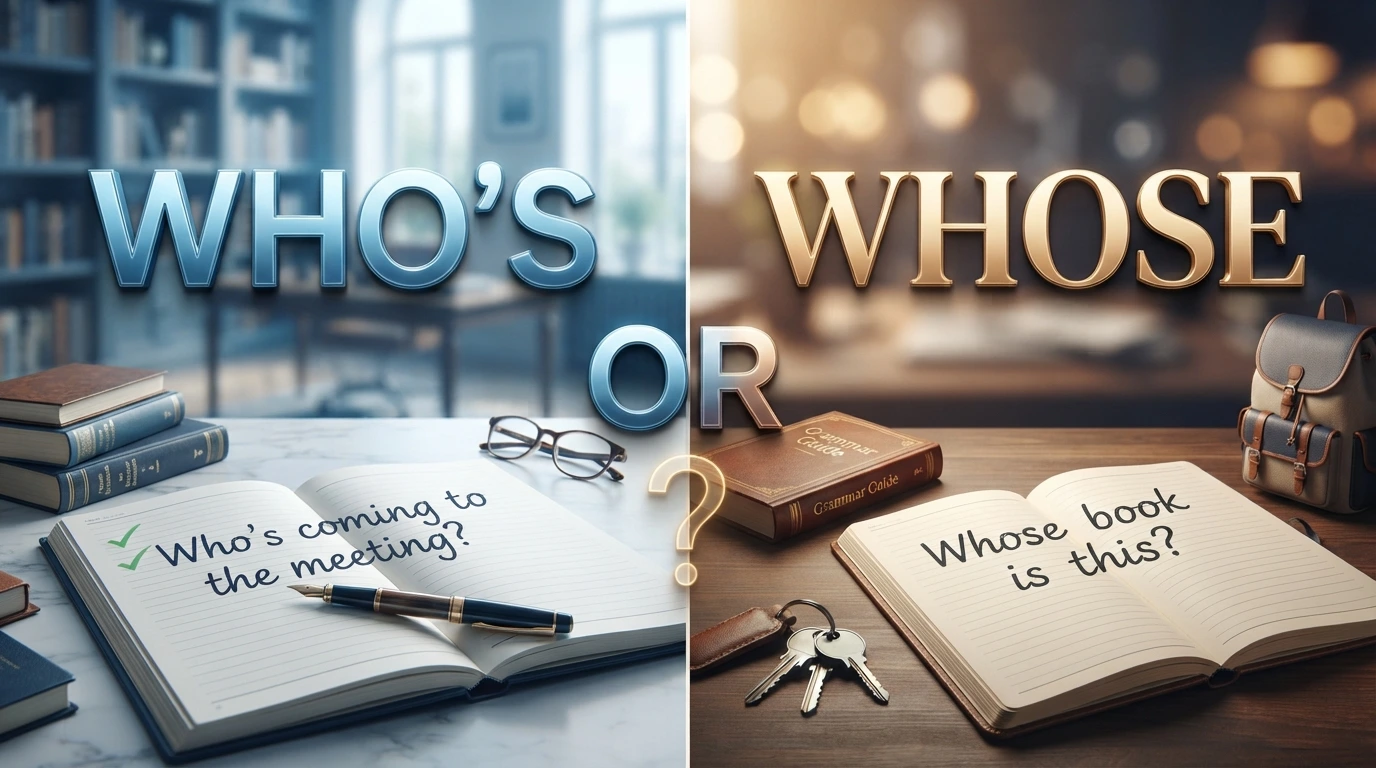
Who’s is a contraction of “who is” or “who has.” Whose shows possession, it means “belonging to whom.” They sound the same, but they never mean the same thing.
I once sent a work email that said “Who’s laptop is this?” My manager circled it in red. That one letter cost me a little pride and a lot of embarrassment.
If you’ve ever paused mid-sentence, unsure whether to type who’s or whose, you’re in good company. These two words are some of the most mixed-up in the English language. They sound identical. They look almost identical. But they do completely different jobs.
This guide clears up the confusion for good. You’ll learn the meaning of each word, see real examples, and pick up a trick so simple you’ll never second-guess yourself again. Let’s fix this once and for all.
Who’s vs Whose: Quick Answer
Who’s always breaks down into two words: “who is” or “who has.” If you can’t replace it with either of those, you need whose instead.
Whose points to ownership. Think of it like “his” or “her,” but for the word “who.”
- Who’s coming to dinner? → “Who is coming to dinner?”
- Whose coat is this? → The coat belongs to someone.
That’s the whole rule in a nutshell.
The Origin of the Confusion
English loves a good contraction. We shorten “do not” to “don’t” and “it is” to “it’s.” Who follows that same pattern? It’s just “who” plus “is” or “has,” squeezed together with an apostrophe.
Whose, on the other hand, comes from an old possessive form of “who.” It never takes an apostrophe, even though your instincts might scream otherwise.
Here’s why people trip up: apostrophes usually signal possession, like in “Sarah’s book.” So your brain assumes an apostrophe word must show ownership. With this pair, that instinct backfires. The apostrophe here signals a missing letter, not possession.
Who’s vs Whose Explained: Key Differences
| Term | Meaning | When to Use | Example |
|---|---|---|---|
| Who’s | Contraction of “who is” or “who has” | Asking a question or making a statement about identity or action | Who’s calling? |
| Whose | Possessive form of “who” | Showing ownership or a relationship | Whose phone keeps ringing? |
Notice the pattern: swap in “who is” or “who has.” If the sentence still makes sense, who’s is correct. If it sounds wrong, switch to whose.
Which Version Should You Use?
- For quick messages or texts → Use who’s when you mean “who is” :Who’s up for coffee?
- For formal writing or reports → Double-check every instance by mentally expanding it to “who is” or “who has.” If it fails that test, use whose.
- For possessive questions → Always default to whose :Whose signature is on this form?
A safe habit: before you hit send, read the sentence back and mentally say “who is” in place of the word. If it sounds odd, you need the other one.
Common Mistakes with Who’s and Whose
Mistake 1:
❌ Who’s bike is blocking the driveway?
✅ Whose bike is blocking the driveway?
Why it happens: the sentence needs possession, not a contraction.
Mistake 2:
❌ I don’t know whose coming to the party.
✅ I don’t know who’s coming to the party.
Why it happens: “coming” needs “who is,” not ownership.
Mistake 3:
❌ Whose been eating my sandwich?
✅ Who’s been eating my sandwich?
Why it happens: this needs “who has,” a job only who’s can do.
Mistake 4:
❌ The dog whose owner left is barking. (This one is actually correct; but writers often “fix” it wrongly to “who’s owner.”)
✅ Keep whose here, since the dog belongs to the owner.
Mistake 5:
❌ Who’s turn is it?
✅ Whose turn is it?
Why it happens: turns belong to someone, so this calls for possession.
Who’s and Whose in Real-World Examples
Professional email:
“Could you confirm who’s presenting the quarterly results on Friday?”
News headline:
“Whose Decision Was It? City Council Faces Backlash Over New Zoning Law”
Social media post:
“Who’s ready for the weekend? Drop a 🙌 below!”
Formal document:
“The applicant whose reference number appears above must sign section three.”
Each example shows the words doing their real job; one asks or states, the other claims ownership.
Cancelation or Cancellation: The Correct Spelling Explained
Who’s and Whose: Data, Trends & Usage
Searches for “who’s vs whose” spike heavily among students, content writers, and non-native English speakers preparing for exams like IELTS or TOEFL. Editors and teachers see this error constantly in essays, emails, and social captions.
This is mostly an informational search; people want a clear rule, not a product or service. It matters now because more writing happens in fast, casual formats like texts and social posts, where autocorrect doesn’t always catch grammar. Getting this right builds credibility, especially in professional writing where small errors stand out.
Standalone Comparison Table
| Term/Variant | Meaning | Region/Context | Best Used When |
|---|---|---|---|
| Who’s | Who is / who has | Universal English usage | Asking a question or describing an action |
| Whose | Belonging to whom | Universal English usage | Showing possession or ownership |
FAQ Section
Q: What does who’s mean?
A: Who’s is short for “who is” or “who has.” It’s a contraction, not a possessive word.
Q: How do you use whose correctly?
A: Use whose whenever you’re asking about or describing ownership. Test it by asking, “Does this belong to someone?” If yes, use whose.
Q: Who’s vs whose; what’s the real difference?
A: Who’s replaces “who is” or “who has.” Whose shows possession. They’re never interchangeable, despite sounding the same.
Q: Is who’s acceptable in formal writing?
A: Yes, as long as it’s used correctly to mean “who is” or “who has.” Some formal styles avoid contractions altogether, so spell it out as “who is” if your style guide requires it.
Q: Which version is correct: who’s or whose: in a possessive sentence?
A: Always whose in possessive sentences.
For example, “Whose umbrella is this?” is correct; “Who’s umbrella” is not.
Q: Where does the confusion between these words come from?
A: It comes from the apostrophe. Readers expect apostrophes to show ownership, but here the apostrophe only marks a missing letter in a contraction.
Q: Can whose be used for objects, not just people?
A: Yes. Whose can describe ownership for things too, like “the company whose profits doubled this year.”
Conclusion:
Understanding the difference between who’s or whose is easier than it first appears. The key is remembering that who’s is simply a shortened form of who is or who has, while whose shows ownership. Although they sound exactly the same, they perform completely different jobs in a sentence.
Whenever you’re unsure, pause for a moment and try the substitution test. If you can replace the word with who is or who has, choose who’s. If you’re asking who owns something or describing something that belongs to someone, choose whose. This quick habit can eliminate one of the most common grammar mistakes in English.
Now you know exactly how to use who’s or whose with confidence. Bookmark this guide so you never second-guess these words again, and share it with someone who still mixes them up.
Who’s or whose explained with grammar rules, meanings, examples, memory tricks, common mistakes, and easy usage tips for confident writing.
its or it’s: Complete Easy Grammar Guide

I specialize in spelling comparisons, confusing word pairs, grammar, and vocabulary development. My content helps readers improve their English, avoid common mistakes, and write with confidence. My goal is to provide accurate, reliable, and easy-to-understand language resources