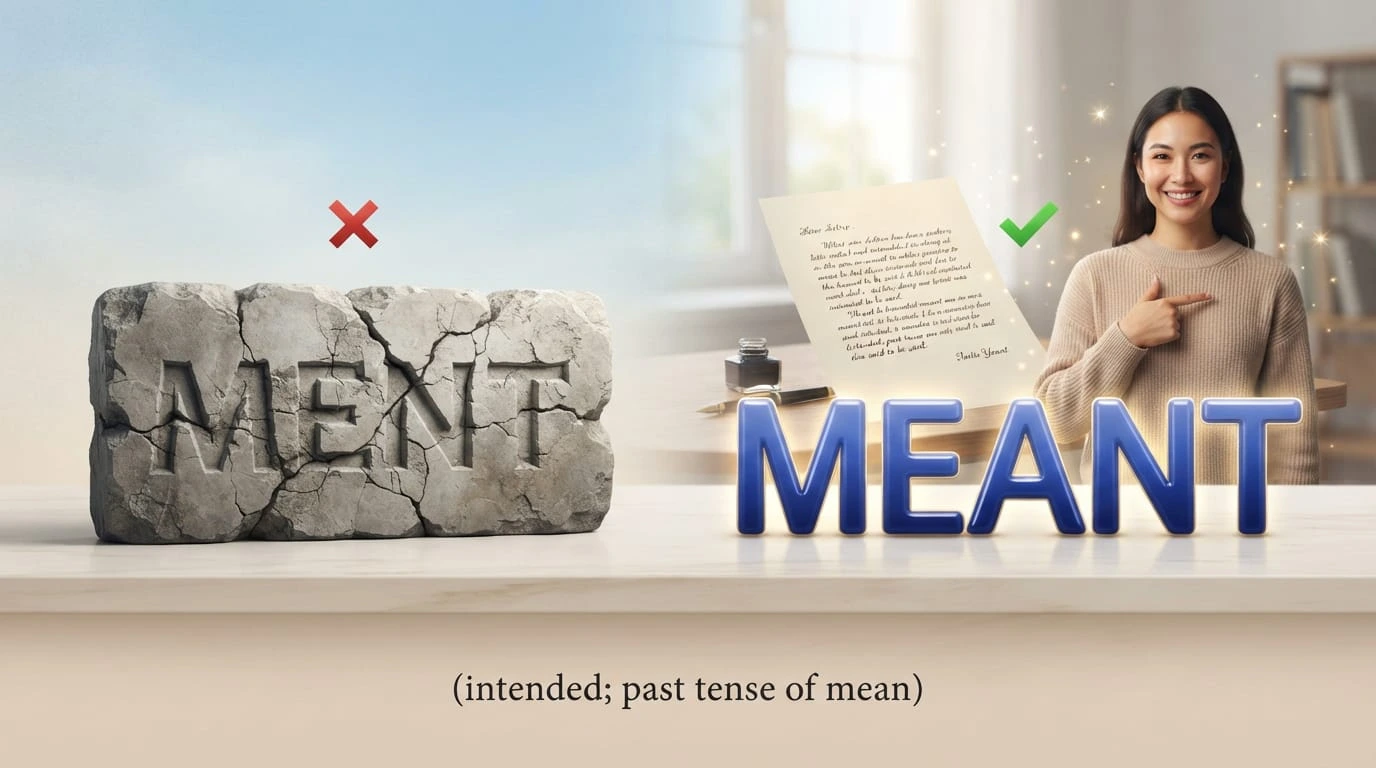
Meant is the correct past tense and past participle of the verb mean. Ment is a common misspelling and is not a standard English word.
A few years ago, I was proofreading a student’s essay when one spelling mistake kept appearing. Instead of writing meant, the student had written ment several times. At first, I thought it was a simple typing error. Then I noticed the same mistake in emails, social media posts, and even online forums.
That made me realize how common this confusion really is.
If you’ve ever wondered whether to write ment or meant, you’re not alone. Many English learners hear the word pronounced quickly and assume it should be spelled ment. Since both words sound almost identical, it’s easy to understand why the mistake happens.
The good news is that the answer is simple. Only meant is correct in standard English. Once you understand why, you’ll never confuse these words again.
Let’s break down the difference with clear explanations, examples, and practical tips.
Ment or Meant: Quick Answer
The answer is straightforward.
- ✅ Meant is the correct spelling.
- ❌ Ment is an incorrect spelling in standard English.
Meant is the past tense and past participle of the verb mean. You use it when talking about what someone intended, expressed, or wanted to say.
Examples
- I meant to call you yesterday.
- What did she mean by that comment?
- He meant every word he said.
The following sentence is incorrect:
- ❌ I ment to finish my homework.
Correct version:
- ✅ I meant to finish my homework.
Quick Tip: If you’re talking about something someone intended or wanted to say in the past, the correct spelling is always meant.
The Origin and Background of Ment or Meant
To understand why meant is correct, it helps to know where the word comes from.
The verb mean has been part of the English language for hundreds of years. It comes from the Old English word mǣnan, which meant to intend, to signify, or to have in mind.
Like many common English verbs, mean changes its spelling in the past tense.
| Base Verb | Past Tense | Past Participle |
|---|---|---|
| mean | meant | meant |
This spelling pattern has remained unchanged for centuries.
So where does ment come from?
The answer is simple. It doesn’t.
Ment is not an official English word. It usually appears because people spell the word exactly as they hear it. Since meant is often pronounced quickly in everyday speech, the missing “a” is easy to overlook.
Why Do People Write “Ment”?
Several reasons explain this common mistake.
- The pronunciation sounds very similar to “ment.”
- Fast speech makes the silent letters less noticeable.
- Many learners spell words based on sound.
- Typing quickly can lead to accidental spelling errors.
- Autocorrect does not always catch every mistake immediately.
Understanding the correct spelling helps you avoid this error in school, work, and everyday writing.
Ment vs Meant Explained
The biggest difference is that only one word actually exists in standard English.
| Term | Meaning | When to Use | Correct? |
|---|---|---|---|
| Meant | Past tense of mean | Talking about intention or meaning in the past | ✅ Yes |
| Ment | Common misspelling of meant | Never in standard English writing | ❌ No |
Using “Meant” Correctly
Use meant whenever you describe an intention, purpose, explanation, or message from the past.
Examples
- I meant to send the email earlier.
- She meant no harm.
- They meant exactly what they said.
- What meant the most to you?
Why “Ment” Is Incorrect
Although ment may appear online or in informal messages, it is considered a spelling mistake.
Incorrect:
- ❌ I ment to apologize.
- ❌ She ment well.
Correct:
- ✅ I meant to apologize.
- ✅ She meant well.
Remember this simple rule:
If the base verb is “mean,” the past tense is always “meant.”
Dilemna or Dilemma: Which Spelling Is Correct?
Which Version Should You Use?
This decision is easy because there is only one correct choice.
For Students
Always write meant in essays, assignments, and exams.
For Professional Writing
Use meant in emails, reports, presentations, and business communication.
For Bloggers and Content Writers
Choose meant in articles, blog posts, newsletters, and website content.
For Social Media
Even in casual posts, using meant makes your writing look more polished and professional.
Unlike many spelling comparisons, this is not a British English versus American English difference.
Both American English and British English use exactly the same spelling:
- ✅ Meant
- ❌ Ment
No matter where your audience lives, meant is always the correct choice.
Common Mistakes with Ment or Meant
Many learners repeat the same spelling mistakes. Fortunately, they are easy to fix.
| Mistake | Correct Version | Why It Happens |
|---|---|---|
| Writing ment instead of meant | Meant | Spelling based on pronunciation |
| Thinking ment is an accepted variant | Meant | Confusing sound with spelling |
| Using ment in formal writing | Meant | Typing too quickly |
| Forgetting that meant is the past tense of mean | Remember the verb form | Grammar confusion |
| Ignoring spell-check warnings | Correct to meant | Overlooking proofreading |
Easy Way to Remember
Think about the base verb.
Mean → Meant
If you are talking about what someone intended or wanted to say in the past, always write meant.
A helpful sentence to remember is:
I meant what I said.
Once you remember this sentence, you’ll naturally choose the correct spelling every time.
Ment or Meant in Real-World Examples
Seeing meant used in everyday situations makes it much easier to remember the correct spelling.
Professional Email
Thank you for your feedback. I meant to reply sooner, but I was away from the office.
News Headline
Coach Says His Comments Were Meant to Motivate the Team
Social Media Post
I meant to start exercising this week, but life got busy!
Formal Report
The policy was meant to improve workplace safety and employee satisfaction.
Each example uses meant correctly. Replacing it with ment would create a spelling error.
Ment or Meant: Data, Trends & Usage
The keyword “ment or meant” is searched by students, English learners, and writers who want to avoid a common spelling mistake.
Who Searches This Topic Most?
People looking up this word often include:
- English language learners
- School and college students
- Teachers
- Bloggers and copywriters
- Editors and proofreaders
- Professionals writing emails and reports
Search Intent
The search intent is informational. Users want to know which spelling is correct and how to use it confidently.
Usage Around the World
Unlike many spelling comparisons, there is no regional difference.
| Region | Correct Spelling |
|---|---|
| United States | Meant |
| United Kingdom | Meant |
| Canada | Meant |
| Australia | Meant |
| New Zealand | Meant |
Why This Matters Today
Typing quickly on phones and computers has made spelling mistakes more common. Since meant is often pronounced like ment in everyday speech, many people accidentally spell it the way they hear it.
Learning the correct spelling helps you write with confidence in school, work, and everyday communication.
Ment vs Meant Comparison Table
| Term | Meaning | Region/Context | Best Used When |
|---|---|---|---|
| Meant | Past tense and past participle of mean | Standard English worldwide | Every time you describe a past intention or meaning |
| Ment | Common misspelling of meant | Incorrect in standard English | Never in formal or correct writing |
Frequently Asked Questions
Q1. Is ment or meant correct?
Meant is the correct spelling. Ment is a common spelling mistake and is not recognized as a standard English word.
Q2. What does meant mean?
Meant is the past tense and past participle of the verb mean. It describes something that someone intended, wanted to express, or planned.
Q3. Why do people write “ment” instead of “meant”?
Many people spell the word based on its pronunciation. Since meant often sounds like ment in fast speech, the spelling mistake is very common.
Q4. Is ment ever a real English word?
No. In standard English, ment is not a correct word. It should always be replaced with meant when referring to the past tense of mean.
Q5. Is meant used in both American and British English?
Yes. Both American English and British English use the spelling meant. There is no regional spelling difference.
Q6. Can I use meant in formal writing?
Absolutely. Meant is correct in academic writing, business emails, legal documents, reports, and everyday communication.
Q7. How can I remember the correct spelling?
Think of the verb forms:
- Mean
- Meant
- Meant
If the base word is mean, the past tense is always meant.
Conclusion
The choice between ment and meant is one of the easiest spelling questions once you know the rule. Meant is the only correct word in standard English. It is the past tense and past participle of mean, and it should be used whenever you describe a past intention, message, or purpose.
The spelling ment is simply a common mistake caused by pronunciation. It is not accepted in formal or standard English, regardless of whether you are writing in American or British English.
Whenever you pause before typing this word, remember the simple pattern: mean → meant. That quick reminder will help you avoid one of the most common English spelling mistakes.
Now you know exactly when to use meant. Bookmark this guide for quick reference, and share it with anyone who has ever typed “ment” by mistake.
Ment or meant explained with meanings, correct spelling, examples, grammar tips, and simple guidance to avoid common writing mistakes confidently.
Journies or Journeys: Which Spelling Is Actually Correct?

I’m an English language researcher and content writer. I am specialized in spelling comparisons, commonly confused words, grammar usage, and vocabulary guides. Through detailed language articles,I am helping readers to understand the differences between similar words and improve their written communication skills.