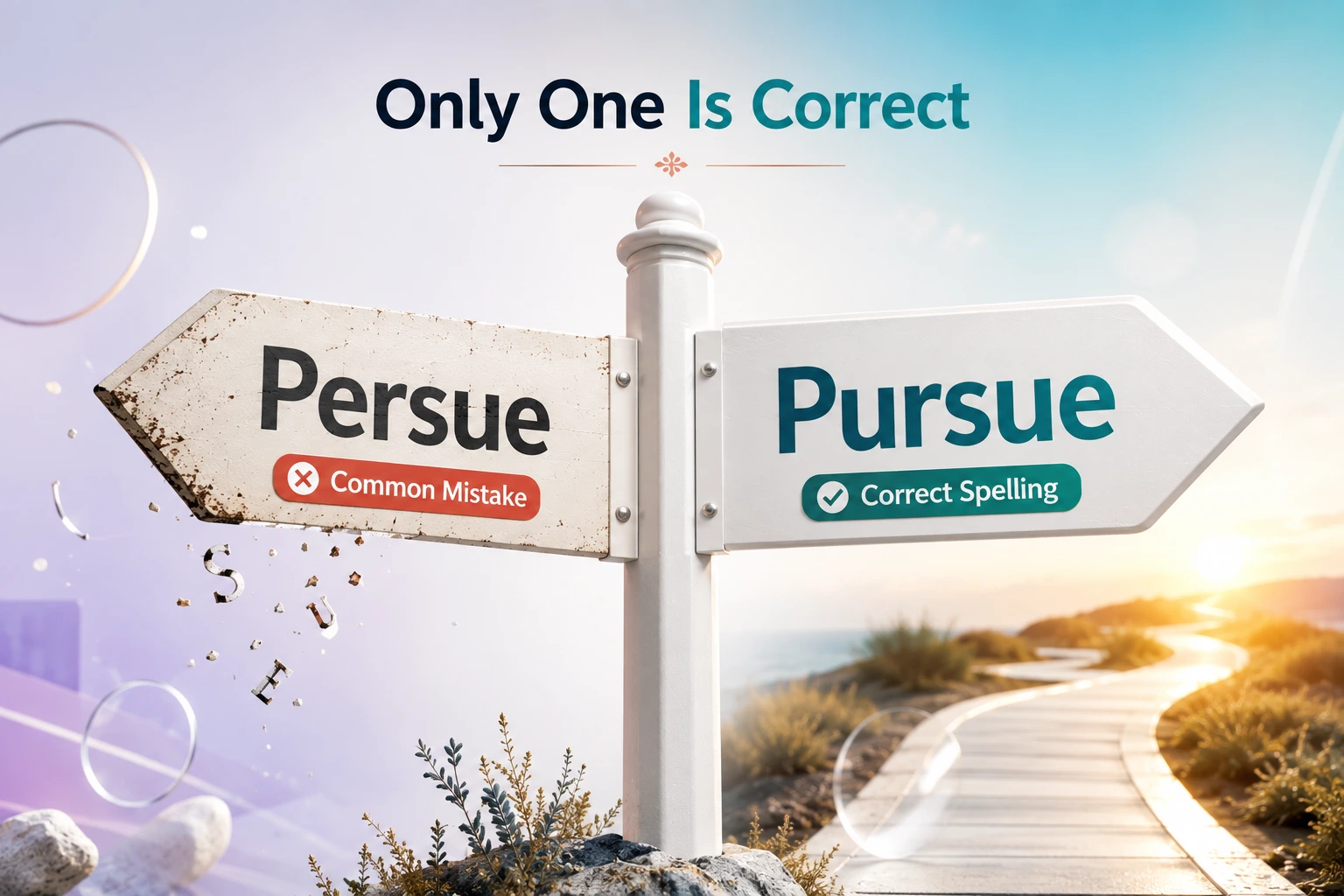
"Pursue" means to follow, chase, or work toward something, like a goal, career, or person. "Persue" is a common misspelling and isn't a real word in standard English.
I once submitted a cover letter stating I wanted to “persue a career in marketing.” I didn’t notice the error until weeks later, and I still cringe thinking about how many people might have read it before I caught it myself.
If you’ve ever made this exact mistake, you’re definitely not alone. This is one of the most commonly misspelled words in professional writing, especially in resumes, cover letters, and career-related content, which makes getting it right even more important.
This guide clears up exactly why “pursue” is spelled the way it is, where the confusion comes from, and how to spell it correctly every time, whether you’re writing a job application, an email, or a personal essay.
Persue or Pursue: Quick Answer
“Pursue” is always correct. “Persue” is a spelling error, not an accepted variant.
- ✅ She decided to pursue a degree in engineering.
- ❌ She decided to persue a degree in engineering.
The confusion happens because the first syllable is often pronounced quickly and softly, making it sound like “per-” instead of the correct “pur-.” Since English has many common words starting with “per-,” like “person” and “perfect,” writers naturally default to that more familiar pattern.
The Origin of Pursue
“Pursue” comes from Old French poursuivre, rooted in Latin prosequi, combining pro- (forward) and sequi (to follow). This origin explains the word’s core meaning clearly, to pursue something means to follow after it, whether that’s a goal, a career, or literally chasing someone or something.
The spelling has remained fairly stable through its journey into English, consistently starting with “pur-,” not “per-.” The misspelling “persue” likely persists because of how the word sounds in casual speech, the unstressed first syllable often gets pronounced with a neutral “uh” sound, making it easy to mishear or misremember as “per-” rather than “pur-.”
This same “pur-” spelling pattern shows up in related words:
- pursue → pursue
- pursuit → pursuit
- pursuer → pursuer
Pursue Explained: Key Differences and Variations
| Word | Correct Spelling | Meaning | Example |
|---|---|---|---|
| Pursue | Pursue | To follow or work toward | She will pursue her dream job. |
| Pursuit | Pursuit | The act of pursuing (noun) | He gave up the pursuit of fame. |
| Pursuer | Pursuer | One who pursues | The pursuer gained ground quickly. |
| Persue | Not a real word | N/A | Incorrect in any context. |
Notice that every correctly spelled form of this word family keeps the same “pur-” beginning, none of them ever switch to “per-,” which makes this a reliable pattern once you commit it to memory.
Which Spelling Should You Use?
For everyday writing
Always use pursue. There’s no context where “persue” is correct.
For resumes, cover letters, and career writing
Double-check carefully, since “persue” is an especially common typo in job applications, where accuracy matters most to potential employers.
For students and ESL learners
Practice the word alongside “pursuit” and “pursuer,” since seeing the consistent “pur-” spelling across related words helps reinforce the correct pattern.
For global or neutral use
Pursue is standard across American, British, Australian, and all other English dialects. There’s no regional variation here.
Common Mistakes with Pursue
Mistake 1: Writing “persue” instead of “pursue”
✅ He plans to pursue his passion for photography.
❌ He plans to persue his passion for photography.
Why it happens: The soft, unstressed first syllable sounds like “per-” in casual speech, leading writers to spell it the way it sounds.
Mistake 2: Misspelling related forms of the word
✅ pursuit, pursuer, pursuing
❌ persuit, persuer, persuing
Why it happens: Once the base word is misspelled, the same error typically carries over into every related form.
Mistake 3: Confusing “pursue” with “persuade”
✅ She will pursue her goals. He tried to persuade her to stay.
❌ She will persuade her goals. (words swapped)
Why it happens: Both words start with similar-sounding syllables and share a vaguely similar rhythm, which occasionally leads to confusion between them.
Mistake 4: Misspelling “pursue” in job applications
✅ I am excited to pursue this opportunity with your team.
❌ I am excited to persue this opportunity with your team.
Why it happens: Nervous, rushed writing during high-stakes documents like cover letters increases the likelihood of this specific typo.
Mistake 5: Assuming spellcheck will always catch it
✅ Proofread carefully, since most tools do catch this error, but it’s still worth double-checking manually.
❌ Relying solely on autocorrect without a final read-through.
Why it happens: While modern spellcheckers usually flag “persue,” older documents, templates, or less common writing tools sometimes miss it.
Grimey or Grimy? Which Spelling Is Actually Correct?
Pursue in Real-World Examples
Professional email:
“I’m excited to pursue this partnership and explore how our teams can collaborate.”
News headline:
“City Officials Vow to Pursue Legal Action Against Developer”
Social media post:
“Finally decided to pursue my passion project full-time. 🎨”
Formal document:
“The applicant intends to pursue graduate studies in environmental science.”
In every case, pursue is the only correct spelling, regardless of tone or formality.
Pursue: Data, Trends & Usage
Search interest in “persue vs pursue” stays consistently high, driven largely by job seekers, students, and professionals confirming spelling before submitting resumes, cover letters, or academic applications. This falls into the informational search category, with people wanting a fast, reliable answer before finalizing important documents.
This misspelling shows up frequently in career-related writing specifically, since “pursue” appears so often in phrases like “pursue a career” or “pursue an opportunity.” Because getting it wrong in a job application can create an unwanted first impression, this remains one of the more consequential spelling errors people actively try to avoid.
Persue vs Pursue: Comparison Table
| Term/Variant | Meaning | Region/Context | Best Used When |
|---|---|---|---|
| Pursue | To follow, chase, or work toward | Universal, all English dialects | Always, in any writing context |
| Persue | Misspelling, not a real word | None, incorrect everywhere | Never, avoid entirely |
| Pursuit | The act of pursuing (noun form) | Universal | Referring to the ongoing effort or chase |
Frequently Asked Questions
Q: What does “pursue” mean?
A: “Pursue” means to follow, chase, or actively work toward something, such as a goal, career, degree, or even a person in a literal chase.
Q: How do you use “pursue” correctly in a sentence?
A: Use “pursue” any time you’re describing an active effort toward a goal, such as “She will pursue a career in law” or “They chose to pursue new opportunities.”
Q: Pursue vs persue, what’s the difference?
A: There’s no real difference in meaning, since “persue” isn’t a correct word at all. “Pursue” is the only accepted spelling.
Q: Is “pursue” acceptable in formal writing?
A: Yes, completely. “Pursue” is standard in resumes, cover letters, academic writing, and professional communication of every kind.
Q: Which version is correct, persue or pursue?
A: “Pursue” is correct. “Persue” is a spelling error that doesn’t appear in any English dictionary.
Q: Where does the word “pursue” come from?
A: It comes from Old French poursuivre, rooted in Latin prosequi, meaning “to follow forward” or “to chase after.”
Q: Can “pursue” be used in casual conversation and texting?
A: Yes. The spelling never changes based on tone, it’s “pursue” whether you’re texting a friend or writing a formal cover letter.
Final Takeaway
Here’s the short version. “Pursue” is always correct. “Persue” is always wrong.
Key points to remember:
- The rule: “Pursue” always starts with “pur-,” never “per-,” despite how it sounds in casual speech
- Watch related words too: It’s “pursuit” and “pursuer,” never “persuit” or “persuer”
- Career writing matters most: This word appears constantly in resumes and cover letters, where accuracy counts
- No exceptions: “Pursue” is standard in every English dialect, formal or casual
Once you lock in the “pur-” spelling, you’ll never write “persue” again.
Bookmark this guide so you never second-guess “pursue” vs “persue” again, and share it with anyone drafting a resume or cover letter.
Pursue vs persue explained, correct spelling, meaning, and examples. Learn the simple rule and avoid this common mistake.
Offerred or Offered: The Correct Spelling Explained (2026)

I am a language content specialist specializing in spelling comparisons, vocabulary usage, and commonly confused English words. I write detailed, informative articles that help readers improve their language skills. I am passionate about helping students, writers, and professionals develop a stronger understanding of the English language.