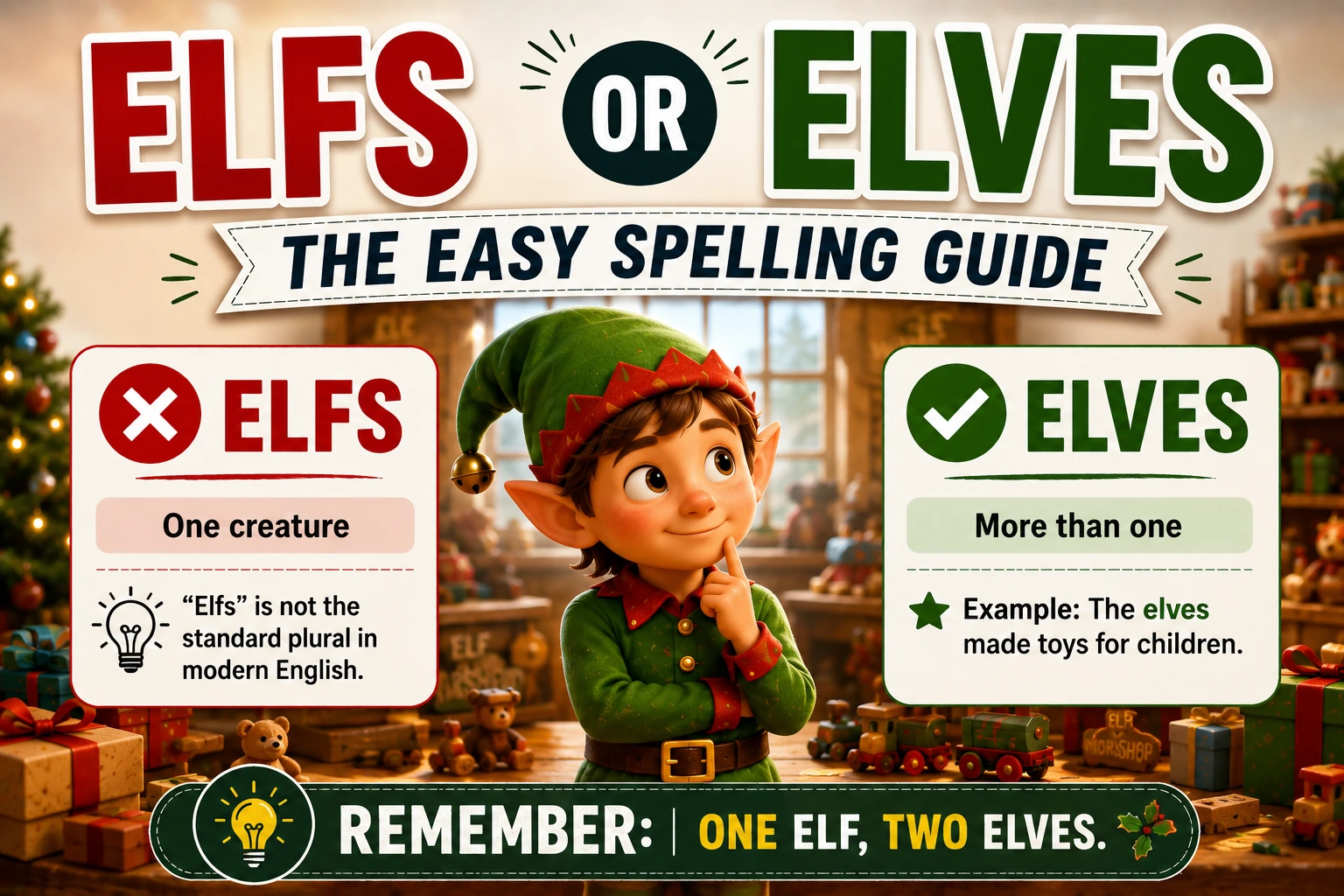
Elves is the standard plural of elf. Elfs is rare and generally not the form you should use in modern English.
Have you ever written “elfs” and then stopped to wonder, “Wait, is that really correct?” You are not alone. The word elf looks simple, but its plural form does not follow the usual rule of adding -s.
I have seen this kind of spelling mistake many times while helping English learners with tricky plural words. A reader may know that one magical creature is an elf, so it feels natural to write elfs for more than one. After all, we write books, cats, and dreams. Why not elfs?
English, however, has a few old spelling patterns that do not follow the simple -s rule.
The correct plural is usually elves. You will see this form in stories, fantasy books, games, folklore, and everyday writing. The change from f to v can feel strange at first, but it becomes easy once you learn the pattern.
So, if you are unsure whether to write elfs or elves, this guide will give you a simple answer and show you exactly when to use each form.
Elfs or Elves: Quick Answer
The correct and standard plural of elf is elves.
- Singular: one elf
- Plural: two elves
Examples
The elf helped the children find their way.
The elves worked together to build the toys.
Elves is the form you should normally use in modern English.
The spelling elfs may appear in some older, specialized, or unusual sources, but it is not the normal plural form.
The Origin and Background of Elves
The word elf has a very old history. It comes from Old English ælf, a word used for a supernatural or magical being.
Over many centuries, the word changed in spelling and pronunciation. Its plural form developed into elves, rather than simply elfs.
This is one reason English can feel unpredictable. Many English words come from older forms of the language. Their spelling and plural forms have survived even though modern speakers may expect a simpler pattern.
The same kind of change appears in other English words.
For example:
- wolf → wolves
- knife → knives
- life → lives
- wife → wives
- leaf → leaves
You can see a pattern here. Some nouns ending in -f or -fe change to -ves in the plural.
But there is an important warning: not every word ending in -f follows this rule.
For example:
- roof → roofs
- chief → chiefs
- belief → beliefs
- proof → proofs
So you cannot always change f to v. You need to learn the plural of each word.
For elf, however, elves is the standard modern plural.
Elfs or Elves: What Is the Difference?
The main difference is simple:
| Term | Meaning | When to Use | Region/Context |
|---|---|---|---|
| elf | One magical or mythical being | Singular | General English |
| elves | More than one elf | Standard plural | Modern English |
| elfs | Rare alternative plural | Unusual or specialized contexts | Rare/limited use |
Elf
Use elf when you are talking about one creature.
The elf wore a green coat.
An elf appeared in the story.
Elves
Use elves when you mean two or more elves.
The elves prepared the gifts.
Several elves lived in the forest.
Santa’s elves are busy making toys.
Elfs
Elfs is not the normal plural in modern standard English.
You may occasionally find it in historical texts, specialized writing, names, or unusual usage. However, if you are writing a school assignment, article, story, email, or general piece of English, elves is the safer and more natural choice.
Why Does Elf Become Elves?
This is the part that often causes confusion.
You may expect:
elf + s = elfs
But English has preserved an older plural pattern:
elf → elves
The f changes to v, and then -es is added.
Think of these familiar examples:
- leaf → leaves
- wolf → wolves
- knife → knives
- life → lives
- wife → wives
This does not mean every word ending in f changes in the same way. English has many exceptions.
A useful approach is to remember common word pairs instead of trying to create a rule that works every time.
For this word, simply remember:
One elf, two elves.
That short sentence is enough to prevent the mistake.
Which Version Should You Use?
For almost all modern writing, choose elves when you need the plural of elf.
For students
Use elves in:
- School assignments
- Exams
- Essays
- Creative writing
- English exercises
It is the standard form your teacher will expect.
For professional writers
Use elves in articles, reports, books, websites, and general communication when referring to multiple elves.
It is clear and widely understood.
For fantasy writers
Elves is also the normal choice when talking about multiple fantasy creatures.
The elves guarded the ancient forest.
The kingdom was ruled by wise elves.
If you are following a particular fictional universe, however, always check that universe’s own terminology. Some fantasy settings create their own names, spellings, or plural forms.
For global English
Elves is the best choice.
It is the familiar standard form for readers across different English-speaking regions.
Common Mistakes with Elfs or Elves
1. Mistake: Using “elfs” as the normal plural
❌ The elfs are preparing the presents.
✅ The elves are preparing the presents.
The standard plural is elves.
2. Mistake: Writing “elves” for one creature
❌ An elves entered the room.
✅ An elf entered the room.
Elf is singular. Elves is plural.
3. Mistake: Adding “s” to “elves”
❌ The elvess are singing.
❌ The elveses are singing.
✅ The elves are singing.
You do not add another ending to elves.
4. Mistake: Assuming every -f word becomes -ves
It is easy to learn:
elf → elves
and then apply the same idea to every word ending in f.
That does not work.
For example:
- roof → roofs
- chief → chiefs
- belief → beliefs
So learn the plural form of each word.
5. Mistake: Confusing “elves” with another word
Elves is the plural of elf.
It can refer to magical beings in folklore, fantasy stories, or popular culture.
The elves lived deep in the forest.
The word can also have different meanings in different fictional settings, but the spelling remains elves when it is the plural of elf.
Elfs or Elves in Real-World Examples
Seeing the word in context makes the difference much easier to remember.
Professional Email
The design team has created several fantasy characters, including elves, fairies, and dragons.
Here, elves is used because the writer is talking about more than one elf.
News or Article Headline
Elves Return to the Holiday Market This Winter
The plural form works naturally in a headline about multiple elves.
Social Media Post
Our little elves are ready for Christmas! 🎄✨
The word elves is correct because the post refers to several characters.
Formal Document
The illustration includes three elves standing beside the main character.
Again, elves is the correct plural form.
Creative Writing
Deep inside the forest, the elves gathered beneath the ancient trees.
This is a natural use of the standard plural.
Elfs or Elves: Data, Trends & Usage
When people search “elfs or elves,” they are usually trying to solve a spelling or grammar problem. The search intent is therefore mainly informational.
The confusion is easy to understand. Many English plurals are formed by adding -s, so elfs looks logical at first glance.
The problem becomes even more common during the holiday season. Words such as Santa, Christmas, toys, and elves appear more often in stories, advertisements, classroom activities, and social media posts.
The word also appears often in fantasy writing. Popular books, films, games, and folklore use elves to describe groups of magical beings.
This makes knowing the standard spelling useful beyond grammar exercises. If you write content about Christmas, fantasy, folklore, or children’s stories, you are likely to use the word more than once.
The simple takeaway is this:
If you mean more than one elf, write “elves.”
Elfs or Elves: Comparison Table
| Term/Variant | Meaning | Region/Context | Best Used When |
|---|---|---|---|
| elf | One elf | Modern English | Talking about one creature |
| elves | More than one elf | Standard modern English | Almost all general writing |
| elfs | Rare alternative form | Limited or unusual contexts | Only when a specific source or context requires it |
For everyday English, the choice is easy:
elf = one
elves = more than one
Why Is “Elves” So Common in Christmas Writing?
The word elves has become strongly linked with Christmas traditions.
In modern popular culture, Santa Claus is often shown with a group of hardworking elves. They make toys, wrap gifts, and help prepare for Christmas.
That is why you often see phrases such as:
- Santa’s elves
- Christmas elves
- Santa’s little elves
- Christmas elf
- Elf on the Shelf
- Santa and his elves
Notice the difference between elf and elves.
The child dressed as an elf.
Here, there is one.
The children dressed as elves.
Here, there is more than one.
This singular-plural difference is simple once you see it in real sentences.
Frequently Asked Questions About Elfs or Elves
Q: What is the plural of elf?
A: The standard plural of elf is elves. For example, “Three elves helped Santa.”
Q: Is “elfs” correct English?
A: Elfs can appear in rare or specialized usage, but it is not the normal modern plural of elf. In general writing, use elves.
Q: Is it elf or elves?
A: Use elf for one and elves for two or more. For example, “one elf” and “five elves.”
Q: Why does elf change to elves?
A: Elf comes from an old English word, and its plural developed with a change from f to v. The same pattern appears in words such as wolf → wolves and leaf → leaves.
Q: Are elves only Christmas characters?
A: No. Elves come from older folklore and mythology and also appear in modern fantasy. Christmas stories are only one popular context for the word.
Q: Is “elves” acceptable in formal writing?
A: Yes. Elves is the standard plural and can be used in formal, academic, creative, and professional writing when the subject calls for it.
Q: How can I remember the correct spelling?
A: Use this simple pair: one elf, two elves. Remembering the pair is easier than trying to work out the spelling each time.
Conclusion: Elfs or Elves?
The elfs or elves question has a very simple answer once you know the standard plural.
Elf is the singular form. It means one magical or mythical creature. When you are talking about more than one, the standard plural is elves.
The spelling may seem unusual because we often make plurals by adding -s. But English has kept the older f → v pattern in several words, including elf → elves, wolf → wolves, and leaf → leaves.
The important points to remember are:
- Elf = one
- Elves = more than one
- Elfs = rare and not the usual modern plural
- Use elves in school, professional, formal, and general writing
So, the next time you are writing about Santa’s helpers, a fantasy kingdom, or magical forest creatures, do not second-guess yourself.
Write elves.
Bookmark this guide so you never have to wonder about “elfs or elves” again.
Elfs or elves explained with meaning, spelling, usage, examples, and easy rules. Learn the correct plural and avoid common mistakes.
Company's or Companies: The Easy Difference

I specialize in spelling comparisons, confusing word pairs, grammar, and vocabulary development. My content helps readers improve their English, avoid common mistakes, and write with confidence. My goal is to provide accurate, reliable, and easy-to-understand language resources