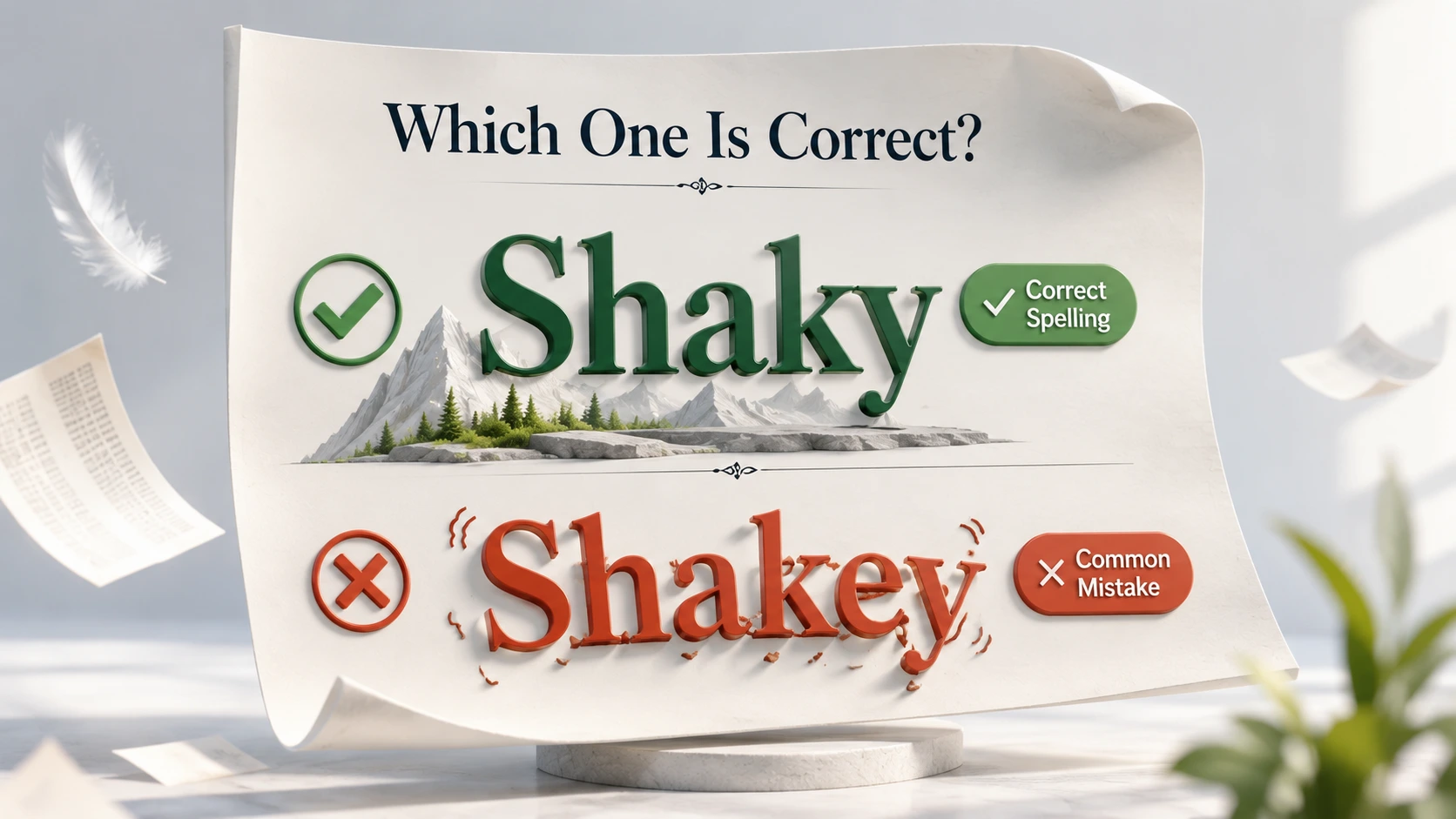
"Shaky" means unsteady, trembling, or unreliable. "Shakey" is a common misspelling and isn't a standard English word, though it does appear as part of a well-known pizza restaurant brand name.
I once filled out a symptom form at a doctor’s office and wrote “shakey hands” to describe how I’d been feeling. The nurse reviewing it gently circled the word and wrote “shaky” beside it. I’d genuinely never questioned the spelling before that moment.
If you’ve ever hesitated over this word, you’re definitely not alone. This is one of those words that looks like it should have an “e” in it, especially since a certain famous pizza chain spells its name that exact way, adding even more confusion to an already tricky spelling.
This guide clears up exactly why “shaky” drops the “e,” where the confusion comes from, and how to spell it correctly every time, whether you’re describing nerves, weather, or a wobbly table.
Shakey or Shaky: Quick Answer
“Shaky” is always correct. “Shakey” is a spelling error, not an accepted variant, despite showing up occasionally even in casual writing.
- ✅ Her voice sounded shaky during the presentation.
- ❌ Her voice sounded shakey during the presentation.
The confusion happens because English has plenty of words that keep a silent “e” before adding “-y,” like “cakey” or “flakey” (itself sometimes debated). “Shake” drops its “e” before “-y” instead, following a different, more common pattern.
How to Pronounce Shaky
“Shaky” is pronounced “SHAY-kee,” with the stress on the first syllable. It rhymes with words like “flaky” and “achy,” both of which follow the same long “a” sound at the start.
Whether you spell it correctly as “shaky” or accidentally write “shakey,” the pronunciation stays exactly the same, the extra “e” in the misspelling doesn’t change how the word sounds at all. Even the restaurant brand “Shakey’s” is pronounced identically to the standard word “shaky’s,” which is likely part of why the misspelling feels so natural to so many people.
The Origin of Shaky
“Shake” comes from Old English sceacan, meaning to move quickly back and forth or tremble. When English forms adjectives by adding “-y” to a base word ending in a silent “e,” the standard rule typically drops that final e before attaching the suffix.
This same pattern shows up across dozens of common words:
- shake → shaky
- smoke → smoky
- bone → bony
Because a handful of other words do keep the “e” before “-y,” like “homey” or “spikey” (also debated), writers sometimes assume “shaky” should follow that less common pattern instead. Adding to the confusion, Shakey’s Pizza, a well-known American restaurant chain founded in 1954, spells its name with the “e” intact as part of its brand identity, not as a reflection of standard English spelling. Many people who grow up seeing that brand name assume it reflects the correct spelling of the everyday word, when it’s actually just a stylized business name.
Shaky Explained: Key Differences and Variations
| Word | Correct Spelling | Rule Applied | Example |
|---|---|---|---|
| Shake | Shake | Base verb, keeps the e | Shake the bottle before opening. |
| Shaky | Shaky | Drops the e before -y | His hands were shaky after the run. |
| Shakily | Shakily | Adds -ily to the adjective | She spoke shakily into the microphone. |
| Shakiness | Shakiness | Adds -ness to the adjective | The shakiness in his voice was noticeable. |
Notice that once “shaky” exists correctly, further forms like “shakily” and “shakiness” build on that same “e”-dropped spelling, none of them bring the silent “e” back.
Which Spelling Should You Use?
For everyday writing
Always use shaky. There’s no context where “shakey” is correct in standard English.
For students and ESL learners
Group “shake” with “smoke” and “bone,” all words that drop the silent “e” before adding “-y,” as a helpful memory pattern.
For medical, professional, or formal writing
Double-check carefully, since “shakey” is a surprisingly persistent typo, especially in casual health descriptions or personal writing.
For referring to the pizza brand specifically
Use Shakey’s, with the “e,” only when referring to the actual restaurant chain by name, never as a substitute for the everyday adjective.
Common Mistakes with Shaky
Mistake 1: Writing “shakey” instead of “shaky”
✅ The ladder felt shaky, so I climbed down carefully.
❌ The ladder felt shakey, so I climbed down carefully.
Why it happens: Writers assume the silent “e” should carry over from “shake” into the adjective form.
Mistake 2: Confusing the brand name with the standard word
✅ We grabbed dinner at Shakey’s Pizza. (brand name, correct) / My hands felt shaky. (adjective, correct)
❌ My hands felt shakey. (incorrectly borrowing the brand spelling)
Why it happens: Frequent exposure to the restaurant’s branding creates a false sense that “shakey” is simply an accepted spelling.
Mistake 3: Misspelling related forms of the word
✅ shakily, shakiness
❌ shakeily, shakeyness
Why it happens: Once the base adjective is misspelled, the error often carries over into every related form.
Mistake 4: Using “shakey” in medical or professional documentation
✅ The patient reported shaky hands and mild dizziness.
❌ The patient reported shakey hands and mild dizziness.
Why it happens: Quick, informal note-taking in medical or personal contexts sometimes lets this common typo slip through.
Mistake 5: Assuming spellcheck will always catch it
✅ Proofread manually, since some casual writing tools and older spellcheckers still miss this error.
❌ Relying only on autocorrect to flag “shakey” as incorrect.
Why it happens: While most modern spellcheckers do catch this mistake, the brand name “Shakey’s” sometimes confuses autocorrect suggestions.
Cheque or Check: What's the Difference? (2026)
Shaky in Real-World Examples
Professional email:
“After the recent turbulence, the market remains shaky heading into next quarter.”
News headline:
“Shaky Ceasefire Holds Despite Reports of Ongoing Tension”
Social media post:
“My hands are still shaky from that roller coaster, worth it though. 🎢”
Formal document:
“The witness described a shaky voice and visible nervousness during questioning.”
In every case, shaky is the only correct spelling, regardless of tone or formality.
Shaky: Data, Trends & Usage
Search interest in “shakey vs shaky” stays fairly steady, with occasional spikes tied to searches for the Shakey’s Pizza restaurant chain, which can blur people’s confidence in the standard word’s spelling. This falls into the informational search category, with writers, students, and health-related searchers checking spelling before publishing or documenting symptoms.
This particular misspelling benefits from an unusual source of confusion, a well-known brand name that spells things differently than the standard dictionary word. Because of this, “shakey” remains one of the more persistently searched spelling questions, even though the underlying rule itself is fairly simple.
Shakey vs Shaky: Comparison Table
| Term/Variant | Meaning | Region/Context | Best Used When |
|---|---|---|---|
| Shaky | Unsteady, trembling, or unreliable | Universal, all English dialects | Always, in any writing context |
| Shakey | Misspelling, except as part of a brand name | Only correct as “Shakey’s Pizza” | Referring specifically to the restaurant chain |
| Shake | Base verb form | Universal | Referring to the action of trembling or moving |
Frequently Asked Questions
Q: What does “shaky” mean?
A: “Shaky” describes something unsteady, trembling, or unreliable, such as shaky hands, a shaky voice, or a shaky economic outlook.
Q: How do you use “shaky” correctly in a sentence?
A: Use “shaky” as an adjective describing instability or trembling, such as “The bridge felt shaky” or “Her confidence seemed shaky before the interview.”
Q: Shaky vs shakey, what’s the difference?
A: There’s no real difference in meaning, since “shakey” isn’t a standard word, except when referring specifically to the restaurant brand “Shakey’s.”
Q: Is “shaky” acceptable in formal writing?
A: Yes, completely. “Shaky” is standard in medical documentation, journalism, business writing, and everyday professional communication.
Q: Which version is correct, shakey or shaky?
A: “Shaky” is correct for the standard English adjective. “Shakey” only appears correctly as part of the “Shakey’s Pizza” brand name.
Q: Where does the word “shaky” come from?
A: It comes from Old English sceacan, meaning to tremble or move quickly, with the adjective form dropping the silent “e” before adding “-y.”
Q: Can “shakey” ever be considered correct?
A: Only when referring directly to the “Shakey’s Pizza” restaurant chain by name. As a standalone adjective describing trembling or instability, “shaky” is always correct.
Final Takeaway
Here’s the short version. “Shaky” is always correct as the standard English adjective. “Shakey” is only correct as part of a specific restaurant’s brand name.
Key points to remember:
- The rule: Words ending in a silent “e” often drop it before adding “-y” (shake → shaky, smoke → smoky)
- Watch the brand confusion: “Shakey’s Pizza” spells its name differently, but that doesn’t change the standard word’s spelling
- Related forms matter too: It’s “shakily” and “shakiness,” never “shakeily” or “shakeyness”
- No exceptions: “Shaky” is standard in every English dialect, formal or casual
Once you separate the brand name from the everyday word, you’ll never write “shakey” again by mistake.
Bookmark this guide so you never second-guess “shaky” vs “shakey” again, and share it with anyone who’s second-guessed this spelling before.
Shaky vs Shakey explained. Discover the correct spelling, meaning, pronunciation, and examples to avoid this common English mistake with confidence.
Flair or Flare? Stop Mixing These Words Up

I specialize in spelling comparisons, confusing word pairs, grammar, and vocabulary development. My content helps readers improve their English, avoid common mistakes, and write with confidence. My goal is to provide accurate, reliable, and easy-to-understand language resources