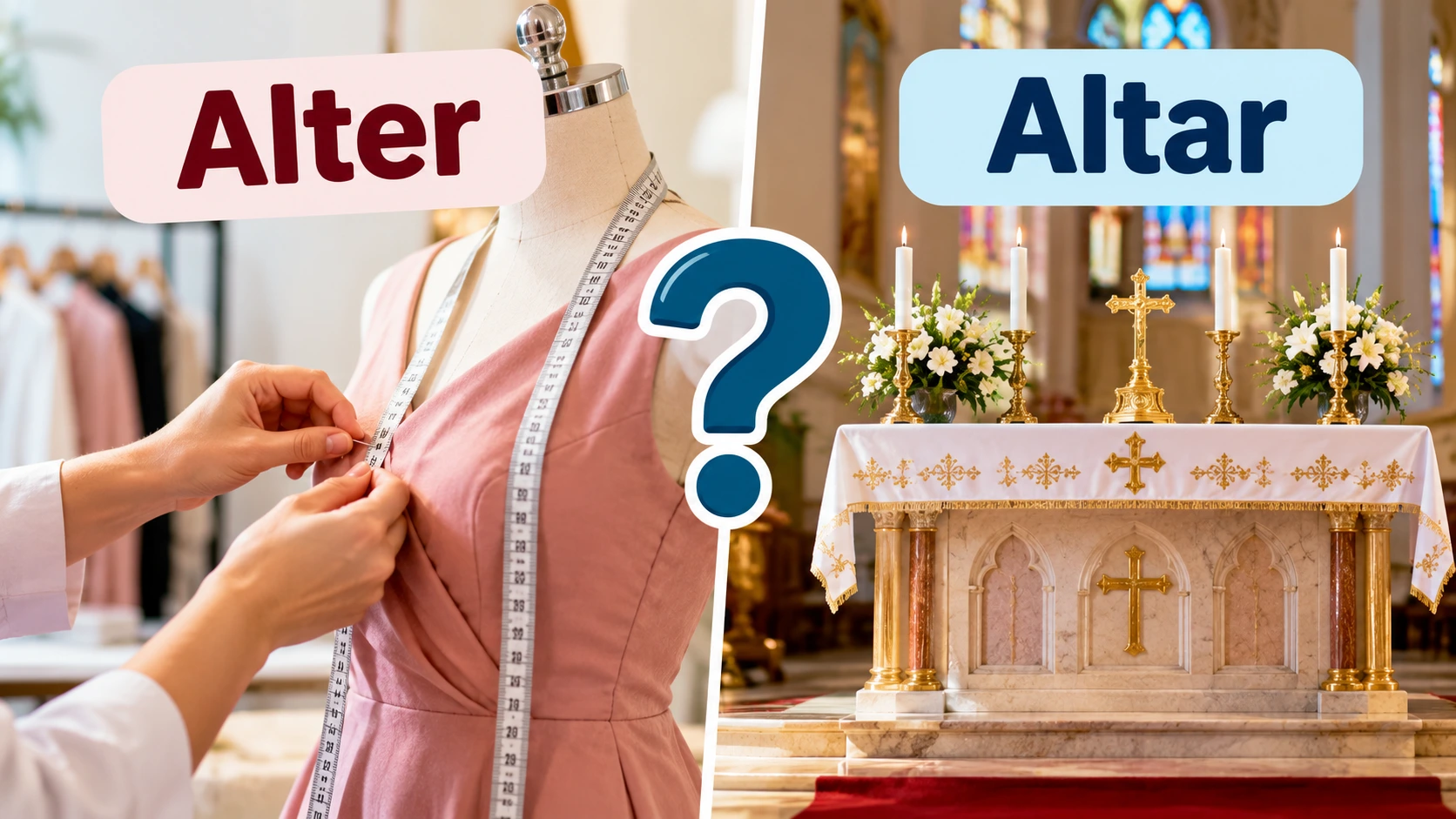
Alter means to change something, while altar is a raised structure used for religious ceremonies. They sound alike but have different meanings and spellings.
Have you ever written “alter” when you meant “altar”? This is an easy mistake to make because the two words sound almost exactly the same.
As an English teacher, I have seen this mix-up many times in student writing. The problem is not usually grammar. It is the fact that alter and altar are homophones. They sound alike, but their meanings are completely different.
One word is about changing something. The other is connected with a religious place or structure.
For example, you might alter a dress to make it fit better. But you might stand near an altar during a wedding ceremony.
That one extra a changes the meaning of the word.
If you are unsure which spelling to use, this guide will make the difference simple. You will learn what alter and altar mean, where they come from, how to use them, common mistakes to avoid, and easy tricks for remembering the correct spelling.
Alter or Altar: Quick Answer
Alter is a verb that means to change, modify, or adjust something.
Altar is a noun that refers to a raised structure or sacred place used in religious ceremonies.
Here are two simple examples:
- She decided to alter the dress.
- The couple stood before the altar.
The words sound alike, but they cannot usually replace each other.
Easy memory trick: Alter = change. Altar = religious place.
The Origin and Background of Alter and Altar
Although alter and altar sound the same, they have different histories.
Where Does Alter Come From?
Alter comes from Latin roots related to changing or making something different. English uses it as a verb when someone changes an object, plan, design, condition, or arrangement.
For example:
We need to alter the schedule.
The schedule will be changed.
You can alter something slightly or make a larger modification. The exact amount of change depends on the context.
Where Does Altar Come From?
Altar has a different history. It comes through Old English and Latin terms connected with a raised place used for religious offerings or ceremonies.
Today, an altar can refer to a sacred structure in a church or another place of worship.
For example:
Flowers were placed on the altar.
The two words became easy to confuse because their pronunciation is very similar in modern English.
Alter vs. Altar Explained: Key Differences
The easiest way to understand the difference is to focus on the part of speech and meaning.
Alter
Alter is usually a verb.
It means:
- to change something
- to modify something
- to adjust something
- to make something different
Examples:
The tailor will alter my jacket.
We had to alter our plans.
She wants to alter the design.
Altar
Altar is a noun.
It refers to:
- a sacred structure
- a religious place
- a raised surface used in worship or ceremonies
Examples:
The flowers were placed on the altar.
The priest stood near the altar.
The wedding ceremony took place beside the altar.
Simple Comparison
| Term | Meaning | When to Use | Region/Context |
|---|---|---|---|
| Alter | To change or modify something | When talking about changes | General English |
| Altar | A sacred structure or place | When talking about worship or ceremonies | Religious context |
Which Version Should You Use?
The correct word depends on what you want to say.
If You Mean “Change,” Use Alter
Choose alter when something is being changed or adjusted.
For example:
Can you alter this dress?
The company decided to alter its policy.
We need to alter the original plan.
A useful question is:
“Am I talking about changing something?”
If the answer is yes, use alter.
If You Mean a Religious Structure, Use Altar
Choose altar when you are talking about a sacred structure or place used during religious worship.
For example:
The priest walked toward the altar.
Candles were placed around the altar.
The couple exchanged vows near the altar.
Ask yourself:
“Am I talking about a religious place or structure?”
If yes, use altar.
For Students and Academic Writing
Both words are correct in academic writing. The key is choosing the one that matches your meaning.
Alter:
The researcher had to alter the original method.
Altar:
The ceremony took place near the church altar.
For Professional Writing
Alter is much more common in business and professional contexts.
For example:
We may need to alter the agreement.
Altar is normally used when the subject involves religion, worship, weddings, or related traditions.
Common Mistakes with Alter and Altar
1. Using Altar When You Mean Change
Wrong: We need to altar the plan.
Correct: We need to alter the plan.
The plan is being changed, so alter is correct.
2. Using Alter for a Religious Structure
Wrong: The flowers were placed on the alter.
Correct: The flowers were placed on the altar.
The sentence refers to a religious structure, so altar is needed.
3. Assuming the Words Have the Same Meaning
They do not.
Alter describes an action.
Altar names a thing or place.
Compare:
She will alter the dress.
She stood near the altar.
4. Relying Only on Pronunciation
Because the words sound alike, listening alone will not always help you choose the spelling.
Instead, look at the meaning.
If you hear:
“They decided to alter the plan.”
Think change.
If you hear:
“They stood near the altar.”
Think religious structure.
5. Confusing Altar With Alter in Wedding Writing
Wedding content can contain both words.
For example:
The couple stood at the altar before the ceremony began.
But:
The tailor agreed to alter the wedding dress.
The first refers to a ceremonial place. The second refers to changing clothing.
Alter or Altar in Real-World Examples
Seeing both words in different situations can make the difference easier to remember.
Professional Email
We may need to alter the delivery schedule because of the delay.
Here, alter means change.
News Article
Officials announced plans to alter the current policy.
Again, alter means modify or change.
Social Media Post
I had to alter my travel plans at the last minute.
The plans were changed.
Formal Document
The agreement may be altered with written approval from both parties.
The word is used to describe a change to an agreement.
Religious Context
The priest placed the flowers on the altar before the ceremony.
Here, altar refers to the sacred structure.
Wedding Context
The couple exchanged vows beside the altar.
The word refers to the place used for the ceremony.
Alter and Altar: Data, Trends & Usage
The search intent behind “alter or altar” is mainly informational. People usually search this phrase because they know the words sound alike but are unsure about their meanings or spellings.
The confusion is especially common among:
- English learners
- Students
- Writers
- Proofreaders
- People writing about weddings
- People discussing religion
- Anyone learning homophones
Alter has a broad range of uses because changing or modifying something is common in everyday language.
For example, you can alter:
- a plan
- a dress
- a document
- a design
- a schedule
- a building
- an agreement
- a decision
Altar has a narrower meaning. It is mostly used in religious, cultural, historical, and wedding contexts.
This difference gives you a useful clue. If the sentence is about changing something, you probably need alter. If it is about a sacred structure, you probably need altar.
Standalone Comparison: Alter vs. Altar
| Term/Variant | Meaning | Region/Context | Best Used When |
|---|---|---|---|
| Alter | Change or modify | General English | Something is being changed |
| Altar | Sacred structure or place | Religious and ceremonial contexts | Referring to worship or ceremonies |
| Altered | Changed or modified | General English | Describing something that has changed |
| Altar | A physical or symbolic religious structure | Churches and other religious settings | Referring to a sacred place |
The spelling difference is small, but the meanings are far apart.
Easy Ways to Remember Alter or Altar
A simple memory trick can help you avoid the mistake.
Think “Alter = Adjust”
Both alter and adjust begin with a similar idea.
If you need to adjust or change something, choose:
ALTER
Alter the plan.
Alter the dress.
Alter the design.
Think “Altar = Area for Worship”
An altar is connected with a religious or ceremonial setting.
Think:
ALTAR = SACRED PLACE
Stand near the altar.
Place flowers on the altar.
The priest stood at the altar.
This small association can make the spelling easier to remember.
Alter vs. Change
Another useful comparison is between alter and change.
Both can describe modification, but alter often suggests making a change to something that already exists.
For example:
We need to change the plan.
We need to alter the plan.
Both sentences can work.
However, alter often sounds more specific or formal when discussing modifications.
You can also use alter for physical things:
The tailor altered the jacket.
Here, the jacket was modified rather than completely replaced.
Frequently Asked Questions
Q: What is the difference between alter and altar?
A: Alter means to change or modify something. Altar is a noun that refers to a sacred structure or place used for religious ceremonies.
Q: Is alter or altar correct?
A: Both are correct words, but they have different meanings. Use alter for change and altar for a religious structure or ceremonial place.
Q: How do you use alter in a sentence?
A: Use alter when something is changed or modified. For example: “We need to alter the schedule.”
Q: How do you use altar in a sentence?
A: Use altar when referring to a sacred structure or ceremonial place. For example: “The flowers were placed on the altar.”
Q: Are alter and altar homophones?
A: Yes. They are commonly treated as homophones because they have the same or nearly the same pronunciation but different meanings and spellings.
Q: Is altar only used in churches?
A: No. An altar can appear in different religious or ceremonial traditions. The exact form and purpose can vary between religions and cultures.
Q: Can alter be used for clothes?
A: Yes. Alter is very common when talking about clothing. For example: “The tailor will alter the dress so it fits better.”
Q: Why are alter and altar confusing?
A: They sound alike, so pronunciation does not clearly show which spelling you need. The best way to choose is to focus on the meaning of the sentence.
Conclusion
The difference between alter or altar becomes easy once you connect each word with its meaning.
Alter is a verb. It means to change, modify, or adjust something. You can alter a plan, dress, design, schedule, agreement, or decision.
Altar is a noun. It refers to a sacred structure or place used in religious or ceremonial settings. You may see an altar in a church or another place of worship.
The two words sound alike, which explains why they are often confused. But their meanings give you a clear way to choose the right spelling.
Remember this simple rule:
Alter = change.
Altar = sacred place.
Once you learn that connection, you will be much less likely to mix them up in your writing.
Bookmark this guide and use the simple “change or sacred place?” test whenever you are unsure.
Muah or Mwah: Meaning, Spelling & Easy Usage

I am a professional content writer with a strong interest in English spelling and vocabulary. I am interested in creating informative guides on commonly confused words, spelling differences, and language usage to help readers write more accurately and effectively.