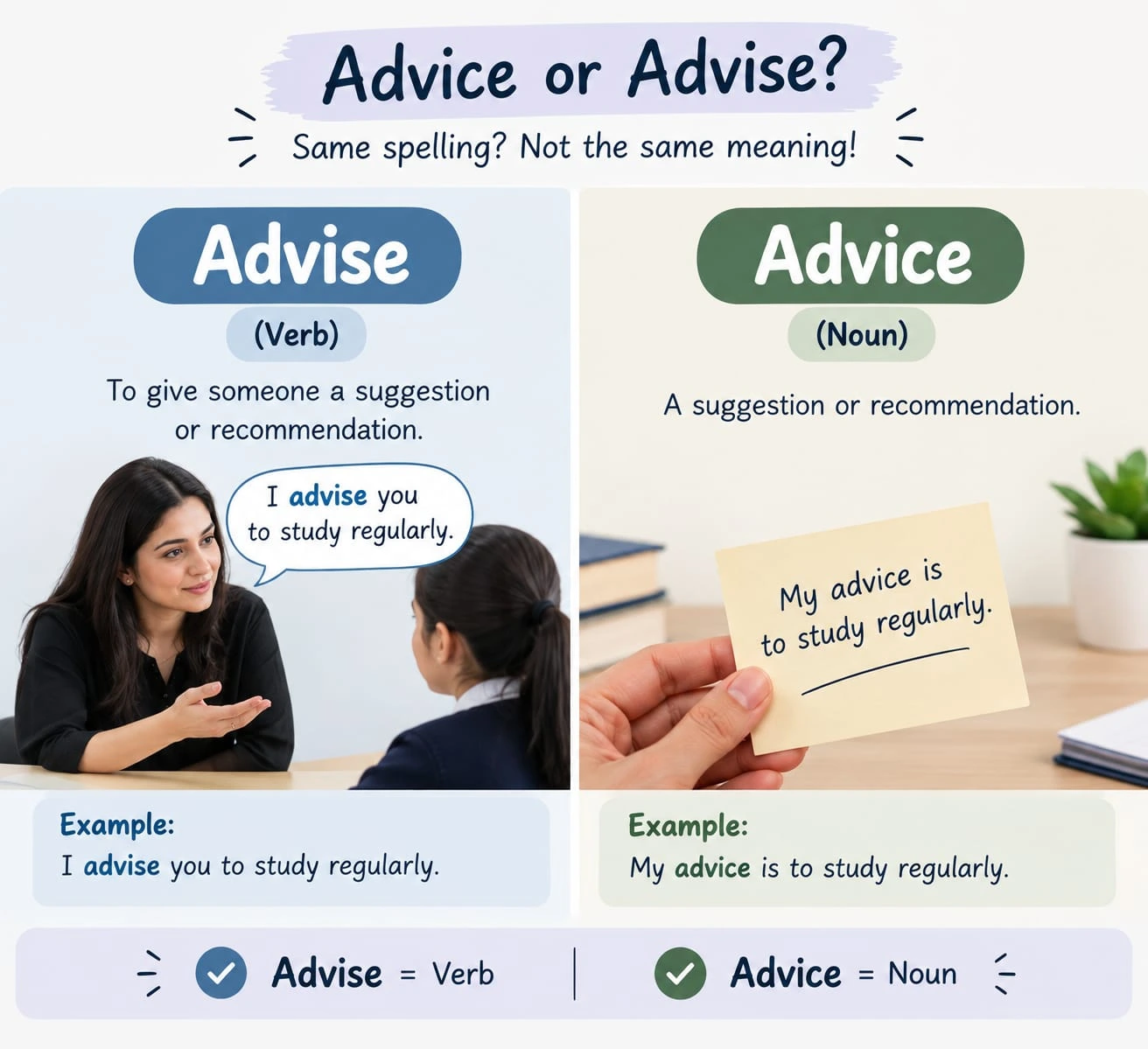
Advise is a verb meaning “to give someone a suggestion,” while advice is a noun meaning “a suggestion or recommendation.” Use advise for the action and advice for the thing you give.
Advise or advice can be confusing because the two words look almost identical and have closely related meanings. The key difference is simple: advise describes the act of giving guidance, while advice refers to the guidance itself.
For example, you can advise a friend to study harder, but the suggestion you give is your advice. Once you understand their parts of speech, choosing the right spelling becomes much easier.
Advise vs. Advice: What’s the Difference?
| Term | Meaning | Part of Speech | Best Used When | Example |
| Advise | To give a suggestion or recommendation | Verb | Describing the action of giving guidance | I advise you to wait. |
| Advice | A suggestion or recommendation | Noun | Referring to the guidance itself | Thank you for your advice. |
The simple rule
Advise = action
Advice = suggestion
Think of it this way:
You advise someone, but you give them advice.
What Does Advise Mean?
Advise is a verb. It means to give someone a suggestion, recommendation, or guidance about what they should do.
Examples
- I advise you to check the document again.
- The doctor advised him to get more rest.
- She advised me not to spend too much money.
- My teacher advised us to practice every day.
Because advise is a verb, it can change tense:
- Advise: present
- Advised: past
- Advising: present participle
Common pattern
A common structure is:
advise + someone + to + verb
For example:
The teacher advised the students to revise their work.
You can also use:
advise + someone + against + noun/-ing
The doctor advised him against driving.
What Does Advice Mean?
Advice is a noun. It refers to an opinion, suggestion, or recommendation about what someone should do.
Examples
- Thank you for your advice.
- She gave me some useful advice.
- His advice helped me make a better decision.
- I need your advice about this problem.
Unlike advise, advice does not describe the action of giving guidance. It names the guidance itself.
Remember
You give advice.
You receive advice.
But you advise someone.
Advise vs. Advice in Real Sentences
Seeing the two words together makes the difference easier to remember.
Example 1
My teacher advised me to study regularly.
Here, advised is a verb because it describes what the teacher did.
Example 2
My teacher gave me some useful advice.
Here, advice is a noun because it refers to the suggestion.
Example 3
I appreciate your advice.
Advice = the recommendation.
Example 4
I advise you to take an umbrella.
Advise = the act of recommending something.
How to Remember Advise and Advice
A simple memory trick can help.
Advise = Verb
Advise ends with an S sound.
Think:
Advise = Suggest
Both describe an action.
Advice = Noun
Advice ends with an S sound too, but the spelling ends in -ice.
Think:
Advice = Suggestion
The advice is the thing being given.
Another easy rule:
You advise someone.
You give someone advice.
If you can put “give” before the word, you probably need advice.
Give me some advice. ✅
Give me some advise. ❌
Is Advice Countable or Uncountable?
One common grammar mistake is treating advice as a countable noun.
In standard English, advice is uncountable.
So these forms are incorrect:
an advice ❌
two advices ❌
Instead, use:
some advice ✅
a piece of advice ✅
two pieces of advice ✅
Examples
She gave me some advice.
He gave me a useful piece of advice.
My parents gave me two pieces of advice.
This is an important difference for English learners.
Is Advise a Verb or Noun?
Advise is a verb.
It means to give someone a suggestion or recommendation.
Example
I advise you to read the instructions carefully.
You cannot normally use advise as the noun for a suggestion.
The noun is advice.
Thank you for your advice. ✅
Thank you for your advise. ❌
Common Mistakes with Advise and Advice
1. Using “advise” as a noun
Incorrect:
Thank you for your advise.
Correct:
Thank you for your advice.
Why?
The word refers to a suggestion, so you need the noun advice.
2. Using “advice” as a verb
Incorrect:
I advice you to wait.
Correct:
I advise you to wait.
Why?
The sentence describes an action, so you need the verb advise.
3. Saying “an advice”
Incorrect:
She gave me an advice.
Correct:
She gave me some advice.
Or:
She gave me a piece of advice.
Why?
Advice is normally an uncountable noun.
4. Saying “advices”
Incorrect:
He gave me several advices.
Correct:
He gave me several pieces of advice.
5. Confusing the pronunciation
The two words also have different pronunciations.
- Advise → /ədˈvaɪz/ — ends with a z sound
- Advice → /ədˈvaɪs/ — ends with an s sound
The spelling difference is small, but the final sound is different.
Advise or Advice in Professional Writing
Both words are common in professional and formal writing, but they have different grammatical roles.
Use advise when describing what a person or organization recommends:
We advise customers to keep their receipts.
Use advice when referring to the recommendation:
Please contact our team if you need further advice.
Professional examples
Email:
I would advise you to review the attached document before submitting it.
Formal notice:
Customers are advised to arrive 15 minutes early.
Business communication:
Thank you for your advice regarding the project.
Which One Should You Use?
The choice depends on what you are trying to say.
Use advise when:
- You mean to recommend something.
- You are describing an action.
- The word functions as a verb.
Example:
I advise you to save a copy.
Use advice when:
- You mean a suggestion or recommendation.
- You are referring to information someone gives you.
- The word functions as a noun.
Example:
I need your advice.
The easiest rule
Advise = give a recommendation.
Advice = the recommendation itself.
Related Words
These words belong to the same word family:
- Advise: verb
- Advised; past tense/adjective
- Advising; present participle
- Advice; noun
- Adviser/Advisor; a person who gives advice
- Advisory; giving information or recommendations
Example
The financial adviser advised us to review our budget and gave us useful advice.
This sentence shows how the related forms work together.
FAQs About Advise or Advice
Q: What is the difference between advise and advice?
A: Advise is a verb meaning to give a recommendation. Advice is a noun meaning the recommendation itself.
Q: Is advice a noun or a verb?
A: Advice is a noun. It refers to a suggestion, recommendation, or guidance.
Q: Is advise a noun or a verb?
A: Advise is a verb. It describes the act of giving someone a recommendation.
Q: Is “give me an advice” correct?
A: No. In standard English, advice is uncountable. Say “give me some advice” or “give me a piece of advice.”
Q: Is “advices” correct?
A: Usually no. Use “pieces of advice” when you need to count individual recommendations.
Q: How do you remember advise and advice?
A: Remember: you advise someone, but you give someone advice. Advise is the verb; advice is the noun.
Conclusion
The difference between advise and advice is mainly grammatical. Advise is a verb that means to give a recommendation, while advice is a noun that means the recommendation itself.
Remember the simple rule:
You advise someone. You give someone advice.
Also remember that advice is uncountable, so use some advice or a piece of advice, not “an advice.”
Once you connect advise with the action and advice with the suggestion, this commonly confused pair becomes much easier to use correctly.
Choose or Chose: Easy Difference With Example

I specialize in spelling comparisons, confusing word pairs, grammar, and vocabulary development. My content helps readers improve their English, avoid common mistakes, and write with confidence. My goal is to provide accurate, reliable, and easy-to-understand language resources