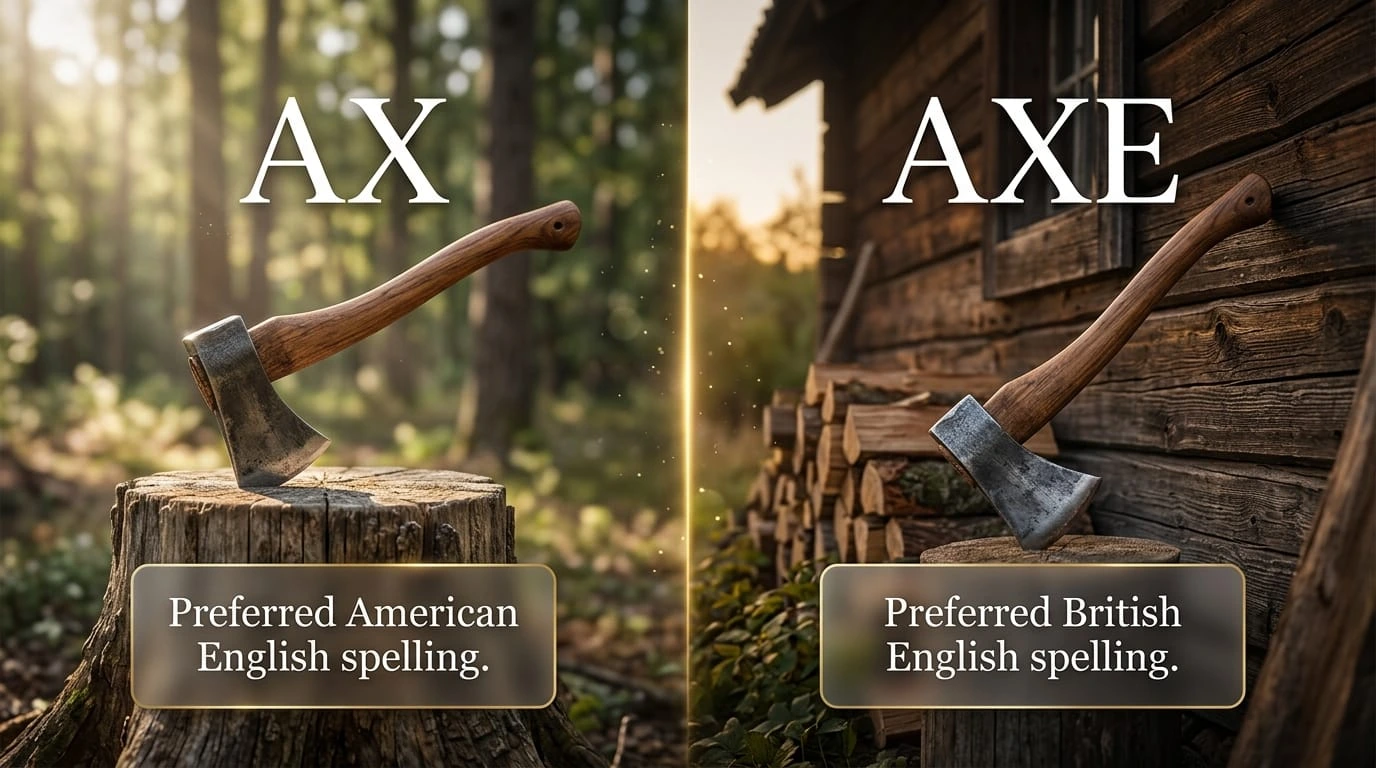
Ax and axe are both correct spellings of the same tool. Ax is the preferred spelling in American English, while axe is standard in British English and most other English-speaking countries.
I still remember editing a woodworking article for an international audience. The writer consistently used axe, but one reader commented that the spelling was wrong and should be ax. A few days later, another reader insisted the exact opposite. That small debate reminded me that not every spelling difference in English has a single “correct” answer.
If you’ve searched for ax or axe, you’re probably wondering which spelling you should use. The confusion is common because both words appear in dictionaries, books, websites, and newspapers. Depending on where you live, one spelling may look completely normal while the other seems incorrect.
The truth is much simpler than most people think. Ax and axe refer to the same cutting tool. The difference is based on regional spelling preferences rather than meaning. In this guide, you’ll learn the history of both spellings, understand when to use each one, and discover which version is best for your audience. By the end, you’ll know exactly which spelling fits your writing with confidence.
Ax or Axe: Quick Answer
Both ax and axe are correct spellings.
The only real difference is the variety of English you are using.
- Ax is the preferred spelling in American English.
- Axe is the preferred spelling in British English, Australian English, Canadian English, and most Commonwealth countries.
Examples
✅ He used an ax to chop firewood. (American English)
✅ She bought a new axe for camping. (British English)
Both sentences describe the same tool. Only the spelling changes.
A Simple Rule
Remember this easy tip:
- Writing for the United States? → Use ax.
- Writing for the United Kingdom or an international audience? → Use axe.
The Background of Ax or Axe
The history of ax and axe goes back hundreds of years.
The word comes from the Old English æx (also written as eax), which referred to a cutting tool with a sharp metal blade attached to a handle. Similar words also appeared in other Germanic languages, showing that the tool has been part of human life for thousands of years.
Over time, English spelling evolved.
For centuries, both ax and axe appeared in books and official documents. Neither spelling was considered incorrect.
As dictionaries became more standardized, regional preferences developed.
- American publishers gradually adopted ax because it is shorter and follows the simplified spelling style common in American English.
- British publishers continued using axe, preserving the traditional spelling.
Today, both spellings remain correct.
The choice depends on where your readers are located.
Why Are People Confused?
The confusion exists because:
- Both spellings appear in major dictionaries.
- Both describe exactly the same tool.
- American and British English follow different spelling conventions.
- Online content often mixes both spellings.
Unlike some confusing word pairs, ax and axe have identical meanings. Only the spelling changes.
Ax or Axe Explained: Key Differences
Although ax and axe look different, they have the same pronunciation and meaning.
The only distinction is regional spelling.
| Term | Meaning | When to Use | Region/Context |
| Ax | A tool used for chopping wood or cutting trees | American English | United States |
| Axe | A tool used for chopping wood or cutting trees | British English and Commonwealth English | United Kingdom, Canada, Australia, New Zealand |
What Does Ax Mean?
Ax is the standard American English spelling.
You’ll commonly see it in:
- American newspapers
- U.S. school textbooks
- American dictionaries
- U.S. government publications
- American websites
Examples
- He sharpened the ax before cutting the tree.
- The firefighter carried an ax during the rescue.
- We packed an ax for the camping trip.
If your audience is primarily American, this spelling is the safest choice.
What Does Axe Mean?
Axe is the traditional spelling used in British English and most Commonwealth countries.
You’ll often find it in:
- British books
- UK newspapers
- Australian publications
- Canadian writing
- International English resources
Examples
- The woodsman picked up his axe.
- She bought a camping axe for hiking trips.
- Keep the axe in a safe place after use.
Although the spelling differs, the meaning is exactly the same as ax.
Are Ax and Axe Interchangeable?
Yes.
Both spellings refer to the same tool.
However, it’s best to stay consistent throughout a piece of writing.
For example:
✔ American article → ax, ax, ax
✔ British article → axe, axe, axe
Avoid switching between spellings in the same document unless you’re specifically discussing regional differences.
A Simple Memory Trick
Here’s an easy way to remember the difference:
- Ax = American English
- Axe = British English and Commonwealth English
Another helpful tip:
Think of the extra “e” in axe as representing England.
If you’re writing for readers in England or other Commonwealth countries, choose axe.
If you’re writing for an American audience, choose ax.
That’s all there is to it. The meaning never changes; only the preferred spelling does.
British English vs American English Spelling
The difference between ax and axe is a classic example of regional spelling variations. Unlike words with different meanings, these two spellings refer to the same tool. The only difference is where each spelling is commonly used.
- Ax is the preferred spelling in American English.
- Axe is the preferred spelling in British English and most Commonwealth countries.
Neither spelling is incorrect. Your choice should match your audience.
Comparison Table
| English Variety | Preferred Spelling | Example |
| American English | Ax | He grabbed an ax to split the logs. |
| British English | Axe | She bought a new axe for gardening. |
| Canadian English | Axe (more common) | The axe was kept in the shed. |
| Australian English | Axe | Campers always carry an axe. |
| New Zealand English | Axe | The old axe needed sharpening. |
Quick Tip
If you’re writing for a global audience and following British English style, use axe. If you’re following American English conventions, use ax.
Which Spelling Should You Use?
The best spelling depends on who will read your content.
For American Writers
Use ax because it matches standard American dictionaries, textbooks, and style guides.
For British and Commonwealth Writers
Use axe because it is the accepted spelling in the UK, Australia, Canada, New Zealand, and many other English-speaking countries.
For International Websites
Choose one spelling and stay consistent throughout your article.
If your website uses:
- American English → ax
- British English → axe
Consistency is more important than choosing one spelling over the other.
Common Mistakes with Ax or Axe
Although both spellings are correct, writers often make these mistakes.
| Mistake | Correct | Why? |
| Using ax and axe in the same article. | Use one spelling consistently. | Avoid confusing readers. |
| Saying axe is always wrong. | Both spellings are correct. | Regional preference matters. |
| Saying ax and axe have different meanings. | They mean exactly the same tool. | Only the spelling differs. |
| Using ax in British English documents. | Use axe for British English. | Matches local spelling standards. |
| Assuming spell-check is always correct. | Follow your chosen English variety. | Spell-check depends on language settings. |
Why These Mistakes Happen
Many people assume every spelling difference means the words have different meanings. In this case, that’s not true. Ax and axe are simply regional variants of the same word.
Baptised or Baptized: The Correct Spelling (2026)
Ax or Axe in Real-World Examples
Professional Email
Please ensure every emergency vehicle is equipped with an ax before leaving the station. (American English)
News Headline
Hiker Uses Axe to Clear Fallen Trees After Storm (British English)
Social Media Post
Finally bought a new camping axe. Can’t wait for the weekend!
Formal Report
The forestry department replaced every damaged ax before the training exercise.
These examples show how the spelling changes depending on the intended audience, while the meaning stays exactly the same.
Ax or Axe: Google Trends & Usage Data
The keyword ax or axe is searched by people who want to know which spelling is correct.
Search Intent
The primary search intent is:
- Informational
Users are looking for spelling guidance rather than information about the tool itself.
Countries Where This Keyword Is Popular
Common searches come from:
- United States
- United Kingdom
- Canada
- Australia
- New Zealand
- India
- Pakistan
Who Searches This Keyword?
Typical audiences include:
- Students
- English learners
- Teachers
- Bloggers
- Editors
- Copywriters
- Outdoor enthusiasts
- Professional writers
Usage Insight
Online searches often increase because people see both spellings on websites, in books, and in movies. Learning the regional difference helps writers choose the spelling that best fits their audience.
Comparison Table
| Term/Variant | Meaning | Region/Context | Best Used When |
| Ax | Cutting tool for chopping wood | American English | Writing for U.S. readers |
| Axe | Cutting tool for chopping wood | British and Commonwealth English | Writing for UK and international readers following British English |
Frequently Asked Questions
Q1: Is it ax or axe?
Both are correct. Ax is preferred in American English, while axe is the standard spelling in British English and most Commonwealth countries.
Q2: Do ax and axe mean different things?
No. They both refer to the same cutting tool used for chopping wood, cutting trees, and similar tasks.
Q3: Which spelling is correct in American English?
American English generally prefers ax in dictionaries, newspapers, and educational materials.
Q4: Which spelling is correct in British English?
British English uses axe as the standard spelling.
Q5: Can I use ax and axe in the same article?
It’s better to avoid mixing them. Choose one spelling based on your target audience and use it consistently.
Q6: Why are there two spellings?
The word has existed for centuries, and regional spelling preferences developed as British and American English evolved separately.
Q7: Which spelling should I use for international readers?
If your content follows British English, use axe. If it follows American English, use ax. The most important rule is to stay consistent.
Conclusion
The debate over ax or axe isn’t about right or wrong, it’s about regional spelling. Both words describe the same cutting tool and have been used in English for centuries.
If you’re writing for an American audience, ax is the preferred spelling. If your readers are in the United Kingdom, Australia, Canada, New Zealand, or other Commonwealth countries, axe is the standard choice.
The key takeaway is simple: choose the spelling that matches your audience and use it consistently throughout your writing. That approach keeps your content professional, clear, and easy to read.
Ax or axe explained with spelling differences, meanings, examples, and usage tips for American and British English writers everywhere.
Cancelation or Cancellation: The Correct Spelling Explained

I am a language content specialist specializing in spelling comparisons, vocabulary usage, and commonly confused English words. I write detailed, informative articles that help readers improve their language skills. I am passionate about helping students, writers, and professionals develop a stronger understanding of the English language.