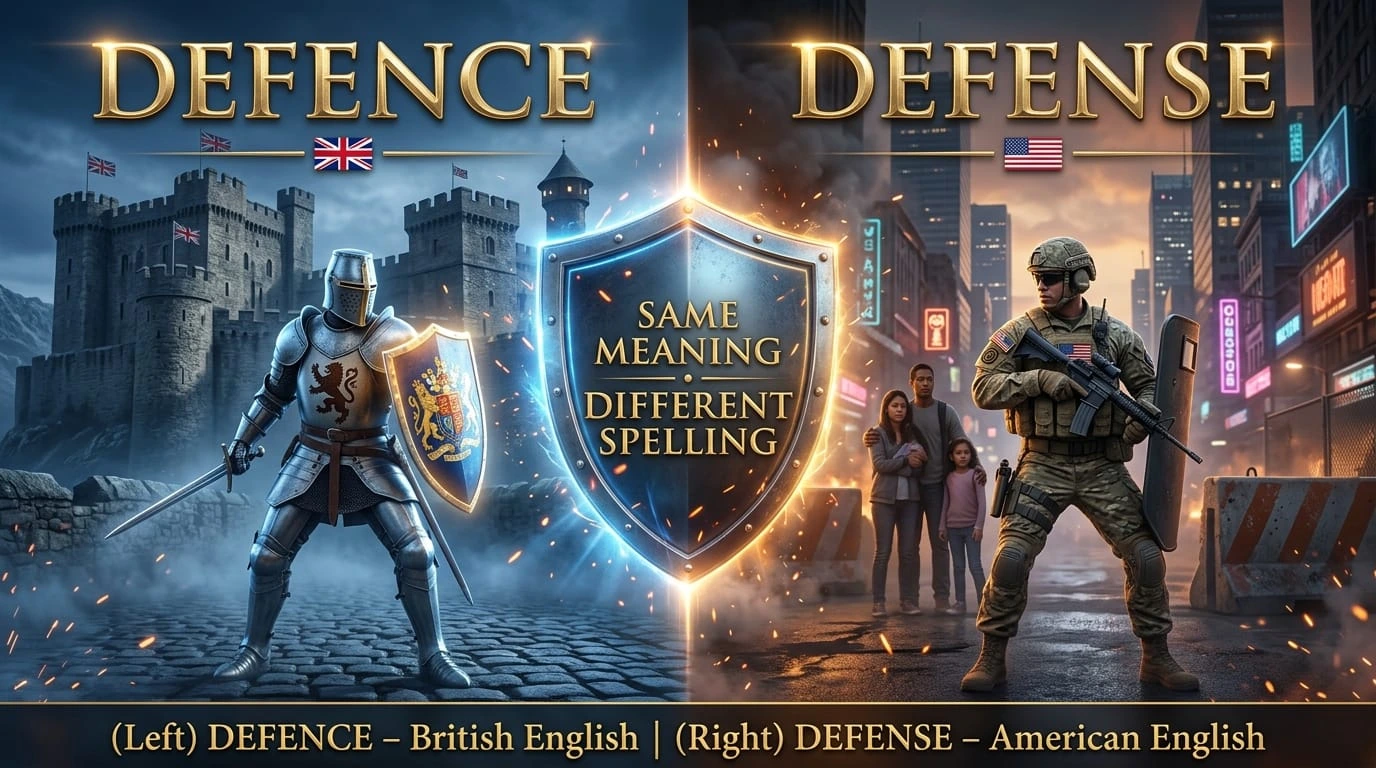
Defence and defense mean the exact same thing; the act of protecting against attack. The only difference is spelling: defence is British English, and defense is American English.
I still remember the email that made me freeze mid-sentence. I was writing to a client in London, and I typed “defense.” Then I stopped. Was that wrong for a British reader? I deleted it, retyped “defence,” stared at both versions, and felt genuinely silly for not knowing.
That moment stuck with me. It’s such a small thing; one letter, yet it trips up writers, students, and even seasoned professionals all the time. You search for an answer, and most articles just tell you “it’s a British vs. American thing” without explaining why it matters or when it actually trips people up.
Here’s the truth: this isn’t just a spelling quirk. Get it wrong in the wrong context, and it can make your writing look careless. Get it right, and you sound like you know exactly who you’re writing for.
This guide clears up the confusion for good. You’ll learn the meaning, the history, the regional rules, and the mistakes to avoid. By the end, you won’t second-guess this word again.
Defence or Defense: Quick Answer
Both words describe protection from harm, attack, or criticism. There’s no difference in meaning, pronunciation, or grammar.
The split is purely geographic. Defence is standard in the UK, Australia, Canada, and most Commonwealth countries. Defense is standard in the United States.
For example, a British newspaper might write “national defence spending,” while a U.S. outlet writes “national defense spending.” Same idea. Different spelling.
The Origin of Defence and Defense
Both words trace back to the Old French word defens, which came from the Latin defensa; meaning “protected” or “guarded.” English absorbed the French spelling first, so defence was the original form used across all English-speaking regions.
Then came Noah Webster. In the early 1800s, this American lexicographer wanted a simpler, more phonetic version of English. He pushed for spelling reforms that dropped extra letters and standardized word endings.
That’s how -ence became -ense in American English. Words like licence/license and offence/offense followed the same pattern. It wasn’t random, it was a deliberate push toward American linguistic independence.
Defence vs Defense: Key Differences and Variations
The two spellings behave identically in grammar. Neither is “more correct.” Context determines which one fits.
Here’s how they split by region and format:
| Term | Meaning | When to Use | Region/Context |
|---|---|---|---|
| Defence | Protection from attack or criticism | UK, Australian, Canadian writing | British English |
| Defense | Protection from attack or criticism | US writing, American publications | American English |
| Defensive | Adjective form (both regions) | Describing protective behavior or stance | Universal |
| Defenceless / Defenseless | Without protection | Follows the regional spelling of the base word | Regional |
One tricky detail: even in British English, the word defense appears in a few fixed legal and sports terms, like “self-defense” in some international contexts. Always check your target audience’s convention first.
Which Version Should You Use?
- For UK, Australian, or Canadian audiences → use defence, because it matches local style guides and reader expectations.
- For US audiences → use defense, because American readers associate the “-ence” spelling with error, not formality.
- For global or neutral content → pick one spelling and stay consistent throughout the piece. Mixing both looks like a proofreading mistake.
- For academic or legal writing → follow your institution’s or publication’s style guide, since some journals mandate British spelling regardless of your location.
If you’re unsure, check your audience’s location first. That single decision solves 90% of the confusion.
Ax or Axe: Which Spelling Is Correct?✨
Common Mistakes with Defence and Defense
Mistake 1: Mixing spellings in one document.
Wrong: “Our defence budget increased, but the defense minister disagreed.
” Correct: “Our defence budget increased, but the defence minister disagreed.”
This happens when writers copy-paste from different sources without checking spelling consistency.
Mistake 2: Misspelling the adjective form.
Wrong: “defencive strategy”
Correct: “defensive strategy”
The adjective defensive never changes spelling, regardless of region. Many writers wrongly assume it follows the same pattern.
Mistake 3: Assuming autocorrect knows your audience.
Wrong: Writing for a UK client while your software defaults to American English, silently changing “defence” to “defense.”
Correct: Manually set your language preference in your writing tool before you start.
Mistake 4: Using the wrong spelling in official documents.
Wrong: A Canadian government report using “defense.”
Correct: Canadian official documents almost always use defence, following British convention.
Mistake 5: Overcorrecting in dialogue or quotes.
Wrong: Changing a direct quote from “defense” to “defence” to match your style.
Correct: Keep quotes exactly as spoken or written by the source, even if it breaks your document’s spelling consistency.
Defence and Defense in Real-World Examples
Professional email (UK):
“Please find attached our updated defence policy proposal for review before Thursday’s meeting.”
News headline (US):
“Pentagon Announces Increase in Defense Spending for Next Fiscal Year”
Social media post (Australian):
“Proud of our national defence force for their work during the floods. 🇦🇺”
Formal document (Canadian):
“The Department of National Defence will review all submissions by March 1st.”
Notice how the spelling shifts naturally based on the source’s country, not the topic itself.
Defence and Defense: Data, Trends, and Usage
Search data shows people look up “defence or defense” mostly out of genuine confusion, not curiosity. It’s an informational search, driven by writers, students, and professionals trying to avoid an embarrassing mistake.
Interest spikes around major news events, like defense budget announcements or military policy debates, when both spellings appear in international coverage simultaneously.
Non-native English learners search this term more than native speakers do. That makes sense. If you learned “American English” in school, seeing “defence” in a British article can feel like a typo.
This matters more now than ever. Global remote work means you’re writing for international audiences constantly. Knowing which spelling fits which reader isn’t just a grammar detail. It’s part of sounding professional and credible.
Standalone Comparison Table
| Term/Variant | Meaning | Region/Context | Best Used When |
|---|---|---|---|
| Defence | Protection from attack | British, Australian, Canadian | Writing for UK/Commonwealth audiences |
| Defense | Protection from attack | American | Writing for US audiences |
| Defensive | Protective in nature (adjective) | Universal | Describing behavior or strategy |
| Self-defence/Self-defense | Protecting oneself from harm | Follows regional spelling | Legal, martial arts, personal safety contexts |
Frequently Asked Questions
Q: What does defence or defense mean?
A: Both words mean the same thing; protecting against attack, criticism, or harm. The spelling difference is purely regional, not a difference in meaning.
Q: How do you use defence or defense correctly?
A: Match the spelling to your audience’s region. Use defence for British, Australian, or Canadian readers, and defense for American readers.
Q: Defence vs defense: what’s the actual difference?
A: There’s no grammatical or meaning-based difference. The only distinction is spelling convention based on British versus American English.
Q: Is defence acceptable in formal writing?
A: Yes, absolutely, especially in British, Commonwealth, or international legal and academic contexts where British spelling is standard.
Q: Which version is correct defence or defense?
A: Both are correct. Correctness depends entirely on which regional spelling convention your audience or publication follows.
Q: Where does the word defence or defense come from?
A: It originates from the Old French word defens, rooted in the Latin defensa. American spelling reform in the 1800s created the “-ense” variant.
Q: Can defense be used in a British document?
A: It’s uncommon and can look like an error to British readers. Stick with defence unless you’re quoting an American source directly.
Conclusion
Defence and defense will never stop looking slightly odd side by side. But now you know the rule isn’t complicated at all.
Here’s what matters most: check your audience, pick one spelling, and stay consistent. British and Commonwealth readers expect defence. American readers expect defense. The adjective defensive never changes.
Get this right, and you eliminate one of the most common; and most avoidable; spelling slip-ups in professional writing.
Bookmark this guide so you never second-guess defence or defense again.
Defence or defense explained; meaning, spelling, correct usage, and examples. Learn which version to use and avoid common mistakes.
Catalog or Catalogue: Which Spelling Is Correct?✍️

I am a professional content writer with a strong interest in English spelling and vocabulary. I am interested in creating informative guides on commonly confused words, spelling differences, and language usage to help readers write more accurately and effectively.