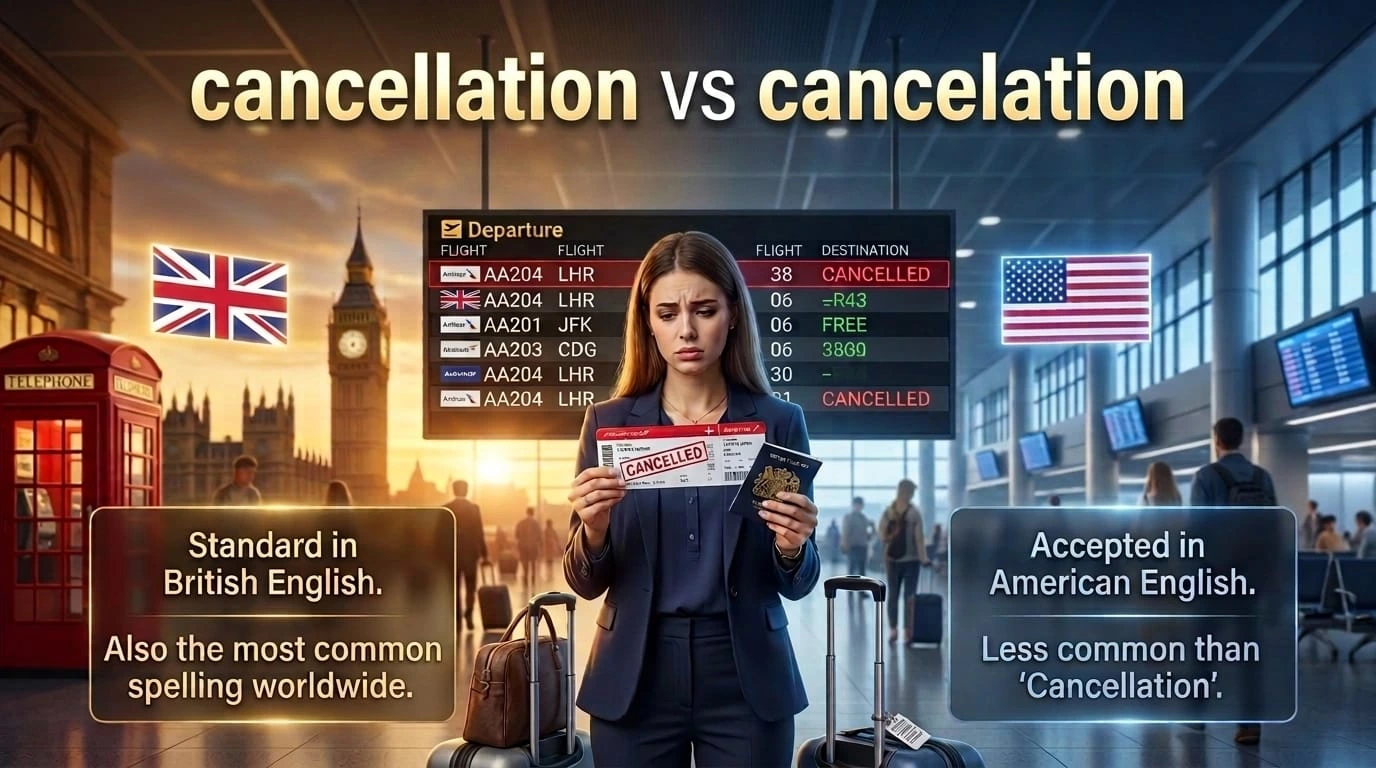
Cancellation is the correct and most widely accepted spelling of the noun meaning the act of calling off, ending, or stopping something, such as a meeting, flight, or subscription. Cancelation is a less common American variant. __________________________________________________________________________________________________
I once sent a client email using “cancelation” and got a reply asking if I’d misspelled it. I hadn’t: technically. But it still looked wrong to my client’s eye, and that’s exactly the problem with this word.
“Cancellation” is one of the most misspelled words in business and everyday writing. People aren’t sure whether it needs one L or two, and both versions show up online enough to add to the confusion.
This mix-up isn’t your fault. English spelling rules around doubling consonants are inconsistent, and this word sits right in the gray zone. This guide clears up exactly which spelling to use, why the confusion exists, and how to avoid looking unsure in your writing.
Let’s fix it for good.
Cancelation or Cancellation: Quick Answer
“Cancellation” is the correct and standard spelling. It means the act of calling something off: an event, a subscription, a reservation, or a plan.
“Cancelation” appears occasionally, mostly in American English, but it’s considered nonstandard by most dictionaries and style guides.
Example: “The airline sent a cancellation notice for our flight.” Not: “The airline sent a cancelation notice.”
Why Does This Confusion Happen?
The root word is “cancel,” which already breaks a common English spelling rule. When you add “-ed” or “-ing” to short verbs, you usually double the final consonant: think “stop” becoming “stopped.” Logically, “cancel” should follow the same pattern.
Here’s where it gets messy. American English treats “cancel” as an exception, often keeping a single L in “canceled” and “canceling.” British English doubles the L consistently, giving you “cancelled” and “cancelling.”
“Cancellation” breaks from that pattern entirely. Even in American English, dictionaries overwhelmingly favor the double-L spelling for this specific word. It’s one of the rare cases where US and UK English actually agree.
Cancelation vs Cancellation: Key Differences
| Term | Meaning | When to Use | Region/Context |
| Cancellation | The act of calling something off | Standard spelling, all contexts | Used in both American and British English |
| Cancelation | Rare, nonstandard variant | Avoid in formal or professional writing | Occasionally seen in informal American writing |
Unlike “canceled” versus “cancelled,” where region genuinely changes the accepted spelling, “cancellation” doesn’t follow the same split. Nearly every major style guide, including AP and Chicago, sticks with the double L here.
Which Version Should You Use?
- For business or professional writing → Always use “cancellation.” It’s the version readers expect and the one spell-checkers won’t flag.
- For academic or formal documents → Use “cancellation.” Both US and UK institutions treat this as the standard.
- For casual writing or texting → Still use “cancellation.” There’s no informal exception here worth remembering.
- For global or neutral communication → “Cancellation” works everywhere without adjustment.
There’s no audience or context where “cancelation” is the better choice. Stick with two L’s.
Common Mistakes with Cancellation
Mistake 1:
Cancellation → Cancelation Dropping the second L, likely influenced by American spellings of “canceled.” Correction: Keep both L’s: c-a-n-c-e-l-l-a-t-i-o-n.
Mistake 2:
Confusing it with “canceled” spelling rules Writers assume “canceled” (one L) means “cancellation” also drops a letter. Correction: These follow different patterns. “Canceled” can vary by region, but “cancellation” stays consistent.
Mistake 3:
Cancellation → Cancelation Policy Businesses sometimes publish policies with the incorrect single-L spelling. Correction: Double-check official documents and web copy before publishing.
Mistake 4:
Adding an extra L: Cancelllation Rushed typing sometimes produces three L’s by mistake. Correction: Slow down and confirm: two L’s, not three.
Mistake 5:
Using “cancelation” because it “looks” more American Some writers assume American English always simplifies double letters. Correction: This word is an exception. American style guides still prefer “cancellation.”
These errors mostly come from applying a spelling rule that doesn’t actually govern this specific word.
travelling or traveling: Which Spelling Should You Use?
Cancellation in Real-World Examples
Professional email
“We regret to inform you of the cancellation of tomorrow’s meeting due to unforeseen circumstances.”
News headline
“Airline Cancellation Rates Spike Amid Winter Storm Warnings”
Social media post
“Just got a cancellation notice for my gym membership: anyone know a good alternative? 😩”
Formal document
“Per section 4.2, cancellation of this agreement requires 30 days’ written notice.”
In every example, the double-L spelling reads as polished and expected. A single-L version would stand out as an error.
Cancellation: Data, Trends & Usage
“Cancellation” ranks high in searches tied to travel, subscriptions, and event planning, especially during peak booking seasons and periods of flight disruptions or service outages.
Businesses search this term often when drafting cancellation policies, refund terms, and customer service templates. The intent is mostly informational, though it overlaps with commercial searches when customers look up how to cancel a specific service or subscription.
This matters now because automated cancellation emails, chatbots, and policy pages get scrutinized closely by customers. A misspelled word in a cancellation policy can quietly undermine trust in an otherwise solid business.
Cancelation vs Cancellation: Full Comparison
| Term/Variant | Meaning | Region/Context | Best Used When |
| Cancellation | The act of calling something off | Global standard — US and UK | Any writing, formal or informal |
| Cancelation | Nonstandard variant | Rare informal American usage | Never recommended, even casually |
Frequently Asked Questions
Q: What does “cancellation” mean?
A: “Cancellation” refers to the act of stopping or calling off something planned, such as an event, order, subscription, or reservation.
Q: How do you use “cancellation” correctly?
A: Use it as a noun describing the act of canceling: “The cancellation was announced this morning” or “We processed your cancellation request.”
Q: Cancellation vs cancelation: what’s the difference?
A: There’s no real difference in meaning. “Cancellation” is the correct, widely accepted spelling. “Cancelation” is a rare, nonstandard variant.
Q: Is “cancelation” acceptable in formal writing?
A: No. Formal, business, and academic writing should always use “cancellation” with two L’s.
Q: Which version is correct: cancelation or cancellation?
A: “Cancellation” is correct in both American and British English. “Cancelation” is considered a spelling error by most style guides.
Q: Where does the word “cancellation” come from?
A: It comes from the verb “cancel,” rooted in the Latin word cancellare, meaning “to cross out” or “make like a lattice,” referencing the crosshatch marks used to strike through text.
Q: Can “cancellation” be used in customer service emails?
A: Yes, and it’s the expected spelling. Using “cancelation” in customer-facing communication can look like a typo and undermine professionalism.
Final Thoughts
“Cancellation” is the correct spelling to use every time, in every context. Unlike some American-British spelling splits, this word doesn’t have a legitimate regional alternative worth adopting.
Remember the pattern: even though “canceled” can vary by region, “cancellation” always keeps both L’s. When in doubt, picture the double L and you’ll never second-guess it again.
Now you know exactly how to spell “cancellation” correctly: go update that policy page, email template, or blog post with confidence. Bookmark this guide so you never second-guess it again.
There or Their: The Complete Guide to Using the Right Word

I’m an English language researcher and content writer. I am specialized in spelling comparisons, commonly confused words, grammar usage, and vocabulary guides. Through detailed language articles,I am helping readers to understand the differences between similar words and improve their written communication skills.