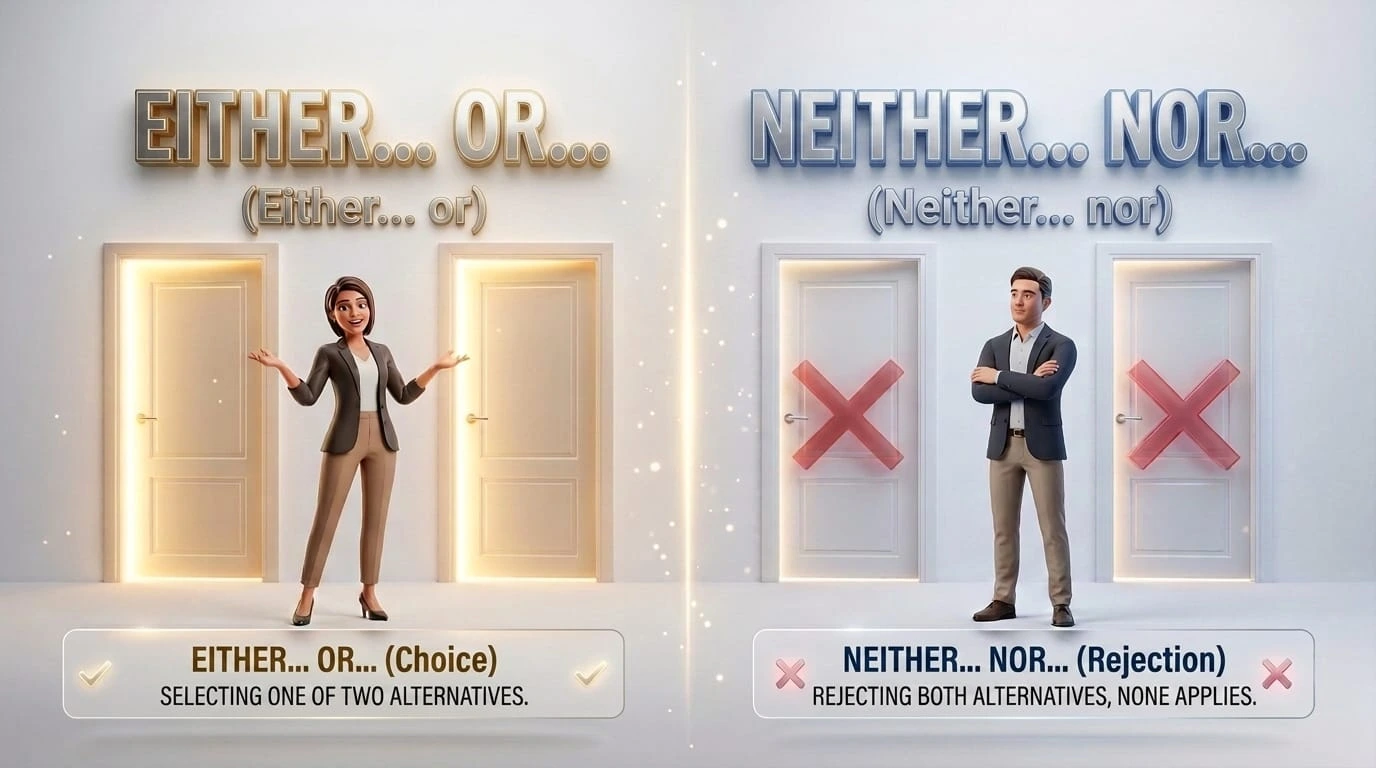
“Either means one of two options, while neither means not one and not the other. Use either for a positive choice and neither when both options are excluded.” _______________________________________________________________________________________________
A few years ago, I was helping a student prepare for an English exam when she wrote, “Neither of these dresses will look good. You can choose neither one.” She paused and asked, “Should I say either or neither here?” It reminded me how often even confident English speakers mix up these two simple words.
The confusion is easy to understand. Either and neither often appear in the same kinds of sentences, usually when we’re talking about two people, places, or things. Add words like or, nor, and negative verbs, and it’s no surprise many people hesitate before choosing the right one.
The good news is that once you understand the basic difference, using them becomes much easier. In this guide, you’ll learn what either and neither really mean, how they differ, common mistakes to avoid, and practical examples from everyday English. By the end, you’ll know exactly which word fits your sentence and why.
Either or Neither: Quick Answer
Both either and neither refer to two people, places, or things, but they express opposite ideas.
- Either means one or the other.
- Neither means not one and not the other.
Examples
✅ Either answer is acceptable.
✅ Neither of the students knew the answer.
A Simple Rule
Remember this:
- Either = One of two
- Neither = Not either one
If you’re offering a choice, use either.
If you’re saying both choices are unavailable or untrue, use neither.
The Origin of Either or Neither
Knowing where these words come from makes their meanings easier to remember.
The word either comes from Old English ǣgther, meaning each of two or one or the other. For hundreds of years, English speakers have used it when talking about a choice between two options.
The word neither developed from Old English nāhwæther, meaning not either or not one of the two.
Even today, their relationship is easy to see.
- Either gives you a choice.
- Neither removes both choices.
Why Do People Confuse Them?
The confusion usually comes from three reasons:
- Both words are used only with two options.
- They often appear with or and nor.
- Many people accidentally use double negatives.
For example:
❌ I don’t want neither option.
The sentence already contains don’t, so neither creates a double negative.
The correct sentence is:
✅ I want neither option.
or
✅ I don’t want either option.
Understanding this difference makes your English sound much more natural.
Either or Neither Explained: Key Differences
Although these words often appear in similar sentences, they have opposite meanings.
| Term | Meaning | When to Use | Context |
| Either | One of two choices | Offering or allowing a choice | Positive statements |
| Neither | Not one and not the other | Rejecting both choices | Negative meaning |
When to Use Either
Use either when one of two options is acceptable or possible.
It tells the reader or listener that both options are available, but only one will be chosen.
Examples
- You can take either bus.
- Either road will get you there.
- We can meet on either Monday or Tuesday.
- Either answer earns full marks.
Notice that the speaker accepts both possibilities.
When to Use Neither
Use neither when both options are rejected.
It means not this one and not that one.
Examples
- Neither restaurant serves breakfast.
- Neither candidate received enough votes.
- Neither answer is correct.
- Neither of my parents drinks coffee.
In every example, both choices are excluded.
Either…Or vs Neither…Nor
These word pairs are very common.
Either…or
Use either…or when presenting two possible choices.
Examples:
- You can either stay home or come with us.
- We’ll travel either by train or by bus.
- She wants either tea or coffee.
Neither…nor
Use neither…nor when rejecting both choices.
Examples:
- Neither Tom nor Jack attended the meeting.
- The movie was neither funny nor interesting.
- She speaks neither French nor Spanish.
Can Either Mean Both?
No.
Either never means both.
It always refers to one of two possibilities.
Incorrect:
❌ You can eat either sandwiches.
Correct:
✅ You can eat either sandwich.
or
✅ You can eat both sandwiches.
A Simple Memory Trick
Here’s an easy way to remember the difference.
- Either = One choice
- Neither = Zero choices
Ask yourself:
Am I choosing one option, or rejecting both?
- If you’re choosing one, use either.
- If you’re rejecting both, use neither.
This simple question will help you choose the correct word in almost every situation.
Which Version Should You Use?
Choosing between either and neither depends on the meaning of your sentence—not on British or American English. Both words are standard in every major variety of English.
For Students
Use either when answering questions or writing essays that involve a choice between two options.
Use neither when both options are incorrect or unavailable.
For Business Professionals
In emails, reports, and presentations:
- Use either to offer alternatives.
- Use neither to reject both possibilities clearly.
For English Learners
Ask yourself one simple question:
Am I choosing one option or rejecting both?
- One option → Either
- Both rejected → Neither
For Global Audiences
The meanings of either and neither are the same in:
- American English
- British English
- Canadian English
- Australian English
- International English
There is no spelling difference between these words.
Quick Recommendation
- Use either when one of two choices is possible.
- Use neither when neither choice is acceptable.
Common Mistakes with Either or Neither
These words are simple, but they often cause grammar mistakes.
| Mistake | Correct | Why? |
| I don’t want neither option. | I don’t want either option. | Avoid a double negative. |
| Either of the answers are correct. | Either of the answers is correct. | “Either” is singular. |
| Neither of the boys have arrived. | Neither of the boys has arrived. | “Neither” usually takes a singular verb. |
| You can choose neither book. | You can choose either book. | You’re offering a choice, not rejecting both. |
| She likes either tea nor coffee. | She likes neither tea nor coffee. | Use neither…nor together. |
Why These Mistakes Happen
Most mistakes occur because people mix:
- Either…or
- Neither…nor
- Negative verbs like don’t, can’t, and won’t
Remember:
- Don’t use neither with another negative word.
- Either and neither usually take singular verbs when referring to two items.
Blonde or Blond: The Correct Spelling (2026)
Either or Neither in Real-World Examples
Professional Email
You may attend either the morning session or the afternoon session.
News Headline
Neither candidate secured enough votes to win the election.
Social Media Post
I can’t decide. Either movie looks amazing!
Formal Report
Neither proposal met the project’s minimum requirements.
Everyday Conversation
Either restaurant is fine with me.
Neither answer sounds correct.
These examples show how naturally the two words fit into everyday communication.
Either or Neither: Data, Trends & Usage
Many people search for either or neither because they’re unsure which word fits their sentence.
Search Intent
The main search intent is:
- Informational
Users want quick grammar guidance with practical examples.
Countries Where This Topic Is Popular
Searches commonly come from:
- United States
- United Kingdom
- Canada
- Australia
- India
- Pakistan
- Ireland
Who Searches This Keyword?
Common audiences include:
- Students
- English learners
- Teachers
- Bloggers
- Editors
- Copywriters
- Professionals
- Job seekers
Why This Topic Matters
As people write more emails, assignments, and online content, choosing the correct word improves clarity and makes writing sound more natural. Understanding either and neither also helps you avoid common grammar mistakes in formal and everyday English.
Comparison Table
| Term/Variant | Meaning | Region/Context | Best Used When |
| Either | One of two choices | Worldwide English | Offering or accepting one option |
| Neither | Not one and not the other | Worldwide English | Rejecting both options |
Frequently Asked Questions
Q1: What is the difference between either and neither?
Either means one of two choices is possible, while neither means both choices are excluded.
Q2: Can either and neither be used interchangeably?
No. They have opposite meanings. Either offers a choice, whereas neither rejects both options.
Q3: Is it either…or or neither…or?
Use either…or when presenting alternatives and neither…nor when rejecting both alternatives.
Q4: Does neither take a singular or plural verb?
In standard English, neither usually takes a singular verb.
Example:
✅ Neither answer is correct.
Q5: Can I say “I don’t want neither”?
No. This creates a double negative.
Correct forms are:
- I don’t want either.
- I want neither.
Q6: Are either and neither different in British and American English?
No. Both words have the same spelling and meaning in British and American English.
Q7: Can either refer to more than two choices?
Traditionally, either refers to two choices. If you have more than two options, words like any or one of are usually more appropriate.
Conclusion
Understanding the difference between either and neither makes your English clearer and more precise. Although the words look similar, they express opposite ideas.
Use either when one of two options is available or acceptable. It helps you present choices and alternatives in conversations, emails, and formal writing.
Use neither when you want to say that both options are rejected or unavailable. It naturally pairs with nor and should not be used with another negative word like don’t.
A helpful rule to remember is simple: either means one choice, while neither means no choices. Keeping this distinction in mind will help you avoid common grammar mistakes and make your writing sound more confident.
Confused about either or neither? Learn meanings, grammar, examples, and correct usage to write confidently without common English mistakes today.
Paid or Payed: The Correct Spelling Explained (2026)

I’m a language enthusiast and content writer. I’m specialized in English grammar, spelling differences, vocabulary explanations, and word comparisons. My goal is to help readers improve their writing skills through clear, accurate, and easy-to-understand language guides.