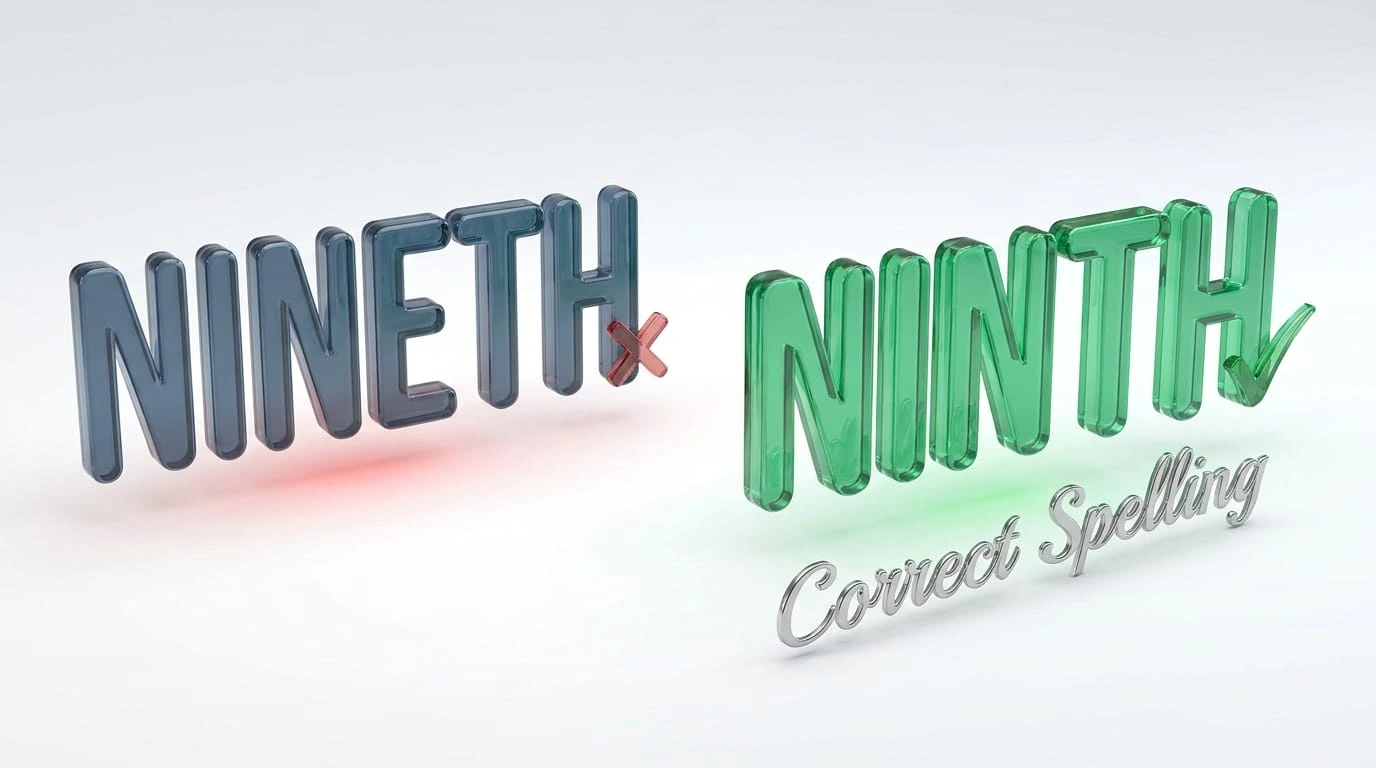
Ninth is the correct spelling. “Nineth” is incorrect because the number nine changes to ninth when it becomes an ordinal number.
Have you ever typed “nineth” and then stopped to wonder if it looks right? You are not alone. This is one of those spelling mistakes that can feel logical because nine ends with an e, so adding -th seems like an easy choice.
As an English teacher, I often see students make this mistake when writing dates, grades, lessons, and ordinal numbers. The problem is not a lack of English knowledge. The spelling pattern simply changes when nine becomes an ordinal number.
The correct form is ninth, not nineth. Once you understand why the e disappears, the spelling becomes much easier to remember.
This guide explains ninth vs. nineth, their meanings, pronunciation, origin, grammar, common mistakes, and real-world examples. You will also see when to use ninth in formal writing, schoolwork, dates, and everyday English.
Let’s make this confusing spelling choice simple.
Ninth or Nineth: Quick Answer
Ninth is the correct spelling of the ordinal form of nine.
- Correct: ninth
- Incorrect: nineth
The word ninth means number nine in a series or order.
Simple Examples
- She is in the ninth grade.
- My birthday is on the ninth of May.
You should always use ninth when you mean the ordinal form of the number nine.
The Origin and Background of Ninth
The spelling ninth comes from the number nine. However, English does not simply add -th to every number.
For example:
- six → sixth
- seven → seventh
- eight → eighth
- nine → ninth
- ten → tenth
The form of nine changes before the ordinal ending is added.
Historically, English developed many ordinal forms through changes in sound and spelling. Over time, ninth became the standard English form.
This explains why nineth may look logical but is not accepted standard spelling.
The same pattern can be seen in other number words. English spelling is not always a simple matter of adding letters. Some words change slightly when their grammatical form changes.
Ninth vs. Nineth: Key Difference
The main difference is simple:
| Term | Meaning | When to Use | Region/Context |
| Ninth | Number nine in order | Correct ordinal form | Standard English |
| Nineth | No standard meaning | Do not use | Incorrect spelling |
Ninth
Ninth is the correct ordinal number.
Examples:
- He finished in ninth place.
- Today is the ninth day of the month.
- She lives on the ninth floor.
Nineth
Nineth is a common spelling mistake.
It may look correct because nine + th seems to produce nineth. However, standard English uses ninth.
❌ She came in nineth place.
✅ She came in ninth place.
Why Is It Ninth and Not Nineth?
The easiest way to remember this rule is:
Nine → Ninth
The final e is dropped.
Think of it as a spelling change rather than simply adding -th.
Compare:
- nine → ninth
- five → fifth
- twelve → twelfth
These forms do not always follow a simple “number + th” pattern.
For learners, the best approach is to remember ninth as a fixed spelling.
A useful memory trick is:
Nine loses its “e” before becoming ninth.
This small rule can help you avoid the mistake in exams, assignments, emails, and formal documents.
Which Version Should You Use?
There is no real choice between ninth and nineth in standard English.
For Students
Use ninth in:
- School assignments
- Exams
- Class names
- Grade levels
- Homework
- Academic writing
Example:
“I am a student in the ninth grade.”
For Professional Writing
Use ninth in:
- Reports
- Business documents
- Emails
- Schedules
- Official notices
Example:
“The meeting will take place on the ninth of September.”
For Global English
Use ninth everywhere standard English is required.
It is understood in both British English and American English.
Best choice: Ninth.
Common Mistakes With Ninth
1. Writing Nineth
❌ I am in the nineth class.
✅ I am in the ninth class.
The mistake happens because writers often add -th directly to nine.
2. Adding the E
❌ The event is on the nineth.
✅ The event is on the ninth.
Remember that the final e in nine disappears.
3. Confusing Nine and Ninth
Nine is a cardinal number.
Ninth is an ordinal number.
- I have nine books.
- The ninth book is mine.
The first sentence tells us how many. The second tells us position or order.
4. Using Ninth When You Need Nine
❌ There are ninth students in the room.
✅ There are nine students in the room.
Use nine for quantity.
Use ninth for position or order.
5. Adding an Unnecessary “e”
❌ nineth
✅ ninth
The spelling nineth is not the standard English form.
Ninth in Real-World Examples
Seeing the word in natural situations makes the rule easier to remember.
Professional Email
“The training session is scheduled for the ninth of October.”
Here, ninth is used to describe a date.
News Headline
“Team Finishes Ninth in National Competition”
Here, ninth describes the team’s position.
Social Media Post
“Celebrating our ninth anniversary today!”
Here, ninth describes the number of completed years.
Formal Report
“The company recorded its ninth consecutive year of growth.”
Here, ninth describes the position in a sequence of years.
School Notice
“The ninth grade examination will begin on Monday.”
Here, ninth identifies the grade level.
Ninth: Data, Trends & Usage
The search intent behind “ninth or nineth” is mainly informational. People usually search this phrase because they are unsure which spelling is correct.
The confusion is especially common among:
- English learners
- School students
- Teachers
- Writers
- People checking dates
- People writing grade levels
The spelling problem exists because nineth looks like a natural combination of “nine” and “th.” However, standard English uses ninth.
This makes the topic useful for spelling guides and English-learning resources. A short explanation can solve the problem quickly, but understanding the difference between cardinal and ordinal numbers gives learners a stronger foundation.
Ninth vs. Nineth: Complete Comparison
| Term/Variant | Meaning | Region/Context | Best Used When |
| Ninth | Number nine in a sequence | Standard English | Talking about order or position |
| Nineth | Incorrect spelling | Non-standard | Never use in standard writing |
| Nine | The number 9 | Standard English | Talking about quantity |
| 9th | Abbreviated form of ninth | General written use | Dates, rankings, lists, and labels |
The key point is that ninth and nine do different jobs.
Nine = quantity
Ninth = position
For example:
“There are nine students.”
“Ali is the ninth student.”
How to Pronounce Ninth
The word ninth has one syllable.
IPA: /naɪnθ/
The ending can feel difficult because the word moves from the n sound to the th sound.
Try to say the word clearly rather than adding an extra vowel sound.
A common mistake is to pronounce it as if it had two syllables. In standard English, ninth is normally pronounced as one syllable.
Ninth in Grammar
Ninth is an ordinal number.
Ordinal numbers show the position of something in a sequence.
Examples include:
- first
- second
- third
- fourth
- fifth
- sixth
- seventh
- eighth
- ninth
- tenth
Cardinal vs. Ordinal Numbers
| Cardinal Number | Ordinal Number |
| one | first |
| two | second |
| three | third |
| four | fourth |
| five | fifth |
| six | sixth |
| seven | seventh |
| eight | eighth |
| nine | ninth |
| ten | tenth |
This distinction is important because nine and ninth have different grammatical functions.
FAQ: Ninth or Nineth
Q: What does ninth mean?
A: Ninth means number nine in a particular order or sequence. For example, “She finished in ninth place.”
Q: Is ninth or nineth correct?
A: Ninth is correct. Nineth is a spelling mistake and should not be used in standard English.
Q: Why is it ninth and not nineth?
A: The final e in nine is removed when the word changes to its ordinal form. The correct form is nine → ninth.
Q: Is ninth acceptable in formal writing?
A: Yes. Ninth is the standard spelling and is completely acceptable in academic, professional, and formal writing.
Q: What is the difference between nine and ninth?
A: Nine shows quantity, while ninth shows position or order. For example, “nine students” means there are nine students, while “the ninth student” identifies one student’s position.
Q: Can I write 9th instead of ninth?
A: Yes. 9th is the common abbreviated form of ninth. It is often used in dates, rankings, addresses, lists, and labels.
Q: Is nineth ever correct?
A: In standard modern English, nineth is not correct. Always use ninth when writing the ordinal form of nine.
Q: How do you use ninth in a sentence?
A: Use ninth when something comes after the eighth position. For example, “She won ninth place in the race.”
Q: What is the opposite of ninth?
A: There is no single direct opposite of ninth. Depending on the context, you may refer to another position, such as first, last, or final.
Conclusion
The answer is simple: ninth is correct, while nineth is incorrect.
The word ninth is the ordinal form of nine. It tells us that something is number nine in a sequence, position, or order. You can use it for school grades, dates, rankings, floors, anniversaries, competitions, and many other situations.
The easiest rule to remember is nine → ninth. The final e disappears. Also remember the difference between nine and ninth. Use nine for quantity and ninth for position.
If you ever hesitate between ninth and nineth, choose ninth. It is the standard spelling in both British and American English.
Dieing or Dying: Which One Is Correct?

I’m a language enthusiast and content writer. I’m specialized in English grammar, spelling differences, vocabulary explanations, and word comparisons. My goal is to help readers improve their writing skills through clear, accurate, and easy-to-understand language guides.