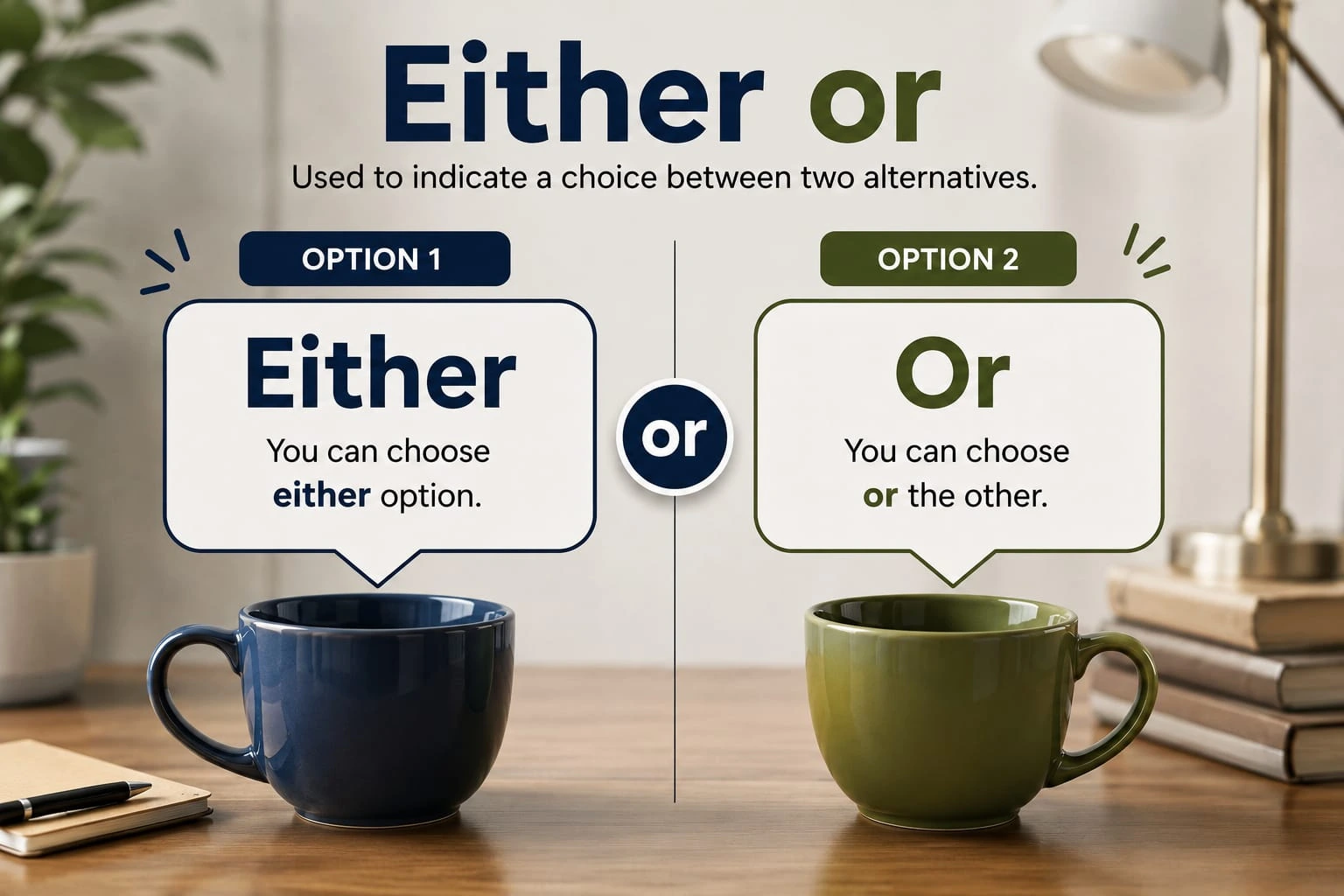
Either or is used to talk about a choice between two options. The usual structure is either A or B, meaning one of the two choices.
Have you ever written a sentence like “You can either stay or leave” and wondered if the word order was correct? Or perhaps you have seen “either…or” and were unsure whether both words must appear together.
This is a common English grammar question. Either and or are often taught together, but they do not always have to be used in the same sentence. That small difference can make the phrase confusing for English learners.
As an English writer, I often see people use either correctly on its own but struggle when they need to connect two choices. The good news is that the main rule is simple.
When you want to present two alternatives, the most common structure is either A or B.
For example:
You can either call me or send me an email.
This guide explains how either or works, where it comes from, when to use it, common mistakes, sentence patterns, and real-world examples. By the end, you will know exactly when to use either, or, and either…or.
Either or: Quick Answer
Either…or is a correlative conjunction used to show a choice between two alternatives.
The basic pattern is:
either + option A + or + option B
For example:
You can either take the bus or walk.
This means there are two choices: take the bus or walk.
Another example is:
We can either eat at home or go to a restaurant.
The phrase does not usually mean that both choices will happen. It presents them as alternatives.
What Does Either Mean?
Either has several uses in English, so its meaning depends on the sentence.
When used with or, it introduces one of two possible choices.
You can choose either tea or coffee.
Here, either points to the first choice, while or introduces the second.
But either can also stand alone.
For example:
You can take either.
This means you can choose one of the two options.
There is another important use of either in negative sentences:
I don’t like either.
Here, either means that neither of two things is liked.
So, do not assume that either must always be followed by or.
For the article, add this section after the Quick Answer. It can target the pronunciation search intent naturally:
How to Pronounce Either
either (EE-thər)
Either has two common pronunciations in English. Both are accepted, and the choice can vary by speaker and region.
- EE-thər: common in both British and American English.
- EYE-thər: also widely used, especially in American English.
Both pronunciations are correct, so you do not need to worry about choosing the “wrong” one.
The Origin and Background of Either or
The word either has a long history in English. It developed from older forms that expressed the idea of one of two or each of two.
The word or is also an old English conjunction used to present alternatives.
Over time, English speakers commonly paired them in the structure:
either…or
This became one of the standard ways to present two choices.
Today, you will find this structure everywhere. It appears in everyday speech, formal writing, business communication, academic writing, and instructions.
For example:
You can either pay online or pay at the counter.
The structure is useful because it makes choices clear.
Either or Explained: Key Differences and Variations
The most common structure is:
Either A or B
The two parts can contain different types of words or phrases.
Either + nouns + or + nouns
You can choose either tea or coffee.
We need either a car or a taxi.
Either + verbs + or + verbs
You can either stay or leave.
She will either call or email you.
Either + adjectives + or + adjectives
The answer is either correct or incorrect.
The room is either too hot or too cold.
Either + complete clauses + or + complete clauses
Either you come with us, or you stay here.
This structure connects two complete ideas.
Comparison Table
| Term | Meaning | When to Use | Context |
| either…or | One of two alternatives | To present two choices | Formal and informal |
| either | One of two choices | When referring to one of two options | General English |
| or | An alternative or choice | To connect options | General English |
| neither…nor | Not one and not the other | To reject both choices | Formal and informal |
| both…and | Two things together | When both options apply | General English |
Either vs Or: What Is the Difference?
Either and or often work together, but they have different jobs.
Either introduces or highlights the possibility of one choice.
Or connects the alternatives.
Look at this sentence:
You can either study at home or study at the library.
Here:
- either introduces the alternatives.
- or connects the two alternatives.
You can sometimes use or without either:
You can study at home or at the library.
This is completely correct.
The word either adds emphasis to the idea that there are two alternatives.
Either…Or vs Neither…Nor
One of the most useful comparisons is either…or versus neither…nor.
Either…or
Use either…or when one of two choices is possible.
You can either call me or text me.
The sentence gives two choices.
Neither…nor
Use neither…nor when both choices are rejected.
I like neither tea nor coffee.
This means I do not like tea and I do not like coffee.
Compare:
Either John or Mark will attend.
One of them will attend.
Neither John nor Mark will attend.
Neither person will attend.
This difference is important in both speaking and writing.
Which Version Should You Use?
For beginners, the easiest structure to remember is:
either A or B
Use it when you want to give someone two choices.
For everyday English
Keep the structure simple.
You can either walk or take the bus.
For professional writing
Use either…or when you need to explain two possible actions.
The customer can either request a refund or exchange the product.
For academic writing
The same structure works well.
The study will either support the theory or challenge it.
For global English
The standard either…or structure is clear and widely understood.
If your goal is simple communication, avoid putting too many words between either and or.
Common Mistakes With Either or
1. Using “either” twice
Incorrect:
You can either take the bus either walk.
Correct:
You can either take the bus or walk.
The normal pair is either…or.
2. Using “or” twice
Incorrect:
You can either stay or leave or wait.
This sentence gives three choices, so the structure becomes awkward.
Better:
You can stay, leave, or wait.
If there are more than two choices, simply using or is often clearer.
3. Using “either…and”
Incorrect:
You can either call me and send an email.
Correct:
You can either call me or send an email.
The standard pair is either…or, not either…and.
4. Mixing different grammatical structures
Try to keep the two choices parallel.
Less clear:
She will either study tonight or a movie tomorrow.
The two choices do not match.
Better:
She will either study tonight or watch a movie tomorrow.
Both choices now contain verbs.
5. Confusing either with neither
Either presents alternatives.
Neither rejects both alternatives.
Either Ali or Sara will help.
Neither Ali nor Sara will help.
Changing the pair changes the meaning.
Parallel Structure With Either…Or
One of the most important grammar points is parallel structure.
The two choices connected by either…or should usually have the same grammatical form.
Correct
She will either study or work.
Both are verbs.
Correct
We can either take the train or drive.
Both are actions.
Correct
He wants either pizza or pasta.
Both are nouns.
Incorrect
She will either study or a movie.
The first option is a verb. The second is a noun phrase.
A simple test is to look at the words after either and or. If they perform the same grammatical role, your sentence will usually sound much better.
Either or in Real-World Examples
Professional email
You can either reply to this email or contact our support team.
This clearly gives the reader two options.
News headline
Customers Can Either Pay Online or Visit the Store
The structure is useful when a headline needs to show two possible actions.
Social media post
You can either join us today or come tomorrow. The choice is yours!
This sounds natural in an informal setting.
Formal document
Applicants may either submit the form online or deliver a printed copy.
This is suitable for formal instructions.
Everyday conversation
We can either order pizza or cook dinner.
Short and natural.
Can Either…Or Be Used With More Than Two Choices?
Traditionally, either…or is used to present two alternatives.
For three or more choices, a simple list with or is usually clearer.
For example:
You can choose tea, coffee, or juice.
You would not normally need:
You can either choose tea, coffee, or juice.
The second sentence can be heard in informal English, but the first is simpler.
For clear writing, remember:
Two choices → either…or
Three or more choices → use a normal list with or
Either or in American and British English
The structure either…or is standard in both American and British English.
There is no major difference in its basic meaning.
| Usage | American English | British English |
| either…or | Common | Common |
| either alone | Common | Common |
| neither…nor | Common | Common |
| or without either | Common | Common |
For example, both varieties use:
You can either stay or leave.
The structure is understood across English-speaking regions.
Either or: Data, Trends & Usage
The search intent behind “either or” is mainly informational. People who search for this phrase often want to know how either…or works in a sentence.
The topic is especially useful for English learners because either, or, neither, and nor can appear in several different patterns.
Searchers may also ask related questions such as:
- How do you use either or?
- Is either or grammatically correct?
- What is the difference between either and or?
- Can you use either without or?
- What is the difference between either or and neither nor?
- Do either and or need to be together?
- How do you use either in a sentence?
This makes the topic useful for a broader grammar cluster rather than a single keyword.
Quick Rules to Remember
If you want a simple rule, remember these four points:
- Either…or gives two choices.
- Either can also be used alone.
- Or can be used without either.
- Neither…nor means both choices are rejected.
Easy examples
Either call me or send a message.
You can call me or send a message.
Neither option works for me.
These three patterns cover many everyday situations.
FAQs About Either or
What does either or mean?
Either…or means that there are two possible choices or alternatives. For example, “You can either stay or leave” gives two options.
How do you use either or correctly?
Use the pattern either A or B when presenting two alternatives. For example, “You can either call me or email me.”
Is either or grammatically correct?
Yes. Either…or is a standard and grammatically correct structure in English. It is used in both formal and informal writing.
Can either be used without or?
Yes. Either can stand alone when referring to one of two choices. For example, “You can take either.”
What is the difference between either or and neither nor?
Either…or presents two alternatives, while neither…nor rejects both alternatives. “Either tea or coffee” gives a choice, while “neither tea nor coffee” means neither one is wanted.
Can I use either or for three choices?
It is better to use or normally when you have three or more choices. For example, “Choose tea, coffee, or juice” is clear and natural.
Is either or used in British and American English?
Yes. Either…or is standard in both British and American English. The basic meaning and grammar are the same.
What is the difference between either and or?
Either refers to one of two possible choices, while or connects alternatives. They often work together in the structure either…or, but or can also be used alone.
Is “either A and B” correct?
Usually, no. When presenting alternatives, the standard pair is either A or B. Use and when you mean that both things are included.
Conclusion
The phrase either or becomes easy once you understand its basic pattern.
Use either…or when you want to present two alternatives. The first choice follows either, and the second follows or.
For example:
You can either call me or send me a message.
Remember that either does not always need or. You can use either alone when talking about one of two choices. Likewise, you can use or without either.
There is also an important difference between either…or and neither…nor. The first gives a choice. The second rejects both options.
For clear writing, keep the two parts parallel. Use similar grammatical forms after either and or.
The easiest rule is this:
Two choices = either…or
Once you learn that pattern, you can use it naturally in emails, conversations, school writing, and professional documents.
Shown or Showed: The Easy Grammar Guide

I am a professional content writer with a strong interest in English spelling and vocabulary. I am interested in creating informative guides on commonly confused words, spelling differences, and language usage to help readers write more accurately and effectively.