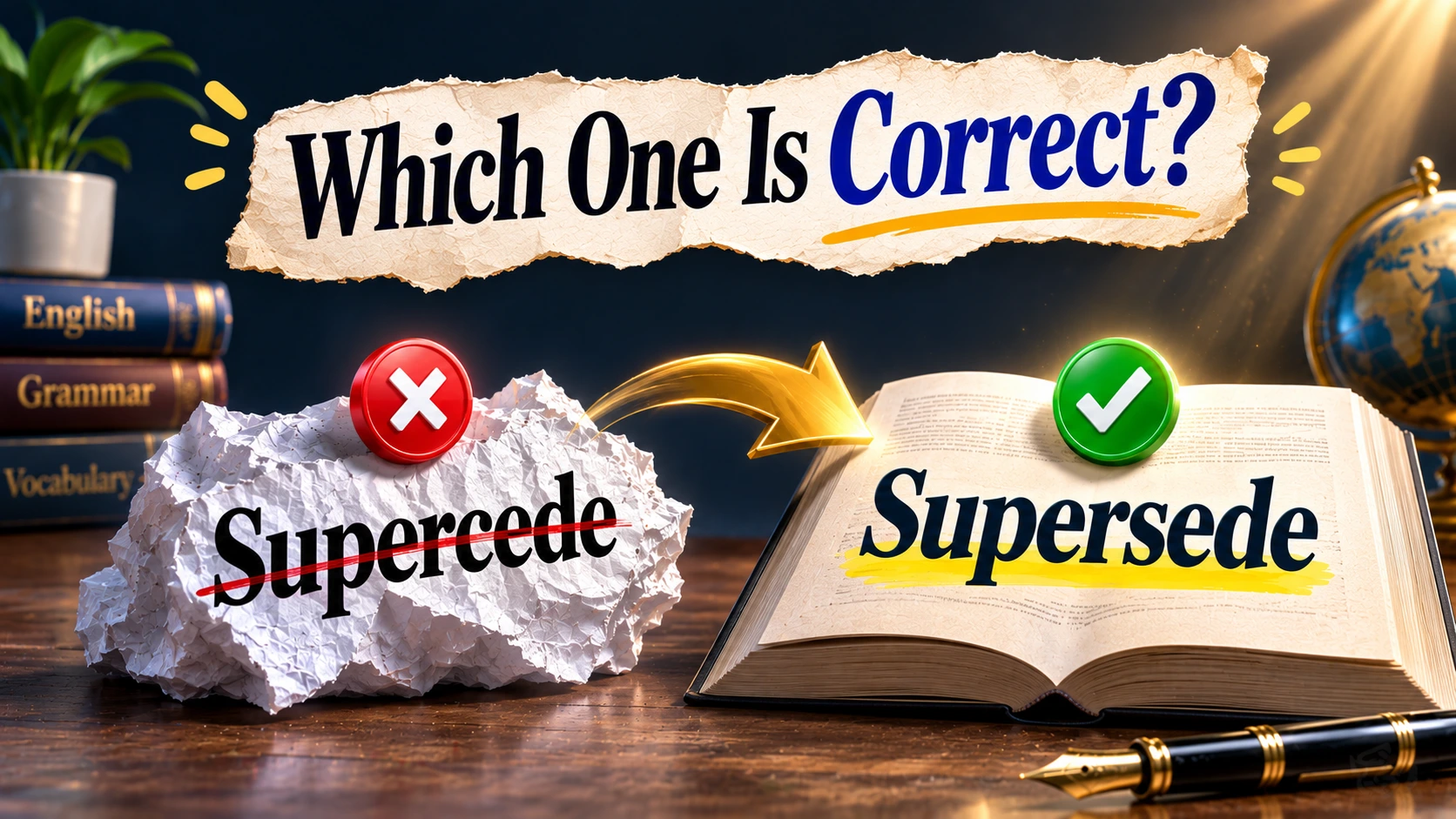
Supersede is the correct spelling in modern English. Supercede is a common misspelling and should be avoided in formal, academic, and professional writing.
Have you ever paused while typing supersede because your fingers wanted to write supercede instead? You’re not alone. I remember proofreading one of my own articles years ago and confidently writing supercede several times. My spell checker immediately highlighted every instance. At first, I thought the software was wrong. After digging into dictionaries and the word’s history, I discovered that supersede is one of English’s most confusing spelling exceptions.
The confusion is understandable. Many English words ending in -cede, such as precede, recede, and concede, make it seem logical that this word should also be spelled supercede. But English doesn’t always follow neat patterns.
If you’ve searched for supercede or supersede, chances are you want a clear answer without complicated grammar lessons. That’s exactly what you’ll find here. By the end of this guide, you’ll know which spelling is correct, why so many people make this mistake, and how to remember the right version forever.
Supercede or Supersede: Quick Answer
The correct spelling is supersede.
The spelling supercede is incorrect and is considered a misspelling in standard English. Whether you’re writing an email, essay, report, or social media post, always use supersede.
Examples
✅ The new software will supersede the old version.
✅ This policy supersedes all previous guidelines.
❌ The new software will supercede the old version.
❌ These rules supercede the earlier instructions.
Easy rule to remember: If you mean replace, take the place of, or override, always write supersede.
Pronunciation
Supersede (soo-per-SEED)
If you’re unsure how to say supersede, don’t worry—it’s a word many English learners mispronounce because of its unusual spelling. Although it contains “super,” the ending is pronounced like “seed,” not “side” or “sed.”
Break it into syllables:
Su • per • sede
➡️ soo – per – SEED
The stress falls on the last syllable (“SEED”), which gives the word its natural English pronunciation.
Example Sentences:
- The updated policy will supersede the previous version.
- This software update supersedes all earlier releases.
Quick Tip:
Remember the phrase “Super + Seed”. Thinking of supersede as “super + seed” makes it much easier to pronounce and remember correctly.
The Origin and Background of Supersede
The story behind supersede explains why this spelling seems so unusual.
The word comes from the Latin verb supersedere, which means to sit above, refrain from, or replace. It is formed from:
- super = above
- sedere = to sit
Because its Latin root contains sedere, English inherited the spelling supersede, not supercede.
So why do so many people write supercede?
The answer is simple. English contains several familiar verbs ending in -cede, including:
- precede
- concede
- recede
- secede
- intercede
When people see these words, their brains naturally expect supercede to follow the same spelling pattern. It feels logical, even though it’s historically incorrect.
That makes supersede one of the most famous spelling exceptions in the English language.
A Fun Fact
Many experienced writers, editors, and even native English speakers accidentally type supercede before correcting themselves. That’s why spell checkers frequently flag this mistake.
Supercede or Supersede Explained: Key Differences
Although the two spellings look almost identical, only one is accepted in standard English.
| Term | Meaning | When to Use | Status |
|---|---|---|---|
| Supersede | To replace, override, or take the place of something | Always | ✅ Correct |
| Supercede | Intended to mean the same thing | Never in standard English | ❌ Incorrect |
Unlike some spelling pairs such as color/colour or organize/organise, this is not a British vs American English difference.
Both British English and American English use supersede.
There is no region where supercede is considered the preferred standard spelling.
Why the Mistake Happens
Most spelling mistakes happen because people write words the way they sound. In this case, another reason exists.
People unconsciously compare supersede with words ending in -cede.
For example:
- precede
- concede
- recede
- secede
Since these are common English verbs, many assume supercede should also end in -cede.
Unfortunately, English refuses to cooperate.
Weird or Wierd: The Complete Spelling Guide (2026)
Side-by-Side Examples
| Sentence | Correct? |
|---|---|
| This agreement supersedes the previous contract. | ✅ |
| The latest update supersedes the old software. | ✅ |
| This agreement supercedes the previous contract. | ❌ |
| The new policy supercedes the old one. | ❌ |
Remember This Trick
Think of supersede as an exception.
Even though many words end with -cede, this one comes from sedere, so it keeps the -sede ending.
A simple memory tip is:
Supersede has “sede,” not “cede.” It stands alone, just like the new thing that replaces the old.
Which Version Should You Use?
The answer is simple: always use supersede.
Whether you’re writing for school, work, publishing, or online, supersede is the only accepted spelling. Dictionaries, style guides, and grammar checkers all recognise supersede as the standard form.
Here’s a quick guide:
- Students → Use supersede in essays, assignments, and exams.
- Professionals → Use supersede in emails, reports, contracts, and business documents.
- Content writers and bloggers → Use supersede for SEO articles and web content.
- Academic writers → Use supersede in research papers and journals.
- Everyone → Avoid supercede, even in informal writing.
Our Recommendation
If you’re ever unsure, remember this simple rule:
Supercede is a mistake. Supersede is the correct spelling every time.
You don’t need to worry about British vs American English because both varieties use “supersede.”
Common Mistakes with Supercede or Supersede
Many people know what the word means but still spell it incorrectly. Here are the mistakes you should avoid.
| Mistake | Correct Form | Why It Happens |
|---|---|---|
| ❌ Supercede | ✅ Supersede | Confused with words ending in -cede |
| ❌ Superceded | ✅ Superseded | The base word is already misspelled |
| ❌ Superceding | ✅ Superseding | Incorrect spelling carried into other forms |
| ❌ Supercedes | ✅ Supersedes | Same spelling mistake in the present tense |
| ❌ “Both spellings are correct.” | ✅ Only supersede is standard English | A common misconception |
Watch Out for These Sentences
❌ The new manager will supercede the old one.
✅ The new manager will supersede the old one.
❌ This law supercedes previous regulations.
✅ This law supersedes previous regulations.
❌ The updated policy has superceded the original version.
✅ The updated policy has superseded the original version.
Supercede or Supersede in Real-World Examples
Seeing a word used in context makes it much easier to remember.
Professional Email
“The updated pricing policy will supersede the version shared last month.”
News Headline
“New Environmental Rules Supersede Older Safety Regulations.”
Social Media Post
“Our latest app update supersedes the previous version. Download it today for improved security.”
Formal Report
“This document supersedes all earlier editions issued before January 2026.”
Everyday Conversation
“The new timetable supersedes the old one, so don’t use yesterday’s schedule.”
Legal Document
“This agreement shall supersede all prior written and verbal understandings between the parties.”
Academic Writing
“Recent evidence supersedes earlier theories regarding language development.”
Notice that every example uses supersede. You’ll rarely see supercede in edited or professionally published writing because it is considered incorrect.
Supercede or Supersede: Data, Trends & Usage
The search term “supercede or supersede” is popular because thousands of people make the same spelling mistake every month.
Search Intent
Primary Intent: Informational
People searching this phrase usually want to know:
- Which spelling is correct?
- Is supercede ever acceptable?
- Why is supersede spelled differently?
- How should the word be used in sentences?
Who Searches for This?
The topic is especially popular among:
- Students
- Teachers
- Copy editors
- Bloggers
- Journalists
- Business professionals
- English learners
Regions Where It’s Common
Searches come from English-speaking countries including:
- United States
- United Kingdom
- Canada
- Australia
- India
- Pakistan
Because English is used globally, spelling questions like this continue to attract steady search traffic.
Why This Confusion Still Exists
Unlike many spelling mistakes, supercede seems logical.
People naturally compare it with:
- precede
- recede
- concede
- secede
- intercede
Since all these words end in -cede, writers often assume supercede follows the same rule.
It doesn’t.
That’s why dictionaries, grammar tools, and editors consistently recommend supersede.
Why This Matters Today
Clear writing builds credibility. A single spelling mistake in a CV, business proposal, academic paper, or website can make readers question your attention to detail. Learning the correct spelling of supersede helps you communicate more confidently and professionally.
Supercede or Supersede: Comparison Table
| Term/Variant | Meaning | Region/Context | Best Used When |
|---|---|---|---|
| Supersede | To replace, override, or take the place of something | British English, American English, Australian English, and all standard English | Always |
| Supercede | Common misspelling of supersede | Not accepted in standard English | Never |
Frequently Asked Questions
Q: Is it supercede or supersede?
Supersede is the correct spelling. Supercede is a common misspelling and should not be used in standard English.
Q: What does supersede mean?
Supersede means to replace, take the place of, or override something that came before it.
Example:
The new policy supersedes all previous guidelines.
Q: Why do people spell it “supercede”?
People often spell it supercede because they compare it with words like precede, concede, recede, and secede, which all end in -cede. However, supersede comes from a different Latin root, so its spelling is an exception.
Q: Is “supercede” ever correct?
No. Modern dictionaries, style guides, and grammar experts consider supercede a misspelling. Always use supersede in formal and informal writing.
Q: Is supersede used in British and American English?
Yes. Supersede is the standard spelling in both British English and American English. There is no regional spelling difference for this word.
Q: Can I use supersede in formal writing?
Absolutely. Supersede is commonly used in legal documents, business reports, academic papers, government publications, and professional emails.
Example:
This agreement supersedes all previous contracts.
Q: What’s the difference between supersede and replace?
Both words mean something takes the place of another. However, supersede is more formal and often appears in legal, official, and technical writing, while replace is more common in everyday conversation.
Conclusion
If you’ve ever wondered whether to write supercede or supersede, you now have a clear answer. The only correct spelling is supersede. Although supercede looks believable because of words like precede and concede, it isn’t accepted in standard English.
Remember these key points:
- Supersede is the correct spelling.
- Supercede is a common misspelling.
- Both British and American English use supersede.
- The word means to replace, override, or take the place of something.
The easiest way to avoid this mistake is to treat supersede as a unique spelling exception. The more you read and write it, the more natural it will become.
Now you know exactly how to use supercede or supersede correctly. Bookmark this guide so you never second-guess the spelling again, and share it with someone who has made the same mistake.
Supercede or supersede? Stop making this common spelling mistake. Learn the correct usage, meaning, and examples in minutes.
Grammar or Grammer? Which Spelling Is Correct? (2026)

I specialize in spelling comparisons, confusing word pairs, grammar, and vocabulary development. My content helps readers improve their English, avoid common mistakes, and write with confidence. My goal is to provide accurate, reliable, and easy-to-understand language resources