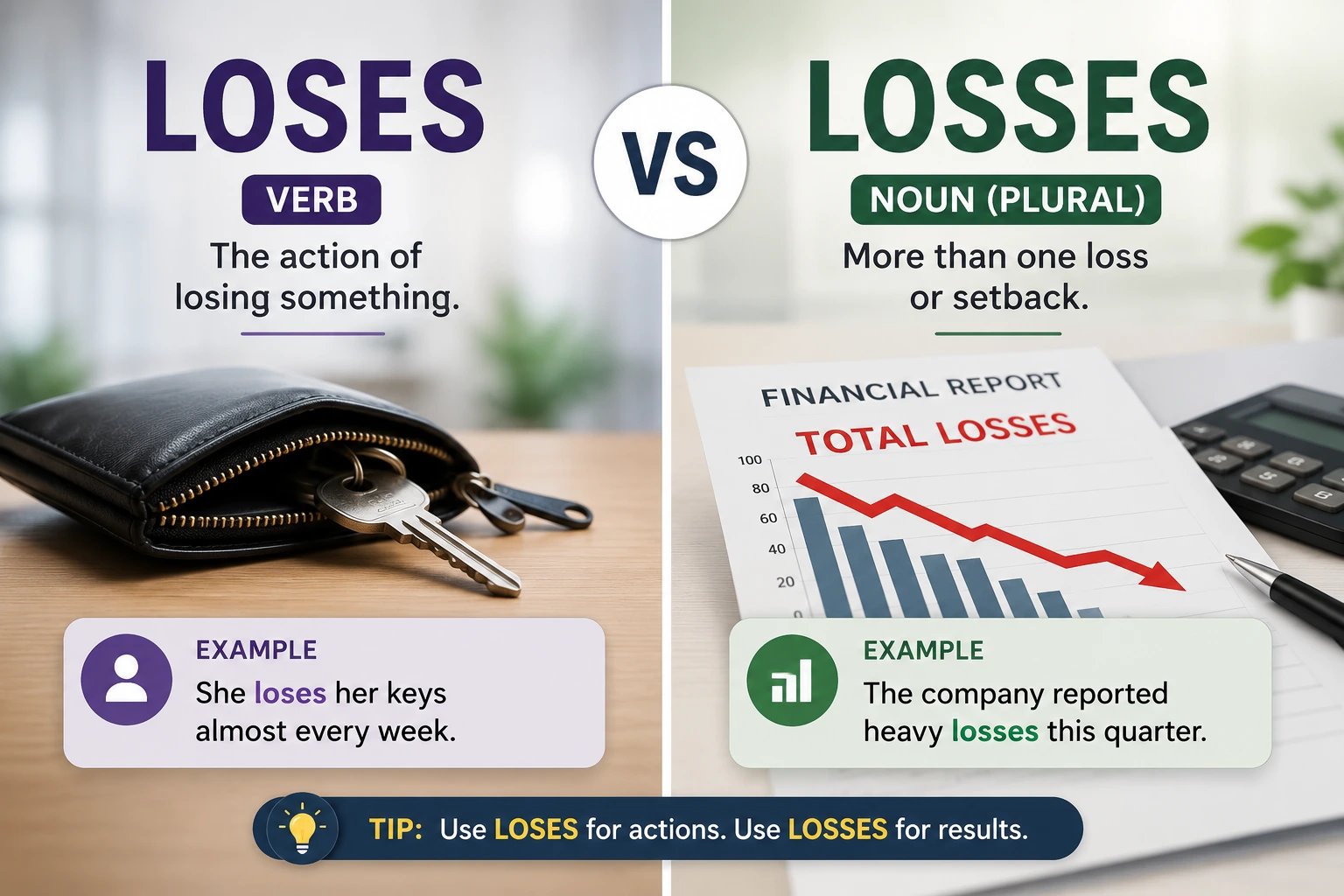
"Loses" is the verb form, meaning fails to keep, misplaces, or is defeated. "Losses" is the plural noun form, meaning more than one loss.
A few years ago, while editing one of my blog posts, I noticed I had written “The company loses millions every year” in one sentence and “The company reported several loses” in another. The first sentence was correct. The second wasn’t. That tiny missing “s” changed the grammar completely.
You’re not alone if loses and losses confuse you. They look almost identical. They sound similar too. Many students, writers, and even native English speakers mix them up because only one extra letter separates them.
The good news is that the difference is actually very simple once you know the grammar behind each word.
In this guide, you’ll learn what loses and losses mean, when to use each one, common mistakes to avoid, easy memory tricks, and plenty of real-life examples. By the end, you’ll never hesitate over these two words again.
Loses or Losses: Quick Answer
The easiest way to remember the difference is this:
- Loses = Verb (an action)
- Losses = Plural noun (more than one loss)
Examples
✅ She loses her keys almost every week.
✅ The business suffered heavy losses last year.
A simple question can help:
- Is someone doing an action? → Use loses.
- Are you talking about one or more setbacks or defeats? → Use losses.
The Origin and Background of Loses and Losses
Although these words look alike, they come from different grammatical forms of the same root word.
The word lose comes from the Old English word losian, meaning to perish, be destroyed, or fail to keep something. Over time, its meaning expanded to include losing a game, losing money, losing an object, or missing an opportunity.
When we add -s to lose, we get loses, which is the third-person singular form of the verb.
Examples:
- He loses his temper easily.
- She loses every chess match.
The word loss, however, developed as a noun. It refers to the act or result of losing.
Adding -es creates losses, which simply means more than one loss.
Examples:
- Financial losses
- Personal losses
- Heavy losses
- Military losses
This is why the two words cannot replace each other. One describes what someone does, while the other names what happened.
Loses or Losses Explained
Although these words share the same root, they belong to different parts of speech.
| Term | Meaning | Part of Speech | When to Use |
| Loses | Fails to keep or win | Verb | When describing an action |
| Losses | More than one loss | Plural noun | When referring to setbacks, defeats, or damage |
What Does Loses Mean?
Loses is a verb. It describes the action of no longer having something or failing to win.
You can use loses when someone:
- Misplaces something
- Is defeated
- Misses an opportunity
- Gives up possession
- Stops having something
Examples:
- Sarah loses her phone every few months.
- Our team loses whenever it rains.
- He loses confidence after making mistakes.
- The company loses customers because of poor service.
Notice that every sentence describes an action happening in the present.
What Does Losses Mean?
Losses is the plural form of loss. It refers to two or more negative outcomes.
These losses may involve:
- Money
- Business
- Sports
- Life
- Property
- Opportunities
Examples:
- The company reported significant losses this quarter.
- Floods caused major crop losses.
- The football club suffered three consecutive losses.
- Insurance covered most of the financial losses.
Unlike loses, losses never describes an action. It names the result of losing.
Key Differences Between Loses and Losses
Many learners remember this pair by focusing on grammar rather than spelling.
| Feature | Loses | Losses |
| Part of speech | Verb | Plural noun |
| Meaning | Performs the action of losing | More than one loss |
| Shows action | ✅ Yes | ❌ No |
| Shows result | ❌ No | ✅ Yes |
| Example | She loses her wallet. | The company reported heavy losses. |
A Simple Memory Trick
Here’s an easy trick I often share with students:
- Loses has one extra “s” because it’s one action.
- Losses has two “s” groups (“ss” + “es”), reminding you of multiple losses.
Another way to remember it:
- Loses = Does something
- Losses = Things that happened
That simple distinction makes choosing the correct word much easier.
Phased or Fazed: The Correct Word Explained (2026)
How to Pronounce Loses and Losses
Although loses and losses look very similar, they’re pronounced differently. The extra “s” changes the sound, which is one reason many English learners confuse them.
Pronunciation of Loses
loses (LOO-ziz)
IPA: /ˈluː.zɪz/
Break it into syllables:
LOO • ziz
The first syllable rhymes with “blue,” and the second sounds like “ziz.” Notice that the middle sound is a soft “z”, not an “s.”
Example:
- She loses her keys almost every week.
- The team loses another match.
Memory Tip: Think of lose + ziz = loses. The “z” sound reminds you it’s the verb.
Pronunciation of Losses
losses (LOSS-iz)
IPA: /ˈlɒs.ɪz/ (UK) • /ˈlɑː.sɪz/ (US)
Break it into syllables:
LOSS • iz
The first syllable sounds like “loss,” followed by “iz.” Unlike loses, the first syllable uses an “o” sound, not the long “oo” sound.
Example:
- The company reported significant losses last year.
- The club suffered three straight losses.
Memory Tip: If you’re talking about many losses, pronounce it just like “loss + iz.”
Which One Should You Use?
Choosing between loses and losses becomes easy once you know whether you need a verb or a noun.
Use loses when someone is performing the action of losing.
Use losses when you’re talking about the results, damage, defeats, or things that were lost.
Here’s a quick guide.
Use Loses if you’re writing about:
- A person losing something
- A team being defeated
- A business losing customers
- Someone missing an opportunity
- An action happening now
Examples:
- She loses her sunglasses every summer.
- The store loses money during the winter.
- He loses interest halfway through the movie.
Use Losses if you’re writing about:
- Financial reports
- Business performance
- Sports records
- Insurance claims
- Military or personal setbacks
Examples:
- The company reported record losses.
- Their financial losses reached millions.
- The team suffered several losses this season.
Common Mistakes with Loses and Losses
Because the spellings are so similar, people often swap these words accidentally.
Here are the most common mistakes.
❌ Mistake 1
Incorrect:
The company reported huge loses.
Correct:
The company reported huge losses.
Why?
The sentence talks about several financial setbacks, so you need the plural noun.
❌ Mistake 2
Incorrect:
She losses her phone every week.
Correct:
She loses her phone every week.
Why?
This is an action, so use the verb.
❌ Mistake 3
Incorrect:
Our team had three loses.
Correct:
Our team had three losses.
Why?
You’re counting defeats, not describing an action.
❌ Mistake 4
Incorrect:
He always losses his wallet.
Correct:
He always loses his wallet.
Why?
The subject performs the action of losing.
❌ Mistake 5
Incorrect:
The business losses customers every month.
Correct:
The business loses customers every month.
Why?
The business is performing the action.
Loses and Losses in Real-World Examples
Seeing these words in everyday writing makes the difference much easier to remember.
Professional Email
Our company loses several clients each year because of delayed deliveries.
Business Report
The organisation recorded significant financial losses during the last quarter.
News Headline
Local Team Loses Championship Final After Late Goal
Financial News
Retail Chain Reports Record Losses Amid Falling Sales
Social Media Post
I always lose one sock after doing the laundry! 😂
School Assignment
The country suffered heavy economic losses after the natural disaster.
Sports Commentary
The goalkeeper loses concentration for a moment, and the opposing team scores.
Loses or Losses: Data, Trends & Usage
Both words receive thousands of searches every month because people often confuse them.
Search Intent
Primary Intent: Informational
People usually want to know:
- Which spelling is correct
- The grammatical difference
- Whether the word is a verb or noun
- How to use each word correctly
Who Searches This Topic?
- English learners
- Students
- Bloggers
- Teachers
- Copywriters
- Business professionals
- Job seekers
- Native speakers checking grammar
Where Is the Confusion Most Common?
The confusion appears frequently in:
- School assignments
- Business reports
- Social media posts
- Emails
- News articles
- Online forums
Why Does This Matter Today?
With grammar checkers and AI writing tools becoming more common, people notice spelling and grammar mistakes more quickly than ever. Knowing the difference between loses and losses helps your writing look more professional, whether you’re sending an email, writing a report, or publishing online.
Loses vs. Losses Comparison Table
| Term | Meaning | Part of Speech | Best Used When |
| Loses | Fails to keep, win, or retain something | Verb | Describing an action |
| Losses | More than one loss, defeat, or setback | Plural noun | Talking about results, damage, or defeats |
| Lose | To no longer have something | Verb (base form) | Present tense after I, you, we, they |
| Loss | A single defeat or setback | Singular noun | Referring to one loss |
Frequently Asked Questions
Q1: Is it “loses” or “losses”?
It depends on the sentence. Loses is a verb that describes the action of losing something. Losses is a plural noun that refers to more than one loss, defeat, or setback.
Q2: What is the difference between loses and losses?
The main difference is grammar. Loses shows an action, while losses names the result of that action.
Example:
- She loses her keys often.
- The company reported heavy losses last year.
Q3: Is “losses” the plural of “loss”?
Yes. Losses is simply the plural form of loss.
Examples:
- One loss
- Two losses
- Several financial losses
Whenever you’re talking about more than one loss, losses is the correct word.
Q4: Can I use “loses” in formal writing?
Absolutely. Loses is standard English and is commonly used in business reports, academic writing, journalism, emails, and everyday communication.
Example:
The company loses customers when service quality declines.
Q5: Why do people confuse loses and losses?
These words look and sound very similar. The only visible difference is an extra “s”, but they belong to different parts of speech. Many writers focus on spelling instead of asking whether the sentence needs a verb or a noun.
Q6: How can I remember the difference between loses and losses?
Use this simple memory trick:
- Loses = Verb = Action
- Losses = Noun = Things you can count
Ask yourself one question:
“Am I describing an action or naming a result?”
If it’s an action, choose loses. If it’s a result or several defeats, choose losses.
Q7: Which word should English learners use?
You should use both, but in the correct situations. Learn the grammar first instead of memorising the spelling. Once you remember that loses is a verb and losses is a noun, you’ll rarely make this mistake again.
Conclusion
The difference between loses and losses is much simpler than it first appears. Although the words look almost identical, they have different jobs in a sentence.
Remember these key points:
- Loses is a verb that means fails to keep, misplaces, or is defeated.
- Losses is the plural noun meaning more than one loss, setback, or defeat.
- Think action vs. result whenever you’re unsure.
- A quick grammar check is often all you need to choose the correct word.
The more you read and write, the more natural this difference will become. After a little practice, you’ll spot the correct word instantly and avoid one of the most common English grammar mistakes.
Fair or Fare: Which Word Should You Use?

I’m an English language researcher and content writer. I am specialized in spelling comparisons, commonly confused words, grammar usage, and vocabulary guides. Through detailed language articles,I am helping readers to understand the differences between similar words and improve their written communication skills.