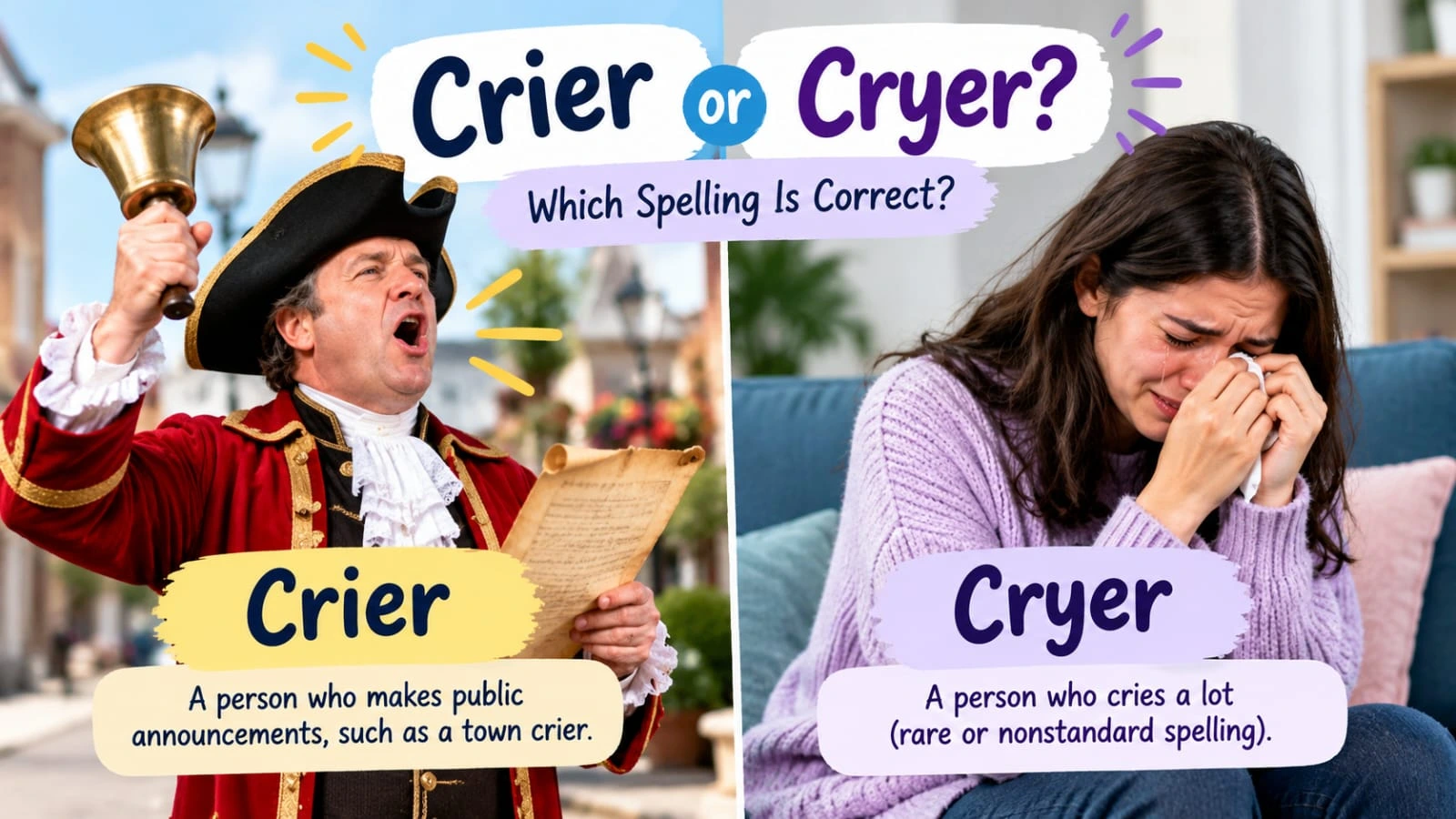
Crier is the correct spelling for a person who cries or makes a public announcement. Cryer is a rare surname and an uncommon spelling variant, but crier is the standard word in modern English.
Have you ever written cryer and wondered if your spelling was wrong? You are not alone. The words cryer and crier look almost the same, and both seem to follow the sound of the verb cry. Yet, when you need the word for a person who cries or someone who makes public announcements, the standard spelling is crier.
This small spelling choice can make a difference in schoolwork, emails, reports, and other writing. A spelling checker may flag cryer, but it may not explain why the other form is preferred. That can leave you unsure about which word to trust.
As an English teacher and language editor, I would explain the choice by starting with the base word: cry. When we add -er to show that a person does an action, the spelling changes from y to i before the ending. That gives us crier, just as try becomes trier.
In this guide, you will learn the correct spelling, the meaning of each form, the reason for the difference, and how to use crier in real sentences. You will also see common mistakes and quick tips to help you remember the right form.
Cryer or Crier: Quick Answer
Crier is the standard spelling when you mean a person who cries or a person who makes public announcements. Cryer is mainly seen as a family name or in older texts.
Examples:
- Correct: She said she was not usually a crier, but the film made her cry.
- Correct: The town crier announced the news in the market square.
- Name: Mr. Cryer will speak at the event.
Remember this simple rule: use crier for the common noun and Cryer when it is someone’s actual surname.
The Origin and Background of Crier
The word crier has a long history. It comes from older forms of English and French linked to the act of crying out or shouting. In the past, a crier often had an official role. This person would call out news, orders, or public notices so people could hear them.
A town crier is a well-known example. Before newspapers, radio, and the internet, people often needed someone to share important news in public. A town crier might announce a royal order, a market event, or a local message.
Today, the word has another common use. A person who cries easily may also be called a crier.
For example:
- “I am a happy crier.” This means the person may cry when feeling joy.
- “The town crier read the notice aloud.” This means the person made a public announcement.
Why do people write cryer? The base word is cry, so adding -er may seem to give cryer. But English spelling does not always follow the same pattern in every word. The established modern spelling is crier. The form cryer has appeared in older writing, but it is not the usual choice today.
Cryer vs. Crier: Key Differences
The main difference is how each form is used. They look and sound alike, but they are not equally common in modern English.
1. What Does Crier Mean?
Crier is a noun. It can describe:
- A person who cries or weeps.
- A person who makes loud public announcements.
- A person who calls out to advertise goods for sale.
Examples:
- My brother is a crier when he watches sad films.
- The crier announced the court’s decision.
- A street crier called out the day’s special offers.
The exact meaning depends on the sentence. If the topic is feelings, it often means someone who cries. If the topic is history or public news, it may mean an announcer.
2. What Does Cryer Mean?
Cryer is much less common as a general word in modern English. It may appear as a surname, or family name. It has also been used as an older spelling of crier.
Examples:
- Cryer is the surname printed on the invitation.
- The historical text used the older spelling cryer.
If you are writing about someone who cries, do not choose cryer just because it seems to follow the spelling of cry. Use crier instead.
3. Cryer vs. Crier Comparison Table
| Term | Meaning | When to Use | Region/Context |
|---|---|---|---|
| Crier | A person who cries or makes public announcements | General writing, schoolwork, and formal text | Modern English |
| Cryer | Mainly a surname; also an older spelling | When spelling a person’s name or quoting a historical text | Names and older writing |
| Town crier | A person who announces news in public | History, civic events, or public announcements | Traditional public role |
| Tearful person | Someone who cries or is close to tears | When you want a plain, descriptive phrase | Everyday English |
The safest choice for most writing is crier. Use Cryer when it is a person’s name or when the source you are quoting uses that spelling.
Which Version Should You Use?
The right choice depends on what you want to say. In most cases, the answer is simple: choose crier.
- For students: Use crier in essays, homework, and exams when referring to a person who cries or announces news.
- For professional writers: Use crier in reports, articles, and general prose. It is the standard modern form.
- For historical writing: Keep cryer if you are quoting an old text and need to preserve its original spelling.
- For names: Use the spelling that the person uses. If someone’s surname is Cryer, do not change it to Crier.
- For international readers: Use crier for the common noun. It is the more widely accepted modern spelling.
One useful tip is to remember the phrase town crier. It is a familiar expression, and it helps you keep the standard spelling in mind.
Common Mistakes with Cryer and Crier
These mistakes are easy to make because the words sound the same.
Mistake 1: Writing Cryer for Someone Who Cries
- Incorrect in standard modern usage: She is a cryer.
- Correct: She is a crier.
Why it happens: The writer adds -er directly to cry. But the standard noun is spelled crier.
Mistake 2: Changing a Person’s Surname
- Incorrect: Mr. Crier gave a speech, when his name is Mr. Cryer.
- Correct: Mr. Cryer gave a speech.
Why it happens: A writer may assume that the common noun and surname must have the same spelling. They do not.
Mistake 3: Treating Crier as a Verb
- Incorrect: She will crier if she gets upset.
- Correct: She may cry if she gets upset.
Why it happens: Crier is a noun, not the verb form for the action. Use cry, cries, cried, or crying as needed.
Mistake 4: Confusing Crier with Crying
- Incorrect: He is a crying when he watches films.
- Correct: He is a crier when he watches films.
- Also correct: He is crying while watching the film.
Why it happens: Crier names a person, while crying describes an action or state.
Mistake 5: Assuming Both Spellings Are Equally Common
- Less suitable for modern general writing: The town cryer made an announcement.
- Preferred: The town crier made an announcement.
Why it happens: Older texts and family names can make cryer look like an equal alternative. For current general writing, crier is the better choice.
Crier in Real-World Examples
Seeing the word in different settings can help you understand how to use it.
1. In a Professional Email
Example:
“Dear Team,
The event host has invited a town crier to announce the opening of the community festival. Please arrive by 9 a.m. to prepare for the event.”
Why it works: The word crier refers to a person who makes a public announcement.
2. In a News Article
Example headline:
“Town Crier Brings a Historic Tradition to the City Centre”
Example sentence:
“The town crier welcomed visitors and shared news about the weekend festival.”
Why it works: A town crier announces news to people in a public place.
3. In a Social Media Post
Example:
“I thought I could watch that film without crying. I was wrong! and am such a crier when it comes to sad endings.”
Why it works: Here, crier describes a person who often cries, especially in response to strong feelings.
4. In a Formal Report
Example:
“The historical event included a town crier, who read the public notice aloud to visitors.”
Why it works: The word suits a report about a public event or a historical tradition.
5. In a School Essay
Example:
“The town crier played an important role in sharing news before modern forms of communication became common.”
Why it works: The word gives a clear name to the person who announced news.
Cryer or Crier: Data, Trends, and Usage
People who search for cryer or crier usually want to check a spelling or learn which form is correct. Their main goal is to avoid an error in writing.
This is an informational search intent. The reader is looking for a direct answer, a simple explanation, and examples.
Which Form Is More Common?
Modern English usage strongly favours crier as the common noun. The spelling cryer is more likely to appear as a surname or in older writing.
However, an exact current search-volume figure for this word pair has not been verified here. It would be misleading to claim that one spelling receives a specific number of searches or is more popular in a certain country without reliable keyword data.
Why Does This Difference Matter?
A small spelling error can affect the quality of your writing. Choosing the standard form helps readers understand your meaning without distraction.
This is useful when you are:
- Writing school assignments or exams.
- Editing articles and website content.
- Preparing reports or professional emails.
- Learning English spelling rules.
- Checking a name against an official record.
The practical lesson is simple: use crier for the common word, and preserve Cryer when it is someone’s actual name.
Cryer vs. Crier: Standalone Comparison Table
| Term/Variant | Meaning | Region/Context | Best Used When |
|---|---|---|---|
| Crier | A person who cries | Modern English | Describing someone who cries often |
| Crier | A public announcer | Historical or civic context | Referring to a town or court crier |
| Cryer | A family name | Personal names | Writing a person’s name correctly |
| Cryer | An older spelling of crier | Historical texts | Preserving the spelling of an original source |
| Cry | To shed tears or call out | Everyday English | Describing the action |
| Crying | The act of shedding tears or calling out | Everyday English | Describing an action in progress |
Final spelling tip: If you are not writing a surname or copying an older text, choose crier.
Frequently Asked Questions
Q: What does crier mean?
A crier is a person who cries or a person who makes public announcements. A town crier, for example, traditionally shared news by calling it out in public.
Q: Is cryer or crier the correct spelling?
Crier is the standard modern spelling for the common noun. Cryer is mainly used as a surname and may also appear in older texts.
Q: What is the difference between cryer and crier?
The main difference is their usual use. Crier is the standard common noun, while Cryer is often a family name. Both forms have appeared in English, but they are not equally common in modern general writing.
Q: Is crier acceptable in formal writing?
Yes. Crier is suitable for formal writing when it fits the meaning. You can use it in a report about a town crier or when describing someone who often cries.
Q: Is Cryer ever correct?
Yes. Cryer is correct when it is a person’s surname. It can also appear as an older spelling in historical material. For a modern sentence about someone who cries, use crier.
Q: Where does the word crier come from?
Crier developed from older English and French forms linked to the verb cry, meaning to call out or shout. The word was used for public announcers centuries ago.
Q: Can I call myself a crier?
Yes. You can call yourself a crier if you mean that you cry easily or often. For example: “I am a crier when I watch emotional films.”
Q: What is a town crier?
A town crier is someone who announces news or public notices aloud. The role became important before modern ways of sharing news were widely available.
Q: Is crier a noun or a verb?
Crier is a noun. It names a person. The verb is cry, as in “I cry,” “she cried,” or “they are crying.”
Q: How can I remember the correct spelling?
Remember the phrase town crier. It uses the standard spelling and links the word to a person who makes announcements. When writing about someone who cries, use the same spelling.
Conclusion
When choosing between cryer or crier, remember that crier is the standard spelling in modern English. It can mean a person who cries or someone who makes public announcements. A town crier is a well-known example of the second meaning.
The spelling cryer is not simply meaningless or invented. It has appeared in older writing and is also used as a family name. That is why the right choice depends on the context.
Here are the key points to remember:
- Use crier when referring to a person who cries.
- Use town crier for someone who announces news in public.
- Use Cryer when that is the person’s correct surname.
- Keep cryer in a historical quotation if the original source uses it.
For everyday writing, schoolwork, and professional content, crier is the safest choice. You do not need to second-guess it each time you write about someone who cries.
Bookmark this guide so you can check the spelling whenever you need it, and share it with anyone who is unsure about cryer and crier.
Comradery or Camaraderie: The Correct Spelling Made Easy

I’m an English language researcher and content writer. I am specialized in spelling comparisons, commonly confused words, grammar usage, and vocabulary guides. Through detailed language articles,I am helping readers to understand the differences between similar words and improve their written communication skills.