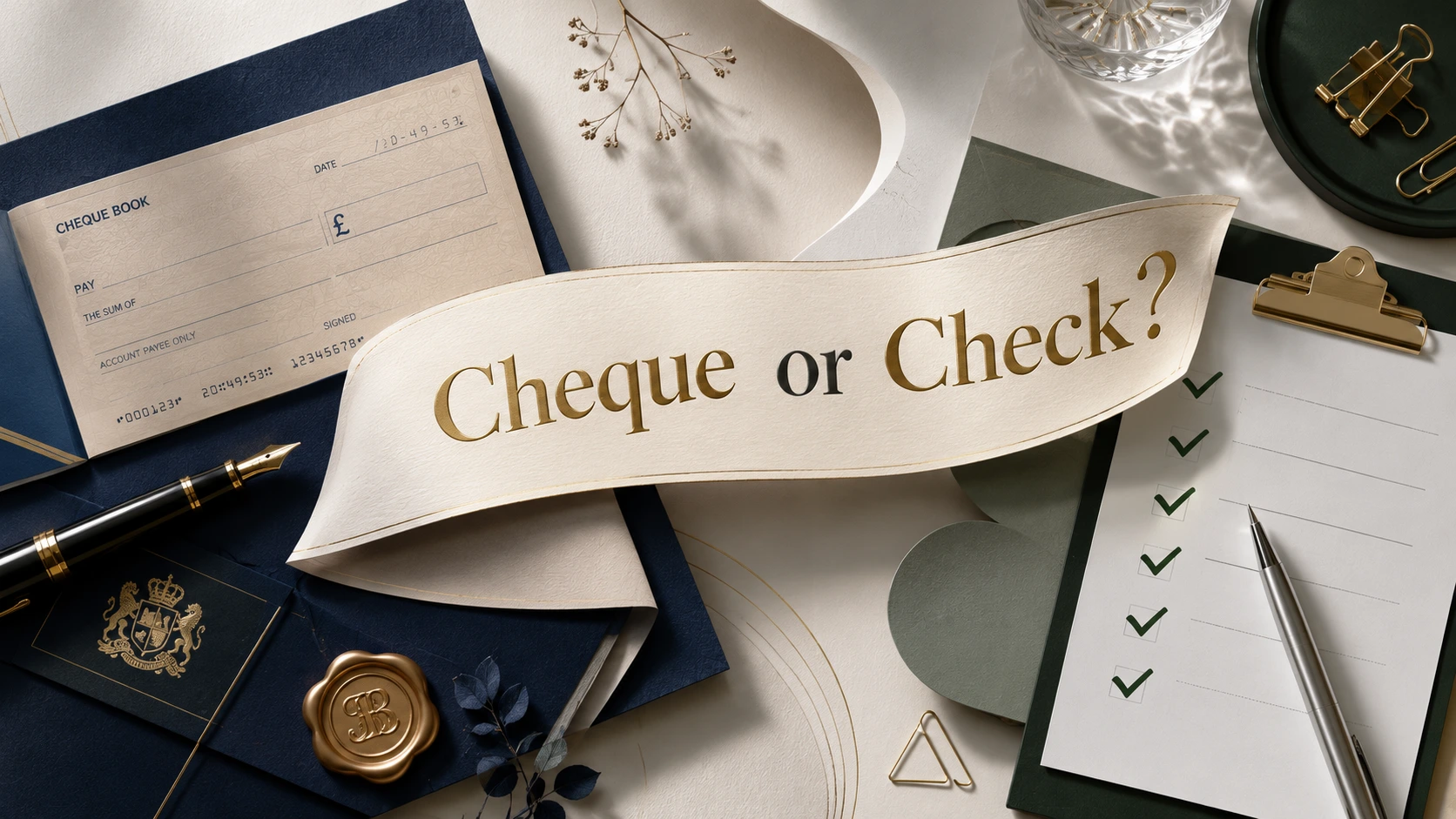
"Cheque" or "check" means a written, signed document instructing a bank to pay a specific amount of money from one account to another. Both spellings are correct. "Check" is standard in American English, while "cheque" is standard in British and Commonwealth English.
I once filled out a form at an American bank and wrote “cheque” out of habit, having grown up reading British spelling. The teller glanced at it and asked if I was visiting from abroad. I wasn’t, I’d simply never realized the spelling actually changes depending on where you are.
Turns out, both spellings are completely correct, and the right one depends entirely on which side of the English-speaking world you’re writing for. This is one of the more distinctive US versus UK spelling splits, since it involves a completely different letter combination, not just a dropped vowel or doubled consonant.
If you’ve ever paused before writing this word, unsure whether to use ck or que, this guide clears it up for good. You’ll learn exactly when each version fits, and why this particular split looks so different from other regional spelling differences.
Cheque or Check: Quick Answer
Both spellings are correct, and both refer to a written, signed order instructing a bank to pay money from one account to another.
- ✅ American English: “She wrote a check to cover the rent.”
- ✅ British English: “She wrote a cheque to cover the rent.”
The rule to remember: American English uses “check,” while British and Commonwealth English use “cheque,” specifically for this financial meaning of the word.
Cheque or Check Pronunciation
Cheque and check are pronounced exactly the same. Both words sound like /tʃek/ (“chek”), even though they are spelled differently.
| Word | Pronunciation | Sounds Like |
|---|---|---|
| Cheque | /tʃek/ | chek |
| Check | /tʃek/ | chek |
Do They Sound Different?
No. Cheque and check are homophones, meaning they have the same pronunciation but different spellings depending on the variety of English.
- Cheque is the standard spelling in British English for a written bank payment.
- Check is the standard spelling in American English for the same banking document and is also used for meanings like inspect, verify, or mark.
Example Sentences
- UK: I wrote a cheque to pay the rent.
- US: I wrote a check to pay the rent.
Although the spelling changes by region, the pronunciation remains /tʃek/ in both British and American English.
The Origin of Cheque or Check
“Check” comes from the Old French word eschequier, related to chess, originally meaning to verify or control something, much like checking a king in the game. Over time, English speakers extended this meaning to include verifying or controlling financial transactions, which is how the word eventually became associated with banking.
The spelling “cheque” developed later in British English, borrowing more directly from French spelling conventions to distinguish the banking term from other, unrelated uses of “check,” such as checking a box or checking someone’s work. American English never adopted this distinction, keeping “check” for both the banking document and every other general meaning of the word.
This is actually a narrower split than most US versus UK spelling differences. Only the banking-related meaning changes spelling, every other use of “check,” like verifying, examining, or the chess term, stays identical in both dialects.
Cheque vs Check Explained: Key Differences and Variations
| Term | Meaning | When to Use | Region/Context |
|---|---|---|---|
| Check | A written bank payment order | American English | US banking and financial writing |
| Cheque | A written bank payment order | British English | UK, Australian, Canadian banking and financial writing |
| Check | To verify, examine, or inspect | Both dialects | Universal, no regional split for this meaning |
| Check (chess) | A move threatening the king | Both dialects | Universal, no regional split for this meaning |
Notice that only the banking meaning splits by region, every other sense of the word “check” remains spelled identically across American and British English.
Which Spelling Should You Use?
For American audiences
Use check, referring to the banking document. This is standard across all American financial and general writing.
For British or Commonwealth audiences
Use cheque specifically for the banking document. This applies throughout the UK, Australia, Canada, and India.
For global or mixed audiences
Either spelling works for the financial meaning, but stay consistent throughout the same document.
For non-financial meanings of “check”
Use check in every context, regardless of dialect, since this spelling never changes for meanings like verifying, examining, or the chess term.
Galinda or Glinda: Solving the Spelling Confusion
Common Mistakes with Cheque or Check
Mistake 1: Using “cheque” for non-financial meanings
✅ Please check the document for errors before submitting.
❌ Please cheque the document for errors before submitting.
Why it happens: Writers unfamiliar with the narrow scope of this split assume “cheque” applies to every use of the word.
Mistake 2: Mixing spellings within the same document
✅ She wrote a check for the deposit, and that check cleared within two days.
❌ She wrote a cheque for the deposit, and that check cleared within two days.
Why it happens: Writers switch unconsciously, especially when copy-pasting from different sources or working with multiple contributors.
Mistake 3: Assuming one spelling is simply “wrong”
✅ Both “check” and “cheque” are correct, depending on dialect and meaning.
❌ “Cheque” is a typo for “check.”
Why it happens: People assume American English spelling rules apply universally, when they don’t.
Mistake 4: Confusing “checking” (verifying) with the banking term
✅ I’m checking my email, and I also need to deposit a check. (US)
❌ I’m chequeing my email. (incorrect in any dialect)
Why it happens: Writers occasionally overapply the regional banking spelling to verb forms of “check,” which never change regardless of region.
Mistake 5: Ignoring house style guides in professional writing
✅ Check your organization’s style guide, then stay consistent.
❌ Randomly switching between “check” and “cheque” in the same financial report.
Why it happens: Writers aren’t always aware their organization has a preferred regional spelling for financial documents.
Cheque/Check in Real-World Examples
Professional email:
“Please find attached a scanned copy of the check for your records.”
News headline (UK):
“Bank Introduces New Security Features on Cheque Payments”
Social media post:
“Just deposited my first paycheck, feeling very adult right now. 💰”
Formal document (UK):
“Payment shall be made by cheque within thirty days of invoice receipt.”
Notice how both spellings fit naturally into financial writing, the choice simply depends on the audience’s regional expectations.
Cheque/Check: Data, Trends & Usage
Search interest in “cheque vs check” is steady, driven largely by banking customers, small business owners, and international writers confirming which spelling fits their audience or transaction type. American users overwhelmingly search “check,” while UK, Australian, and Indian users search “cheque” far more often.
Unlike most spelling splits, this one carries genuine commercial importance, since banking forms, invoices, and legal documents often require the region-appropriate spelling for clarity and compliance. Financial services and accounting industries drive a notable share of searches, given how frequently this term appears in official paperwork.
Cheque vs Check: Comparison Table
| Term/Variant | Meaning | Region/Context | Best Used When |
|---|---|---|---|
| Check | A bank payment order, or to verify/examine | American English (all meanings) | Writing for a US audience, any context |
| Cheque | A bank payment order only | British and Commonwealth English | Writing for UK, Australian, or Canadian audiences, financial context only |
| Check (non-financial) | To verify, examine, or inspect | Universal, no regional split | Any context, in any English dialect |
Frequently Asked Questions
Q: What does “cheque” or “check” mean?
A: Both words refer to a written, signed document instructing a bank to pay a specific amount of money. The meaning is identical, only the spelling changes by region.
Q: How do you use “check” correctly in a sentence?
A: Use “check” the same way you’d use “cheque” for the banking meaning, for example, “I’ll write a check tomorrow” works exactly like “I’ll write a cheque tomorrow.”
Q: Cheque vs check, what’s the difference?
A: The difference is regional, and only applies to the banking meaning. American English uses “check” for everything, while British English uses “cheque” specifically for payment documents.
Q: Is “cheque” acceptable in formal writing?
A: Yes, especially in British, Australian, or Commonwealth contexts, specifically for financial documents. American style guides use “check” instead.
Q: Which version is correct, cheque or check?
A: Both are correct for the banking meaning. Choose based on your audience’s region, and use “check” for every other meaning regardless of dialect.
Q: Where does the word “check” come from?
A: It comes from Old French eschequier, related to chess, originally meaning to verify or control something before extending to financial transactions.
Q: Does “checking” as a verb change spelling in British English?
A: No. “Checking,” meaning to verify or examine, stays the same in both American and British English. Only the noun referring to the banking document changes.
Final Takeaway
Here’s the short version. Both “check” and “cheque” are correct for the banking document, the choice depends on your audience, not on right versus wrong.
Key points to remember:
- The rule: American English uses “check” for everything; British English uses “cheque” only for banking
- Narrower than most splits: Every other meaning of “check” stays identical in both dialects
- Financial writing matters: This split carries real significance in banking and legal documents
- Consistency matters: Pick one style per document and stick with it
Once you know your audience, choosing between “check” and “cheque” becomes automatic.
Bookmark this guide so you never second-guess “check” vs “cheque” again, and share it with anyone writing for international banking or financial audiences.
Cheque vs Check: Learn the correct spelling, regional differences, and usage with simple examples for British and American English
Couch vs. Coach: What’s the Difference and How to Use Each Correctly (2026)

I specialize in spelling comparisons, confusing word pairs, grammar, and vocabulary development. My content helps readers improve their English, avoid common mistakes, and write with confidence. My goal is to provide accurate, reliable, and easy-to-understand language resources