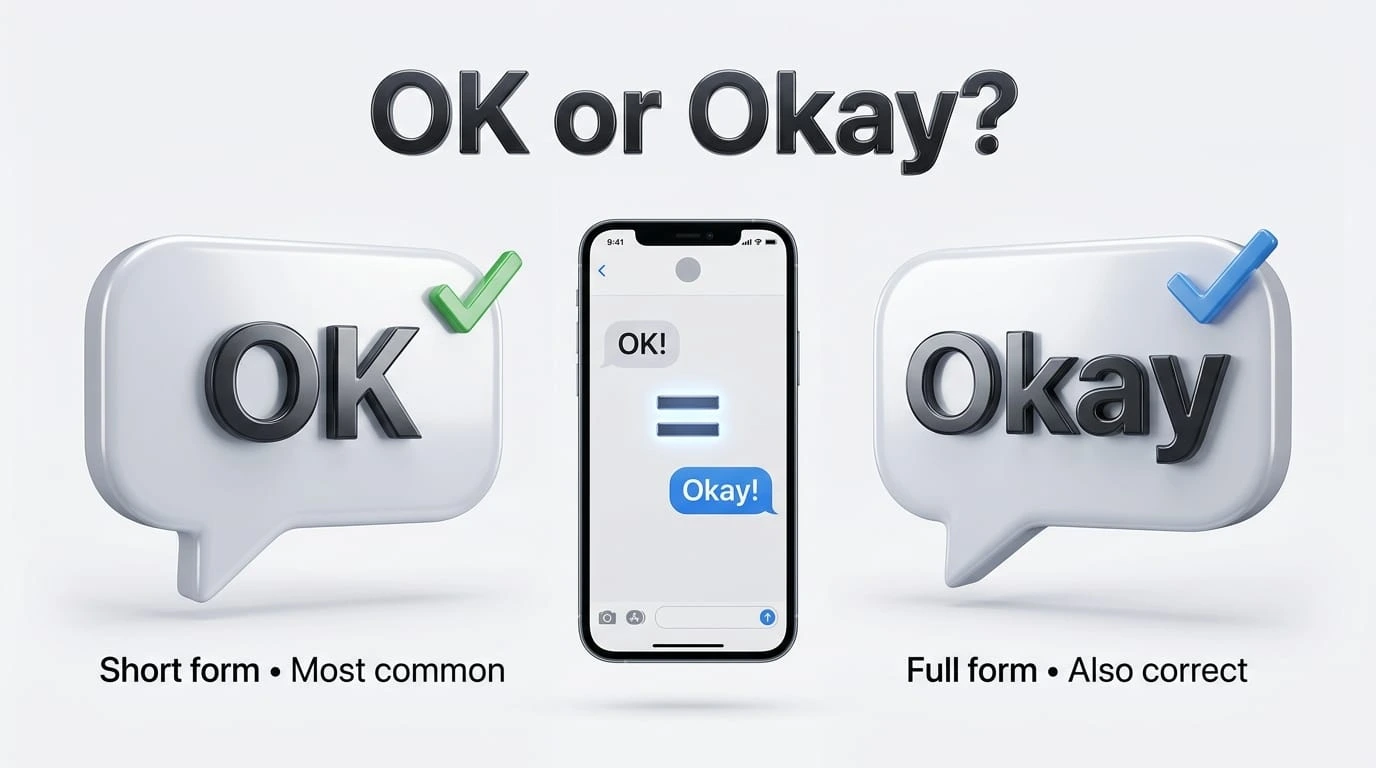
OK and okay are both correct English words with the same meaning. OK is more common in business writing, forms, and headlines, while okay often feels more natural in everyday and conversational writing.
A few years ago, I was editing an email before sending it to a client. I wrote, “Everything looks okay.” Then I paused and wondered if OK would look more professional. That tiny decision turned into a surprisingly interesting grammar question.
If you’ve searched for OK or okay, you’ve probably had the same thought. Both forms appear everywhere in text messages, emails, books, news articles, and even official documents. Since they have the same meaning, many people wonder if one is more correct than the other.
The good news is that neither is wrong. OK and okay are both accepted in modern English. The real difference is style, tone, and context rather than grammar. Knowing when to use each one can make your writing look more polished and natural.
In this guide, you’ll learn where these words came from, how they differ, when to choose one over the other, and the common mistakes you should avoid.
OK or Okay: Quick Answer
Both OK and okay mean acceptable, satisfactory, or all right. They have the same meaning, but OK is usually preferred in formal, professional, and shortened writing, while okay is common in casual and conversational English.
Examples
- ✅ The report is OK to publish.
- ✅ I’m okay now. Thanks for asking.
Quick Memory Tip:
If you want a short, clean style, choose OK. If you prefer a more conversational tone, okay works perfectly.
The Origin and Background of OK or Okay
The story behind OK is one of the most interesting in the English language.
Most language experts believe OK began in the United States during the 1830s. At that time, writers enjoyed using humorous abbreviations with intentionally misspelled phrases. One of them was “oll korrect,” a playful spelling of “all correct.” It was shortened to OK, and the abbreviation quickly became popular.
The phrase became even more famous during the 1840 U.S. presidential election, when supporters of President Martin Van Buren used OK as part of his campaign slogan because he was nicknamed “Old Kinderhook.”
Years later, people started spelling the abbreviation as okay to match how it sounded when spoken.
Today, both forms are accepted by major English dictionaries and style guides.
OK or Okay Explained: Key Differences
Although OK and okay have the same meaning, they are used slightly differently depending on tone and style.
| Term | Meaning | When to Use | Region/Context |
| OK | Acceptable, approved, all right | Business writing, headlines, forms, buttons | Worldwide |
| Okay | Acceptable, fine, all right | Conversations, blogs, informal writing | Worldwide |
Use OK
Choose OK when you want writing that looks short, direct, and professional.
Examples:
- The manager said the proposal is OK.
- Press OK to continue.
- Everything is OK now.
Use Okay
Choose okay when writing naturally in conversations or storytelling.
Examples:
- Are you okay after the accident?
- It’s okay if you’re running late.
- She felt okay after resting.
The meaning does not change. Only the writing style feels different.
Which Version Should You Use?
The best choice depends on your audience and the type of writing.
Students
You can use either form in essays if your teacher has no preference. Just stay consistent throughout your work.
Business Professionals
Use OK in emails, reports, forms, presentations, and workplace communication because it looks concise and professional.
Bloggers and Content Writers
Both forms are acceptable. Okay often creates a warmer, more conversational tone that readers enjoy.
Fiction Writers
Use okay in dialogue because it sounds more natural when characters speak.
Global English
Whether you’re writing for readers in the United States, the United Kingdom, Canada, Australia, or elsewhere, both OK and okay are widely understood. There is no British vs American spelling difference between them.
The most important rule is to be consistent. Don’t switch between OK and okay without a reason.
Common Mistakes with OK or Okay
Because both forms are correct, the biggest mistakes involve consistency and inappropriate style rather than spelling.
| Mistake | Correct Form | Why |
| Mixing OK and okay in the same document | Choose one style | Consistency improves readability |
| Writing ok in formal documents | OK | Uppercase is more professional in formal writing |
| Assuming okay is incorrect | Okay is correct | Major dictionaries accept both forms |
| Thinking OK is only an abbreviation | OK is now treated as a standard English word | It has become a complete word over time |
| Using O.K. everywhere | OK | Modern English usually drops the periods |
Why These Mistakes Happen
People often get confused because:
- They think OK is only an abbreviation.
- They assume okay is informal or incorrect.
- Different books and style guides prefer different forms.
- Software, apps, and websites often use OK, while everyday conversations usually use okay.
A simple rule to remember is:
- OK = Short and professional.
- Okay = Natural and conversational.
Blonde or Blond: The Correct Spelling (2026)
OK or Okay in Real-World Examples
Seeing OK and okay in everyday situations makes it easier to choose the right one.
Professional Email
✅ Your request has been reviewed and is OK to proceed.
✅ Everything looks OK. We can move forward with the project.
News Headline
✅ City Council Says New Safety Plan Is OK to Launch.
✅ Doctors Confirm the Injured Driver Is Okay.
Social Media Post
✅ I’m okay now. Thanks for all your kind messages! ❤️
✅ Vacation is over, but that’s okay. Time to make new memories.
Formal Report
✅ The inspection found all equipment OK for normal operation.
✅ The results were reviewed and marked OK by the quality assurance team.
OK or Okay: Data, Trends & Usage
The keyword “OK or okay” receives steady search interest because many English learners and writers want to know whether one form is more correct than the other.
Searches are especially common in:
- United States
- United Kingdom
- Canada
- Australia
- India
Search Intent
- Primary Intent: Informational
- Audience: Students, professionals, bloggers, editors, and English learners
Usage Trends
In digital interfaces, apps, and software, OK is far more common because it is short and easy to recognize. In blogs, novels, and personal conversations, okay appears more often because it feels warmer and more natural.
Why This Matters
Choosing the right style helps your writing match your audience. A business report may look cleaner with OK, while a friendly email or social media post often sounds better with okay.
OK vs Okay Comparison Table
| Term/Variant | Meaning | Region/Context | Best Used When |
| OK | Acceptable, approved, all right | Worldwide | Business writing, forms, headlines, buttons |
| Okay | Acceptable, fine, all right | Worldwide | Conversations, blogs, emails, everyday writing |
Frequently Asked Questions
Q: Is OK or okay correct?
A: Both are correct. They have the same meaning, and the best choice depends on your writing style and audience.
Q: Is “okay” more formal than “OK”?
A: No. In fact, OK is often preferred in business writing because it is shorter and widely recognized. Okay is more common in casual writing and conversations.
Q: Is OK an abbreviation?
A: It began as an abbreviation in the 1830s, but today OK is considered a complete English word by major dictionaries and style guides.
Q: Should I use OK in academic writing?
A: Yes, you can. However, some academic writing may sound more formal if you use words like acceptable, approved, or satisfactory, depending on the context.
Q: Is there a British and American difference between OK and okay?
A: No. Both British English and American English accept OK and okay. The difference is mainly one of style, not region.
Q: Why do computers and phones use OK instead of okay?
A: OK is shorter and easier to fit on buttons, menus, and screens. That’s why it became the standard choice for software and digital interfaces.
Q: Can I use OK and okay in the same article?
A: You can, but it’s better to stay consistent. Choose one style unless you have a specific reason to switch between them.
Conclusion
The debate over OK or okay is not about right versus wrong. Both forms are correct, accepted by dictionaries, and understood around the world. The difference comes down to style and context rather than grammar.
If you’re writing a business email, filling out a form, creating a website button, or preparing a report, OK is usually the better choice because it is short, clean, and professional. If you’re writing a blog, chatting with friends, telling a story, or posting on social media, okay often feels warmer and more conversational.
The most important rule is consistency. Pick one style and use it throughout your writing. That small detail makes your work look polished and professional.
Now you know exactly when to use OK and okay. Bookmark this guide so you never second-guess your choice again, and share it with someone who has wondered which version is correct.
OK or okay explained with meanings, differences, examples, usage tips, and advice to choose the right form confidently every time.
Accept or Except: Which one is correct? (2026)

I am a professional content writer with a strong interest in English spelling and vocabulary. I am interested in creating informative guides on commonly confused words, spelling differences, and language usage to help readers write more accurately and effectively.