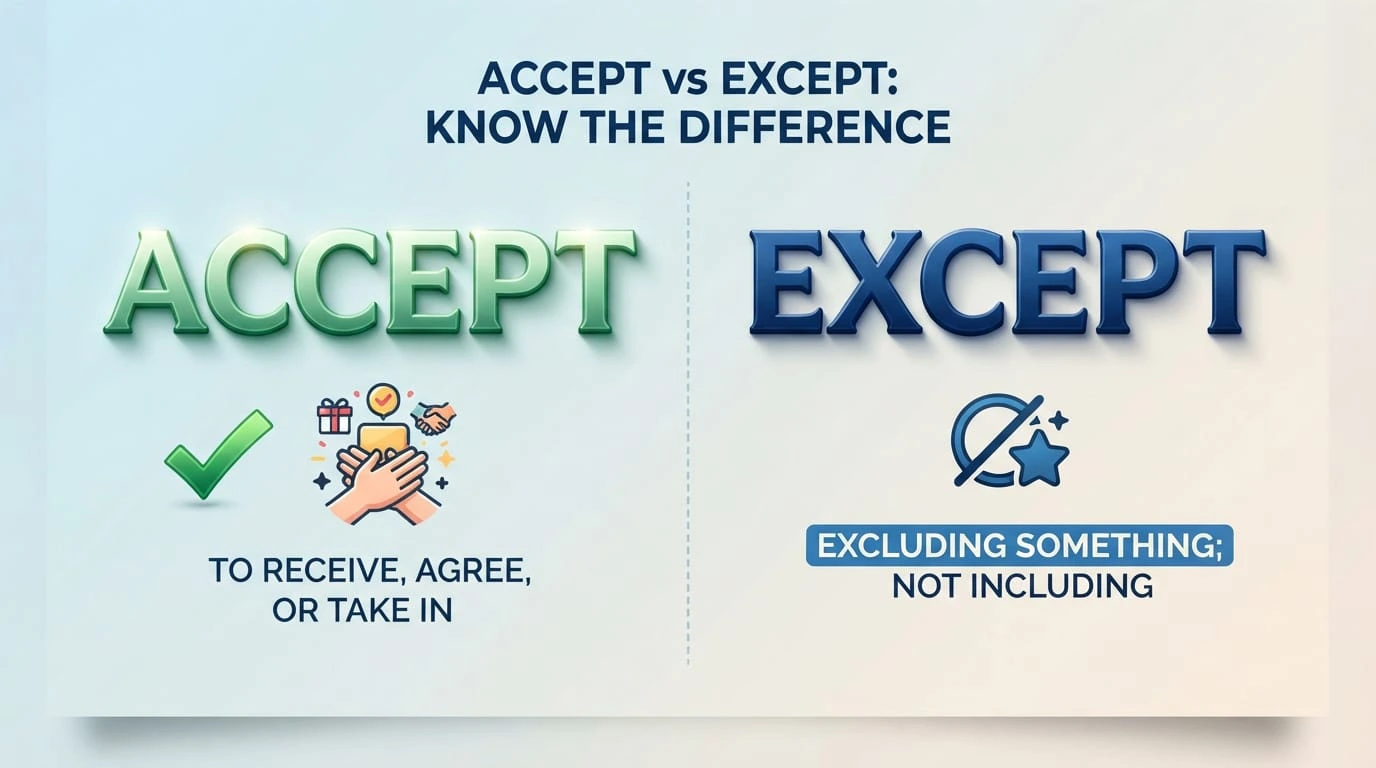
Accept means to receive, agree to, or approve something. Except means excluding or leaving something out. They sound similar but have completely different meanings and uses.
Have you ever paused while writing an email and wondered whether to use accept or except? I certainly have. Years ago, I was proofreading an article when I wrote, “Everyone accepted the invitation except John.” For a second, I almost typed accept instead of except because they sound nearly identical. That small mistake completely changed the sentence.
This confusion is common among students, English learners, and even native speakers. Since both words are pronounced similarly, it’s easy to mix them up while writing. Spell check may not always catch the mistake because both real English words.
If you’ve searched for accept or except, you’re probably looking for a simple explanation. Which word should you use? How do you remember the difference? This guide answers those questions with clear examples, easy memory tricks, and practical writing tips.
Quick Answer
- Accept means to receive, agree to, or say yes.
- Except means excluding someone or something.
Examples
✅ I accept your apology.
✅ All the stores were open except one.
Choosing the correct word depends on the meaning of your sentence.
The Origin and Background
Both words come from Latin, but they developed different meanings over time.
The word accept comes from the Latin word acceptare, meaning to receive willingly or to welcome.
The word except comes from the Latin word excipere, meaning to leave out or to take out.
Because both words share similar sounds and historical roots, they are often confused in modern English. However, their meanings have remained very different.
Today:
- Accept is usually a verb.
- Except is most often a preposition, although it can sometimes be a conjunction or verb.
Understanding this difference makes choosing the correct word much easier.
Key Differences
The biggest difference is their meaning.
| Term | Meaning | When to Use | Part of Speech |
|---|---|---|---|
| Accept | To receive, agree to, approve, or welcome | When saying “yes” to something | Verb |
| Except | Excluding or leaving something out | When talking about an exception | Usually a preposition |
Which Version Should You Use?
The correct choice depends entirely on what you want to say.
| If You Mean… | Use This Word | Example |
|---|---|---|
| Receive something | Accept | I accept your offer. |
| Agree to something | Accept | She accepted the invitation. |
| Leave something out | Except | Everyone came except Liam. |
| Exclude someone | Except | All rooms were full except one. |
For Students
Think about the sentence.
If someone is receiving or agreeing, choose accept.
If someone or something is being left out, choose except.
For Professionals
Use accept when talking about:
- Job offers
- Business proposals
- Invitations
- Payments
- Agreements
Use except when describing exclusions or exceptions.
Burned or Burnt: The Correct Spelling (2026)
Common Mistakes
Many people confuse these words because they sound almost the same.
Here are the mistakes seen most often.
| Mistake | Correct |
|---|---|
| I except your apology. | I accept your apology. |
| Everyone accept Tom came. | Everyone except Tom came. |
| We except credit cards. | We accept credit cards. |
| All days are open accept Sunday. | All days are open except Sunday. |
| Please except my invitation. | Please accept my invitation. |
Why Does This Mistake Happen?
Several reasons explain the confusion.
- Both words sound very similar.
- They differ by only one letter.
- Spell check cannot always detect the error.
- Writers focus on pronunciation instead of meaning.
- English learners often memorize spelling before understanding usage.
The best solution is to think about the meaning before choosing the word.
An Easy Trick to Remember the Difference
Here’s the memory trick I use.
Remember “A” for Ac.cept
Remember “EX” for Except
Except begins with EX.
Think of:
EX = Exclude
If something is excluded or left out, use except.
Quick Memory Formula
- Accept = Agree
- Except = Exclude
This simple trick helps you choose the correct word almost every time.
Real-World Examples
Seeing these words in real situations makes the difference much easier to remember.
Professional Email
Dear Sarah,
We are pleased to accept your proposal for the upcoming marketing campaign. Thank you for your detailed presentation.
Best regards,
Michael
News Headline
All Schools Reopen Except Those Affected by Flooding
Social Media Post
I accepted the challenge, and I’m excited to see where it takes me! 💪
Formal Report
All departments met their quarterly targets except the finance division, which requested additional time.
Everyday Conversation
“I’d love to accept your invitation, but I’m out of town.”
“Everyone was there except Jake.”
Data, Trends & Usage
The keyword “accept or except” is searched by thousands of English learners each month because the two words sound almost identical but have very different meanings.
Here are a few useful insights.
- Search Intent: Informational
- Primary Audience: Students, English learners, teachers, writers, and professionals
- Most Common Question: “When should I use accept instead of except?”
- Difficulty Level: Beginner to Intermediate
Who Searches This Topic Most?
This grammar topic is especially popular among:
- Students preparing for English exams
- ESL (English as a Second Language) learners
- Content writers and bloggers
- Teachers and editors
- Professionals writing emails and reports
Why Does This Matter Today?
Using the wrong word can completely change the meaning of a sentence.
For example:
- Please accept my apology. ✔️
- Please except my apology. ❌
Small word choices make a big difference in clear communication.
Standalone Comparison Table
| Term/Variant | Meaning | Part of Speech | Best Used When |
|---|---|---|---|
| Accept | To receive, agree to, approve, or welcome | Verb | Someone receives or agrees to something |
| Except | Excluding or leaving something out | Usually a preposition | Someone or something is not included |
Quick Tips to Remember the Difference
Use these simple tricks whenever you’re unsure.
- Accept starts with A, which reminds you of Agree.
- Except starts with EX, which reminds you of Exclude.
- Think about the meaning before choosing the word.
These habits will help you avoid one of the most common English mistakes.
Frequently Asked Questions
Q: What is the difference between both?
A: Accept means to receive, agree to, or approve something. Except means to leave someone or something out.
Q: Which is correct?
A: Both words are correct, but they have different meanings. Choose accept when someone receives or agrees to something, and except when you mean excluding someone or something.
Q: Is accept a verb?
A: Yes. Accept is a verb because it describes an action, such as receiving an invitation, accepting an apology, or agreeing to an offer.
Q: Is except always a preposition?
A: Most of the time, yes. Except usually functions as a preposition meaning “excluding,” although it can occasionally act as a conjunction or verb in certain contexts.
Q: How can I remember the difference easily?
A: Remember this simple rule: Accept = Agree and Except = Exclude. The first letters help you remember the correct meaning.
Conclusion
If you’ve ever wondered whether to use accept or except, the answer depends on what you want to say. Accept means to receive, agree to, or approve something, while except means excluding or leaving something out. Although the words sound almost identical, their meanings are completely different.
Whenever you’re unsure, focus on the meaning instead of the pronunciation. That small habit will help you choose the correct word every time.
Whether you’re writing an email, completing a school assignment, preparing a report, or posting online, using accept and except correctly makes your writing clearer and more professional.
Either or Neither: What’s The Difference?

I am a professional content writer with a strong interest in English spelling and vocabulary. I am interested in creating informative guides on commonly confused words, spelling differences, and language usage to help readers write more accurately and effectively.