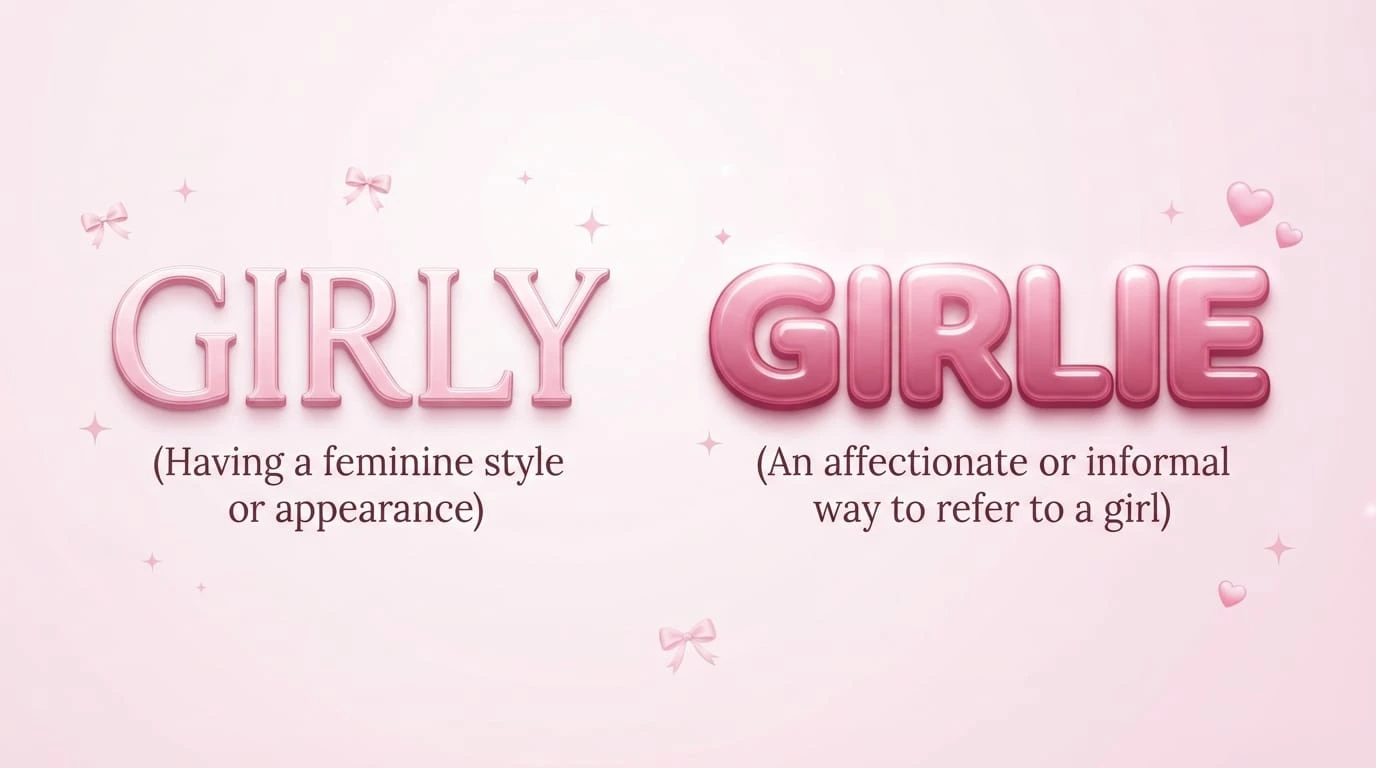
“Girly” and “girlie” both describe something considered stereotypically feminine, cute, or associated with girls. Both spellings are correct, though “girly” is more common in everyday modern writing.
I once wrote a product description for a boutique client, describing a dress as having a “girlie charm.” My editor asked if I meant “girly” instead. Honestly, I wasn’t sure which spelling was actually correct, I’d seen both used plenty of times.
Here’s the twist: both spellings are genuinely accepted. Unlike a lot of English spelling debates, this one doesn’t come down to a strict right-versus-wrong answer. Both “girly” and “girlie” appear in dictionaries, though they carry slightly different tones depending on context.
This guide breaks down exactly where each spelling comes from, which one shows up more often today, and how to choose confidently between “girly” and “girlie” in your next piece of writing.
Quick Answer
Both “girly” and “girlie” describe something considered stereotypically feminine, often cute, delicate, or associated with girls or girlhood.
- ✅ She decorated her room in a girly pink theme.
- ✅ He teased his brother for wearing a girlie apron.
In modern usage, “girly” has become the more common spelling overall, especially in casual and everyday writing. “Girlie” survives mostly in older or specific idiomatic contexts.
The Origin of Girly/Girlie
Both spellings trace back to the same source, “girl,” combined with the adjective-forming suffix “-y” or its variant “-ie.” English frequently allows both endings for informal or diminutive adjectives, which is exactly why two spellings developed side by side rather than one clearly winning out.
Historically, “girlie” appeared first in casual English usage during the early 20th century, often used affectionately or, in some contexts, in phrases like “girlie magazine,” a somewhat dated term referring to publications featuring pin-up style photography. This particular usage gave “girlie” a slightly different cultural connotation over time.
“Girly” gained popularity later, especially from the mid-20th century onward, and gradually became the more neutral, widely accepted spelling for describing anything feminine or cute, from clothing to decor to personality traits.
Girly vs Girlie Explained: Key Differences and Variations
| Term | Meaning | When to Use | Context |
|---|---|---|---|
| Girly | Feminine, cute, or associated with girls | General everyday use | Fashion, decor, casual conversation |
| Girlie | Feminine, cute, or associated with girls | Older or idiomatic use | Vintage phrases, informal or dated writing |
| Girlie (dated) | Referring to pin-up style content | Rare, historical context | Older publications, historical references |
Unlike stricter spelling pairs, “girly” and “girlie” largely overlap in meaning, the main difference lies in tone and how modern or dated each spelling feels.
Which Spelling Should You Use?
For general or modern writing
Use girly. It’s the more widely recognized and commonly used spelling in current everyday English.
For fashion, lifestyle, or product descriptions
Girly is the safer, more contemporary choice, since it reads as neutral and current.
For vintage, retro, or historical writing
Girlie can work well if you’re intentionally evoking an older tone or referencing period-specific phrases.
For global or neutral use
Girly is the safer default, since it dominates modern search volume and everyday usage across most English-speaking regions.
Common Mistakes with Girly/Girlie
Mistake 1: Assuming one spelling is simply wrong
✅ Both “girly” and “girlie” are accepted spellings.
❌ “Girlie” is a typo for “girly.”
Why it happens: People assume every spelling variation must have one strictly correct answer, when this one allows both.
Mistake 2: Mixing spellings within the same document
✅ The store sells girly accessories, and each girly item is handmade.
❌ The store sells girly accessories, and each girlie item is handmade.
Why it happens: Writers switch unconsciously between the two accepted forms.
Mistake 3: Using “girlie” without realizing its dated connotation
✅ Check your context, since “girlie” can carry an old-fashioned or specific historical tone.
❌ Using “girlie” in modern marketing copy without considering how it might read to readers.
Why it happens: Writers unfamiliar with the word’s history may not realize it can sound outdated in certain contexts.
Mistake 4: Overthinking casual, everyday writing
✅ Pick either spelling for casual writing, and stay consistent.
❌ Agonizing over “girly” versus “girlie” in a quick text or casual social post.
Why it happens: Writers assume this distinction matters more in casual contexts than it actually does.
Mistake 5: Ignoring brand or publication style guides
✅ Check whether your organization has a preferred spelling before publishing.
❌ Assuming every publication treats “girly” and “girlie” identically.
Why it happens: Style guides vary, and not every writer checks before submitting content.
OK or Okay: Which One Should You Use? ✅
Girly/Girlie in Real-World Examples
Professional email:
“The new packaging design leans into a soft, girly aesthetic that matches our target audience.”
News headline:
“Retailer Faces Backlash Over ‘Too Girly’ Marketing for Children’s Toys”
Social media post:
“Feeling extra girly today, pink everything. 💗”
Formal document (historical context):
“The magazine was once criticized for its girlie cover imagery, a term rarely used in modern publishing.”
Notice how “girly” dominates current, everyday writing, while “girlie” appears more often in historical or intentionally retro contexts.
Girly/Girlie: Data, Trends & Usage
Search interest in “girly vs girlie” is steady, driven largely by writers, marketers, and parents confirming spelling before publishing content related to fashion, toys, or lifestyle branding. This falls into the informational search category, with people wanting a fast, reliable answer before finalizing copy.
“Girly” consistently dominates modern search volume, especially in fashion, beauty, and parenting content. “Girlie” sees more niche interest, often tied to vintage or historical searches, or occasional confusion from writers encountering the older spelling in classic literature or older media.
Girly vs Girlie: Comparison Table
| Term/Variant | Meaning | Region/Context | Best Used When |
|---|---|---|---|
| Girly | Feminine, cute, associated with girls | Dominant in modern English | General, everyday, and marketing writing |
| Girlie | Feminine, cute, associated with girls | Older, idiomatic, or historical use | Vintage tone, dated phrases, historical references |
| Girlish | Behaving or appearing like a young girl | Universal, slightly different nuance | Describing behavior or demeanor, not style |
Frequently Asked Questions
Q: What does “girly” or “girlie” mean?
A: Both words describe something considered stereotypically feminine, cute, or associated with girls, such as clothing, decor, or personality traits.
Q: How do you use “girly” correctly in a sentence?
A: Use “girly” the same way you’d use “girlie,” for example, “She has a girly sense of style” works exactly like “She has a girlie sense of style.”
Q: Girly vs girlie, what’s the difference?
A: There’s no strict grammatical difference. “Girly” is the more modern, widely used spelling, while “girlie” carries a slightly older or more idiomatic tone.
Q: Is “girlie” acceptable in formal writing?
A: It’s uncommon in formal writing overall, but when used, it typically appears in historical, vintage, or intentionally retro contexts rather than modern professional writing.
Q: Which version is correct, girly or girlie?
A: Both are correct. Choose “girly” for modern, everyday use, or “girlie” if you’re intentionally referencing an older or vintage tone.
Q: Where does the word “girly” come from?
A: It comes from “girl” plus the adjective suffix “-y,” with “girlie” as an earlier variant using “-ie” instead, both developing as informal, feminine-associated adjectives.
Q: Can “girlie” sound outdated in modern writing?
A: Yes, in some contexts. Because of its association with older phrases and dated publications, “girlie” can read as old-fashioned compared to the more contemporary “girly.”
Final Takeaway
Here’s the short version. Both “girly” and “girlie” are correct; this isn’t a right-versus-wrong spelling situation.
Key points to remember:
- The rule: No strict rule exists; both spellings are dictionary-accepted
- Modern trend: “Girly” leads in everyday and marketing use
- Watch the tone: “Girlie” can read as dated or historical in certain contexts
- Consistency matters: Pick one spelling per document and stick with it
Once you know both are valid, choosing between “girly” and “girlie” comes down to tone and context, not correctness.
Tear or Tare: The Correct Word (2026)

I’m an English language researcher and content writer. I am specialized in spelling comparisons, commonly confused words, grammar usage, and vocabulary guides. Through detailed language articles,I am helping readers to understand the differences between similar words and improve their written communication skills.