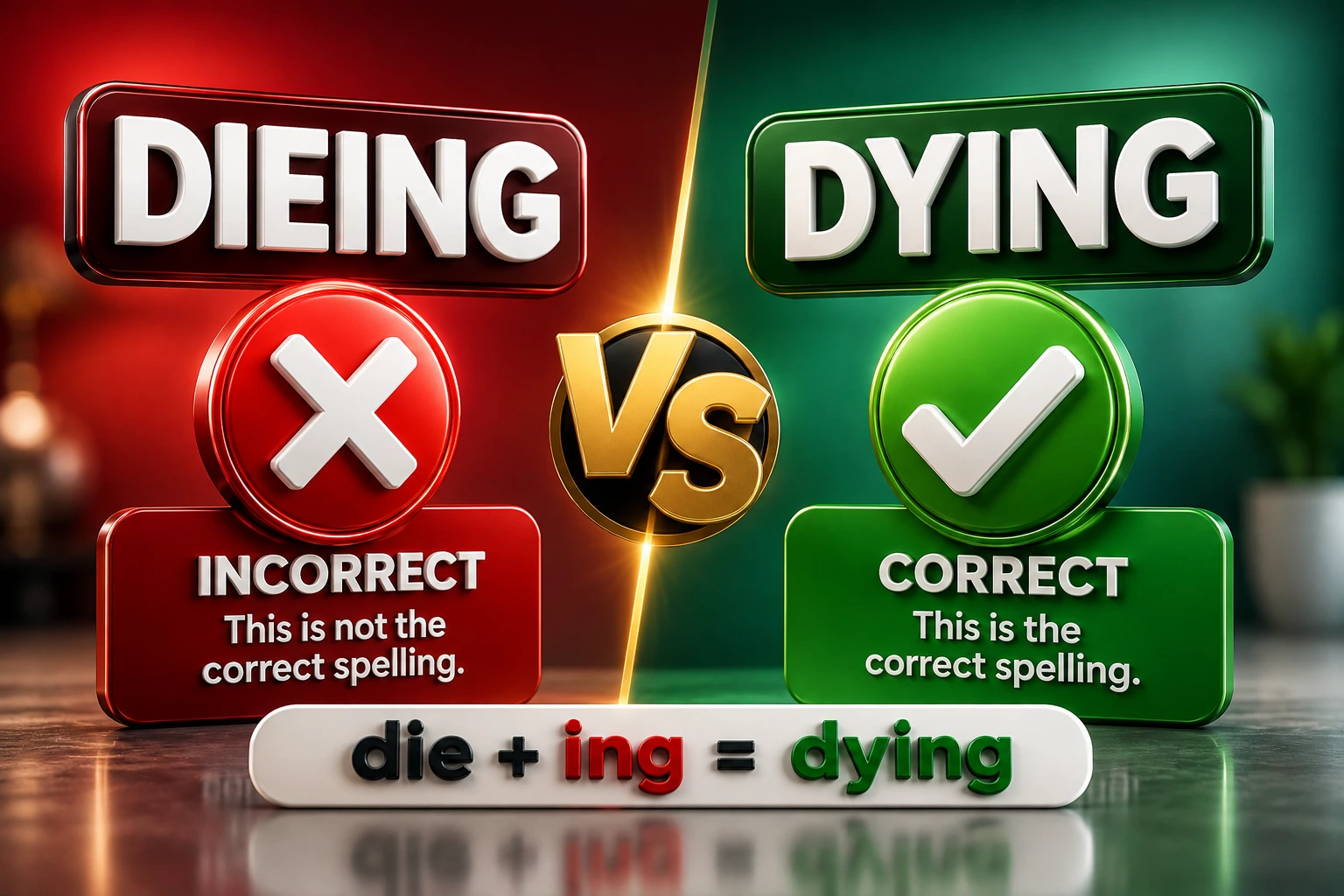
Dying is the correct spelling. Dieing is usually incorrect when you mean “stopping to live” or “coming to an end.” The correct form of die + -ing is dying.
Have you ever typed dieing and then paused because it looked wrong? That tiny spelling mistake is easy to make. The word die seems like it should simply become dieing when you add -ing. But English does not follow that pattern here.
As an English writer, I have seen this mistake many times. It often appears in school work, social media posts, emails, and even quick messages. The problem is not the meaning. Most people know what they want to say. The problem is knowing what happens to the spelling when die becomes an -ing form.
The correct word is dying.
Once you learn the spelling rule behind it, the difference becomes much easier to remember. This guide explains dieing vs dying, why dying is correct, what dieing means in rare cases, and how to use each form in real sentences.
Dieing or Dying: Quick Answer
Dying is the correct spelling when die means to stop living, fail, fade away, or stop functioning.
The plant is dying.
The old battery is dying.
Dieing is generally not the correct spelling for these meanings.
However, dieing can rarely be a valid word when it comes from the noun die, meaning a tool used to cut, shape, or stamp material. In normal everyday English, though, dying is the word you almost always need.
The Origin and Background of Dieing and Dying
The confusion comes from the spelling of the verb die.
Many English verbs form their present participle by adding -ing:
- make → making
- take → taking
- write → writing
- hope → hoping
So it may seem logical to write:
die → dieing
But English has a special spelling pattern here.
When die becomes an -ing form, the ie changes to y:
die → dying
The same type of spelling change appears in:
lie → lying
and
tie → tying
This helps explain why dying looks different from the base word die.
The spelling is not random. It follows a common English spelling pattern used when certain verbs ending in -ie take -ing.
Dieing or Dying Explained: Key Differences
The easiest way to understand these words is to separate their meanings.
| Term | Meaning | When to Use | Region/Context |
| Dying | Stopping living or coming to an end | Use with the verb die | Standard English |
| Dieing | Cutting, shaping, or stamping with a die | Rare technical use | Manufacturing and technical contexts |
What does dying mean?
Dying is the present participle of die.
It can describe a person, animal, plant, machine, feeling, trend, or other thing that is coming to an end.
Examples:
The flowers are dying.
The patient is dying.
My phone battery is dying.
The tradition is slowly dying out.
What does dieing mean?
Dieing is a rare technical form related to die as a noun.
A die can be a tool used to cut, shape, or stamp materials such as metal.
For example:
The factory is dieing the metal parts.
This use is uncommon in everyday writing. Most readers searching for dieing or dying are trying to spell the -ing form of the verb die.
So, if you mean “stopping to live,” use dying.
Why Is Dying Spelled With a Y?
This is the key spelling rule to remember.
When some verbs ending in -ie take -ing, the ie changes to y.
Examples
| Base Verb | + ing Form |
| die | dying |
| lie | lying |
| tie | tying |
So:
die + ing ❌ dieing
die + ing ✅ dying
A simple memory trick is:
IE changes to Y before ING.
Think:
die → dying
lie → lying
tie → tying
This makes the spelling much easier to remember.
Which Version Should You Use?
For almost all everyday situations, choose dying.
For students
Use dying when writing about someone or something coming to an end.
The plant is dying because it needs water.
For professional writing
Use dying when the word describes decline, failure, or an ending.
The company is dying because it has lost many customers.
For everyday conversation
Dying is also the correct choice.
My phone is dying.
I’m dying of laughter.
For technical writing
Dieing may appear in a specialized manufacturing context when die is being used as a tool or process.
If you are not talking about manufacturing, cutting, stamping, or shaping with a die, dying is almost certainly the form you need.
Common Mistakes with Dieing or Dying
1. Writing dieing for the verb die
Incorrect:
The flowers are dieing.
Correct:
The flowers are dying.
The mistake happens because writers add -ing directly to die.
2. Assuming every verb simply takes -ing
English spelling has several changes when suffixes are added.
For die, the spelling changes:
die → dying
Do not simply attach -ing.
3. Confusing dying with dyeing
This is another common problem.
Dying comes from die.
Dyeing comes from dye, which means changing the color of something.
Compare:
The plant is dying.
She is dyeing her hair.
These words sound similar, but they have completely different meanings.
4. Using dieing when you mean dyeing
Incorrect:
She is dieing her shirt blue.
Correct:
She is dyeing her shirt blue.
The second sentence means she is changing the shirt’s color.
5. Using dying when talking about a manufacturing die
In a specialized technical context, dieing can have a different meaning.
For example:
The machine is dieing the metal components.
This is rare outside technical writing. Do not use it as the normal spelling of die + ing.
Die, Dying, Dye, and Dyeing
These four words are easy to mix up.
| Word | Meaning | Example |
| Die | Stop living | Plants die without water. |
| Dying | In the process of dying | The plant is dying. |
| Dye | Add color to something | We will dye the fabric. |
| Dyeing | In the process of adding color | She is dyeing the fabric. |
A quick memory trick
If you mean life ending, think:
die → dying
If you mean adding color, think:
dye → dyeing
The extra e stays in dyeing because dye is a different word.
Word Forms Of Die
| Form | Word |
|---|---|
| Base verb | die |
| Present participle | dying |
| Past tense | died |
| Past participle | died |
| Noun | death |
Dieing or Dying in Real-World Examples
1. Professional email
Subject: Dying Plant in the Office
Hi Sarah,
I noticed that the office plant is dying. Could we arrange for it to be watered regularly?
Here, dying means the plant is becoming unhealthy and may die.
2. News article
Local Tradition Is Dying Out as Younger People Move Away
Here, dying means the tradition is gradually disappearing.
3. Social media post
My phone is dying, and I forgot my charger!
This is a common informal use.
4. Formal report
The report found that several local businesses were dying due to declining demand.
Here, dying means the businesses were failing or becoming less active.
5. Technical context
The factory uses specialized equipment for dieing metal components.
Here, dieing has a specialized meaning related to the use of a die as a tool.
Dieing or Dying; Data, Trends & Usage
The search intent behind “dieing or dying” is mainly informational. People usually search this phrase because they want to know which spelling is correct.
The confusion is easy to understand. Many English verbs simply take -ing, so dieing looks logical at first glance.
There is also another source of confusion: dyeing. Since dying and dyeing sound alike, writers sometimes mix all three spellings.
For everyday English, the practical rule is simple:
If you mean the process of dying, spell it D-Y-I-N-G.
You only need dieing in rare technical contexts involving the noun die.
Standalone Comparison Table
| Term/Variant | Meaning | Region/Context | Best Used When |
| Dying | In the process of dying or ending | Standard English | Talking about death, decline, failure, or disappearance |
| Dieing | Using a die to cut or shape something | Rare technical English | Talking about a specialized manufacturing process |
| Dyeing | Coloring something with dye | Standard English | Talking about changing the color of fabric, hair, or another material |
| Die | To stop living or exist | Standard English | Used as the base verb |
FAQs About Dieing or Dying
Q: Is dieing or dying correct?
A: Dying is correct when you mean the process of dying. Dieing is only used in rare technical contexts involving a manufacturing die.
Q: Why is dying spelled with a y?
A: The spelling changes when die takes -ing. The ie changes to y, giving us dying.
Q: Is “dieing” ever a correct word?
A: Yes, but it is rare. Dieing can refer to using a die as a tool to cut, shape, or stamp material. In normal writing, you almost always need dying.
Q: Is dying the correct spelling of die + ing?
A: Yes. The correct form is dying, not dieing. This follows the spelling pattern in words such as lying and tying.
Q: What is the difference between dying and dyeing?
A: Dying means coming to an end or stopping to live. Dyeing means changing the color of something.
Q: Is “the plant is dieing” correct?
A: No. The correct sentence is “The plant is dying.” Use dying because the sentence describes a plant losing its life.
Q: Is “I am dying” grammatically correct?
A: Yes. I am dying is grammatically correct. It uses am + dying, the present continuous form of the verb die.
Q: Is “dying” acceptable in formal writing?
A: Yes. Dying is the standard spelling and is completely acceptable in formal writing. The context determines whether the literal or figurative meaning is intended.
Conclusion
The choice between dieing and dying is much easier once you know the spelling rule.
When you mean stopping to live, use dying. It is the standard present participle of die.
Remember:
- Die → dying
- Lie → lying
- Tie → tying
- Dye → dyeing
The spelling dieing does exist, but it has a rare technical use connected to a die, a tool used to shape or cut material. It is not the normal -ing form of die.
Also watch out for dyeing. If you are talking about changing the color of fabric, hair, or another object, dyeing is the word you need.
So, when you want to say that someone, something, or an idea is coming to an end, choose dying.
Issac or Isaac: Which Spelling Is Correct?

I’m an English language researcher and content writer. I am specialized in spelling comparisons, commonly confused words, grammar usage, and vocabulary guides. Through detailed language articles,I am helping readers to understand the differences between similar words and improve their written communication skills.