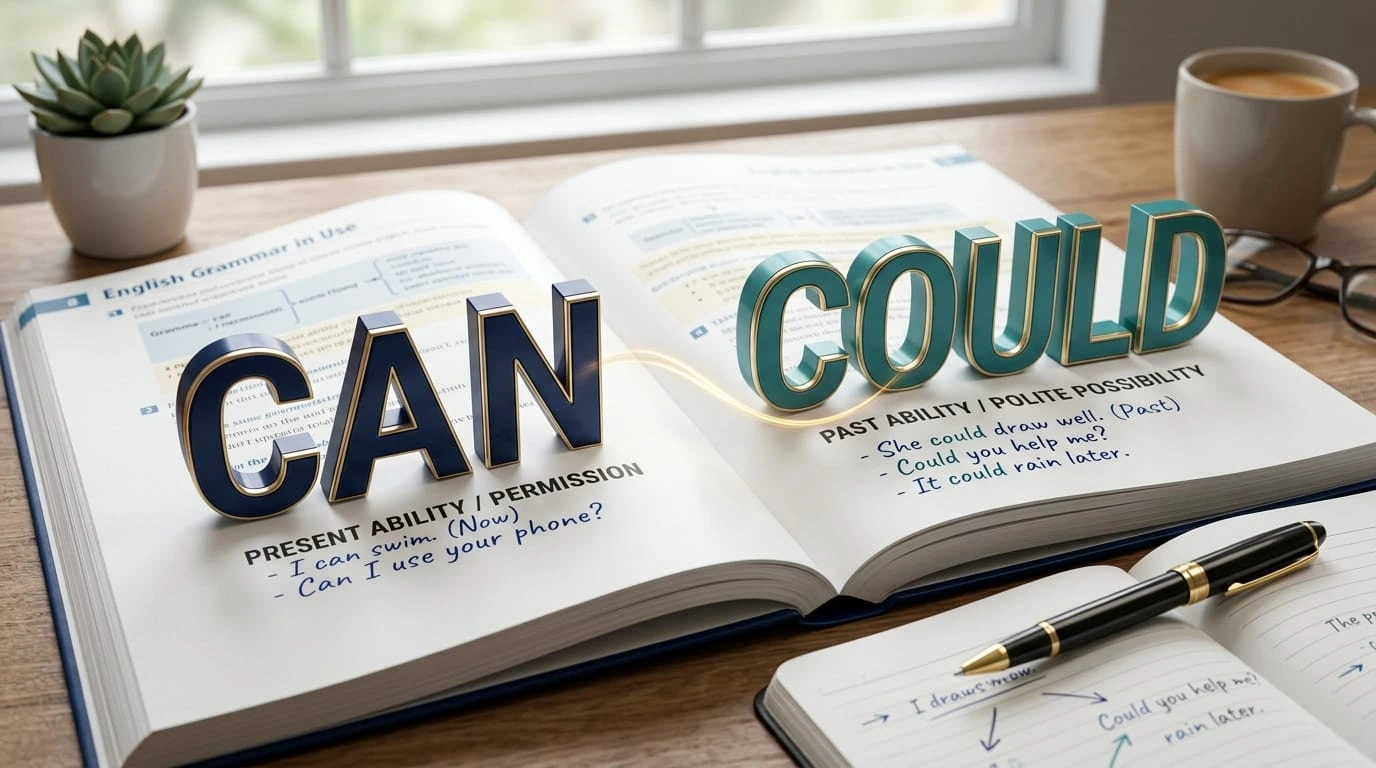
“Can you help me?” and “Could you help me?” look almost identical, yet they do not always sound the same. This tiny change can make English learners stop and think.
Can usually talks about present ability, permission, or possibility. Could can describe past ability, polite requests, or a possible situation, so the best choice depends on context.
I have noticed this confusion often when helping writers improve everyday English. The problem is not that can and could are difficult words. The problem is that both can talk about ability, possibility, and requests. Their meanings overlap, but their time, tone, and level of certainty can change.
For example, can usually sounds direct and natural:
I can swim.
But when talking about ability in the past, we often use could:
I could swim when I was five.
Then there is politeness:
Can you open the window?
Could you open the window?
Both are requests, but could often sounds more polite or less direct.
This guide will show you exactly when to use each word, with simple rules, examples, common mistakes, and practical comparisons.
Can or Could: Quick Answer
Can and could are both modal verbs, but they are not interchangeable in every sentence.
Use can for:
- Present ability
- General possibility
- Permission
- Direct requests
I can drive.
Can I use your phone?
Use could for:
- Past ability
- More polite requests
- Possibility that is less certain
- Suggestions
- Conditional situations
I could swim when I was six.
Could you help me?
The easiest rule is:
Can = present, direct, or more certain.
Could = past, polite, possible, or conditional.
The Origin and Background of Can and Could
Can and could are closely related.
The history of “can”
Can comes from Old English cunnan, which meant “to know,” “to know how,” or “to be able.”
Over time, the meaning became strongly connected with ability.
Today, we use can to show that someone has the ability to do something:
She can speak French.
The history of “could”
Could developed as the past form associated with can.
Its older history is linked to forms of the verb that eventually developed into modern could.
Today, could still commonly expresses past ability:
When I was young, I could run very fast.
But its use expanded beyond past time. Modern English also uses could for polite requests, suggestions, possibility, and conditional ideas.
That is why simply thinking of could as “the past of can” is not enough.
Can vs. Could Explained
The key difference depends on what you are trying to express.
1. Ability
Use can for present ability.
I can play the piano.
Use could for general ability in the past.
I could play the piano when I was a child.
2. Permission
Can is common for asking or giving permission in everyday English.
Can I leave early?
You can use my laptop.
Could can sound more polite:
Could I leave early?
This does not usually refer to past permission. It is a polite request for permission now.
3. Requests
Both can make requests.
Can you pass the salt?
Could you pass the salt?
The second sounds softer and more polite.
4. Possibility
Can can describe general possibility:
It can get very cold here in winter.
Could can describe a particular possibility:
It could rain tonight.
The second sentence suggests that rain is possible, but it is not certain.
5. Suggestions
Could is often used to suggest an option.
We could take the train.
This means taking the train is one possible choice.
Can vs. Could Comparison Table
| Term | Meaning | Region/Context | Best Used When |
| Can | Present ability | Standard English | Talking about what someone is able to do now |
| Could | Past ability | Standard English | Talking about general ability in the past |
| Can | Permission | Everyday English | Asking or giving permission |
| Could | Polite permission | Everyday/formal English | Making a softer request |
| Can | General possibility | Standard English | Describing something that can happen |
| Could | Possible situation | Standard English | Describing a particular possibility |
| Could | Suggestion | Standard English | Offering an option |
| Could | Conditional ability | Standard English | Talking about what would be possible under certain conditions |
Which One Should You Use?
The right choice depends on your meaning.
For present ability → use can
I can drive.
You are talking about an ability you have now.
For past ability → use could
I could ride a bike when I was four.
You are talking about a general ability in the past.
For a direct request → use can
Can you help me?
This is natural and common.
For a polite request → use could
Could you help me?
This sounds softer and more polite.
For general possibility → use can
Too much sun can damage your skin.
This describes something that is generally possible.
For a specific possibility → use could
The package could arrive tomorrow.
This describes one possible future outcome.
For a global audience
Both are standard English. The important issue is meaning, not British versus American spelling.
Can or Could for Requests?
This is one of the most common questions.
Can you…?
Can you send me the file?
This is perfectly polite in normal conversation.
Could you…?
Could you send me the file?
This is usually softer and more polite.
Which is better?
Neither is grammatically “better.”
Use can when you want a natural, direct request.
Use could when you want a softer or more formal tone.
Compare:
Can you close the door?
Could you close the door?
The second can sound more courteous, but both are normal English.
Can or Could for Permission?
Both can appear when asking for permission.
Can I…?
Can I borrow your pen?
This is common and natural.
Could I…?
Could I borrow your pen?
This is more polite or tentative.
Important point
Although could is historically related to the past form of can, could I…? does not normally mean that you are asking about past permission.
It is simply a polite way to ask for permission.
Common Mistakes with Can and Could
1. Using “could” for every past ability
❌ I could swim across the river yesterday.
This can sound like general past ability rather than one successful action.
For a single completed achievement, was able to is often clearer:
✅ I was able to swim across the river yesterday.
However, could is natural for general past ability:
When I was younger, I could swim for hours.
2. Thinking “could” always means past
❌ Could is only the past form of can.
✅ Could has several modern uses.
It can express:
- Past ability
- Polite requests
- Possibility
- Suggestions
- Conditional ability
3. Thinking “can” is rude
❌ Can you help me? is rude.
✅ Can you help me? is a normal polite request.
Could you help me? may sound softer, but can is not automatically rude.
4. Using “can” for a specific uncertain future event
It can rain tomorrow.
This is possible in some contexts, but if you mean one uncertain future event, could is usually more natural:
It could rain tomorrow.
5. Confusing possibility and ability
Compare:
I can swim.
This means I have the ability.
I could swim when I was young.
This describes past ability.
I could swim tomorrow.
This does not naturally mean future ability. Context is needed.
Can or Could in Real-World Examples
Professional email
Can:
Can you send the updated report by Friday?
Could:
Could you send the updated report by Friday?
For professional emails, could often sounds a little softer.
News article
Heavy rain could cause delays across the region.
Here, could expresses possibility.
Another example:
Extreme heat can cause serious problems for older adults.
Here, can describes a general possibility.
Social media post
Can anyone recommend a good book?
This is a natural everyday question.
You could also write:
Could anyone recommend a good book?
This sounds slightly more tentative.
Formal document
The proposed changes could reduce costs.
This means the changes have the potential to reduce costs.
The new system can reduce costs when used correctly.
This describes a general capability.
Can or Could for Possibility
This difference is especially useful.
Can = general possibility
Accidents can happen.
This means accidents are possible in general.
Could = particular possibility
An accident could happen if the road remains icy.
This focuses on a particular situation.
Compare:
Exercise can improve your mood.
General possibility.
Exercise could improve your mood.
A possible result in a particular situation.
Can or Could for Conditional Sentences
Could is common when talking about what would be possible under certain conditions.
If we leave early, we could catch the first train.
This means catching the train is a possible result.
Compare:
We can catch the first train.
This sounds more certain or simply states that it is possible based on the current situation.
Can vs. Could: Confidence and Certainty
One useful way to remember the difference is to think about certainty.
Can
Often sounds more direct or certain:
She can finish the work today.
This suggests that finishing today is within her ability or available options.
Could
Often sounds more tentative:
She could finish the work today.
This suggests that finishing today is one possibility.
It does not guarantee that she will.
Can or Could: Data, Trends & Usage
The search intent for “can or could” is strongly informational. Learners usually want to understand the grammar difference and choose the right modal verb in a sentence.
The confusion is common because can and could overlap in several areas. Both can be used for requests. Both can relate to possibility. And could is connected historically with can.
The most useful distinction is not simply “present versus past.”
Instead, consider three questions:
- Are you talking about ability?
- Are you making a request?
- Are you describing possibility or a condition?
Once you answer those questions, the correct modal is usually much easier to choose.
Can vs. Could: Quick Rules
| Situation | Use | Example |
| Present ability | Can | I can swim. |
| General past ability | Could | I could swim at six. |
| Everyday permission | Can | Can I go? |
| Polite permission | Could | Could I go? |
| Direct request | Can | Can you help? |
| Softer request | Could | Could you help? |
| General possibility | Can | It can be dangerous. |
| Specific possibility | Could | It could be dangerous tonight. |
| Suggestion | Could | We could leave early. |
| Conditional possibility | Could | We could win if we practice. |
Can or Could: Which Is More Polite?
Could is generally considered more polite or less direct when making a request.
Compare:
Can you open the window?
Could you open the window?
Both are polite in normal conversation. The second simply softens the request.
You can think of it this way:
Can = direct and friendly
Could = softer and more tentative
The difference is about tone, not basic correctness.
Frequently Asked Questions
Q: What is the difference between can and could?
A: Can commonly expresses present ability, permission, or general possibility. Could can express past ability, polite requests, suggestions, conditional situations, and possible outcomes.
Q: Is could the past tense of can?
A: Could is historically related to the past form of can, and it is used for past ability. However, modern English also uses could for requests, possibility, suggestions, and conditional meanings.
Q: Is “Can you help me?” correct?
A: Yes. Can you help me? is a normal and polite request. Could you help me? is also correct and usually sounds a little softer.
Q: Is “Could you help me?” more polite than “Can you help me?”
A: Usually, yes. Could you…? often sounds more polite or less direct. However, Can you…? is also commonly used as a polite request.
Q: Can I use could for present situations?
A: Yes. Could is not limited to the past. For example, Could you help me? refers to a present request, while It could rain tonight refers to a future possibility.
Q: Should I use can or could for possibility?
A: Use can for general possibilities and could for a particular or uncertain possibility. For example, Accidents can happen describes a general truth, while It could happen tonight describes a specific possibility.
Q: Which is better for formal writing, can or could?
A: Both can be correct. Could may sound more cautious or tentative, while can is often clearer when describing ability or general possibility. Choose the word that matches your intended meaning.
Conclusion
Understanding can or could becomes much easier when you stop thinking of them as simple interchangeable words.
Use can for present ability, everyday permission, direct requests, and general possibilities. Use could for past ability, softer requests, suggestions, conditional situations, and uncertain possibilities.
Remember that could does not always mean past. You can use it for a present request:
Could you help me?
You can also use it for a future possibility:
It could rain tonight.
The best choice depends on what you want your sentence to mean and how certain or direct you want it to sound.
When you are talking about a current ability, can is usually the natural choice. When you want to make a request softer or describe a possibility, could often fits better.
Elfs or Elves: Which Spelling Is Correct?

I specialize in spelling comparisons, confusing word pairs, grammar, and vocabulary development. My content helps readers improve their English, avoid common mistakes, and write with confidence. My goal is to provide accurate, reliable, and easy-to-understand language resources