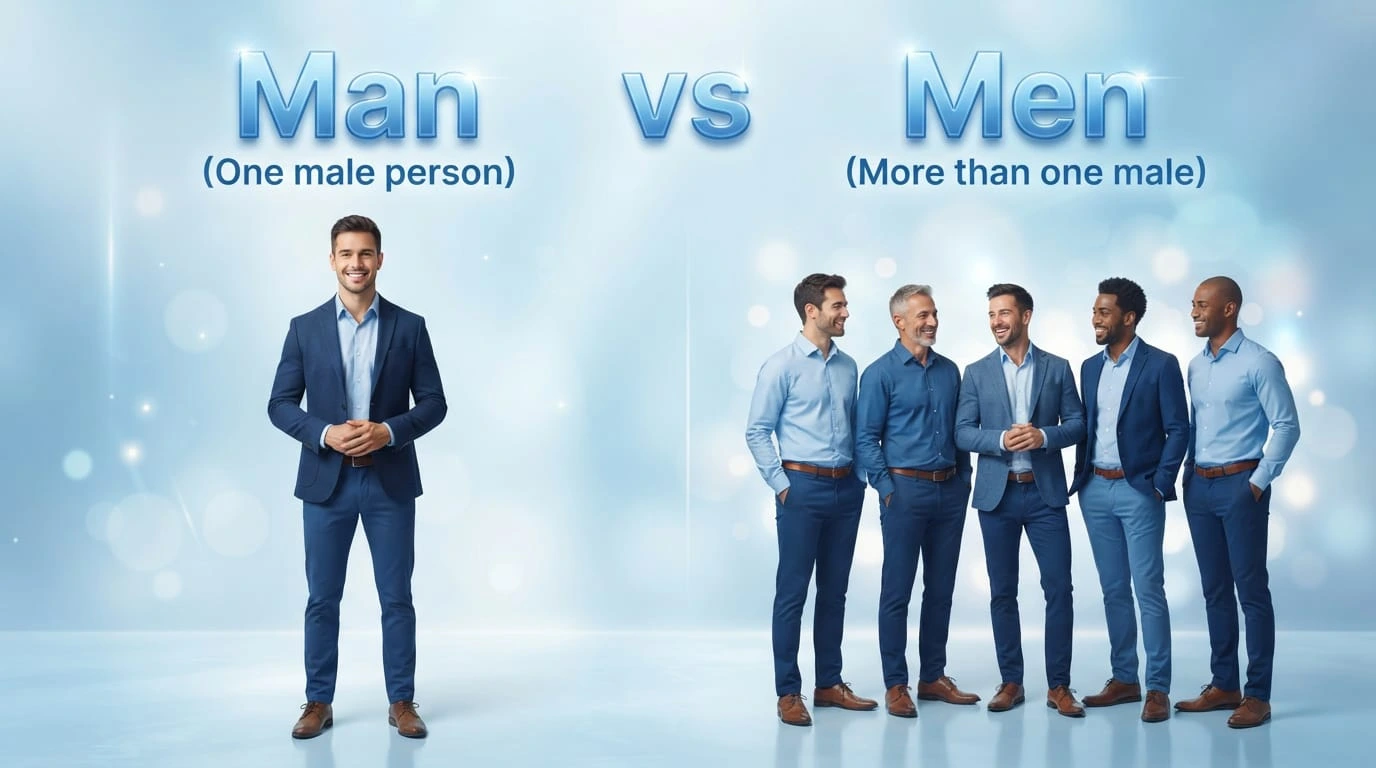
“Man” means one adult male person, the singular form. “Men” means more than one adult male person, the plural form. They aren’t spelling variants, they’re the singular and plural versions of the same word, following an irregular pattern.
I once drafted a project summary describing “a three man team” handling a client account. My manager corrected it to “three-person team,” then gently pointed out that even if I’d kept “man,” it needed to be “men” to match the plural number.
If you’ve ever paused over which form to use, you’re not alone. “Man” and “men” follow one of English’s classic irregular plural patterns, and while native speakers usually get it right instinctively, explaining the actual rule trips up a surprising number of writers and learners.
This guide breaks down exactly when to use “man,” when “men” is correct, and how this irregular pattern compares to other similar English words.
Man or Men: Quick Answer
“Man” refers to one adult male person.
- ✅ A man walked into the store.
“Men” refers to more than one adult male person.
- ✅ Several men walked into the store.
- ❌ Several man walked into the store.
A simple trick: if you’re talking about exactly one person, use “man.” If you’re talking about two or more, use “men.”
The Origin of Man/Men
“Man” comes from Old English mann, which originally referred to a human being of any gender before narrowing over time to specifically mean an adult male. Its plural form, “men,” comes from the same root, menn, and reflects a pattern called umlaut pluralization, an old Germanic process where a vowel sound shifts to signal a change in number, rather than adding a suffix like “-s.”
This same irregular pattern shows up in a small, well-known group of English nouns:
- man → men
- woman → women
- foot → feet
- tooth → teeth
Unlike most English nouns, which simply add “-s” or “-es” to form plurals, these words change their internal vowel instead. This pattern is a leftover from Old English grammar, and it’s exactly why “man” doesn’t become “mans” the way “cat” becomes “cats.”
Man vs Men Explained: Key Differences and Variations
| Term | Meaning | When to Use | Example |
|---|---|---|---|
| Man | One adult male person | Singular reference | A man crossed the street. |
| Men | More than one adult male person | Plural reference | Several men crossed the street. |
| Individuals | Humanity as a whole (older, gender-general usage) | Broad, general reference | Individual have made remarkable progress. |
| Man (verb) | To operate or staff something | Describing an action | They man the front desk in shifts. |
Notice that “man” can also function as a verb, meaning to operate or staff something, which follows entirely different rules from the noun forms “man” and “men.”
Which Word Should You Use?
When referring to one person
Use man. This applies whenever you’re describing a single adult male individual.
When referring to more than one person
Use men. This applies to any group of two or more adult male individuals.
When referring to humanity broadly
Consider whether “humanity,” or “people” better fits modern, gender-inclusive writing, since “man” alone can sound outdated when used generically.
For workplace or team descriptions
Consider gender-neutral alternatives like “team,” “staff,” or “crew” instead of “man” or “men,” especially in professional or inclusive writing contexts.
Common Mistakes with Man/Men
Mistake 1: Using “man” with a plural number
✅ Five men joined the volunteer group.
❌ Five man joined the volunteer group.
Why it happens: Writers sometimes treat “man” like an unchanging word, similar to “sheep” or “fish,” when it actually has a distinct plural form.
Mistake 2: Adding “-s” to “man” instead of using “men”
✅ The men gathered in the conference room.
❌ The mans gathered in the conference room.
Why it happens: English learners often apply the standard “-s” pluralization rule without realizing “man” is irregular.
Mistake 3: Confusing compound words that include “man” or “men”
❌ policeman, fireman, businessman used incorrectly as plurals
Why it happens: Compound words follow the same singular-to-plural shift as the base word, and writers sometimes forget to adjust the ending.
Mistake 4: Using “man” generically without considering modern usage
✅ Humanity has faced many challenges throughout history.
❌ Man has faced many challenges throughout history, without considering whether a more inclusive term fits the context better.
Why it happens: Older writing conventions used “man” broadly to mean all people, a usage many modern style guides now discourage.
Where or Were: Complete GuideTo The Correct Usage (2026)
Man/Men in Real-World Examples
Professional email:
“We’ll need two men from the warehouse team to help load the truck tomorrow morning.”
News headline:
“Search Continues for Missing Man Last Seen Near the Trailhead”
Formal document:
“The report identified three men and two women among the survey respondents.”
Notice how “man” and “men” shift naturally based on whether the sentence describes one person or several.
Man/Men: Data, Trends & Usage
Search interest in “man vs men” stays fairly steady, driven largely by ESL learners, students, and writers confirming correct pluralization before submitting assignments or professional writing. This falls into the informational search category, with people wanting a clear, simple answer about basic grammar.
This topic sees consistent interest from language learners specifically, since irregular plurals like “man/men,” “woman/women,” and “foot/feet” are commonly taught together as an exception group in English grammar lessons. Because the pattern doesn’t follow standard pluralization rules, it remains a frequently searched grammar topic for learners at all levels.
Man vs Men: Comparison Table
| Term/Variant | Meaning | Region/Context | Best Used When |
|---|---|---|---|
| Man | One adult male person | Universal, all English dialects | Referring to a single person |
| Men | More than one adult male person | Universal, all English dialects | Referring to two or more people |
| Humans | Humanity broadly (older usage) | Universal, though increasingly replaced | Formal or historical writing, though many prefer “humanity” today |
Frequently Asked Questions
Q: What does “man” mean?
A: “Man” refers to a single adult male person. It can also function as a verb meaning to operate or staff something, such as “to man a station.”
Q: How do you use “men” correctly in a sentence?
A: Use “men” whenever referring to more than one adult male person, such as “The men finished the project ahead of schedule.”
Q: Man vs men, what’s the difference?
A: “Man” is singular, referring to one person, while “men” is plural, referring to more than one. They follow an irregular pluralization pattern rather than simply adding “-s.”
Q: Is “men” acceptable in formal writing?
A: Yes, completely. “Men” is standard in formal, academic, and professional writing whenever referring to multiple adult male individuals.
Q: Which version is correct, man or men?
A: Both are correct, but they refer to different quantities. Use “man” for one person and “men” for more than one.
Q: Where does the word “men” come from?
A: It comes from Old English menn, following an ancient Germanic pluralization pattern that changes the internal vowel rather than adding a suffix.
Q: Can “man” be used to refer to all of humanity?
A: Yes, historically, though many modern style guides now recommend “humanity,” “people,” or “human” instead, since “man” alone can sound outdated or exclude half of the population in general references.
Final Takeaway
Here’s the short version. “Man” is singular. “Men” is plural. They follow one of English’s classic irregular pluralization patterns, not a simple “-s” ending.
Key points to remember:
- The rule: “Man” changes its internal vowel to become “men,” rather than adding “-s”
- Same pattern elsewhere: “Woman/women” and “foot/feet” follow the identical irregular pattern
- Consider modern usage: Many style guides now favor inclusive alternatives to generic uses of “man”
Once you lock in the singular-versus-plural distinction, you’ll never confuse “man” and “men” again.
Like or As: The Complete Guide to Using Them Correctly

I’m an English language researcher and content writer. I am specialized in spelling comparisons, commonly confused words, grammar usage, and vocabulary guides. Through detailed language articles,I am helping readers to understand the differences between similar words and improve their written communication skills.