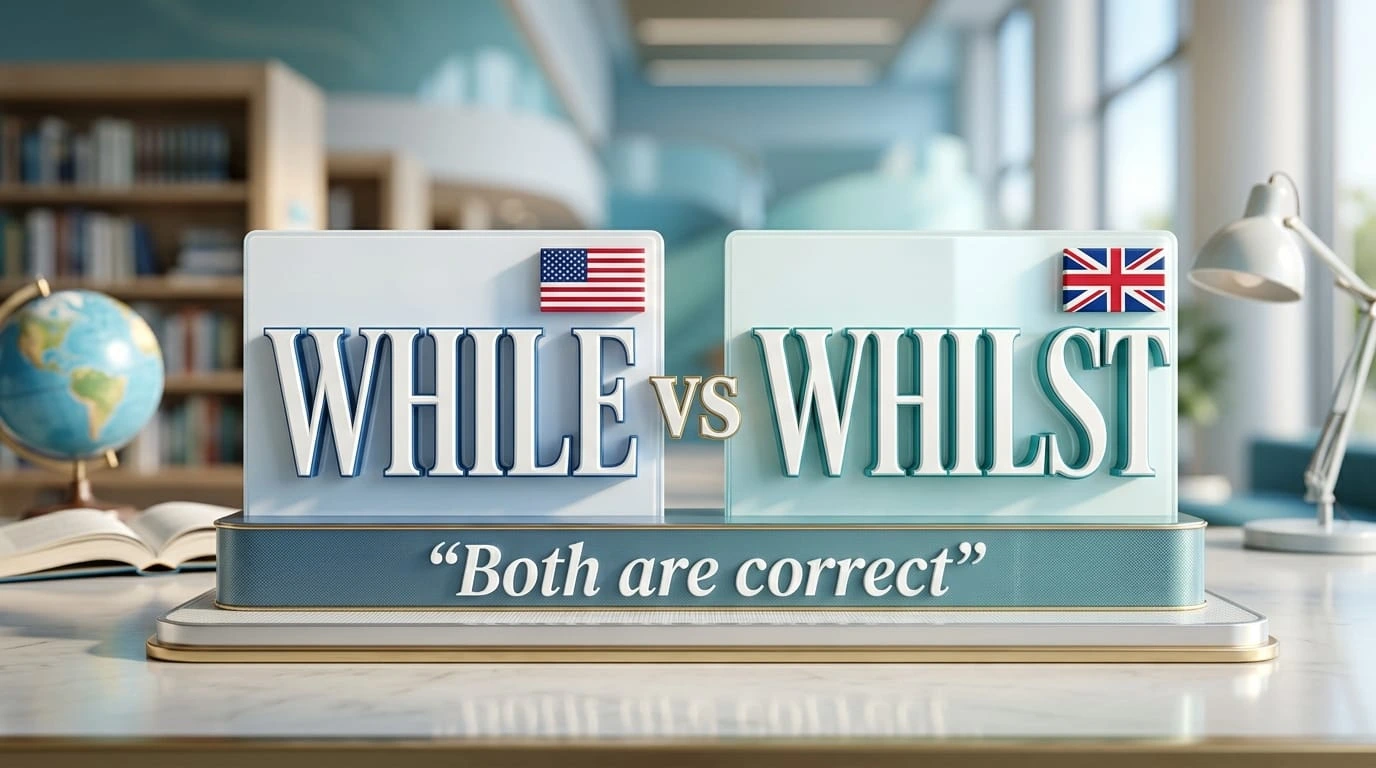
While and whilst have the same basic meaning, but while is more common and works naturally in both American and British English. Whilst is mainly used in British English and can sound more formal or old-fashioned.
Have you ever written a sentence with while, then wondered if whilst would sound better? This is a common question, especially when reading British English.
Both words can mean “during the time that” or “although.” For example, you can say, “I listened to music while I worked” or “I listened to music whilst I worked.” The basic meaning stays the same.
As an English writer, I often see learners hesitate over this small difference. The confusion usually comes from style rather than grammar. One word is not simply “correct” while the other is “wrong.”
The real question is which one sounds natural for your audience and situation.
In this guide, you will learn the meaning, history, pronunciation, grammar, regional differences, and practical uses of while and whilst. You will also see examples that show when each word works best.
By the end, choosing between them should feel much easier.
While or Whilst: Quick Answer
While and whilst can both be used as conjunctions to mean “during the time that.” They can also introduce a contrast, similar to “although” or “whereas.”
For most readers, while is the safer and more natural choice.
Examples
I read a book while I waited for the bus.
I read a book whilst I waited for the bus.
Both sentences are grammatically correct.
The main difference is style and regional preference:
- While → common in American and British English
- Whilst → more common in British English
- While → usually more natural in everyday writing
- Whilst → can sound more formal, traditional, or literary
So, if you are unsure, choose while.
The Origin and Background of While and Whilst
The two words have a long shared history.
Where does “while” come from?
While comes from Old English hwīl, meaning “a period of time” or “a space of time.”
Over time, the word developed into the conjunction we use today.
Its meaning expanded from a period of time to the idea of something happening during that period.
For example:
She listened to music while she studied.
Here, the word connects two actions happening at the same time.
Where does “whilst” come from?
Whilst developed as a form of while with the added ending -st.
Older forms such as whilest appeared in English. Over time, this developed into the modern form whilst.
So, whilst is not a completely different word. It is historically related to while.
This explains why the two words can often be used in the same sentence without changing the basic meaning.
Why do both words still exist?
English often keeps older and newer forms of words at the same time.
In this case, while became the more widely used form, especially in modern everyday English. Whilst survived more strongly in British English and is still used today.
That does not make whilst incorrect. It simply gives it a different style and regional feel.
While vs. Whilst Explained
The biggest difference between while and whilst is not their basic meaning.
It is how they sound and where they are commonly used.
| Term | Meaning | When to Use | Region/Context |
| While | During the time that; although | Everyday and formal writing | American and British English |
| Whilst | During the time that; although | Formal, traditional, or literary contexts | Mainly British English |
While for time
I cooked dinner while my sister cleaned the kitchen.
Both actions happened during the same period.
Whilst for time
I cooked dinner whilst my sister cleaned the kitchen.
The meaning is almost identical.
The second sentence simply has a more British or formal feel.
While for contrast
While can also mean “although” or “whereas.”
While I enjoy football, I prefer cricket.
Here, while does not mean that two actions happened at the same time. It introduces a contrast.
Whilst for contrast
Whilst I enjoy football, I prefer cricket.
This is also possible, particularly in British English.
However, whilst can make the sentence sound more formal.
Which One Should You Use?
If you need one simple rule, use while.
For American English
Choose while.
I worked while I studied.
Whilst is understood by American readers, but it may sound unusual or overly formal.
For British English
Both while and whilst are acceptable.
Use while for a natural, everyday tone.
Use whilst when you want a more formal, traditional, or literary style.
For students
While is usually the best choice.
It is common, easy to understand, and accepted in both British and American English.
For academic writing
Both can be correct.
However, do not choose whilst simply because you think it sounds more intelligent. Good academic writing should be clear first.
While the results were positive, further research is needed.
This is perfectly suitable for formal writing.
For global audiences
Choose while.
It is the more universally familiar option.
Simple recommendation
When in doubt, use “while.”
You will rarely go wrong with it.
Common Mistakes with While and Whilst
1. Thinking “whilst” is incorrect
❌ Whilst is always wrong.
✅ Whilst is a correct English word, especially common in British English.
The issue is usually style, not grammar.
2. Thinking “whilst” is always more formal
Whilst can sound more formal, but using it does not automatically make your writing better.
Compare:
While the company grew, its costs increased.
Whilst the company grew, its costs increased.
Both are correct. The first sounds more neutral. The second has a more traditional British tone.
3. Using “whilst” in American-focused writing
This is not a grammar error, but it can sound unusual.
For a mainly American audience, while is usually the better choice.
4. Assuming “while” only refers to time
While can also express contrast.
Time:
I listened to music while I worked.
Contrast:
While I like the design, I dislike the price.
The meaning depends on the sentence.
5. Using both words as if their style were identical
The basic meaning can be the same, but their register and regional use differ.
While is neutral and widely used.
Whilst is more strongly associated with British English and can have a formal or old-fashioned tone.
While or Whilst in Real-World Examples
Professional email
For most professional emails, while sounds natural:
While I understand your concerns, we need more time to review the proposal.
You could use whilst in British English:
Whilst I understand your concerns, we need more time to review the proposal.
Both are correct, but while is more neutral.
News headline or article
While prices continue to rise, consumers are changing their habits.
A British publication might also write:
Whilst prices continue to rise, consumers are changing their habits.
Again, the choice is mainly stylistic.
Social media post
I listen to podcasts while I drive.
While is the natural choice for casual online writing.
Whilst can sound more formal than the situation requires.
Formal document or report
While the findings are encouraging, further testing is required.
This sentence is clear and professional.
In British formal writing, you may also see:
Whilst the findings are encouraging, further testing is required.
Both work, but while remains the simpler option.
While or Whilst: Data, Trends & Usage
The search intent behind “while or whilst” is mainly informational. People usually want to know whether the words mean the same thing and which one they should use.
The regional difference is especially important. While is widely used in both American and British English. Whilst is much more closely associated with British English.
This means that your audience matters.
If you write for readers around the world, while gives you the safest neutral choice. If you are writing specifically in British English and want a more traditional style, whilst can fit naturally.
The important lesson is that frequency and style do not equal correctness. A less common word is not automatically wrong.
Standalone Comparison: While vs. Whilst
| Term/Variant | Meaning | Region/Context | Best Used When |
| While | During the time that; although | US and UK English | Almost any situation |
| Whilst | During the time that; although | Mainly British English | Formal, traditional, or literary contexts |
| While | Whereas | US and UK English | Showing contrast |
| Whilst | Whereas | Mainly British English | Showing contrast in a more formal style |
The easiest rule
While = neutral and widely accepted
Whilst = British, more formal or traditional
While vs. Whilst: More Examples
Showing two actions happening at the same time
I read while I waited.
I read whilst I waited.
Showing contrast
While the plan is expensive, it could save money later.
Whilst the plan is expensive, it could save money later.
Everyday English
Call me while you’re on your way.
This sounds natural and conversational.
More traditional British style
Whilst you are here, we can discuss the matter.
This sounds more formal and distinctly British.
Can “While” and “Whilst” Be Used Interchangeably?
Often, yes.
When both words mean “during the time that,” you can usually replace one with the other without changing the basic meaning.
She listened to music while she cooked.
She listened to music whilst she cooked.
However, replacing while with whilst can change the tone.
The first sentence sounds neutral.
The second sentence may sound more formal or British.
So they are often grammatically interchangeable but stylistically different.
While vs. Whilst: Which Is Better for Formal Writing?
Neither word is automatically better.
For formal writing, clarity should come first.
While is completely acceptable in academic, professional, and formal writing.
Use whilst if it fits the variety of English you are using and the tone you want.
For example:
While the evidence is limited, the results are promising.
This is clear and professional.
There is no need to change while to whilst simply to make the sentence sound more formal.
Frequently Asked Questions
Q: Is while or whilst correct?
A: Both are correct. While is much more common and works naturally in both American and British English, while whilst is mainly associated with British English.
Q: What is the difference between while and whilst?
A: They usually have the same basic meaning. The main difference is style and regional use: while is neutral and widely used, while whilst can sound more formal, traditional, or British.
Q: Is whilst more formal than while?
A: Whilst can sound more formal or old-fashioned, especially to some readers. However, using whilst does not automatically make writing more formal or better.
Q: Is whilst used in American English?
A: It is understood, but it is much less common in American English. American writers normally prefer while.
Q: Is whilst British English?
A: Yes. Whilst is strongly associated with British English, although it is not used in every British sentence. Many British speakers and writers use while instead.
Q: Can while and whilst be used interchangeably?
A: Often, yes. When they mean “during the time that” or introduce a contrast, either may work. However, whilst can give the sentence a different regional or stylistic feel.
Q: Which should I use in an essay: while or whilst?
A: While is usually the safest choice. It is clear, natural, and accepted in both British and American academic writing. Use whilst only when it suits your preferred variety and style.
Conclusion
The choice between while or whilst is easier than it first appears. Both words are correct, and both can mean “during the time that” or introduce a contrast.
The main difference is usage and style. While is the common, neutral choice in both American and British English. Whilst is mainly used in British English and can sound more formal, traditional, or literary.
If you are writing for a global audience, while is the safest option. Students and English learners can also confidently use while in everyday, academic, and professional writing.
You do not need to avoid whilst, though. If you are writing in British English and like its tone, it is a perfectly valid choice.
The easiest rule to remember is:
Use “while” for a natural, universal choice. Use “whilst” for a more distinctly British or formal feel.
Flautist or Flutist: Which Spelling Is Correct?

I am a language content specialist specializing in spelling comparisons, vocabulary usage, and commonly confused English words. I write detailed, informative articles that help readers improve their language skills. I am passionate about helping students, writers, and professionals develop a stronger understanding of the English language.