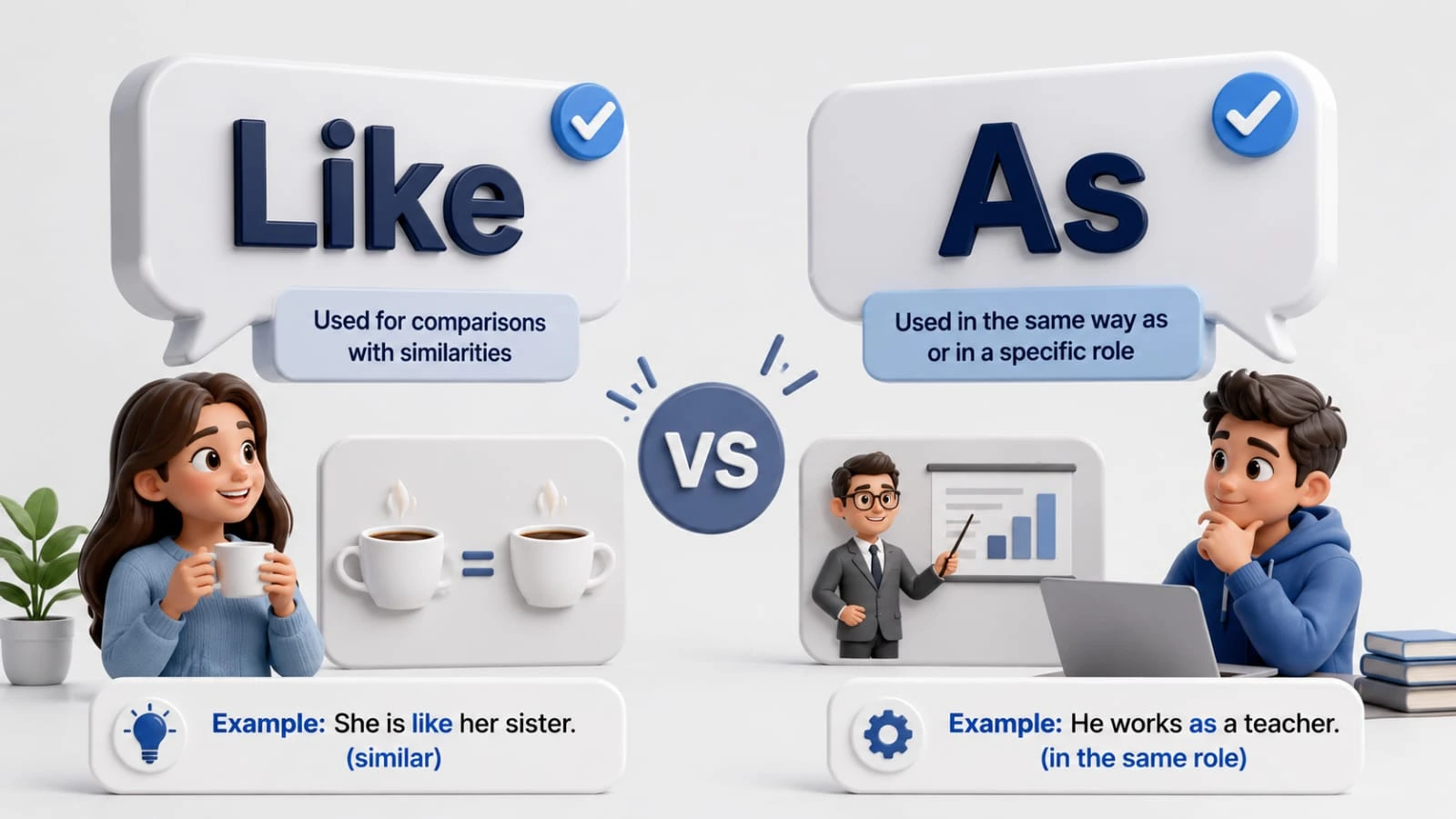
Like is usually used to compare nouns or pronouns, while as is used to compare actions, clauses, or roles. If you’re unsure, remember: like compares things, and as connects actions or explains someone’s role. _______________________________________________________________________________________________
A few years ago, I was editing an article when I came across the sentence, “Nobody understands grammar like she does.” It sounded natural, but then another sentence appeared: “Nobody understands grammar as she does.” For a moment, I paused. Both seemed correct, yet they followed different grammar rules. That experience reminded me that like and as are two of the most misunderstood words in English.
If you’ve ever wondered whether to use like or as, you’re not alone. Students, writers, and even native English speakers often mix them up because both are used to make comparisons. The difference isn’t about British or American English; it’s about grammar and sentence structure.
The good news is that the rule is much easier than many grammar books make it seem. In this guide, you’ll learn the difference between like and as, discover when each word is correct, avoid common mistakes, and see plenty of real-world examples. By the end, you’ll know exactly which word to choose in everyday conversations and professional writing.
Like or As: Quick Answer
The easiest way to remember the difference is this:
- Like compares people, things, or ideas.
- As introduces actions, complete clauses, or someone’s role.
Example
✅ This cake tastes like chocolate.
✅ Do as I told you.
Quick Memory Trick
Ask yourself:
- Am I comparing things? → Use like.
- Am I comparing actions or describing someone’s job or role? → Use as.
The Origin / Background of Like or As
Although like and as often appear in similar sentences, they come from different parts of English history and have developed different grammatical functions.
The Origin of Like
The word like comes from the Old English word gelīc, meaning similar or having the same qualities. For centuries, English speakers have used like to compare one person or thing with another.
Examples:
- He looks like his father.
- It smells like fresh bread.
The Origin of As
The word as comes from Old English alswā, meaning in the same way or to the same degree. Over time, it became the standard word for introducing clauses and describing roles.
Examples:
- Do as I say.
- She works as a nurse.
Why Do People Confuse Them?
The confusion exists because both words can express similarity. In everyday speech, especially informal English, many people use like where traditional grammar prefers as.
For example:
Informal:
Nobody understands me like you do.
Formal:
Nobody understands me as you do.
Today, both forms are common in conversation, but knowing the grammatical difference helps you write more accurately.
Like or As Explained: Key Differences
The main difference depends on what comes after the word.
| Word | Meaning | When to Use | Context |
| Like | Similar to | Before a noun or pronoun | Comparisons |
| As | In the same way / In the role of | Before a clause or job title | Actions and roles |
Use Like to Compare Things
Think of like as meaning similar to.
Examples:
- She dances like a professional.
- The clouds look like cotton.
- Your voice sounds like your sister’s.
In each example, like is followed by a noun or noun phrase.
Use As Before a Clause
Use as when another action follows.
Examples:
- Do as I asked.
- He solved the problem as I expected.
- Everything happened as we planned.
Notice that as introduces a complete clause with its own subject and verb.
Use As for Roles or Jobs
When describing someone’s position or function, use as.
Examples:
- She works as an engineer.
- I joined the company as a manager.
- He served as team captain.
Quick Comparison
Correct:
- She looks like her mother.
- She sings as her mother taught her.
Incorrect:
- Do like I said. ❌ (Formal English)
Correct:
- Do as I said. ✅
Easy Memory Trick
Remember this simple rule:
Like compares things. As connects actions or describes roles.
This trick works in most everyday situations.
Which One Should You Use?
The best choice depends on what you’re trying to say and how formal your writing is.
For Students
Follow the traditional grammar rule.
- Use like before nouns.
- Use as before clauses.
Example:
✅ She swims like a fish.
✅ Do as your teacher instructed.
For Business Professionals
Formal writing should usually follow standard grammar.
Examples:
- Please complete the report as instructed.
- She joined the company as a consultant.
These choices sound more polished in emails and reports.
For Casual Conversations
Informal English often uses like instead of as.
Examples:
- Nobody cooks like my grandmother.
- It happened like I told you.
These sentences are common in speech, but the second example is less formal than “It happened as I told you.”
For Global English
Whether your audience is in the:
- United States
- United Kingdom
- Canada
- Australia
- India
- Pakistan
…the grammar rule is essentially the same.
However, informal American English tends to use like more freely in everyday conversation, while formal writing in all English varieties still prefers as where grammar requires it.
Where or Were: Complete GuideTo The Correct Usage (2026)
Common Mistakes with Like or As
Here are some of the most common mistakes and how to fix them.
| ❌ Incorrect | ✅ Correct | Why? |
| Do like I told you. | Do as I told you. | A clause follows. |
| She works like a doctor. | She works as a doctor. | Refers to a role or job. |
| He looks as his father. | He looks like his father. | Comparing people. |
| It tastes as chocolate. | It tastes like chocolate. | Comparing things. |
| Act like I showed you. | Act as I showed you. (Formal) | A clause follows. |
Why Do These Mistakes Happen?
People confuse like and as because:
- Both express similarity.
- Everyday speech often ignores the traditional rule.
- Native speakers regularly use like in casual conversation.
- Learners focus on meaning instead of sentence structure.
The Simple Check
Before choosing a word, ask yourself:
- Is a noun or thing coming next? → Like
- Is a complete action or clause coming next? → As
- Am I talking about someone’s role or profession? → As
Using these three questions will help you choose the correct word with confidence in almost every sentence.
Like or As in Real-World Examples
Seeing like and as in everyday writing makes the difference much easier to remember.
Professional Email
Subject: Project Update
Please complete the report as discussed during yesterday’s meeting. The final design should look like the sample attached.
News Headline
Athlete Performs Like a Champion in Historic Final
The committee acted as expected after reviewing the evidence.
Social Media Post
This sunset looks like a painting. 🌅
Do as your future self will thank you for.
Formal Report
The consultant served as an independent advisor throughout the project.
The new model performs like the previous version but uses less energy.
Like or As: Data, Trends & Usage
The keyword “like or as” is searched consistently by people learning English grammar. Many users need a quick explanation while writing school assignments, business emails, or professional documents.
Search Intent
- Primary Intent: Informational
- Secondary Intent: Grammar learning and writing improvement
Who Searches for It?
This topic is especially popular among:
- Students
- English language learners (ESL/EFL)
- Teachers
- Writers and editors
- Bloggers
- Business professionals
- Competitive exam candidates
Countries Where It Is Commonly Searched
- United States
- United Kingdom
- Canada
- Australia
- India
- Pakistan
Why It Matters Today
Modern communication happens through emails, blogs, and social media, where grammar mistakes are easy to spot. Understanding the difference between like and as helps you communicate more clearly, sound more professional, and build confidence in both speaking and writing.
Like or As Comparison Table
| Term | Meaning | Region/Context | Best Used When |
| Like | Similar to | Worldwide | Comparing people, things, or ideas |
| As | In the same way; in the role of | Worldwide | Introducing clauses or describing roles |
Frequently Asked Questions
Q: What is the difference between like and as?
A: Like compares nouns or pronouns, while as introduces clauses or describes someone’s role. A simple rule is: like compares things; as compares actions or explains roles.
Q: Is “like” grammatically correct before a clause?
A: In casual conversation, many native speakers use like before a clause. However, in formal writing, as is usually the preferred choice.
Q: Should I say “Do like I say” or “Do as I say”?
A: Do as I say is the grammatically correct form in standard English because as introduces the clause I say.
Q: Can I use “like” in formal writing?
A: Yes. Use like when comparing people or things. Avoid using it where as is required to introduce a clause or describe a role.
Q: Is there a British vs American English difference?
A: Not really. Both British and American English follow the same grammar rule. Informal American English may use like more often in conversation, but formal writing follows the standard distinction.
Q: Where do “like” and “as” come from?
A: Both words come from Old English. Like developed to express similarity, while as evolved to describe manner, comparison, and roles.
Q: How can I remember when to use like or as?
A: Use this memory trick: Like compares things. As connects actions or describes roles. If a complete clause follows, as is usually the better choice.
Conclusion
The difference between like and as is simpler than it first appears. Like is mainly used to compare people, objects, or ideas, while as introduces clauses and explains how something happens or what role someone has. Once you understand this basic rule, choosing the correct word becomes much easier.
Remember that everyday conversation is often more flexible than formal writing. You may hear native speakers use like where grammar books recommend as, but following the traditional rule will make your writing clearer and more professional. When you’re unsure, check what comes next in the sentence. If it’s a noun, like is usually correct. If it’s a complete clause or a role, choose as.
With regular practice, you’ll stop second-guessing these two common words. Bookmark this guide so you can revisit it anytime you need a quick grammar refresher, and share it with someone who’s still confused about like or as.
Confused about like or as? Learn the correct grammar, meanings, examples, and simple tricks to avoid mistakes every time.
Who’s or Whose: The Complete Guide to Using Them Correctly (2026)

I am a language content specialist specializing in spelling comparisons, vocabulary usage, and commonly confused English words. I write detailed, informative articles that help readers improve their language skills. I am passionate about helping students, writers, and professionals develop a stronger understanding of the English language.