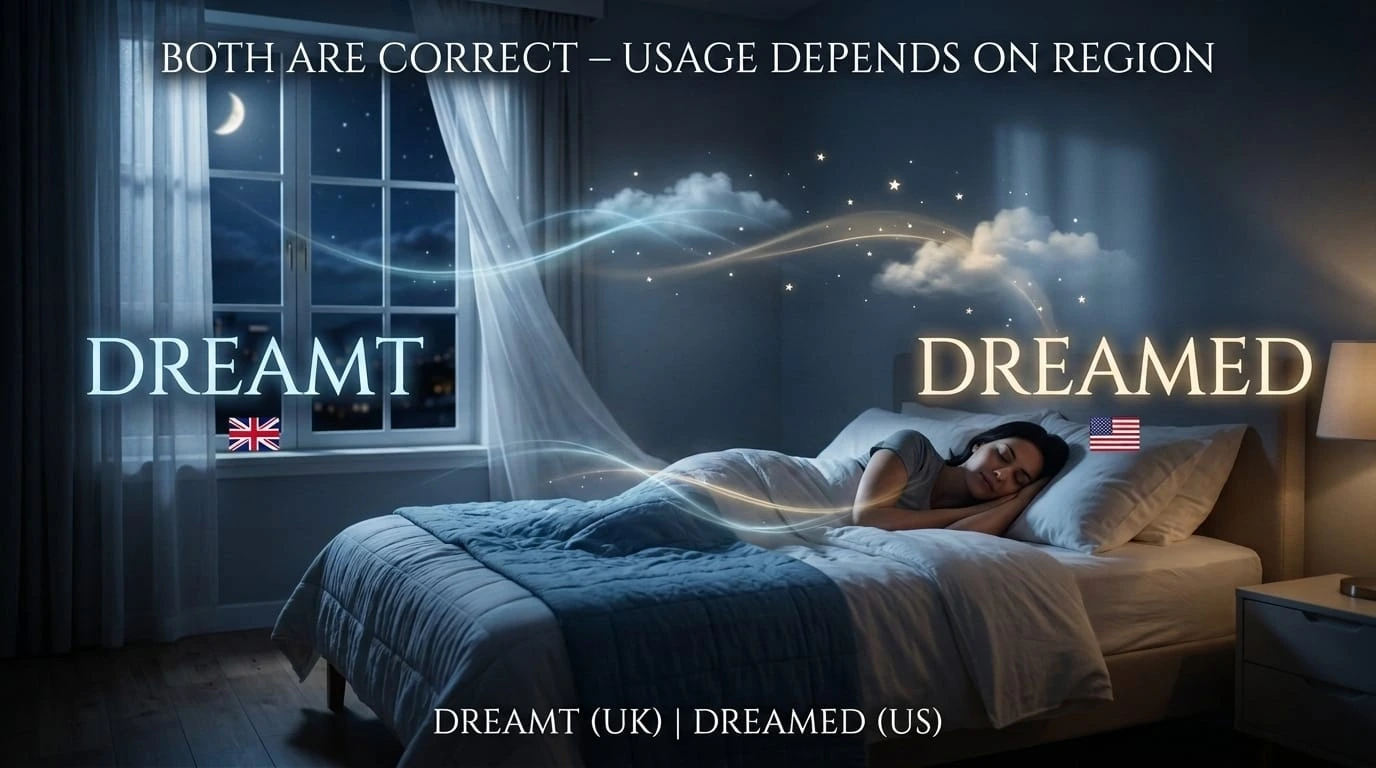
Both spellings are correct. “Dreamed” is more common in American English, while “dreamt” is more common in British English.
Years ago, I wrote “I dreamt about flying” in a school essay. My American teacher marked it incorrect and wrote “dreamed” in the margin. I was confused, since I’d read “dreamt” plenty of times in books.
Turns out, my teacher wasn’t entirely right, and neither was I. Both spellings are genuinely correct, they just belong to different sides of the English-speaking world. This is one of those word pairs where dictionaries accept two forms, yet almost nobody explains why.
If you’ve ever paused before writing this word, unsure whether to add that extra t, this guide clears it up completely. You’ll learn exactly when to use “dreamed,” when “dreamt” fits better, and why English allows both in the first place.
Dreamt or Dreamed: Quick Answer
Both “dreamt” and “dreamed” are correct past-tense forms of “dream.” They mean exactly the same thing.
- ✅ American English: “I dreamed about my old house last night.”
- ✅ British English: “I dreamt about my old house last night.”
The rule to remember: American English favors the regular “-ed” ending, while British English often favors the irregular “-t” ending.
The Origin of Dreamt/Dreamed
“Dream” comes from Old English drēam, though its modern meaning of sleep-visions developed later, likely influenced by Old Norse draumr. As English verbs formed their past tense, most settled into the regular pattern of adding “-ed.” But a smaller group of verbs kept an older, irregular pattern instead, ending in “-t.”
This same “-ed” versus “-t” split shows up across a whole family of English verbs:
- burn → burned / burnt
- learn → learned / learnt
- spell → spelled / spelt
- dream → dreamed / dreamt
American English gradually standardized on the regular “-ed” form during the 1800s and 1900s, favoring consistency across verbs. British English kept the older “-t” endings for many of these words, which is why “dreamt,” “learnt,” and “burnt” remain common across the UK today.
Dreamt vs Dreamed Explained: Key Differences and Variations
| Term | Meaning | When to Use | Region/Context |
|---|---|---|---|
| Dreamed | Past tense of “dream” | American English (primary) | US writing, also accepted in the UK |
| Dreamt | Past tense of “dream” | British English (primary) | UK, Australia, and Commonwealth writing |
| Daydreamed/Daydreamt | Past tense of “daydream” | Same regional split applies | Follows the base verb’s regional preference |
Notice that this isn’t a right-versus-wrong split like many spelling errors. Both forms appear in dictionaries on both sides of the Atlantic, they simply carry different regional preferences.
Which Spelling Should You Use?
For American audiences
Use dreamed. This is the more common and expected form throughout the US.
For British or Commonwealth audiences
Use dreamt. This fits naturally with British spelling conventions and reads more traditionally.
For global or mixed audiences
Either spelling works, but stay consistent throughout the same piece of writing.
For creative or literary writing
Some American writers still choose “dreamt” for stylistic reasons, since it can feel more poetic or old-fashioned, even outside the UK.
Common Mistakes with Dreamt/Dreamed
Mistake 1: Mixing spellings within the same document
✅ She dreamed about the ocean, and that dream stayed with her all day.
❌ She dreamt about the ocean, and that dreamed stayed with her all day.
Why it happens: Writers switch unconsciously between forms, especially when copy-pasting from different sources.
Mistake 2: Assuming one spelling is simply “wrong”
✅ Both “dreamt” and “dreamed” are correct, depending on region and style.
❌ “Dreamt” is a typo for “dreamed.”
Why it happens: People assume every spelling pair must have one incorrect option, when this one genuinely allows both.
Mistake 3: Forgetting the pattern applies to related verbs
✅ He learned the lesson quickly. (US) / He learnt the lesson quickly. (UK)
❌ Using “dreamt” but “learned” inconsistently within the same British-audience document.
Why it happens: Writers remember the rule for one verb but forget it applies to a whole family of similar words.
Mistake 4: Ignoring house style guides in professional writing
✅ Check your publication’s style guide, then stay consistent.
❌ Randomly switching between “dreamt” and “dreamed” across different articles on the same site.
Why it happens: Writers aren’t always aware their organization has a preferred regional spelling.
Mistake 5: Assuming “dreamt” is outdated or incorrect everywhere
✅ “Dreamt” remains standard and current in British English today.
❌ Treating “dreamt” as old-fashioned or no longer valid.
Why it happens: American readers unfamiliar with British spelling conventions sometimes assume it’s archaic rather than regional.
Cancelation or Cancellation: The Correct Spelling Explained
Dreamt/Dreamed in Real-World Examples
Professional email:
“The design team dreamed up a bold new concept for next quarter’s campaign.”
News headline (UK):
“Local Artist Says She Dreamt the Idea for Her Award-Winning Sculpture”
Social media post:
“Never dreamed I’d actually run a marathon, but here we are. 🏃”
Formal document (UK):
“The founder often said she had dreamt of building the company since childhood.”
Notice how both spellings fit naturally into everyday writing, the choice simply depends on the audience’s regional expectations.
Dreamt/Dreamed: Google Trends & Usage Data
Search interest in “dreamt vs dreamed” is steady and mostly informational, driven by writers, students, and editors confirming which spelling suits their audience. American users search “dreamed” more frequently, while UK, Australian, and Indian users show stronger interest in “dreamt.”
This mirrors the same regional pattern seen in “learned/learnt” and “burned/burnt”, confirming this isn’t a random inconsistency, but a consistent group of irregular verbs that split differently between American and British English. Creative writing and poetry communities also drive notable search interest, since “dreamt” is often chosen deliberately for its rhythm and tone, regardless of the writer’s location.
Dreamt vs Dreamed: Comparison Table
| Term/Variant | Meaning | Region/Context | Best Used When |
|---|---|---|---|
| Dreamed | Past tense of “dream” | American English (primary), accepted in the UK | Writing for a US audience |
| Dreamt | Past tense of “dream” | British English (primary) | Writing for UK, Australian, or Commonwealth audiences |
| Daydreamed/Daydreamt | Past tense of “daydream” | Same regional split as “dream” | Match your chosen dialect throughout |
Frequently Asked Questions
Q: What does “dreamt” or “dreamed” mean?
A: Both words are the past tense of “dream,” describing something experienced during sleep or imagined while awake. The meaning is identical, only the spelling changes by region.
Q: How do you use “dreamed” correctly in a sentence?
A: Use “dreamed” the same way you’d use “dreamt,” for example, “I dreamed about the beach” works exactly like “I dreamt about the beach.”
Q: Dreamt vs dreamed, what’s the difference?
A: The difference is regional, not grammatical. American English favors “dreamed,” while British English favors “dreamt.” Both are equally correct.
Q: Is “dreamt” acceptable in formal writing?
A: Yes, especially in British, Australian, or Commonwealth contexts. American style guides typically prefer “dreamed” instead.
Q: Which version is correct, dreamt or dreamed?
A: Both are correct. Choose based on your audience’s region, and stay consistent throughout your writing.
Q: Where does the word “dreamt” come from?
A: It comes from the same root as “dream,” following an older irregular English verb pattern that adds “-t” instead of the regular “-ed” ending.
Q: Can “dreamt” be used in American English?
A: Yes, it’s not incorrect, just less common. Some American writers choose it for stylistic or poetic effect, even though “dreamed” remains the standard choice.
Final Takeaway
Here’s the short version. Both “dreamt” and “dreamed” are correct, the choice depends on your audience and style, not on right versus wrong.
Key points to remember:
- The rule: American English favors “dreamed”; British English favors “dreamt”
- Part of a bigger family: This split matches “learned/learnt” and “burned/burnt”
- Style still matters: “Dreamt” can add a poetic tone, even in American writing
- Consistency matters: Pick one style per document and stick with it
Once you know your audience, choosing between “dreamt” and “dreamed” becomes automatic.
Dreamt vs dreamed explained, correct spelling, regional usage, and examples for American and British English writers.
travelling or traveling: Which Spelling Should You Use?

I am a language content specialist specializing in spelling comparisons, vocabulary usage, and commonly confused English words. I write detailed, informative articles that help readers improve their language skills. I am passionate about helping students, writers, and professionals develop a stronger understanding of the English language.