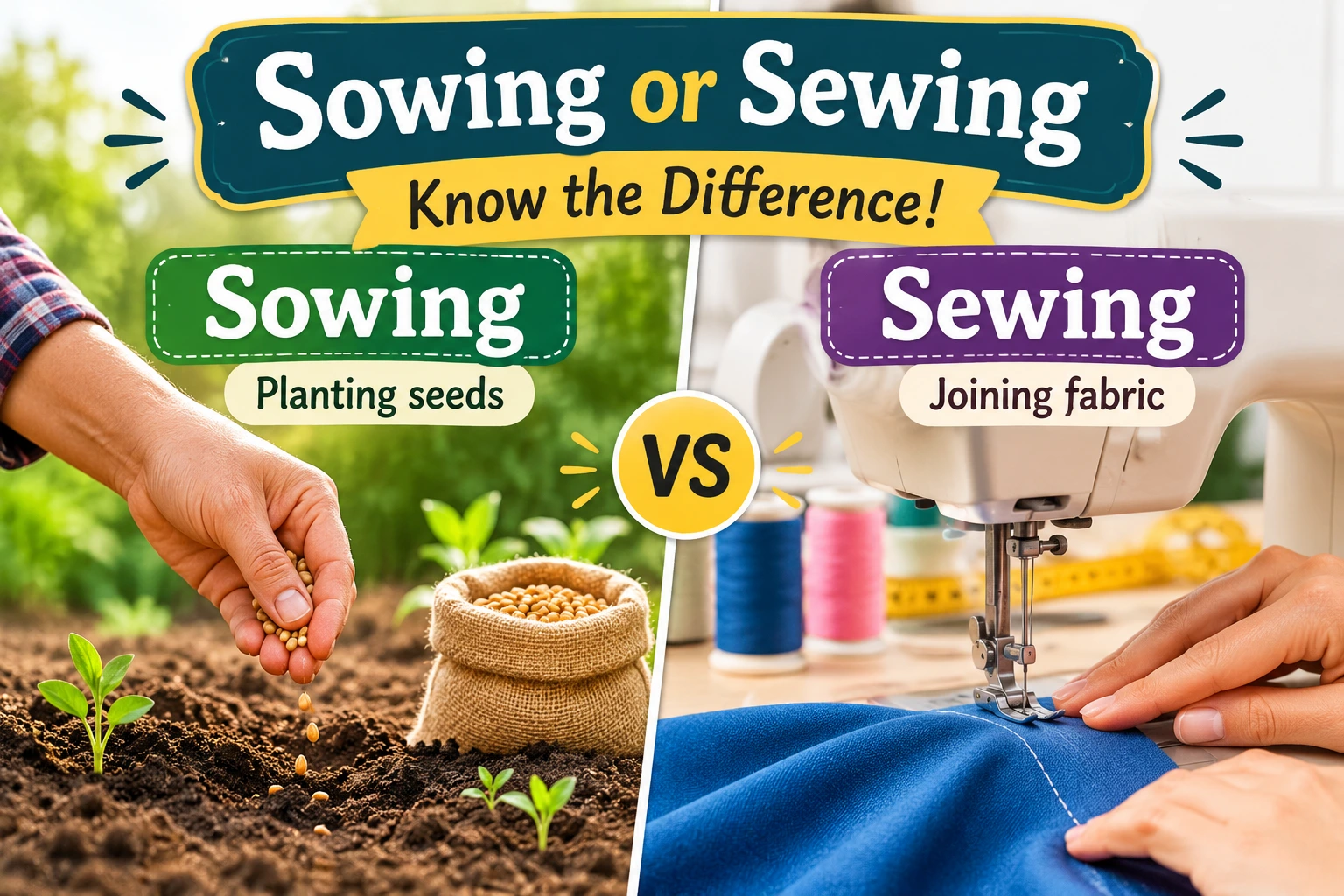
Sowing means planting seeds to grow crops or plants, while sewing means joining fabric with a needle and thread. Both words sound alike, but they have different meanings and uses.
Have you ever mixed up sowing and sewing? You are not alone. These words sound the same, but they describe two very different activities. One helps plants grow, while the other helps people make or repair clothes.
Imagine a farmer working in a field. He spreads seeds in the soil. He is sowing seeds. Now imagine a tailor fixing a torn shirt with a needle and thread. She is sewing the shirt.
The difference is simple once you know what each word means. However, spelling mistakes can still happen because both words sound alike. Choosing the wrong one can change the meaning of your sentence.
In this guide, you will learn the meanings of sowing and sewing, their spelling rules, and how to use each word correctly. You will also see clear examples, common mistakes, and answers to frequently asked questions.
Sowing vs. Sewing: Quick Answer
- Sowing: Planting or scattering seeds in soil.
- Sewing: Joining, making, or repairing fabric with a needle and thread.
Examples:
- The farmer is sowing wheat seeds.
- My mother is sewing a button onto my shirt.
Remember: Sowing is for seeds; sewing is for stitches.
What Does Sowing Mean?
Sowing is the act of planting or scattering seeds so that plants can grow. It is often used in farming, gardening, and agriculture.
The word comes from the verb sow. Farmers sow seeds in fields, while gardeners sow seeds in pots or garden beds.
Examples of Sowing
- The farmer is sowing rice in the field.
- We are sowing flower seeds in the garden.
- Early sowing can help some crops grow well.
- She spent the morning sowing vegetable seeds.
- The rain started while they were sowing wheat.
Sowing can also have a figurative meaning. It may describe starting something that will grow or develop over time.
Example: The teacher is sowing the seeds of curiosity in her students.
This sentence does not mean the teacher is planting real seeds. It means she is helping students develop an interest in learning.
What Does Sewing Mean?
Sewing means joining pieces of fabric or attaching items to cloth with a needle and thread. People sew to make clothes, repair holes, add buttons, and create other fabric items.
The word comes from the verb sew.
Examples of Sewing
- My sister is sewing a dress.
- He is sewing a button onto his coat.
- She learned sewing from her grandmother.
- The tailor is sewing a pocket onto the shirt.
- I enjoy sewing bags and cushion covers.
Sewing can be done by hand or with a sewing machine. It is a useful skill in clothing design, fashion, crafts, and home repairs.
Sowing vs. Sewing: Key Differences
| Word | Meaning | Common Context | Example |
|---|---|---|---|
| Sowing | Planting or scattering seeds | Farming and gardening | He is sowing corn. |
| Sewing | Joining fabric with needle and thread | Clothing and crafts | She is sewing a skirt. |
Both words end in -ing, but they come from different verbs.
- Sow → Sowing
- Sew → Sewing
The spelling stays clear when you remember the meaning of each base verb.
Which Word Should You Use?
Choose the word that matches the action in your sentence.
- For farming or gardening: Use sowing when someone plants seeds.
- For clothes or fabric: Use sewing when someone joins or repairs material with a needle and thread.
- For figurative meanings: Use sowing in phrases such as “sowing doubt” or “sowing the seeds of success.”
For example, “She is sowing a shirt” is incorrect if you mean she is making it with a needle. The correct sentence is “She is sewing a shirt.”
Likewise, “The farmer is sewing seeds” is incorrect. The correct sentence is “The farmer is sowing seeds.”
Common Mistakes With Sowing and Sewing
1. Using Sewing for Planting Seeds
Incorrect: The farmer is sewing wheat.
Correct: The farmer is sowing wheat.
Use sowing because the farmer is planting seeds.
2. Using Sowing for Making Clothes
Incorrect: She is sowing a dress.
Correct: She is sewing a dress.
Use sewing because she is making clothing with a needle and thread.
3. Confusing the Base Verbs
- Sow → Sowing
- Sew → Sewing
Learn the meaning of each base verb to avoid confusion.
4. Forgetting the Figurative Use of Sowing
Example: His lies are sowing distrust among friends.
Here, sowing means causing something to develop. It does not refer to planting seeds in soil.
Sowing and Sewing in Real-World Examples
1. In a School Assignment
“The farmer began sowing seeds before the rainy season.”
This sentence describes planting seeds.
2. In a Fashion Article
“The designer spent hours sewing beads onto the wedding dress.”
This sentence describes attaching items to fabric.
3. In a Professional Email
“Please allow the tailor two more days to finish sewing the uniforms.”
The word sewing is correct because the uniforms are being made or completed with stitches.
4. In a Gardening Post
“It is the perfect time for sowing tomato seeds in your garden.”
The word sowing refers to planting seeds.
5. In a Motivational Message
“Small acts of kindness can be like sowing seeds of hope.”
Here, sowing has a figurative meaning. It describes starting something positive that may grow over time.
Sowing or Sewing: Spelling and Word Forms
Knowing the base verb makes both words easier to spell.
| Base Verb | -ing Form | Past Tense | Example |
|---|---|---|---|
| Sow | Sowing | Sowed | They sowed the seeds yesterday. |
| Sew | Sewing | Sewed | She sewed the torn sleeve. |
The past participle of sow can be sown or sowed, depending on the sentence and variety of English. The past participle of sew is sewn or sewed.
Examples:
- The seeds were sown in spring.
- The shirt was sewn by hand.
Sowing or Sewing: Usage and Search Intent
People may search for sowing or sewing because the words sound alike and are easy to confuse. This is an informational spelling and grammar question.
The words appear in different contexts:
- Sowing: Gardening, farming, crop production, and figurative expressions.
- Sewing: Fashion, clothing repair, tailoring, crafts, and fabric work.
The best way to choose is to focus on the action, not just the sound. If seeds are being planted, use sowing. If fabric is being joined with stitches, use sewing.
Frequently Asked Questions
Q: What is the difference between sowing and sewing?
A: Sowing means planting seeds, while sewing means joining fabric with a needle and thread. The words sound alike but have different meanings.
Q: Is sowing the correct word for planting seeds?
A: Yes. Sowing is the correct word for planting or scattering seeds. For example, “The farmer is sowing wheat.”
Q: Is sewing the correct word for making clothes?
A: Yes. Sewing is used when making or repairing clothes with stitches. For example, “She is sewing a new dress.”
Q: Are sowing and sewing pronounced the same?
A: In many English accents, sowing and sewing sound the same or very similar. Their meanings and spelling are different.
Q: Can sowing have a meaning beyond farming?
A: Yes. Sowing can describe starting or spreading an idea, feeling, or action. For example, “The rumor is sowing fear.”
Q: What is the past tense of sowing?
A: The past tense of sow is sowed. Its past participle can be sown or sowed, depending on usage.
Q: What is the past tense of sewing?
A: The past tense of sew is sewed. The past participle can be sewn or sewed, as in “The dress was sewn by hand.”
Conclusion
The difference between sowing and sewing is easy to remember. Sowing means planting seeds, while sewing means joining or repairing fabric with a needle and thread.
Use sowing when you talk about farms, gardens, crops, or the growth of ideas. Use sewing when you talk about clothes, stitches, fabric, or tailoring.
Remember these two simple examples:
- The farmer is sowing seeds.
- The tailor is sewing a shirt.
Both words are correct, but they cannot usually replace each other. Focus on the action in your sentence, and you will choose the right spelling.
Save this guide or share it with someone who often confuses sowing and sewing!
Payer or Payor: Which Spelling Is Correct?

I am a professional content writer with a strong interest in English spelling and vocabulary. I am interested in creating informative guides on commonly confused words, spelling differences, and language usage to help readers write more accurately and effectively.