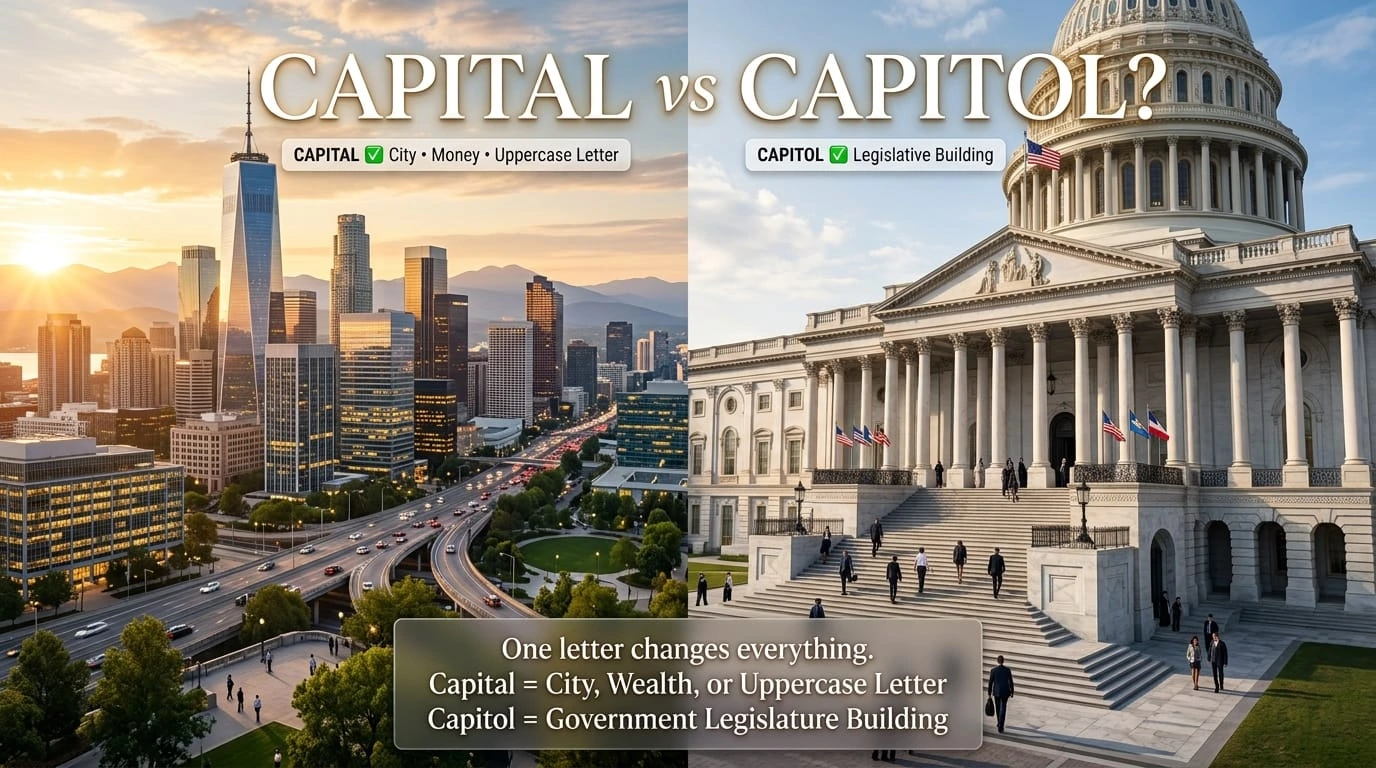
“Capital” means a city that serves as a seat of government, or refers to money, wealth, or uppercase letters. “Capitol” means a specific building where lawmakers meet, most famously the US Capitol. They are two different words, not spelling variants.
I once wrote a school report describing “the capitol of Texas is Austin.” My teacher circled the word and wrote “capital” above it. I was confused, since I’d definitely seen “Capitol” written somewhere before, usually next to a picture of a big domed building.
That mix-up taught me something most people never learn clearly. “Capital” and “capitol” aren’t different spellings of the same word. They mean two genuinely different things, and only one refers to an actual building.
This guide breaks down exactly what each word means, how to remember the difference instantly, and how to avoid this mix-up in essays, news writing, or everyday conversation.
Capital or Capitol: Quick Answer
“Capital” refers to a city that serves as the seat of government, or to money, wealth, or uppercase letters.
- ✅ Paris is the capital of France.
- ✅ The company raised new capital last quarter.
“Capitol” refers to the specific building where lawmakers meet, most often the US Capitol building in Washington, D.C.
- ✅ Protesters gathered outside the Capitol.
- ❌ Paris is the capitol of France.
The Origin of Capital/Capitol
“Capital” comes from Latin capitalis, meaning “of the head,” related to caput, meaning “head.” Over time, it broadened to describe anything considered chief or primary, a capital city being the “head” city of a country or state, and capital letters being the primary or “head” form of a letter.
“Capitol” traces back to a completely different Latin source, Capitolium, the name of a specific hill in ancient Rome, home to the Temple of Jupiter. When the United States built its own government building in the late 1700s, architects modeled it after this Roman landmark and named it the Capitol, directly borrowing the Latin spelling.
Because both words sound identical when spoken, and differ by only one letter in writing, they get confused constantly, even by careful writers.
Capital vs Capitol Explained: Key Differences and Variations
| Term | Meaning | When to Use | Context |
|---|---|---|---|
| Capital | A city that serves as a seat of government | Naming a city, state, or country’s government hub | Geography, politics, general writing |
| Capital | Money, wealth, or financial assets | Business and finance | Economics, investing, corporate writing |
| Capital | Uppercase letters | Referring to letter case | Writing, grammar, style guides |
| Capitol | A specific government building | Referring to the actual structure | US politics, architecture, news |
Notice that “capital” carries multiple meanings on its own, while “capitol” has exactly one specific job, naming a building.
Which Word Should You Use?
When naming a city that serves as a government center
Use capital. This applies to national capitals, state capitals, and any city serving that role.
When talking about money or financial resources
Use capital as well, since this meaning shares the same spelling as the geographic sense.
When referring to uppercase letters
Use capital, as in “capital letter” or “written in capitals.”
When referring to the actual government building
Use capitol, specifically for the physical structure where lawmakers meet, such as the US Capitol or a state capitol building.
Common Mistakes with Capital/Capitol
Mistake 1: Using “capitol” instead of “capital” for a city
✅ Sacramento is the capital of California.
❌ Sacramento is the capitol of California.
Why it happens: Writers see “capitol” used in political news so often that they assume it applies to cities too.
Mistake 2: Using “capital” instead of “capitol” for the building
✅ Lawmakers debated the bill inside the Capitol.
❌ Lawmakers debated the bill inside the Capital.
Why it happens: Since “capital” is the more common word overall, writers default to it even when the sentence specifically means the building.
Mistake 3: Forgetting “capitol” is almost always capitalized
✅ The US Capitol was built in the late 1700s.
❌ The us capitol was built in the late 1700s.
Why it happens: Writers treat “Capitol” as a generic noun instead of recognizing it often functions as part of a proper name.
Mistake 4: Assuming every state government building is called a “capitol”
✅ Most US states have a capitol building, but the term itself refers to the structure, not the city.
❌ Confusing “the capitol” with “the capital” when discussing a state’s government seat.
Why it happens: Both words appear together so often in political writing that the distinction blurs.
Mistake 5: Relying on spellcheck to catch the error
✅ Proofread carefully, since both “capital” and “capitol” are valid English words.
❌ Assuming spellcheck will flag an incorrect word choice.
Why it happens: Because both words are spelled correctly on their own, spellcheck tools won’t catch a simple word swap.
Mam or Ma’am: What’s The Difference? (2026)
Capital/Capitol in Real-World Examples
Professional email:
“Our new office will be located in the state capital, close to major transit lines.”
News headline:
“Thousands Gather Outside the Capitol to Protest New Legislation”
Social media post:
“Visiting the Capitol building today, the architecture is incredible. 🏛️”
Formal document:
“The company secured additional capital to fund its expansion into new markets.”
Notice how “capitol” appears almost exclusively in political or architectural contexts, while “capital” covers cities, money, and letter case.
Capital/Capitol: Data, Trends & Usage
Search interest in “capital vs capitol” spikes heavily around election seasons, major political events, and news coverage involving government buildings. This falls into the informational search category, with students, journalists, and everyday readers confirming correct usage before writing or publishing.
Search volume for “capitol” concentrates almost entirely around US politics and news, since the word rarely appears outside that context. “Capital” sees much broader, steadier search interest year-round, thanks to its use in geography, finance, and everyday writing.
Capital vs Capitol: Comparison Table
| Term/Variant | Meaning | Region/Context | Best Used When |
|---|---|---|---|
| Capital | A government city, money, or uppercase letters | Universal, all English dialects | Geography, finance, or letter case |
| Capitol | A specific government building | Primarily US politics and news | Referring to the physical building |
| Capitol Hill | The area around the US Capitol in Washington, D.C. | US politics specifically | Referring to the broader political district |
Frequently Asked Questions
Q: What does “capital” mean?
A: “Capital” has several meanings, a city that serves as a government seat, money or financial assets, or uppercase letters. Context makes clear which meaning applies.
Q: How do you use “capitol” correctly in a sentence?
A: Use “capitol” specifically when referring to the actual government building, such as “The governor gave a speech inside the state capitol.”
Q: Capital vs capitol, what’s the difference?
A: “Capital” refers to a city, money, or letter case, while “capitol” refers only to a specific government building. They aren’t interchangeable.
Q: Is “capitol” acceptable in formal writing?
A: Yes, specifically when referring to the government building itself. Using it for a city or financial term would be incorrect.
Q: Which version is correct, capital or capitol?
A: Both are correct, but they mean different things. Choose “capital” for cities, money, or letters, and “capitol” only for the building.
Q: Where does the word “capitol” come from?
A: It comes from Capitolium, a hill in ancient Rome that housed the Temple of Jupiter. US architects borrowed the name for the government building in Washington, D.C.
Q: Is every state government building called a “capitol”?
A: Yes, most US states use “capitol” to refer to their state government building, following the same naming convention as the federal Capitol.
Final Takeaway
Here’s the short version. “Capital” refers to a city, money, or uppercase letters. “Capitol” refers only to a specific government building.
Key points to remember:
- The test: If you mean a building, use “capitol.” Everything else uses “capital”
- Watch capitalization: “Capitol” is often capitalized when naming a specific building
- Mostly a US term: “Capitol” appears almost exclusively in American political contexts
- No shortcuts: Spellcheck won’t catch this mix-up, since both words are valid on their own
Once you separate the building from everything else, you’ll never confuse “capital” and “capitol” again.
Capital vs capitol explained, correct meaning, usage, and examples. Learn the simple trick to tell these two words apart.
Paid or Payed: The Correct Spelling Explained (2026)

I specialize in spelling comparisons, confusing word pairs, grammar, and vocabulary development. My content helps readers improve their English, avoid common mistakes, and write with confidence. My goal is to provide accurate, reliable, and easy-to-understand language resources