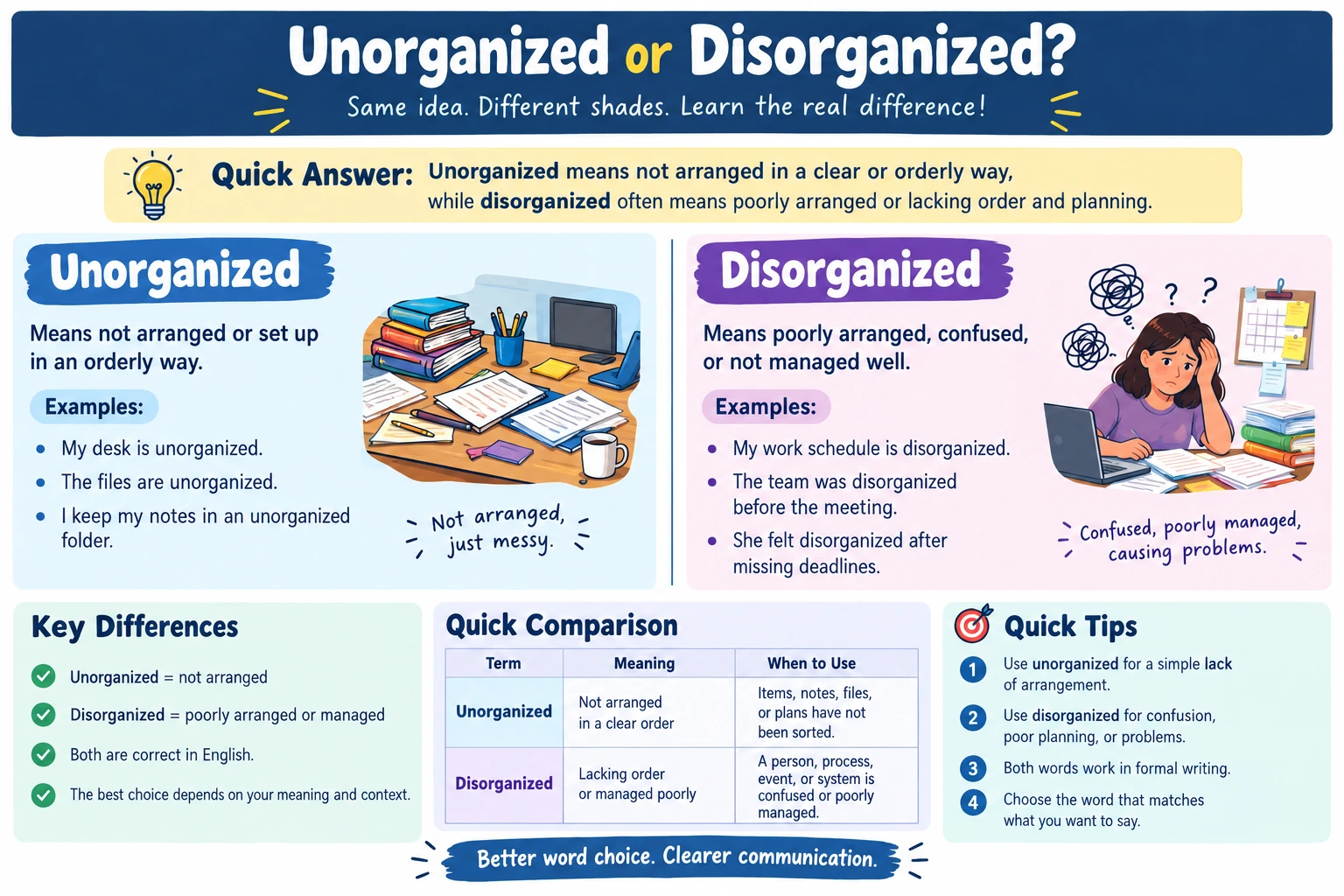
Unorganized means not arranged in a clear or orderly way, while disorganized often means poorly arranged or lacking order and planning. Both words are correct, but disorganized can suggest a stronger lack of order or control.
Have you ever looked at a messy desk and wondered whether to call it unorganized or disorganized? Both words seem to fit. Yet, the word you choose can change how your message sounds.
Imagine that a student has books, papers, and pens scattered across a desk. You might say the desk is unorganized because nothing has a proper place. Now imagine that the student also forgets homework, misses deadlines, and cannot find important notes. You might describe the student as disorganized.
The difference is subtle, but it can help you express your ideas more clearly.
As an English teacher and writer, I focus on how words work in real situations. Small word choices can make your writing sound more natural, especially in schoolwork, emails, reports, and daily talks.
In this guide, you will learn the meaning of unorganized and disorganized, how they differ, and when to use each one. You will also find simple examples, common mistakes, and answers to the questions readers ask most often.
By the end, you will know which word fits your sentence best.
Unorganized or Disorganized: Quick Answer
Both unorganized and disorganized are correct English words. They describe a lack of order, but they may carry slightly different meanings.
- Unorganized: Something has not been arranged or set up in an orderly way.
- Disorganized: Something is poorly arranged, confused, or not managed well.
For example:
- “My desk is unorganized.” — The desk has not been arranged neatly.
- “My work schedule is disorganized.” — The schedule lacks order and may be hard to follow.
These meanings overlap. In many everyday sentences, you can use either word. The best choice depends on what you want to say.
The Origin and Background of Unorganized and Disorganized
To understand these words, look at their parts. Both contain the word organized, which comes from organize. To organize means to arrange things in a clear and useful way.
The words use two different prefixes: un- and dis-.
What Does Unorganized Mean?
The prefix un- often means “not.” So, unorganized means “not organized.”
It often describes something that has not been arranged, planned, or sorted.
Examples:
- The files are unorganized.
- We held an unorganized meeting.
- Her notes were unorganized, so she sorted them by topic.
The word can describe a simple lack of structure. It does not always suggest that something has gone wrong.
What Does Disorganized Mean?
The prefix dis- can suggest a lack of order or a failure to arrange things properly. So, disorganized often describes something that is confused or poorly managed.
Examples:
- The office is disorganized.
- He felt disorganized after missing two deadlines.
- The team had a disorganized start to the project.
This word can suggest a bigger problem than a few misplaced items. It may point to poor planning, confusion, or weak control.
Why Do People Confuse Them?
The main reason is that the words share the same root and describe similar situations. A messy room, a poor plan, or a confusing meeting could be called either unorganized or disorganized.
English also allows words with similar meanings to overlap. Their exact difference often depends on context, not a strict rule.
Remember this simple guide:
- Use unorganized when you mean “not arranged.”
- Use disorganized when you mean “poorly arranged or managed.”
This is a useful guide, not an absolute rule.
Unorganized vs. Disorganized: Key Differences
The two words are close in meaning, but they can create different impressions.
| Term | Meaning | When to Use | Region/Context |
| Unorganized | Not arranged or planned in an orderly way | When something lacks a clear structure | General English |
| Disorganized | Poorly arranged, confused, or badly managed | When a lack of order causes problems | General English, including formal writing |
1. Unorganized: A Lack of Arrangement
Use unorganized when things have not been put into a clear order.
For example:
“My photo collection is unorganized.”
This means the photos have not been sorted into folders or groups. It does not necessarily mean the collection is causing serious problems.
Other examples include:
- The classroom library is unorganized.
- I keep my old notes in an unorganized folder.
- The event was unorganized because no one made a clear plan.
In each case, the focus is on the lack of arrangement or structure.
2. Disorganized: Poor Order or Planning
Use disorganized when things are messy, confused, or poorly managed.
For example:
“Our project became disorganized after the team changed its plan.”
This suggests that the project lacked clear direction. The problem may have affected the team’s work.
Other examples include:
- The manager is disorganized and often forgets meetings.
- The files were so disorganized that we lost an important record.
- Their travel plans became disorganized after the train was delayed.
Here, the word often points to confusion or problems caused by poor order.
Can You Use Both Words for the Same Thing?
Yes. In many cases, both words work.
Consider these sentences:
- “The notes are unorganized.”
- “The notes are disorganized.”
Both sentences are correct. The first may simply mean that the notes have not been sorted. The second may suggest that the notes are hard to follow or poorly arranged.
The difference is one of emphasis. It is not always a difference in basic meaning.
Which Word Should You Use?
Your choice depends on your meaning, audience, and sentence.
For Students and Everyday Writing
Use unorganized when you want to say that something is not arranged.
Examples:
- My school bag is unorganized.
- The papers are unorganized.
- I need to sort my unorganized notes.
Use disorganized when the lack of order makes something hard to manage.
Examples:
- My study plan is disorganized.
- I feel disorganized when I have too many tasks.
- Our group work was disorganized.
For Professional Emails and Reports
Both words are acceptable in formal writing.
Choose unorganized when you are describing material that needs sorting. Choose disorganized when you are describing a process, team, or system that is not working in an orderly way.
For example:
“The records are unorganized and need to be sorted by date.”
“The approval process is disorganized and causes delays.”
The second sentence points to a problem with how the process is managed.
For Global or Neutral English
Both words are widely understood in English. Neither is limited to British or American English.
If you are unsure, use the word that best matches your intended meaning. For a simple lack of arrangement, unorganized is a clear choice. For confusion or poor management, disorganized is often more natural.
Common Mistakes with Unorganized and Disorganized
These words are easy to mix up. Here are five mistakes to avoid.
1. Thinking One Word Is Always Wrong
Incorrect claim: “Unorganized is not a real word.”
Correction: Both unorganized and disorganized are correct.
Why the mistake happens: Disorganized is often used to describe messy spaces and poor planning, so some readers assume it is the only correct form.
2. Using Disorganized for Every Messy Thing
Less precise: “The papers are disorganized.”
Possible alternative: “The papers are unorganized.”
Why it matters: If the papers simply have not been sorted, unorganized may express the idea more directly. Use disorganized when you want to stress poor arrangement or confusion.
3. Using Unorganized When You Mean Poor Management
Less precise: “The whole project was unorganized, and no one knew what to do.”
More natural: “The whole project was disorganized, and no one knew what to do.”
Why it matters: The second sentence makes the problem with planning and control clearer.
4. Assuming the Words Have Different Spellings by Region
Incorrect claim: “Unorganized is British English, but disorganized is American English.”
Correction: Both words are used in British and American English.
Why the mistake happens: English spelling has many regional differences, such as colour and color. This pair is not the same kind of regional spelling difference.
5. Confusing Disorganized with Unprofessional
Less precise: “The employee is disorganized, so they must be unprofessional.”
Correction: “The employee is disorganized and needs a clearer work plan.”
Why it matters: Disorganized describes a lack of order. It does not automatically mean someone is careless, lazy, or unprofessional.
Unorganized or Disorganized in Real-World Examples
The best way to learn these words is to see them in common situations.
1. Professional Email
Example:
Subject: Updating Our Project Files
“Hi team,
Our project files are currently unorganized. Please sort them into the correct folders before Friday so everyone can find the latest versions.
Thank you.”
Why it works: Unorganized describes files that need to be sorted.
2. News Headline or Article
Example headline:
“Disorganized Planning Causes Delays at Community Event”
Example sentence:
“The event faced several delays because the schedule was disorganized and volunteers did not know where to report.”
Why it works: Disorganized describes poor planning that caused confusion.
3. Social Media Post
Example:
“My desk is completely unorganized today! Time to sort my books, notes, and study papers. 📚”
This is a natural use of unorganized because the speaker is talking about items that need to be arranged.
Another example:
“Our group project felt disorganized until we made a task list and gave everyone a clear role.”
Here, disorganized describes a lack of planning.
4. Formal Document or Report
Example:
“The review found that the department’s filing system was unorganized. Records were not grouped by date or category.”
Why it works: The sentence describes a filing system that needs a clearer structure.
A report about poor management could instead say:
“The department’s process was disorganized, leading to repeated errors and missed deadlines.”
The second example stresses the problems caused by poor order.
Unorganized vs. Disorganized: Data, Trends, and Usage
People often search for unorganized or disorganized when they are unsure which word sounds right. This is an informational search. They want a clear definition, a comparison, and examples they can use in their own writing.
There is no need to treat the words as strict opposites. Both are adjectives, and both can describe people, objects, systems, plans, or events.
Which Word Is More Common?
Disorganized is a common choice when people talk about poor planning, messy systems, or someone who struggles to manage tasks. Unorganized is also used, especially when the focus is on something that has not been arranged.
However, exact popularity can vary by topic, region, and type of writing. Without a specific, current corpus or search-volume report, it would be misleading to give exact percentages or claim that one word always ranks higher.
Who Searches for This Difference?
Readers who may look up this pair include:
- Students who want to use the right word in essays.
- English learners who are building their vocabulary.
- Writers and editors who want more precise sentences.
- Professionals who need clear wording in emails and reports.
Why Does the Difference Matter?
Clear word choice helps readers understand the problem you are describing.
Calling a folder unorganized suggests that it needs sorting. Calling a work process disorganized may suggest that it needs better planning or management.
The key lesson is simple: choose the word that matches the problem, not the word that sounds stronger.
Standalone Comparison Table: Unorganized vs. Disorganized
| Term/Variant | Meaning | Region/Context | Best Used When |
| Unorganized | Not arranged in a clear order | General English | Items, notes, files, or plans have not been sorted |
| Disorganized | Lacking order or managed poorly | General English | A person, process, event, or system is confused or poorly managed |
Use this table as a quick guide when you need to choose between the two words. Both are correct, and the context helps you decide.
Frequently Asked Questions
Q: What does unorganized or disorganized mean?
A: Both words describe a lack of order or structure. Unorganized often means not arranged, while disorganized often means poorly arranged or managed.
Q: How do you use unorganized in a sentence?
A: Use unorganized when something has not been put into a clear order. For example: “My notes are unorganized, so I need to sort them by topic.”
Q: What is the difference between unorganized and disorganized?
A: Unorganized often focuses on the absence of arrangement. Disorganized can suggest confusion, poor planning, or problems caused by a lack of order. In many situations, the words can overlap.
Q: Is disorganized acceptable in formal writing?
A: Yes. Disorganized is suitable for professional emails, reports, essays, and other formal writing. Use it when you want to describe poor order or management.
Q: Which is correct: unorganized or disorganized?
A: Both are correct English words. Choose unorganized for something that has not been arranged, and disorganized when you want to stress confusion or poor management.
Q: Where do the words unorganized and disorganized come from?
A: Both words come from organized, which is linked to the verb organize. The prefixes un- and dis- change the meaning to express a lack of order or organization.
Q: Can I use unorganized or disorganized to describe a person?
A: Yes. You can describe a person as unorganized if their belongings or tasks are not arranged well. Disorganized is often more natural when the person struggles with planning, deadlines, or daily tasks.
Conclusion: Unorganized or Disorganized?
The difference between unorganized and disorganized is small, but it can help you write with more care.
Remember these key points:
- Unorganized often means that something has not been arranged or sorted.
- Disorganized often means that something is poorly arranged, confused, or badly managed.
- Both words are correct in British and American English.
- The best choice depends on your sentence and the meaning you want to express.
If you are describing papers that need sorting, unorganized may be the better fit. If you are describing a project with poor planning or a person who often misses deadlines, disorganized may sound more natural.
Still, there is no strict rule that separates the two words in every case. Their meanings overlap, so focus on clarity rather than trying to force a difference.
Now you know how to use unorganized and disorganized with more confidence. Bookmark this guide for your next essay, email, or report, and share it with someone who finds these words confusing.
Cryer or Crier: The Correct Spelling Explained

I am a professional content writer with a strong interest in English spelling and vocabulary. I am interested in creating informative guides on commonly confused words, spelling differences, and language usage to help readers write more accurately and effectively.