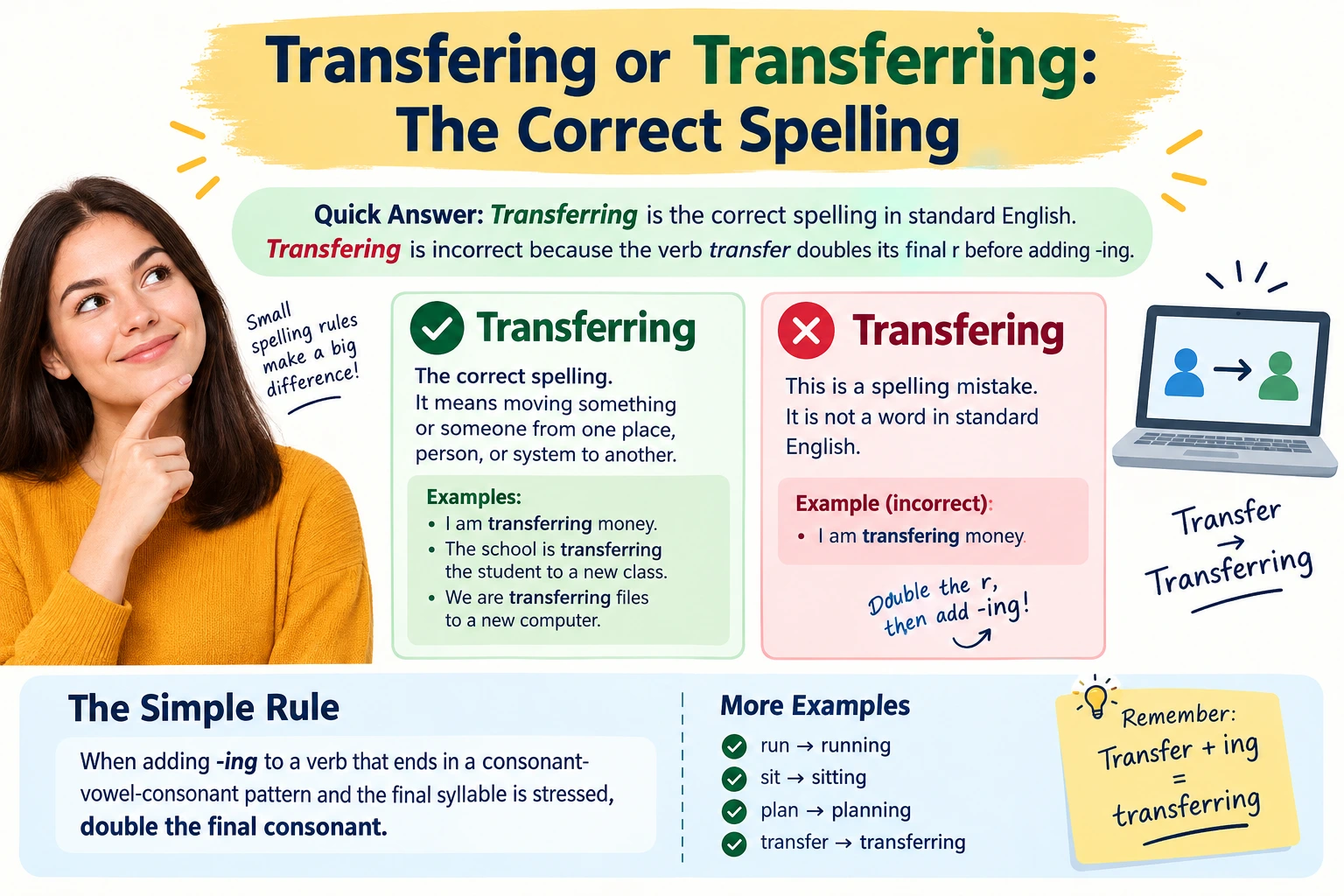
Transferring is the correct spelling in standard English. Transfering is incorrect because the verb transfer doubles its final r before adding -ing.
Have you ever typed a word, looked at it twice, and still wondered if it was correct? The spelling of transfering and transferring can cause this kind of doubt. Both forms look almost the same, but only one is correct.
As an English teacher, I know that small spelling errors can make writers pause, even when they know the meaning of a word. This is especially true when adding endings such as -ing to verbs. Some verbs keep their final letter, while others double it. That small change can be easy to miss.
The word transfer means to move something or someone from one place, person, or situation to another. You might transfer money, change schools, move files, or transfer your duties to a colleague. When you describe an action that is happening now, you need the -ing form.
So, should you write transfering or transferring?
The answer is transferring. The final r must be doubled before adding -ing. In this guide, you will learn the spelling rule, see real examples, and discover how to avoid this common mistake in your everyday writing.
Transfering or Transferring: Quick Answer
Transferring is the correct spelling in English. The word comes from the verb transfer, and its final r doubles when you add -ing.
- Correct: I am transferring money to my savings account.
- Incorrect: I am transfering money to my savings account.
Remember this simple rule: write transfer + ring? No. Start with transfer, double the final r, and then add -ing to form transferring.
The Origin and Background of Transferring
The word transfer comes from Latin roots linked to carrying or moving something across. Over time, it became part of English and gained several related uses.
Today, you can transfer many things, including:
- Money from one bank account to another.
- A student from one school to another.
- Files between computers.
- An employee to a different office.
- Ownership of a car or property.
The word has a broad meaning, but its spelling follows a clear English grammar rule.
Why Does the Final R Double?
English spelling rules often require you to double the last consonant of a verb before adding -ing. This usually happens when the verb ends in a consonant-vowel-consonant pattern and the final syllable is stressed.
For example:
- Run → Running
- Sit → Sitting
- Plan → Planning
- Transfer → Transferring
The word transfer has two syllables: trans-fer. The final syllable is stressed, so the final r doubles before the ending is added.
This gives us:
- Transfer + ing = transferring
- Transfer + ed = transferred
- Transfer + s = transfers
The spelling changes because English uses different patterns when adding endings to verbs.
Transferring Explained: Key Differences
The difference between transfering and transferring is simple. One is a spelling error, while the other is the correct present participle and gerund form of transfer.
| Term | Meaning | When to Use | Region/Context |
|---|---|---|---|
| Transferring | Moving something or someone | When describing an ongoing action or activity | Standard English |
| Transfering | No accepted standard spelling | Do not use in formal or informal writing | Spelling mistake |
| Transfer | To move or shift something | For the base verb or present-tense use | Standard English |
| Transferred | Moved something or someone in the past | For past actions or completed transfers | Standard English |
| Transfers | Moves something or someone | For present-tense actions with a singular subject | Standard English |
What Does Transferring Mean?
Transferring describes the act of moving something from one place, person, or system to another.
For example:
- She is transferring money to her brother.
- The school is transferring the student to another class.
- We are transferring our files to a new computer.
The word can also act as a noun-like form called a gerund.
For example: Transferring money online is easy.
Here, transferring names an activity rather than describing what a person is doing at that moment.
Why Is Transfering Incorrect?
The spelling transfering leaves out one r. English spelling rules require the final r to double when forming transferring.
This mistake often happens because writers add -ing without checking whether the final consonant needs to double.
The same pattern appears in other verbs:
- Prefer → Preferring
- Refer → Referring
- Occur → Occurring
- Transfer → Transferring
Learning these related words can help you remember the correct spelling.
Which Version Should You Use?
You should always use transferring when you want the -ing form of transfer. The correct spelling does not change between American and British English.
For Students
If you are writing an essay, answering an exam question, or completing homework, use transferring.
Example: The student is transferring to a new school next term.
Remember to check the final consonant when adding -ing to a verb.
For Professionals
In emails, reports, and business documents, the correct form is also transferring.
Example: We are transferring your request to the appropriate department.
Correct spelling makes your message easier to read and helps you present your work professionally.
For Everyday Writing
Use transferring in text messages, social media posts, and online forms.
Example: I am transferring the photos to my new phone.
Even in casual writing, the correct spelling helps prevent confusion.
For American and British English
There is no regional spelling difference here. Both American and British English use transferring.
You do not need to choose between two accepted variants. The form transfering is incorrect in both varieties.
Common Mistakes with Transferring
Knowing the spelling is helpful, but it is also important to understand how to use the word correctly.
1. Writing Transfering Instead of Transferring
- Incorrect: I am transfering the money.
- Correct: I am transferring the money.
Why it happens: Writers may forget to double the final consonant before adding -ing.
2. Using Transferring When You Need Transferred
- Incorrect: She has transferring the files.
- Correct: She has transferred the files.
Why it happens: Both words come from transfer, but they serve different grammatical purposes. After has in this sentence, you need the past participle transferred.
3. Confusing Transferring with Transfer
- Incorrect: He is transfer the documents.
- Correct: He is transferring the documents.
Why it happens: The verb after is usually takes the -ing form when describing an action in progress.
4. Using Transferring Instead of Transfers
- Incorrect: The bank transferring money every Friday.
- Correct: The bank transfers money every Friday.
Why it happens: The simple present tense uses transfers with a singular subject such as the bank.
5. Forgetting the Double R in Formal Writing
- Incorrect: The company is transfering its staff.
- Correct: The company is transferring its staff.
Why it happens: Fast typing and autocorrect may not always help you catch spelling mistakes. Proofread important documents before sending them.
Transferring in Real-World Examples
The word transferring appears in many situations. These examples show how to use it naturally in different types of writing.
1. In a Professional Email
Subject: Account Transfer Update
Dear Customer,
We are transferring your account details to our updated system. You will receive a confirmation email once the process is complete.
Best regards,
Customer Support Team
2. In a News Article
The university is transferring several academic programs to its new campus to provide students with improved facilities.
This example shows how the word can describe an institution moving programs from one location to another.
3. In a Social Media Post
I’m transferring all my photos to my new laptop today. I hope the process finishes soon!
This informal example uses the word to describe an action that is happening now.
4. In a Formal Report
The finance department is transferring the approved funds to the regional offices according to the new budget plan.
This sentence uses the word in a business context.
5. In Education
Maya is transferring to another school because her family is moving to a new city.
Here, transferring describes a change from one school to another.
6. In Banking
I am transferring $200 from my checking account to my savings account.
The word describes moving money between two accounts.
7. In Technology
The technician is transferring the data to a secure server.
This example shows how the word is used when moving digital information between systems.
Transferring: Data, Trends, and Usage
The spelling question transfering or transferring reflects a common type of English language problem: knowing a word’s meaning but being unsure how to form it correctly.
The question has a clear informational search intent. People who search for it usually want a quick spelling answer, a simple explanation of the rule, or examples they can use in their writing.
Why Do People Confuse These Spellings?
There are three main reasons:
- The double consonant rule: English does not double the final consonant in every verb.
- Fast typing: People may leave out a letter when writing quickly.
- Similar word patterns: Some verbs take -ing without doubling the final consonant, while others require it.
For example, open becomes opening, but refer becomes referring. These differences can make English spelling feel less predictable.
Where Is Transferring Used Most?
The word appears in several common areas:
- Banking: Transferring money between accounts.
- Education: Transferring students between schools.
- Business: Transferring employees or responsibilities.
- Technology: Transferring files and data.
- Travel: Transferring between flights or transport services.
These examples show why learning the correct spelling is useful in both personal and professional communication.
What Is the Best Way to Remember It?
Use this quick memory trick:
Transfer + ing = transferring.
Think of the double r as part of the spelling pattern. You can also remember the related forms referred and referring, which follow the same consonant-doubling rule.
There is no need to memorize a long list of exceptions for this word. Just remember that transfer doubles its final r before -ing and -ed.
Transfering or Transferring: Comparison Table
Use this table as a quick reference when you are writing.
| Term/Variant | Meaning | Region/Context | Best Used When |
|---|---|---|---|
| Transferring | Moving something or someone | American and British English | Describing an ongoing action or activity |
| Transfering | Incorrect spelling | No standard regional use | Never use as the intended spelling |
| Transfer | To move or shift | Standard English | Using the base verb |
| Transferred | Moved or shifted | Standard English | Describing a completed action |
| Transfers | Moves or shifts | Standard English | Describing a regular action with a singular subject |
The key point is that transferring is the only correct choice when you need the -ing form of transfer.
Frequently Asked Questions
Q1: Is it transfering or transferring?
A: Transferring is correct. You must double the final r in transfer before adding -ing. The spelling transfering is incorrect in standard English.
Q2: What does transferring mean?
A: Transferring means moving something or someone from one place, person, or system to another. For example, you might be transferring money between bank accounts or transferring to a new school.
Q3: Why does transferring have two Rs?
A: The final r doubles because transfer follows a consonant-doubling spelling pattern when the final syllable is stressed. The same rule applies to words such as referring and preferring.
Q4: Is transferring acceptable in formal writing?
A: Yes. Transferring is correct in formal and informal writing. You can use it in emails, reports, school assignments, business documents, and everyday messages.
Q5: Is transferring spelled the same in American and British English?
A: Yes. Both American and British English use transferring. There is no regional spelling difference between these varieties.
Q6: What is the difference between transferring and transferred?
A: Transferring usually describes an action in progress or names an activity. Transferred is the past-tense and past-participle form. For example, “I am transferring the file” describes an ongoing action, while “I transferred the file” describes a past action.
Q7: Can transferring be used as a noun?
A: Yes. Transferring can function as a gerund, which is a verb form ending in -ing that acts as a noun. For example, “Transferring money online is convenient” uses the word to name an activity.
Conclusion
The choice between transfering and transferring is easy once you know the spelling rule. Transferring is the correct form, while transfering is a common spelling mistake.
Remember these four points:
- Transferring doubles the final r before adding -ing.
- The same double r appears in transferred.
- American and British English use the same spelling.
- The word can describe moving money, files, students, employees, or responsibilities.
You can avoid this mistake by checking the final consonant whenever you add an ending to a verb. Practice with related words such as referring, preferring, and occurring to build confidence.
Correct spelling does not have to be difficult. A simple rule can help you write more clearly in school, at work, and in everyday life.
Now you know exactly how to spell transferring. Bookmark this guide so you never second-guess this word again, and share it with someone who needs a quick spelling reminder.
Appendices or Appendixes: The Complete Guide

I specialize in spelling comparisons, confusing word pairs, grammar, and vocabulary development. My content helps readers improve their English, avoid common mistakes, and write with confidence. My goal is to provide accurate, reliable, and easy-to-understand language resources