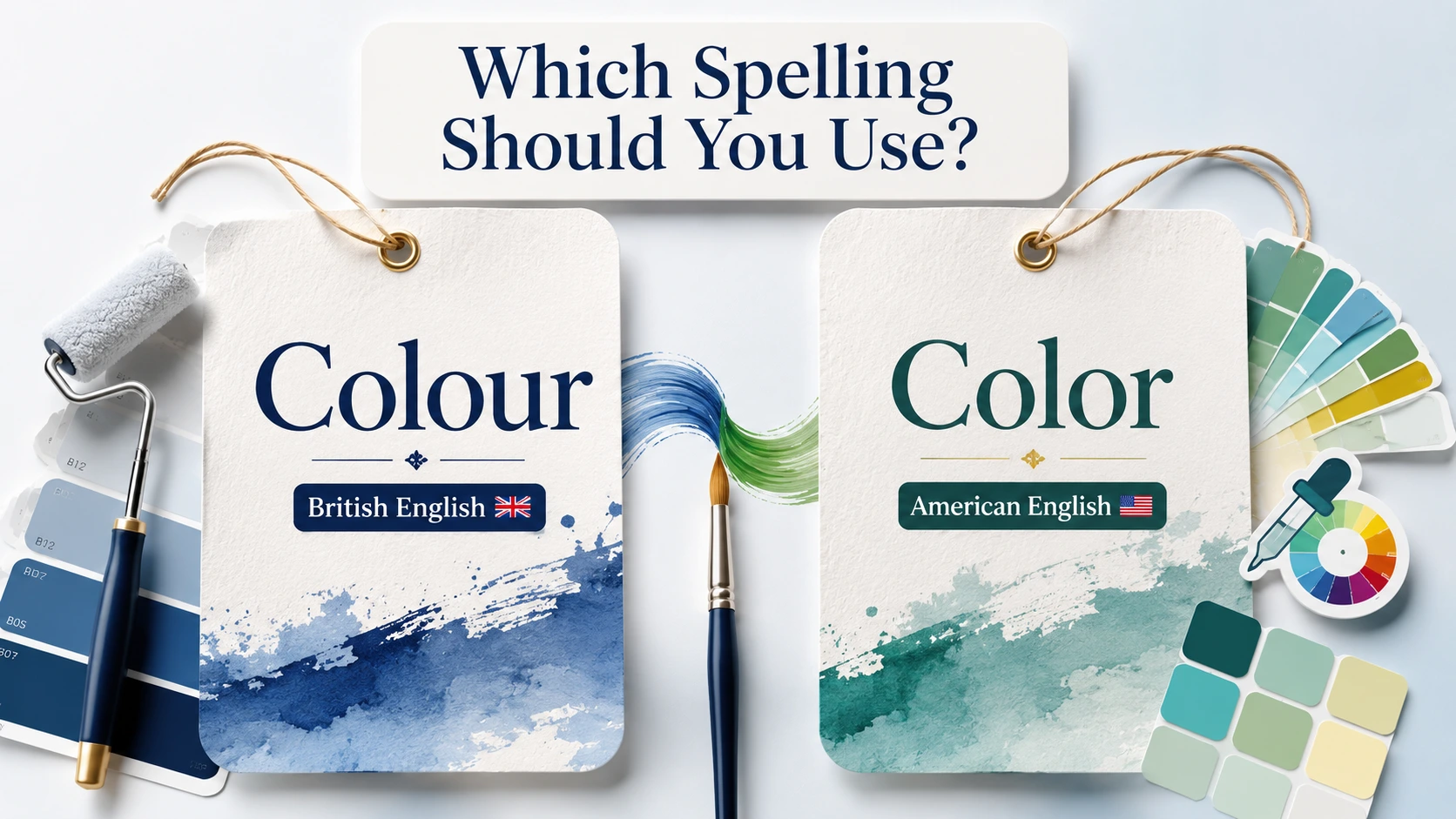
Both colour and color are correct spellings of the same word. Color is used in American English, while colour is the standard spelling in British English, Canada, Australia, New Zealand, and many other Commonwealth countries.
Have you ever typed colour into a document only to see your spell checker underline it in red? I remember writing an article for a U.S. client after spending weeks working with British publications. Without thinking, I wrote colour throughout the entire piece. The editor politely asked me to change every instance to color. That small difference reminded me how one extra letter can matter depending on your audience.
This is one of the most searched spelling questions in English. Since both versions appear online, in books, and in everyday writing, many people assume one must be wrong. The truth is much simpler.
The difference between colour and color isn’t about grammar or meaning. It’s about regional spelling conventions. Once you know which countries use each version, you’ll never second-guess yourself again.
In this guide, you’ll learn the history behind both spellings, discover when to use each one, compare real-world examples, and avoid common mistakes.
Colour or Color: Quick Answer
Colour and color have the same meaning. They both refer to the appearance of something based on the light it reflects.
The only difference is where each spelling is used.
- Color → Standard in American English 🇺🇸
- Colour → Standard in British English 🇬🇧 and most Commonwealth countries 🌍
Examples
American English
✅ My favorite color is blue.
British English
✅ My favourite colour is blue.
Notice that the meaning stays exactly the same. Only the spelling changes.
How to Pronounce Colour and Color
The pronunciation is almost identical in every major variety of English.
Color
Pronunciation: /ˈkʌl.ɚ/
Phonetic spelling: KUL-er
Colour
Pronunciation: /ˈkʌl.ə/
Phonetic spelling: KUL-uh
The spelling changes, but the pronunciation is nearly the same. Most listeners won’t notice any difference.
Quick Tip
The extra “u” in colour changes the spelling, not the meaning or pronunciation.
The Origin and Background of Colour or Color
Both spellings come from the same Latin word, color, meaning color, appearance, or hue.
The word entered English through Old French as colour, which is why British English still keeps the “u.”
In the early 1800s, American lexicographer Noah Webster introduced spelling reforms to simplify American English. He removed silent letters from many words to make spelling more consistent.
As a result:
- colour became color
- favour became favor
- honour became honor
- labour became labor
These simplified spellings became standard in the United States, while Britain and many Commonwealth countries continued using the original forms.
Today, both spellings are officially correct. The best choice depends entirely on your audience.
Colour or Color Explained: Key Differences
The meaning never changes. The only difference is the preferred spelling in different regions.
| Term | Meaning | When to Use | Region/Context |
|---|---|---|---|
| Color | The appearance of something based on light | American writing, schools, business, websites | United States |
| Colour | The appearance of something based on light | British writing, education, publishing | United Kingdom, Canada, Australia, New Zealand, and most Commonwealth countries |
Examples
Color
- My favorite color is green.
- The designer chose a bright color palette.
- Please select your preferred color from the menu.
Colour
- Her favourite colour is green.
- The artist mixed several colours on the canvas.
- The autumn leaves changed colour overnight.
Why People Get Confused
There are several reasons this spelling pair causes confusion:
- Both versions are correct.
- American and British English follow different spelling rules.
- Spell checkers often flag the “wrong” version based on your language settings.
- International websites may use either spelling depending on their audience.
Easy Memory Trick
Remember this simple rule:
- Color → America (both have no extra “u”)
- Colour → United Kingdom and most Commonwealth countries (keeps the “u”)
If you’re writing for a global audience, choose the spelling that matches your readers and use it consistently throughout your content.
Saviour or Savior: Which Spelling Is Correct?
Which Version Should You Use?
Since both colour and color are correct, the best choice depends on where your audience is located.
Here’s a simple guide:
- American students and writers → Use color because it’s the standard American spelling.
- British students and writers → Use colour because it’s the standard British spelling.
- Canadian writers → Colour is generally preferred in Canadian English, although color sometimes appears in American-influenced content.
- Australian and New Zealand writers → Use colour.
- International businesses → Match the spelling to your target audience. If your customers are mostly American, use color. Otherwise, colour is suitable for most Commonwealth audiences.
Our Recommendation
If you’re writing for a U.S. audience, choose color.
If you’re writing for readers in the UK, Canada, Australia, New Zealand, or other Commonwealth countries, choose colour.
For global websites, either spelling works, but stay consistent throughout your article, website, or document.
Simple rule: Match your spelling to your audience, not to personal preference.
Common Mistakes with Colour or Color
Most mistakes happen because writers accidentally mix American and British spellings in the same piece of writing.
| Mistake | Correct Form | Why It Happens |
|---|---|---|
| ❌ My favourite color is blue. | ✅ Favourite colour (British) or Favorite color (American) | Mixing language varieties |
| ❌ The colour of the theater. | ✅ Colour of the theatre (British) or Color of the theater (American) | Mixed regional spelling |
| ❌ Colur | ✅ Colour / Color | Simple spelling error |
| ❌ Colours and colors together | ✅ Use one style consistently | Inconsistent editing |
| ❌ Colorful in British writing | ✅ Colourful | British English keeps the u |
Correct These Sentences
❌ My favourite color is green.
✅ British English: My favourite colour is green.
✅ American English: My favorite color is green.
❌ The building changed colour after the renovation. (American article)
✅ The building changed color after the renovation.
❌ We love bright colors in this British magazine.
✅ We love bright colours in this British magazine.
Colour or Color in Real-World Examples
Seeing both spellings in context makes the regional difference easier to remember.
Professional Email (American English)
“Please confirm the color preferences for the new company logo.”
Professional Email (British English)
“Please confirm the colour preferences for the new company logo.”
News Headline
“Scientists Discover New Color Pattern in Tropical Birds.” (American publication)
“Scientists Discover New Colour Pattern in Tropical Birds.” (British publication)
Social Media Post
“I finally painted my room my favorite color! 🎨”
“I finally painted my room my favourite colour! 🎨”
Formal Report
“The color of the product should remain consistent across all packaging.” (U.S.)
“The colour of the product should remain consistent across all packaging.” (U.K.)
Both versions are equally correct: the spelling simply changes with the audience.
Colour or Color: Data, Trends & Usage
The keyword “colour or color” is one of the most searched English spelling comparisons because millions of people write for international audiences.
Search Intent
Primary Search Intent: Informational
Most users want to know:
- Which spelling is correct?
- Is colour wrong?
- Why does American English remove the “u”?
- Which spelling should I use?
Who Searches for This?
This topic is especially popular among:
- English learners
- Students
- Teachers
- Bloggers
- SEO writers
- Editors
- Copywriters
- Business professionals
Regions Where It’s Most Searched
Searches commonly come from:
- United States
- United Kingdom
- Canada
- Australia
- New Zealand
- India
- Pakistan
Why This Matters Today
Many websites serve readers from multiple countries. Choosing the correct regional spelling helps build trust, improves readability, and creates a more professional experience for your audience.
Colour or Color: Comparison Table
| Term/Variant | Meaning | Region/Context | Best Used When |
|---|---|---|---|
| Color | The appearance of something based on light | American English | U.S. websites, schools, businesses, books, and everyday writing |
| Colour | The appearance of something based on light | British English and Commonwealth English | U.K., Canada, Australia, New Zealand, and international publications |
Frequently Asked Questions
Q: Is it colour or color?
Both colour and color are correct spellings. Color is the standard spelling in American English, while colour is used in British English and most Commonwealth countries.
Q: Which spelling is correct, colour or color
Both are correct. The right choice depends on your audience. If you’re writing for American readers, use color. For British, Canadian, Australian, or New Zealand readers, use colour.
Q: Why does American English use “color” instead of “colour”?
American English adopted color after Noah Webster simplified many spellings in the early 1800s. He removed silent letters, including the “u” in words like colour, honour, and favour.
Q: Is colour used in Canada?
Yes. Colour is the standard spelling in Canadian English. Although color sometimes appears because of American influence, colour is generally preferred in schools, government, and formal writing.
Q: Do colour and color have different meanings?
No. They have exactly the same meaning. Both refer to the appearance of something based on the light it reflects.
Q: Can I mix colour and color in the same article?
It’s best not to. Choose one spelling based on your audience and use it consistently throughout your writing. Mixing the two can make your content look unprofessional.
Q: How can I remember the difference?
A simple trick is:
- Color → American English (shorter spelling)
- Colour → British English and Commonwealth English (includes the extra “u”)
Conclusion
Choosing between colour or color is easier than many people think. Both spellings are correct, and both mean exactly the same thing. The only real difference is where they’re used.
Here’s a quick recap:
- Color is the standard spelling in American English.
- Colour is preferred in British English, Canadian English, Australian English, and most Commonwealth countries.
- The pronunciation and meaning are identical.
- The key to professional writing is consistency. Pick the spelling that matches your audience and use it throughout your content.
Whether you’re writing an email, a school assignment, a business report, or a blog post, choosing the right regional spelling helps your writing feel natural and polished.
Now you know exactly when to use colour and color. Bookmark this guide so you never second-guess the spelling again, and share it with someone who still wonders which version is correct.
Colour or color? Learn the correct spelling, regional differences, pronunciation, usage, and examples to write confidently for every audience.
Orthopedic or Orthopaedic? Why Both Spellings Exist

I’m an English language researcher and content writer. I am specialized in spelling comparisons, commonly confused words, grammar usage, and vocabulary guides. Through detailed language articles,I am helping readers to understand the differences between similar words and improve their written communication skills.