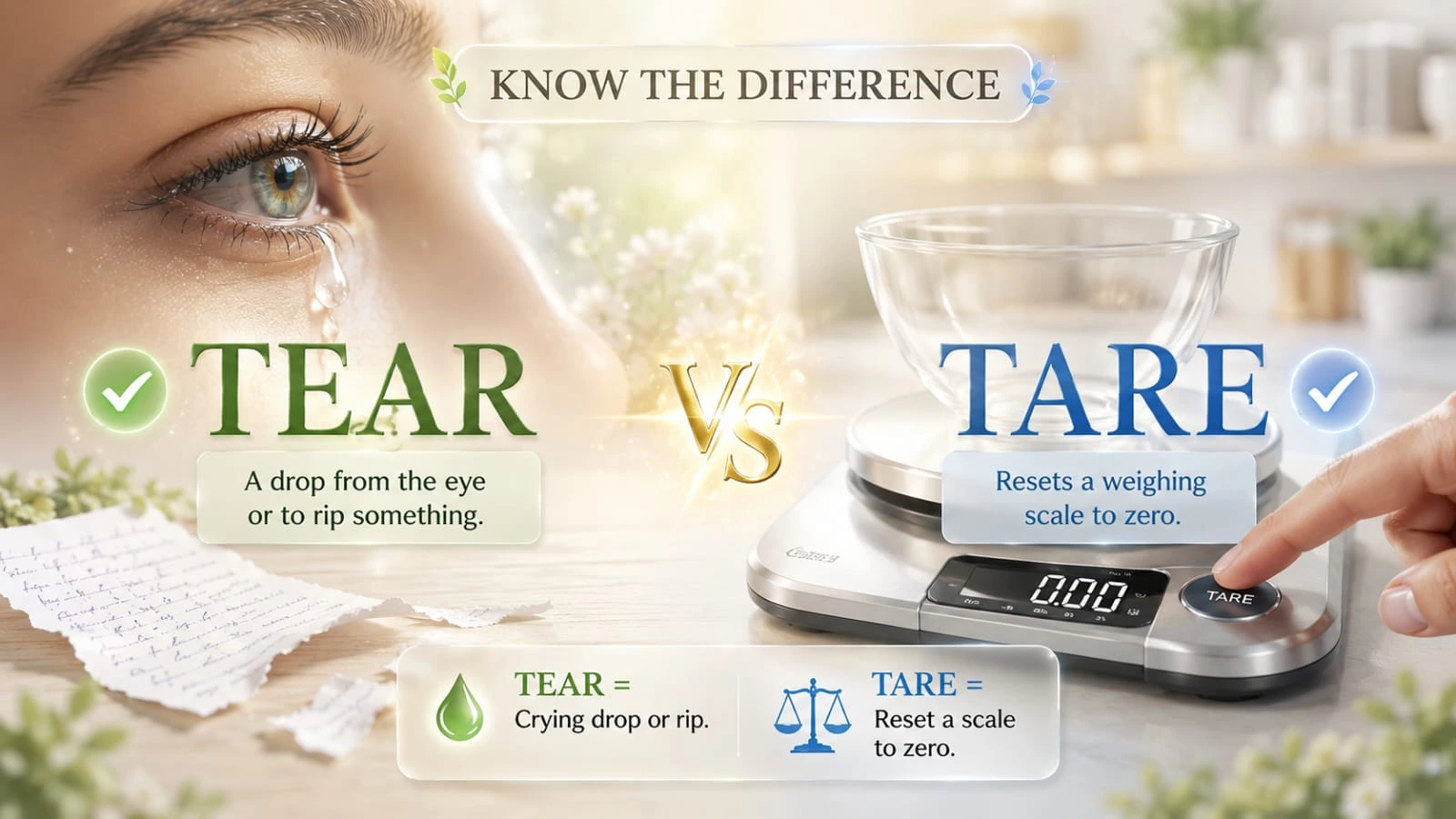
“Tear” means to rip something, or refers to a teardrop when crying. “Tare” is a completely different word, referring to the weight of empty packaging in shipping, or an old term for a weed. They aren’t spelling variants, they’re two separate words.
I once filled out a shipping form for a small business and wrote “tear weight” instead of “tare weight” for the empty box. The warehouse manager gently corrected me, and I realized I’d never actually seen that word written out before, only heard it spoken.
If you’ve ever mixed these two up, you’re definitely not alone. “Tear” and “tare” sound nearly identical in certain contexts, yet they mean completely different things, one relates to ripping or crying, the other relates to weight and packaging.
This guide breaks down exactly what each word means, where “tare” actually comes from, and how to use both correctly, whether you’re writing a shipping label, a story, or an everyday email.
Tear or Tare: Quick Answer
“Tear” means to rip something apart, or refers to a drop of liquid from crying.
- ✅ She began to tear the paper into small pieces.
- ✅ A tear rolled down his cheek.
“Tare” refers to the weight of empty packaging, or an old-fashioned term for a weed.
- ✅ The tare weight of the container is fifty pounds.
- ❌ She began to tare the paper into small pieces.
The Origin of Tear/Tare
“Tear,” meaning to rip, comes from Old English teran, related to Germanic roots describing the act of pulling something apart. The other “tear,” meaning a teardrop, comes from a completely different Old English word, tear or teagor, related to crying and grief. These two words are actually spelled identically but pronounced differently, depending on their meaning, which already causes plenty of confusion on its own.
“Tare” comes from an entirely separate source. In shipping and commerce, it traces back to Arabic tarah, meaning “to reject” or “deduction,” passed through French and Italian trade vocabulary into English. It specifically refers to the weight of packaging material, subtracted from the total weight to determine the actual product weight.
A secondary, older meaning of “tare” refers to a weed, most famously mentioned in the biblical parable of the wheat and the tares, describing an unwanted plant growing among crops.
Tear vs Tare Explained: Key Differences and Variations
| Term | Meaning | When to Use | Context |
| Tear (rip) | To pull something apart | Describing physical damage or separation | Everyday writing, instructions, stories |
| Tear (teardrop) | A drop of liquid from crying | Describing emotion or crying | Storytelling, emotional writing |
| Tare | Weight of empty packaging | Shipping, logistics, commerce | Business, manufacturing, shipping documents |
| Tare (weed) | An old term for an unwanted plant | Rare, mostly biblical or literary references | Literature, historical texts |
Notice that “tear” alone carries two different meanings depending on pronunciation, while “tare” is a completely separate word used almost exclusively in specific technical or historical contexts.
Which Word Should You Use?
For describing ripping or physical damage
Use tear. This applies to paper, fabric, or any material being pulled apart.
For describing crying or emotion
Use tear as well, since both meanings share the same spelling, context makes the meaning clear.
For shipping, logistics, or commercial weight calculations
Use tare. This is standard terminology in manufacturing, freight, and packaging industries.
For literary or historical writing
Tare appears occasionally as an old-fashioned word for a weed, mostly in classic literature or biblical references.
Common Mistakes with Tear/Tare
Mistake 1: Using “tare” instead of “tear” for ripping
✅ Be careful not to tear the wrapping paper.
❌ Be careful not to tare the wrapping paper.
Why it happens: The words sound alike in casual speech, especially in regions where vowel pronunciation shifts slightly.
Mistake 2: Using “tear” instead of “tare” in shipping documents
✅ The tare weight must be subtracted before calculating shipping costs.
❌ The tear weight must be subtracted before calculating shipping costs.
Why it happens: Many writers have never seen “tare” written out, since it’s a fairly specialized business term.
Mistake 3: Confusing the two meanings of “tear” itself
✅ A tear (teardrop) fell as she watched the fabric tear (ripping).
❌ Assuming both uses of “tear” always sound and mean the same thing.
Why it happens: Readers unfamiliar with the word’s dual pronunciation don’t realize context changes both the sound and the meaning.
Mistake 4: Misapplying “tare” outside of technical contexts
✅ Reserve “tare” for shipping, packaging, or historical/literary references.
❌ Using “tare” in casual writing when “tear” is what’s actually meant.
Why it happens: Writers who’ve heard “tare” used professionally sometimes misapply it to everyday ripping or crying contexts.
Mistake 5: Assuming spellcheck will catch the error
✅ Proofread carefully, since both “tear” and “tare” are valid English words.
❌ Relying on autocorrect to flag an incorrect word choice.
Why it happens: Because both words are spelled correctly on their own, spellcheck tools won’t catch a simple word swap.
Flyer or Flier: Which Spelling Is Correct? (2026)
Tear/Tare in Real-World Examples
Professional email:
“Please confirm the tare weight of the shipping container before we finalize the invoice.”
News headline:
“Community Sheds a Tear as Historic Theater Closes Its Doors”
Social media post:
“Accidentally let a tear slip during that movie, no regrets. 😢”
Formal document:
“Gross weight minus tare weight equals the net weight of the shipment.”
Notice how “tare” appears almost exclusively in shipping and business contexts, while “tear” covers both emotional and physical meanings in everyday writing.
Tear/Tare: Data, Trends & Usage
Search interest in “tear vs tare” splits sharply by audience. Logistics professionals, warehouse workers, and manufacturing staff search “tare” specifically to confirm correct usage in shipping documentation and weight calculations, falling into the informational and commercial search category. Meanwhile, general writers and students search “tear” mostly to clarify pronunciation and emotional versus physical meaning.
“Tare” sees the most consistent search volume from supply chain and e-commerce industries, where accurate weight documentation directly affects shipping costs and inventory accuracy.
Tear vs Tare: Comparison Table
| Term/Variant | Meaning | Region/Context | Best Used When |
| Tear | To rip, or a drop from crying | Universal, all English dialects | Everyday writing, emotional or physical description |
| Tare | Weight of empty packaging | Shipping, logistics, commerce | Business and manufacturing documentation |
| Tare (weed) | Old term for an unwanted plant | Rare, literary or historical | Classic literature, biblical references |
Frequently Asked Questions
Q: What does “tear” mean?
A: “Tear” has two meanings, to rip or pull something apart, or a drop of liquid released while crying. Context and pronunciation clarify which meaning applies.
Q: How do you use “tare” correctly in a sentence?
A: Use “tare” specifically for the weight of empty packaging in shipping, such as “The tare weight of the crate is fifteen kilograms.”
Q: Tear vs tare, what’s the difference?
A: “Tear” relates to ripping or crying, while “tare” refers to packaging weight or, rarely, a weed. They’re unrelated words that happen to sound similar.
Q: Is “tare” acceptable in formal writing?
A: Yes, especially in shipping, logistics, and manufacturing documentation, where it’s the standard technical term for packaging weight.
Q: Which version is correct, tear or tare?
A: Both are correct, but they mean entirely different things. Choose based on whether you’re describing ripping, crying, or shipping weight.
Q: Where does the word “tare” come from?
A: It comes from Arabic tarah, meaning “to reject” or “deduction,” passed into English through French and Italian trade terminology.
Q: Can “tare” be used outside of shipping contexts?
A: Rarely, and mostly in older literary or biblical references describing a weed. In modern everyday writing, “tare” almost always refers to packaging weight.
Final Takeaway
Here’s the short version. “Tear” relates to ripping or crying. “Tare” relates to shipping weight, or occasionally, an old-fashioned word for a weed.
Key points to remember:
- The test: If you’re describing ripping or crying, use “tear.” If you’re describing packaging weight, use “tare”
- Watch pronunciation: “Tear” changes sound depending on whether it means ripping or crying
- Industry-specific term: “Tare” is mostly used in shipping, logistics, and manufacturing
- No shortcuts: Spellcheck won’t catch this mix-up, since both words are valid on their own
Once you separate these two words by meaning, you’ll never confuse “tear” and “tare” again.
Tear vs tare explained, correct meaning, usage, and examples. Learn the difference between ripping, crying, and shipping weight.
Where or Were: Complete GuideTo The Correct Usage (2026)

I’m a language enthusiast and content writer. I’m specialized in English grammar, spelling differences, vocabulary explanations, and word comparisons. My goal is to help readers improve their writing skills through clear, accurate, and easy-to-understand language guides.