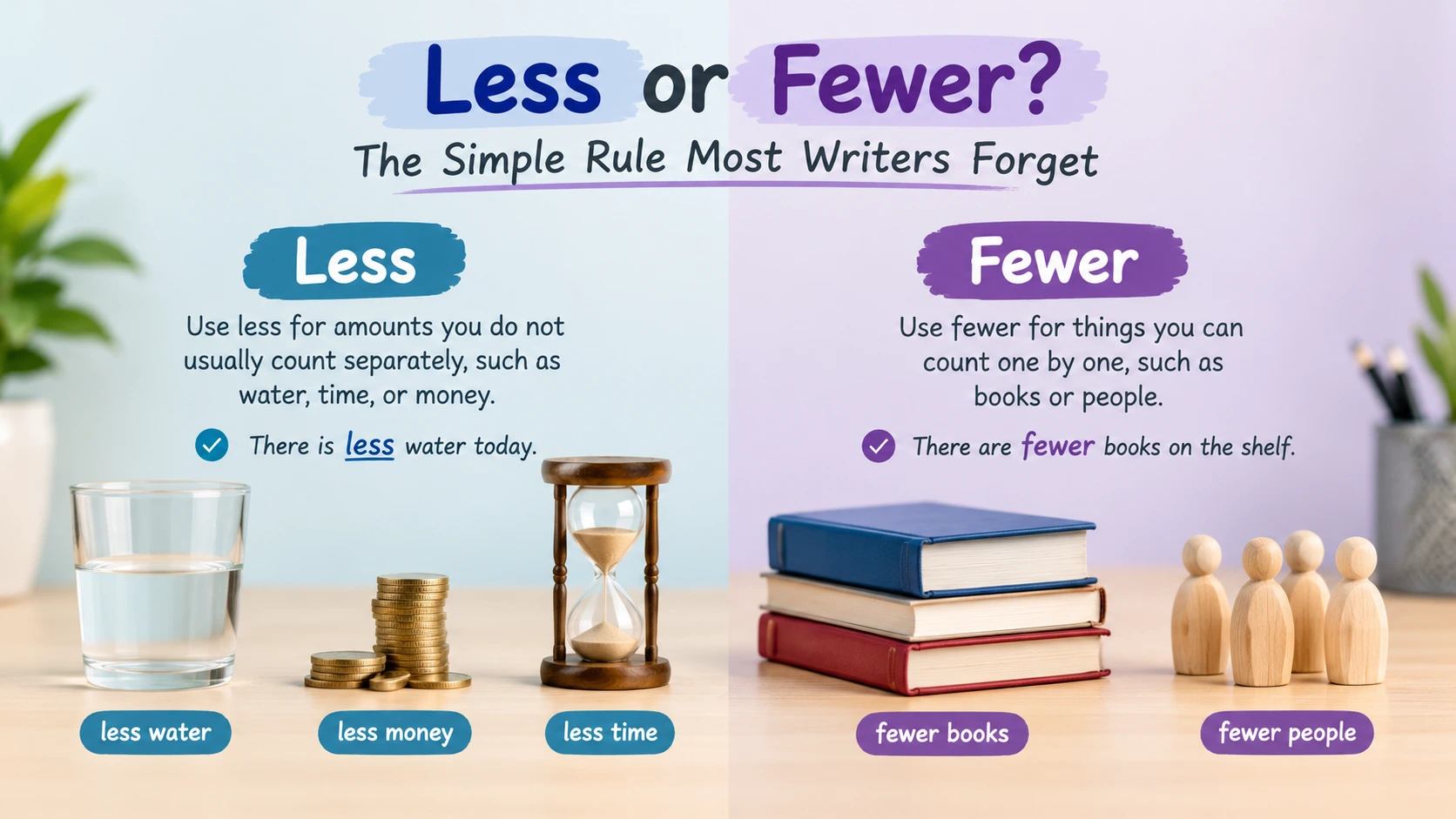
Use fewer for things you can count one by one, such as books or people. Use less for amounts you do not usually count separately, such as water, time, or money.
Have you ever wondered whether to write “less mistakes” or “fewer mistakes”? You may hear both phrases in everyday speech, but traditional grammar favors fewer mistakes. The reason is simple: you can count mistakes one by one.
This small rule can make a big difference in your writing. You may need it when writing a school essay, sending a work email, or creating content for your website. Yet the choice is not always easy. What about money, time, distance, or words? These can cause confusion because some are measured as amounts, while others can be counted as separate items.
As an English teacher, I would teach this rule with two simple examples: fewer apples and less juice. You can count the apples one by one, but you usually measure the juice as an amount.
There are also common expressions where less is correct even when numbers are involved. In this guide, you will learn the basic rule, the important exceptions, and how to choose the right word with confidence.
Less or Fewer: Quick Answer
The difference between less and fewer depends on whether a noun is countable or uncountable.
- Use fewer with countable plural nouns.
- Use less with uncountable nouns.
Examples:
- We need fewer chairs in this room.
- I want less sugar in my tea.
- She has fewer books than I do.
- We have less time to finish the task.
A simple trick can help: if you can count the items as one, two, and three, fewer is usually the right choice. If you measure the amount, less is usually better.
The Origin and Background of Less and Fewer
The words less and fewer have been part of English for a long time. Both help us describe a small amount or number, but they developed different roles in everyday grammar.
Less is used to describe a smaller amount or degree. For example, you can have less water, less patience, or less interest in a subject.
Fewer refers to a smaller number of separate things. You can have fewer books, fewer students, or fewer problems.
The confusion often comes from daily speech. People sometimes say “less people” or “less mistakes.” These phrases are easy to understand, but fewer people and fewer mistakes follow the traditional grammar rule.
There is another reason the rule can feel confusing. Some nouns can be counted in one context but treated as an amount in another. Money, time, distance, and weight are common examples.
For instance:
- I have less money than before.
- I made fewer purchases this month.
Both sentences describe a reduction, but the nouns work differently.
Less vs. Fewer: Key Differences Explained
1. When to Use Less
Use less with uncountable nouns. These are things that we usually think of as a whole amount rather than separate items.
Common examples include:
- Water
- Milk
- Sugar
- Rice
- Time
- Money
- Traffic
- Information
- Patience
- Noise
Examples in sentences:
- Please add less salt to the soup.
- I have less time today.
- We need less information to make this decision.
- There is less traffic on Sundays.
- He has less patience than his sister.
Less can also describe degree, distance, or a lower value.
For example, “This bag weighs less than that one” compares the amount of weight, not separate objects.
2. When to Use Fewer
Use fewer with countable plural nouns. These are things you can count separately.
Common examples include:
- Books
- Cars
- People
- Students
- Mistakes
- Questions
- Apples
- Emails
- Tickets
- Days
Examples in sentences:
- I made fewer mistakes in my last test.
- There are fewer students in class today.
- We received fewer emails this week.
- She bought fewer apples than her brother.
- The new road has fewer traffic lights.
The key is that each item can be counted separately.
3. What About Money, Time, and Distance?
These words often cause the most confusion.
| Word | Correct Example | Why? |
| Money | I spent less money. | Money is treated as an amount. |
| Coins | I have fewer coins. | Coins are separate items. |
| Time | We have less time. | Time is treated as an amount. |
| Hours | I worked fewer hours. | Hours can be counted. |
| Distance | We walked less distance today. | Distance is treated as a measured amount. |
| Kilometers | We walked fewer kilometers than planned. | Kilometers are counted units. |
| Water | There is less water in the bottle. | Water is uncountable. |
| Bottles | There are fewer bottles on the shelf. | Bottles are countable. |
Notice that the same general topic can use either word. The noun and the way you describe it determine the choice.
4. Less Than vs. Fewer Than
Both phrases are correct, but they are used differently.
Use less than with amounts, measurements, and values.
- The journey took less than an hour.
- The bag weighs less than five kilograms.
- The meal costs less than $20.
Use fewer than with countable items.
- There were fewer than ten people at the meeting.
- I received fewer than five emails.
- She made fewer than three mistakes.
There is one useful exception to remember: less than is common with numbers, prices, measurements, and time expressions. Do not try to apply the countable-noun rule to every sentence without considering how the phrase works.
Which Word Should You Use?
The best choice depends on the noun and the situation.
For Students and Exams
Use the standard rule in grammar tests and formal assignments.
- Correct: There are fewer questions in this test.
- Correct: We have less homework today.
This approach is clear and safe for schoolwork.
For Teachers and Academic Writers
Use fewer for countable items and less for uncountable amounts in explanations, essays, and research writing.
For example:
“Students made fewer errors after receiving more practice.”
“Students spent less time completing the task.”
For Business and Professional Writing
Choose the word that matches the noun.
- Less spending can help a company save money.
- Fewer expenses can improve a budget.
- Less time may be needed to complete a task.
- Fewer meetings may give staff more time to work.
These small choices make professional writing more precise.
For Everyday Conversation
You may hear people use less with countable nouns in casual speech. The meaning is often clear, but the traditional distinction is still useful.
If you want to speak and write carefully, use fewer people, fewer problems, and fewer mistakes.
For Signs and Public Messages
The choice can depend on the phrase and the context. For example, “10 items or fewer” follows the traditional rule because items can be counted.
You may also see “less than 10 minutes” because time is being expressed as a measurement.
My recommendation: Learn the countable-versus-uncountable rule first, then learn the common exceptions.
Common Mistakes with Less and Fewer
1. Saying “Less People”
Incorrect: There are less people in the park today.
Correct: There are fewer people in the park today.
Why? People can be counted as individuals.
2. Saying “Fewer Water”
Incorrect: We need fewer water for this recipe.
Correct: We need less water for this recipe.
Why? Water is an uncountable noun when it refers to a substance.
3. Saying “Less Mistakes”
Incorrect: I made less mistakes this time.
Correct: I made fewer mistakes this time.
Why? Mistakes are separate things that can be counted.
4. Saying “Fewer Money”
Incorrect: She spends fewer money than I do.
Correct: She spends less money than I do.
Why? Money is treated as an amount. If you are counting coins or banknotes as individual items, fewer may be appropriate for those items.
5. Using “Fewer Than” with an Uncountable Amount
Incorrect: We have fewer than five minutes to leave.
Correct: We have less than five minutes to leave.
Why? Here, five minutes expresses a duration of time. The natural expression is less than five minutes.
Less and Fewer in Real-World Examples
1. Professional Email
Dear Team,
We aim to spend less time on repeated tasks and hold fewer meetings each week.
Please review your current tasks and suggest ways to make our workflow simpler and more effective.
Thank you for your support.
Best regards,
Team Manager
Here, less refers to time, while fewer refers to meetings that can be counted.
2. News Headline
New Road Plan Aims to Reduce Traffic and Prevent Accidents
A related sentence in the article could read:
“The plan aims to create fewer traffic delays and help drivers spend less time on the road.”
3. Social Media Post
Want a simpler week? Try making fewer commitments and giving yourself less stress. Small changes can help you feel more in control! ✨
4. Formal Report
Report: Improving Work Efficiency
The new process resulted in fewer errors and required less time to complete each task. These changes helped the team improve its workflow and meet deadlines more easily.
Less or Fewer: Usage, Trends, and Search Intent
People who search for “less or fewer” usually want a clear grammar rule. They may be checking a sentence, preparing for an exam, or improving their English writing.
The main search intent is informational.
This topic is useful for:
- Students learning English grammar.
- Teachers preparing grammar lessons.
- Writers editing essays and articles.
- Business professionals writing reports and emails.
- English learners who want to sound more natural.
The confusion remains common because everyday speech does not always follow formal grammar rules. Some expressions also depend on how a noun is used. For example, we say less money but fewer coins.
For website owners and language educators, a helpful explanation should do more than state the basic rule. It should show how the rule works with real nouns, measurements, and common exceptions.
There is no verified search-volume data here to identify the most interested country or measure current search trends. Still, the question has lasting value because it relates to a common grammar choice.
The key insight is this: count the items, but measure the amount. That simple idea will help you make the right choice in most sentences.
Standalone Comparison Table: Less vs. Fewer
| Term or Phrase | Meaning | Context | Best Used When |
| Less | A smaller amount or degree | Uncountable nouns | Less water, less time |
| Fewer | A smaller number | Countable plural nouns | Fewer books, fewer people |
| Less than | A smaller amount, value, or duration | Measurements and amounts | Less than an hour |
| Fewer than | A smaller number of items | Countable nouns | Fewer than ten students |
| Less money | A smaller amount of money | Money as an amount | Comparing spending |
| Fewer coins | A smaller number of coins | Separate countable items | Comparing coin totals |
| Less work | A smaller amount of work | Work as an activity or amount | Comparing workloads |
| Fewer tasks | A smaller number of tasks | Separate jobs or duties | Comparing task lists |
Frequently Asked Questions
Q1: What is the difference between less and fewer?
Use less for an amount and fewer for a number of countable items. For example, say “less milk” but “fewer bottles.”
Q2: How do you use less correctly?
Use less with uncountable nouns, measurements, and degrees. Examples include less water, less noise, less time, and less stress.
Q3: How do you use fewer correctly?
Use fewer with countable plural nouns. Examples include fewer books, fewer people, fewer questions, and fewer mistakes.
Q4: Is less or fewer correct in formal writing?
Both are correct when used in the right context. In formal writing, use less for amounts and fewer for countable items, while recognizing established expressions and measurement phrases.
Q5: Should I say less people or fewer people?
Fewer people is the traditional and recommended form in careful writing. People can be counted as individuals, so fewer fits the noun.
Q6: Is it less than 10 or fewer than 10?
Both can be correct, depending on what follows. Use fewer than 10 students for countable people, but less than 10 minutes for a duration of time.
Q7: Do we say less money or fewer money?
Say less money because money is usually treated as an amount. Use fewer coins or fewer banknotes when counting those items separately.
Q8: What is the rule for less and fewer with time?
Use less time when talking about duration. Use fewer hours or fewer days when counting units of time as separate items.
Q9: Why do people say less instead of fewer?
In casual speech, people often use less broadly. The meaning is usually understood, but fewer is the traditional choice for countable plural nouns in careful writing.
Q10: Is “10 items or less” wrong?
The traditional expression is “10 items or fewer” because items are countable. However, “10 items or less” is common on signs and in everyday use.
Conclusion
The difference between less and fewer becomes much easier when you focus on the noun. Use fewer when you mean a smaller number of things you can count. Use less when you mean a smaller amount, degree, or measurement.
For example, you can have fewer books, fewer students, and fewer mistakes. You can have less water, less time, and less money. These simple patterns will help you write more clearly in school, at work, and online.
Remember that some expressions need extra care. We usually say less than five minutes because we are talking about a duration. We also often use less with money, distance, and other measurements.
You do not need to worry about every sentence. Start with the basic rule, check the noun, and think about whether you are counting separate items or describing an amount.
Bookmark this guide so you can check the rule whenever you need it. Share it with a friend who wants to improve their English grammar, too.
Who or Whom: How to Know Which One to Use

I am a language content specialist specializing in spelling comparisons, vocabulary usage, and commonly confused English words. I write detailed, informative articles that help readers improve their language skills. I am passionate about helping students, writers, and professionals develop a stronger understanding of the English language.