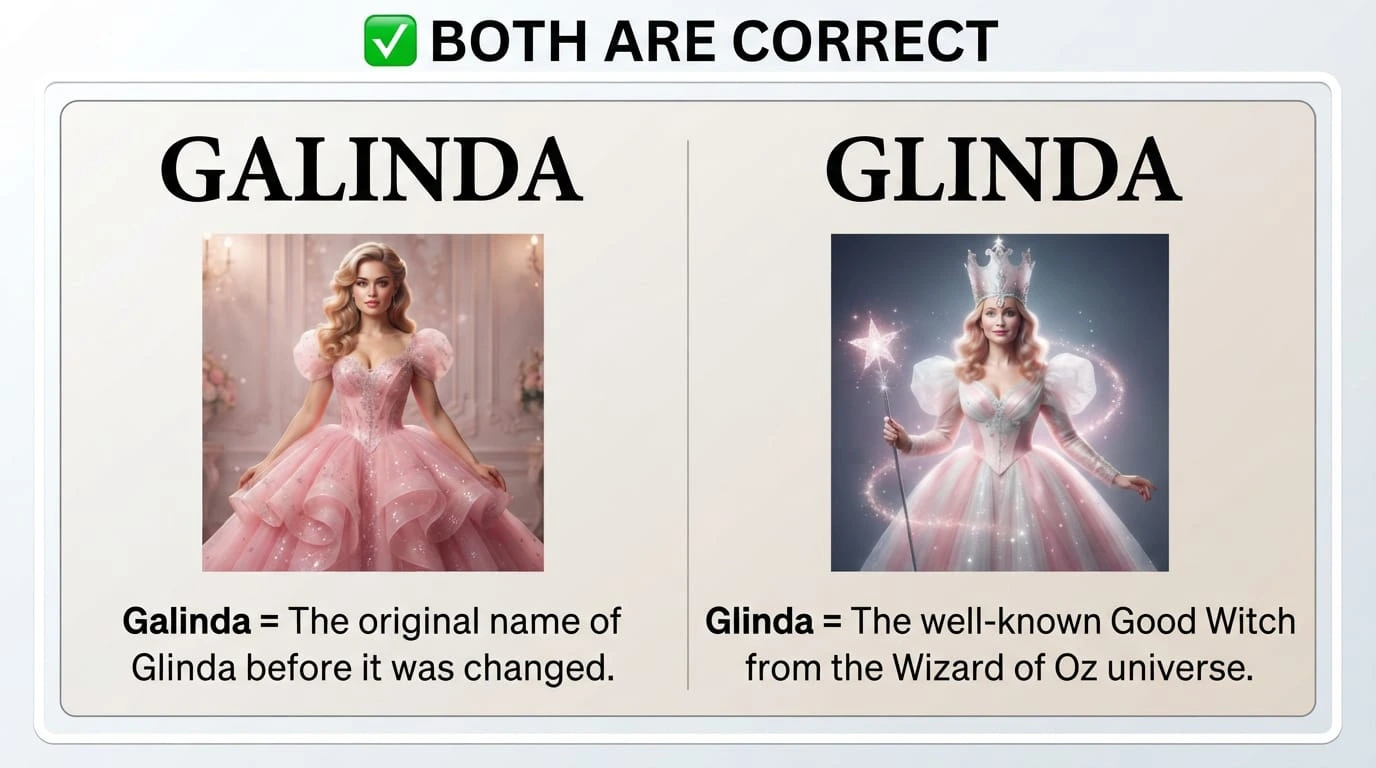
“Glinda” is the classic Good Witch from L. Frank Baum’s original Wizard of Oz stories. “Galinda” is a specific, different spelling used for the same character’s younger self in the musical and novel “Wicked,” before she renames herself Glinda partway through the story.
I once played an Oz-themed trivia game and confidently typed “Galinda” as the name of the Good Witch of the North. The app marked it wrong, insisting on “Glinda” instead. I was genuinely confused, since I’d definitely heard “Galinda” used somewhere before.
Here’s what I didn’t realize at the time: both names are correct, just in different stories. “Glinda” comes from the original Oz books, while “Galinda” is a specific detail from a completely different, later work that reimagines the character’s backstory.
This guide breaks down exactly where each spelling comes from, which one applies to which story, and how to keep them straight whether you’re discussing classic literature, musical theater, or trivia night.
Galinda or Glinda: Quick Answer
“Glinda” is the original spelling, used throughout L. Frank Baum’s Oz book series, beginning with “The Wonderful Wizard of Oz” in 1900.
- ✅ Glinda the Good Witch guided Dorothy home in the original story.
“Galinda” is a specific spelling used only in “Wicked,” referring to the character’s name before she adopts “Glinda” partway through the story.
- ✅ In “Wicked,” the character starts out as Galinda before changing her name.
- ❌ Assuming “Galinda” is simply a misspelling of “Glinda.”
The Origin of Galinda/Glinda
“Glinda” first appeared in L. Frank Baum’s 1900 novel “The Wonderful Wizard of Oz,” where she serves as the Good Witch who helps Dorothy return home. Baum used this spelling consistently across his Oz book series, and it remained the standard name for the character in adaptations for decades, including the beloved 1939 film.
“Galinda” entered the picture much later, through Gregory Maguire’s 1995 novel “Wicked: The Life and Times of the Wicked Witch of the West,” which reimagines the Oz story from a different perspective. In this version, the character is introduced as a young woman named Galinda Upland, and over the course of the story, she changes her name to “Glinda” as a personal and symbolic transformation.
When “Wicked” became a hit Broadway musical in 2003, and later a major film, this naming detail carried over, making “Galinda” a recognizable name specifically tied to this particular retelling, rather than a variant spelling of the original character.
Galinda vs Glinda Explained: Key Differences and Variations
| Term | Meaning | When to Use | Context |
|---|---|---|---|
| Glinda | The Good Witch’s name in the original Oz books | Classic literature, the 1939 film, general Oz references | L. Frank Baum’s Oz universe |
| Galinda | The character’s original name in “Wicked” | Specifically discussing “Wicked” | Gregory Maguire’s novel, the musical, and its film adaptation |
| Glinda (in Wicked) | The name Galinda adopts later in the story | Discussing character development within “Wicked” | Later chapters, acts, or scenes of “Wicked” |
Notice that within “Wicked” itself, the character actually uses both names at different points in the story, making this less about correct-versus-incorrect spelling and more about which part of the narrative you’re referencing.
Which Name Should You Use?
For classic Oz literature or the original 1939 film
Use Glinda. This has always been the character’s name in Baum’s original stories and their direct adaptations.
For discussing “Wicked,” specifically early in the story
Use Galinda, since this is the character’s name before her transformation within that particular narrative.
For discussing “Wicked” later in the story, or its overall themes
Use Glinda, since the character adopts this name partway through and it becomes her identity for the rest of the story.
For general or casual conversation
Glinda is the safer default, since it’s the more widely recognized spelling across all adaptations and general pop culture references.
Common Mistakes with Galinda/Glinda
Mistake 1: Assuming “Galinda” is simply a misspelling
✅ “Galinda” is an intentional, specific name used in “Wicked.”
❌ Treating “Galinda” as an error rather than a deliberate story detail.
Why it happens: Since “Glinda” is the far more widely known spelling, many people assume any variation must be a typo.
Mistake 2: Using “Galinda” when discussing the original Oz books
✅ Glinda guides Dorothy in L. Frank Baum’s original novel.
❌ Galinda guides Dorothy in L. Frank Baum’s original novel.
Why it happens: Fans familiar with “Wicked” sometimes apply that story’s naming convention to the original, unrelated source material.
Mistake 3: Using “Glinda” exclusively when discussing early “Wicked” plot points
✅ Galinda’s journey at the start of “Wicked” sets up her later transformation.
❌ Referring to the character exclusively as “Glinda” even when discussing her earliest scenes in “Wicked.”
Why it happens: Writers unfamiliar with the story’s details default to the more famous name throughout.
Mistake 4: Assuming both names appear in every adaptation
✅ Check which specific adaptation or story you’re referencing before choosing a name.
❌ Assuming “Galinda” appears in the original Oz books or the 1939 film.
Why it happens: Writers sometimes blend details from different Oz-related works without realizing they originate from separate sources.
Either or Neither: What’s The Difference?
Galinda/Glinda in Real-World Examples
Trivia or quiz content:
“Question: What is the Good Witch’s original name in the classic Wizard of Oz books? Answer: Glinda.”
Entertainment news headline:
“Fans Debate Galinda vs Glinda Ahead of the Next Wicked Film Release”
Social media post:
“Still can’t get over Galinda’s transformation into Glinda, such a great character arc. ✨”
Formal review or article:
“The musical’s early scenes establish Galinda as a self-absorbed but ultimately sympathetic character before her eventual growth into Glinda.”
Notice how the correct choice depends entirely on which story or moment within that story is being discussed.
Galinda/Glinda: Data, Trends & Usage
Search interest in “Galinda vs Glinda” spikes heavily around major “Wicked” releases, including Broadway revivals, national tours, and film adaptations. This falls into the informational search category, with fans and casual viewers trying to understand the naming difference after encountering both spellings.
“Glinda” maintains steady, broad search interest year-round, tied to its status as the more universally recognized name across all Oz adaptations. “Galinda” search volume rises sharply during periods of heavy “Wicked” media coverage, then settles back down between major releases.
Galinda vs Glinda: Comparison Table
| Term/Variant | Meaning | Source | Best Used When |
|---|---|---|---|
| Glinda | The Good Witch’s name | Original Oz books, 1939 film, general references | Discussing classic Oz media or the character broadly |
| Galinda | The character’s original name in “Wicked” | Gregory Maguire’s novel, the musical, the film | Discussing early “Wicked” plot points specifically |
| Glinda (in Wicked) | The name adopted later in “Wicked” | Same “Wicked” universe, later in the story | Discussing the character’s transformation or later scenes |
Frequently Asked Questions
Q: What does “Glinda” mean?
A: “Glinda” is the name of the Good Witch character created by L. Frank Baum in his original Oz book series, first appearing in 1900.
Q: How do you use “Galinda” correctly?
A: Use “Galinda” specifically when referring to the character’s identity early in the story “Wicked,” before she changes her name.
Q: Galinda vs Glinda, what’s the difference?
A: “Glinda” is the character’s name in the original Oz books, while “Galinda” is a specific naming detail unique to “Wicked,” referring to the character before her transformation.
Q: Is “Galinda” ever used outside of “Wicked”?
A: No. “Galinda” is specific to Gregory Maguire’s novel and its adaptations. The original Oz books and most other adaptations use only “Glinda.”
Q: Which name is correct, Galinda or Glinda?
A: Both are correct, but they apply to different contexts. “Glinda” for classic Oz media, “Galinda” specifically for early “Wicked” references.
Q: Where does the name “Glinda” come from?
A: It was created by author L. Frank Baum for his 1900 novel “The Wonderful Wizard of Oz” and has remained the character’s name across most adaptations since.
Q: Does the character keep the name “Galinda” throughout all of “Wicked”?
A: No. The character begins the story as Galinda and changes her name to Glinda partway through, marking a significant point in her character development.
Final Takeaway
Here’s the short version. “Glinda” is the classic, widely recognized name from the original Oz books. “Galinda” is a specific detail from “Wicked,” referring to the character before her transformation.
Key points to remember:
- The source matters: Classic Oz media uses “Glinda”; early “Wicked” uses “Galinda”
- It’s not a typo: “Galinda” is an intentional storytelling choice, not a misspelling
- Context within “Wicked”: The character uses both names at different points in that specific story
- When in doubt: “Glinda” is the safer, more universally recognized default
Once you know which story you’re referencing, choosing between “Galinda” and “Glinda” becomes simple.
Accept or Except: Which one is correct? (2026)

I’m an English language researcher and content writer. I am specialized in spelling comparisons, commonly confused words, grammar usage, and vocabulary guides. Through detailed language articles,I am helping readers to understand the differences between similar words and improve their written communication skills.