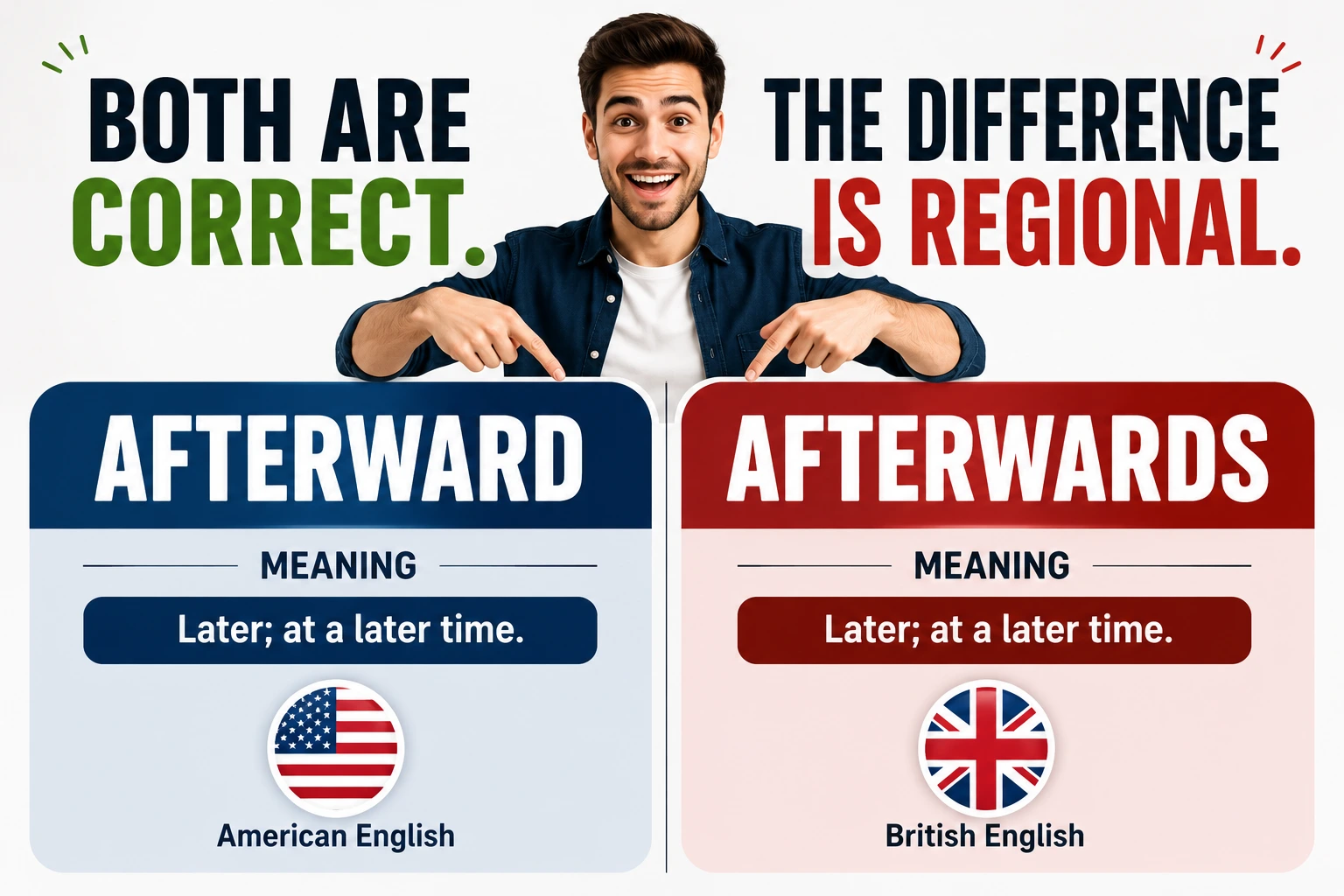
Afterward and afterwards are both correct. Afterward is more common in American English, while afterwards is preferred in British English. Their meaning is exactly the same. ____________________________________________________________________________________________________
Have you ever paused while writing an email and wondered whether to use afterward or afterwards? I remember editing an article for an international client where one paragraph used afterward, while the next switched to afterwards. Neither was technically wrong, but mixing them made the writing look inconsistent.
That’s why so many people search for afterwards or afterward. The words look almost identical, and both appear in books, newspapers, and websites. It makes many writers wonder whether one is correct and the other is a mistake.
The good news is that you don’t have to memorize complicated grammar rules. The difference is mainly about regional preference, not meaning. Once you know when each version is commonly used, choosing the right one becomes easy.
In this guide, you’ll learn the difference between afterward and afterwards, discover which version suits your audience, see real-world examples, and avoid common writing mistakes.
Afterwards or Afterward: Quick Answer
Both afterward and afterwards mean “at a later time” or “later.”
The only real difference is regional usage:
- Afterward → Preferred in American English 🇺🇸
- Afterwards → Preferred in British English 🇬🇧
Examples
American English
✅ We went out for dinner, and afterward we watched a movie.
British English
✅ We went out for dinner, and afterwards we watched a movie.
Both sentences are correct. The choice depends on your audience.
How to Pronounce Afterward and Afterwards
Afterward
Pronunciation: /ˈæf.tər.wɚd/
Phonetic spelling: AF-ter-werd
Afterwards
Pronunciation: /ˈæf.tə.wədz/ (British)
Phonetic spelling: AF-tuh-wudz
The pronunciation changes slightly depending on your accent, but both words are spoken almost the same way.
Quick Tip
The extra “s” in afterwards changes the spelling, not the meaning.
The Origin and Background of Afterwards or Afterward
Both words have been part of English for centuries.
They come from the combination of after and -ward, a suffix that means “toward a direction or time.” Over time, English speakers also added an -s to create afterwards, just as they did with words like towards and backwards.
As English spread around the world, regional preferences developed.
American English gradually favored the shorter form afterward, while British English continued using afterwards more frequently.
This pattern isn’t unique.
You’ll see the same difference in pairs such as:
- toward / towards
- forward / forwards
- backward / backwards
In each case, both versions are correct, but one is simply more common in a particular variety of English.
Afterwards or Afterward Explained: Key Differences
Although the spellings differ by one letter, their meanings are identical.
| Term | Meaning | When to Use | Region/Context |
| Afterward | Later; at a later time | American writing, business communication, academic papers | American English |
| Afterwards | Later; at a later time | British writing, newspapers, everyday communication | British English |
Examples
Afterward
- We finished lunch and afterward visited the museum.
- She called me afterward to explain everything.
Afterwards
- We finished lunch and afterwards visited the museum.
- He thanked everyone and afterwards left the meeting.
Why People Get Confused
Most writers become confused because:
- Both spellings appear in books and online articles.
- Grammar checkers may suggest different versions depending on language settings.
- The words have exactly the same meaning.
- Many people assume one spelling must be wrong.
Easy Memory Trick
Remember this simple rule:
- American English → Afterward (no s)
- British English → Afterwards (with s)
If your audience is international, either spelling is acceptable. The important thing is to stay consistent throughout your writing.
Which Version Should You Use?
The answer depends on who you’re writing for, not on grammar. Both afterward and afterwards are correct, so your choice should match your audience and remain consistent throughout your writing.
Here’s a simple guide:
- Students in the United States → Use afterward because it’s the preferred American spelling.
- Students in the United Kingdom → Use afterwards because it’s more common in British English.
- Business professionals → Follow your company’s style guide. Many international companies choose one spelling and use it consistently.
- Content writers and bloggers → Match your audience. Use afterward for American readers and afterwards for British readers.
- Academic writers → Use the spelling required by your university or citation style, then stick with it.
Our Recommendation
If your audience is mainly American, choose afterward.
If your readers are mostly British or follow British English, choose afterwards.
For international audiences, either spelling is correct, but don’t switch between them in the same article.
Consistency matters more than choosing one version over the other.
Common Mistakes with Afterwards or Afterward
Since both spellings are correct, the biggest mistake isn’t choosing the wrong one—it’s using them inconsistently.
| Mistake | Correct Form | Why It Happens |
| ❌ We went home afterward. Afterwards we slept. | ✅ Use one spelling consistently | Mixing American and British English |
| ❌ Afterwards, he afterwards called me. | ✅ Avoid unnecessary repetition | Poor sentence style |
| ❌ Afterwardly | ✅ Afterward / Afterwards | “Afterwardly” is not a standard English word |
| ❌ We met afterward yesterday. | ✅ We met afterward. | Redundant time expressions |
| ❌ Afterward’s | ✅ Afterward / Afterwards | Apostrophes are incorrect here |
Correct These Sentences
❌ We had dinner and afterward went shopping. Afterwards we watched TV.
✅ We had dinner and afterward went shopping. Afterward we watched TV.
OR
✅ We had dinner and afterwards went shopping. Afterwards we watched TV.
❌ We will talk afterwardly.
✅ We will talk afterward.
❌ I’ll explain everything afterward’s.
✅ I’ll explain everything afterward.
Afterwards or Afterward in Real-World Examples
Seeing these words in context makes it easier to know when to use them.
Professional Email (American English)
“Thank you for attending today’s meeting. Afterward, I’ll send the presentation slides.”
Professional Email (British English)
“Thank you for attending today’s meeting. Afterwards, I’ll send the presentation slides.”
News Headline
“The president met world leaders and afterward addressed the media.”
Social Media Post
“We hiked to the top of the mountain and afterwards celebrated with pizza! 🍕”
Formal Report
“The data was reviewed carefully. Afterward, the findings were submitted for approval.”
Everyday Conversation
“Let’s grab coffee first. We can go shopping afterward.”
Both versions sound natural. The only difference is the variety of English being used.
Afterwards or Afterward: Data, Trends & Usage
The keyword “afterwards or afterward” receives steady search traffic because many writers notice both spellings in books, websites, and grammar checkers.
Search Intent
Primary Search Intent: Informational
Most people want answers to questions like:
- Is afterward correct?
- Is afterwards better?
- What’s the difference between them?
- Which spelling should I use?
Who Searches for This?
This topic is especially popular among:
- English learners
- Students
- Teachers
- Bloggers
- Copy editors
- Business professionals
- Academic writers
Orthopedic or Orthopaedic? Why Both Spellings Exist
Regions Where It’s Most Common
Searches come from English-speaking countries around the world, including:
- United States
- United Kingdom
- Canada
- Australia
- India
- Pakistan
Why This Matters Today
Many people write for global audiences. Choosing the spelling that matches your readers makes your writing feel more natural and professional. Whether you’re publishing a blog, sending an email, or writing a report, consistency helps build trust.
Afterwards or Afterward: Comparison Table
| Term/Variant | Meaning | Region/Context | Best Used When |
| Afterward | At a later time; later | American English | Writing for U.S. audiences, business, academic, and everyday communication |
| Afterwards | At a later time; later | British English | Writing for U.K. audiences, British publications, and everyday communication |
Frequently Asked Questions
Q: Is it afterward or afterwards?
Both afterward and afterwards are correct. The difference is regional: afterward is more common in American English, while afterwards is preferred in British English.
Q: What does afterward mean?
Afterward means later or at a later time. It refers to something that happens after another event.
Example:
We finished the meeting and afterward went out for lunch.
Q: Is afterwards wrong in American English?
No. Americans can understand and use afterwards, but afterward is the preferred spelling in American English. Using afterwards won’t usually be considered incorrect, though it may sound more British.
Q: Is afterward wrong in British English?
No. Afterward is still a correct English word. However, afterwards is far more common in British English, so it usually sounds more natural to British readers.
Q: Do afterward and afterwards have different meanings?
No. They have exactly the same meaning. Both mean later or at a later time. The only difference is the preferred spelling in different varieties of English.
Q: Can I use afterward in formal writing?
Yes. Afterward is perfectly acceptable in formal writing, academic papers, business reports, and professional emails. Just make sure it matches the variety of English you’re using.
Q: How can I remember the difference?
Use this simple memory trick:
- Afterward → American English (no s)
- Afterwards → British English (with s)
The meaning stays the same. Only the regional preference changes.
Conclusion
If you’ve ever hesitated between afterwards or afterward, you now know there’s no wrong choice. Both spellings are correct, and both mean “later” or “at a later time.” The main difference is where they’re most commonly used.
Here’s a quick recap:
- Afterward is preferred in American English.
- Afterwards is more common in British English.
- The meaning never changes.
- The most important rule is to stay consistent throughout your writing.
Whether you’re writing an email, an essay, a blog post, or a business report, choosing the version that matches your audience will make your writing look polished and professional.
Now you know exactly how to use afterwards or afterward with confidence. Bookmark this guide so you never second-guess the spelling again, and share it with someone who has wondered which version is correct.
Apologize or Apologise: Which Spelling Is Correct?

I am a language content specialist specializing in spelling comparisons, vocabulary usage, and commonly confused English words. I write detailed, informative articles that help readers improve their language skills. I am passionate about helping students, writers, and professionals develop a stronger understanding of the English language.