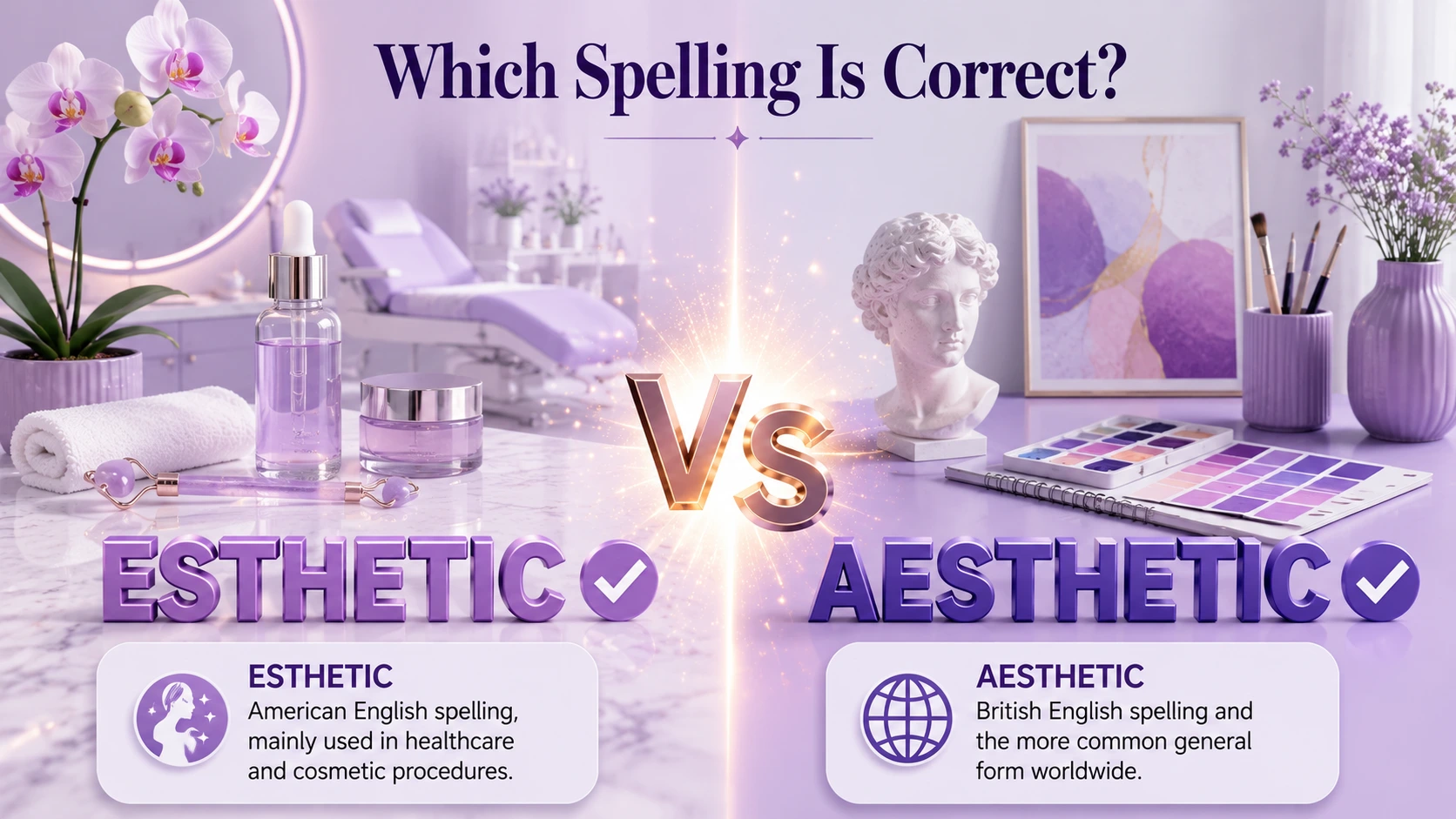
Aesthetic and esthetic are both correct spellings. Aesthetic is the standard and more widely used spelling worldwide, while esthetic is an accepted American variant, especially in healthcare and cosmetic industries.
Have you ever typed esthetic into a document only to see your spell checker suggest aesthetic? I had the same experience while editing a blog about interior design. At first, I assumed esthetic was simply a typo. After checking several dictionaries and style guides, I discovered that both spellings are correct; they’re just used differently depending on the audience and context.
If you’ve searched for esthetic or aesthetic, you’re probably wondering which spelling you should use. The answer isn’t about right or wrong. It’s about knowing your readers and choosing the spelling that fits them best.
In this guide, you’ll learn the difference between esthetic and aesthetic, where each spelling is used, their history, pronunciation, and simple tips to help you choose the right one every time.
Esthetic or Aesthetic: Quick Answer
Both esthetic and aesthetic describe beauty, artistic taste, visual style, or the appreciation of art and design.
The only real difference is spelling preference and usage.
- Aesthetic is the standard spelling used in most English-speaking countries.
- Esthetic is an accepted American spelling that appears mainly in medical, cosmetic, and dental fields.
Examples
General English:
- She loves minimalist aesthetic designs.
- The room has a modern aesthetic.
American Medical Context:
- The clinic specializes in esthetic dentistry.
- She completed training in esthetic skin care.
Both spellings are correct, but aesthetic is far more common in everyday writing.
Key Takeaways
- Aesthetic and esthetic have the same meaning.
- Aesthetic is the preferred spelling worldwide.
- Esthetic is mainly an American variant.
- Esthetic often appears in cosmetic, dental, and medical industries.
- For most readers, aesthetic is the safest choice.
- Choose one spelling and use it consistently.
The Origin and Background of Esthetic or Aesthetic
The word comes from the Greek word aisthētikos, meaning sensitive to perception or feeling.
It entered English through German and Latin during the eighteenth century and became closely connected with philosophy, beauty, and art.
Originally, English writers almost always used aesthetic.
Later, some American dictionaries accepted esthetic as a simplified spelling by removing the silent a at the beginning of the word.
Although both spellings became acceptable, aesthetic remained much more popular across books, universities, newspapers, and professional writing.
Today:
- Aesthetic dominates worldwide.
- Esthetic survives mainly in specialized American industries such as:
- Esthetic medicine
- Esthetic dentistry
- Esthetic surgery
- Esthetician training
Esthetic or Aesthetic Explained: Key Differences
The meaning stays exactly the same.
Only the spelling and common usage differ.
| Term | Meaning | When to Use | Region/Context |
|---|---|---|---|
| Aesthetic | Beauty, art, or visual style | General writing, education, publishing | Worldwide |
| Esthetic | Same meaning | Mainly medical and cosmetic fields | Mostly United States |
Examples Using Aesthetic
- Her home has a Scandinavian aesthetic.
- The artist developed a unique visual aesthetic.
- Good typography improves the website’s aesthetic appeal.
Examples Using Esthetic
- She works in esthetic medicine.
- The dentist specializes in esthetic restorations.
- The clinic offers advanced esthetic treatments.
The definitions never change; only the preferred spelling does.
Blonde or Blond: The Correct Spelling (2026)
Which Version Should You Use?
The best spelling depends on your audience.
For Students
Use aesthetic unless your teacher or institution specifically prefers esthetic.
For Bloggers and Content Writers
Use aesthetic because it is:
- More familiar to readers
- Better recognized worldwide
- More common in search engines
For Businesses
Choose the spelling your customers expect.
- International audience → Aesthetic
- American cosmetic clinic → Esthetic may fit industry terminology.
For Medical and Beauty Professionals
Many American clinics use esthetic in terms like:
- Esthetic dentistry
- Esthetic medicine
- Licensed esthetician
Using the industry-standard wording can sound more natural for professional audiences.
For Global Audiences
Choose aesthetic.
It is recognized almost everywhere and is the safest spelling for websites, blogs, books, and educational content.
Easy Memory Trick
Here’s a simple way to remember which spelling to choose.
- A = Accepted Almost Everywhere
Think of the extra A in aesthetic as standing for Accepted Almost Everywhere.
- E = Esthetic Industry
Think of esthetic as the spelling commonly used in esthetic medicine, esthetic dentistry, and by estheticians in the United States.
Remember this simple sentence:
Aesthetic for almost everyone. Esthetic for specialized American industries.
Common Mistakes with Esthetic or Aesthetic
Many people assume esthetic is a misspelling of aesthetic, but that isn’t true. Both spellings are correct. The difference lies mainly in regional preference and professional usage.
| Mistake | Correct Version | Why It Happens |
|---|---|---|
| Using esthetic in a British English article | Use aesthetic | British English almost always uses aesthetic. |
| Thinking esthetic is incorrect | Both spellings are correct | Esthetic is an accepted American variant. |
| Mixing esthetic and aesthetic in one article | Choose one spelling and stay consistent | Consistency improves readability. |
| Using esthetic in academic writing without checking style guides | Most academic publications prefer aesthetic | Style guides often recommend the traditional spelling. |
| Assuming both spellings have different meanings | They mean the same thing | Only the spelling preference differs. |
Tips to Avoid These Mistakes
- Decide whether you’re writing in American or British English.
- If you’re writing for a global audience, aesthetic is usually the safest choice.
- Follow your company’s or publisher’s style guide.
- Stay consistent throughout your document.
Esthetic or Aesthetic in Real-World Examples
Professional Email
We redesigned the website to create a more aesthetic and user-friendly experience.
American Medical Example
The clinic offers advanced esthetic treatments for skin rejuvenation.
News Headline
Interior Designers Predict Minimalist Aesthetic Will Dominate Next Year
Social Media Post
Loving the cozy autumn aesthetic in this café. 🍂
Formal Report
The renovation improved both the building’s functionality and its aesthetic appeal.
These examples show that aesthetic appears far more often in everyday writing, while esthetic is commonly seen in American healthcare and cosmetic industries.
Esthetic or Aesthetic: Data, Trends & Usage
The keyword “esthetic or aesthetic” has informational search intent. Most people search because they’re unsure whether esthetic is a typo or an accepted spelling.
This topic is especially popular among:
- Students
- English learners
- Bloggers
- Copywriters
- Designers
- Beauty professionals
- Editors
- SEO writers
Regional Usage
- United States: Both spellings exist, but aesthetic is much more common.
- United Kingdom: Aesthetic is the standard spelling.
- Canada: Aesthetic is preferred.
- Australia: Aesthetic is standard.
- New Zealand: Aesthetic is standard.
Why This Matters Today
Words like aesthetic have become extremely popular because of social media platforms such as Instagram, Pinterest, TikTok, and YouTube. Millions of people now search for phrases like dark aesthetic, clean girl aesthetic, cottagecore aesthetic, and minimalist aesthetic. Knowing the correct spelling helps your writing appear more professional and easier to find in search engines.
Pronunciation Guide
One reason people become confused is that esthetic and aesthetic are pronounced exactly the same.
| Word | Pronunciation | Sounds Like |
|---|---|---|
| Aesthetic | es-THET-ik (/esˈθetɪk/) | “es-THET-ik” |
| Esthetic | es-THET-ik (/esˈθetɪk/) | “es-THET-ik” |
Remember: The pronunciation never changes—only the spelling does.
Standalone Comparison Table
| Term | Meaning | Region/Context | Best Used When |
|---|---|---|---|
| Aesthetic | Related to beauty, art, or visual appearance | Worldwide, especially British English and formal writing | Best choice for most writing and international audiences |
| Esthetic | Same meaning as aesthetic | Mainly American English, especially healthcare and cosmetic industries | Suitable for U.S. medical, dental, and cosmetic contexts |
Frequently Asked Questions
Q: Which is correct, esthetic or aesthetic?
Both are correct. Aesthetic is the standard spelling worldwide, while esthetic is an accepted American variant.
Q: Is esthetic a real word?
Yes. Esthetic is a recognized spelling in American English, although it is less common than aesthetic.
Q: Why is aesthetic more common?
The traditional spelling has remained the preferred form in education, publishing, media, and most English-speaking countries.
Q: Which spelling should I use in formal writing?
For essays, articles, books, and business writing, aesthetic is generally the safest and most widely accepted choice.
Q: Why do beauty clinics use esthetic?
Many American clinics use esthetic because terms like esthetician, esthetic medicine, and esthetic dentistry have become common in healthcare industries.
Q: Do esthetic and aesthetic have different meanings?
No. They mean exactly the same thing. Only the spelling differs.
Q: Which spelling is better for SEO?
Because aesthetic has significantly higher search volume, it is usually the better choice unless you’re specifically targeting searches related to esthetic medicine or esthetician.
Conclusion
Choosing between esthetic or aesthetic is easier once you know the context. Both spellings are correct and share the same meaning, but aesthetic is by far the more common and widely accepted form. It appears in schools, books, newspapers, websites, and most professional writing around the world.
The spelling esthetic is mainly used in American English, especially in medical, cosmetic, and dental fields. If you’re writing for an international audience, aesthetic is almost always the better choice.
Remember this simple rule:
When in doubt, choose aesthetic. Use esthetic only when it matches your audience or industry.
Fair or Fare: Which Word Should You Use?

I’m a language enthusiast and content writer. I’m specialized in English grammar, spelling differences, vocabulary explanations, and word comparisons. My goal is to help readers improve their writing skills through clear, accurate, and easy-to-understand language guides.