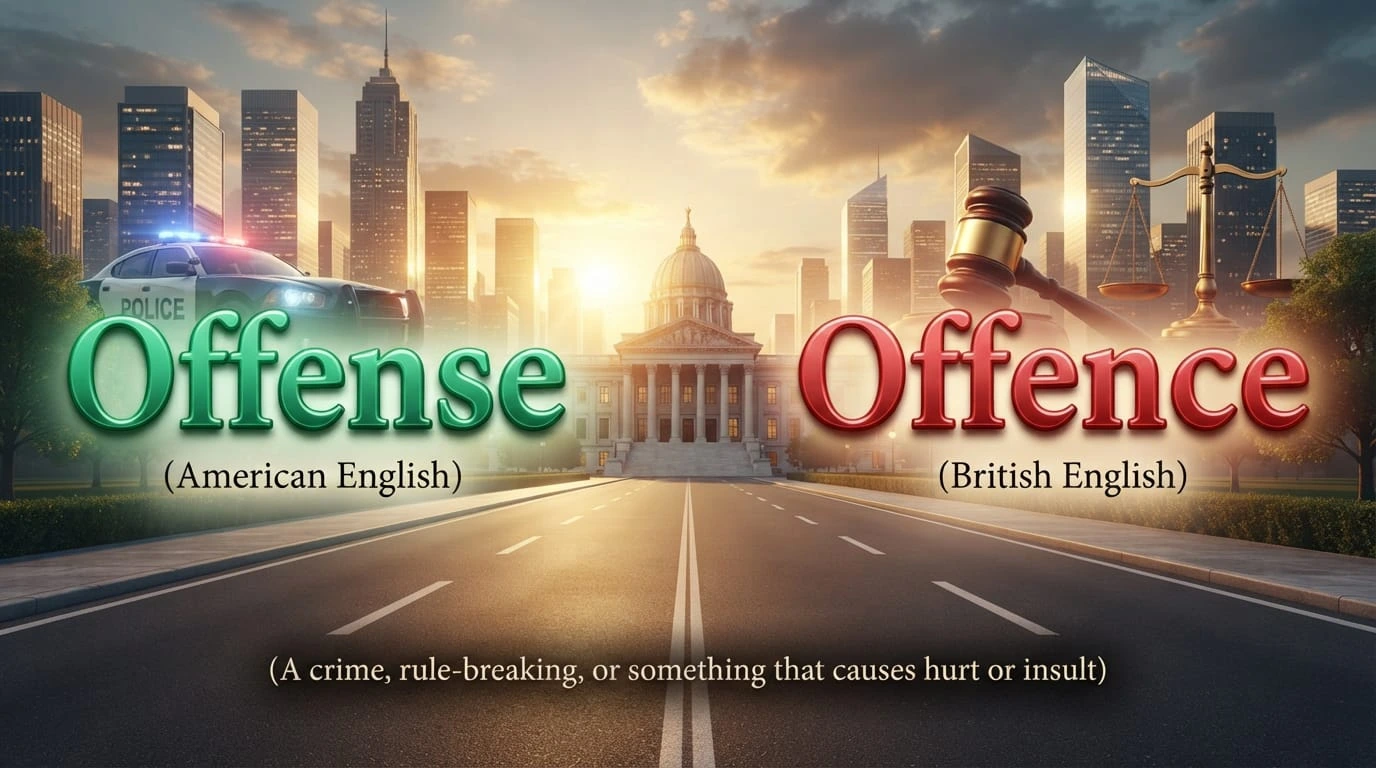
Offense and offence have the same meaning. The only difference is spelling. Offense is the standard spelling in American English, while offence is preferred in British English and most other English-speaking countries.
A few years ago, I was editing an article for an international client. Everything looked polished until one small word stopped me in my tracks: offence. My spell checker immediately flagged it as a mistake and suggested offense instead.
At first, I thought it was simply a typo. Then I realized the client was based in the United Kingdom. The spelling was completely correct; it just followed British English instead of American English.
If you’ve ever paused before writing offense or offence, you’re not alone. Students, writers, bloggers, and even professionals often wonder which spelling is correct. The good news is that you don’t have to memorize two different meanings because both words mean exactly the same thing.
The real question isn’t which spelling is right. It’s which spelling is right for your audience.
By the end of this guide, you’ll know the difference between offense and offence, when to use each one, common mistakes to avoid, and how to write confidently for readers anywhere in the world.
Offense or Offence: Quick Answer
The answer is simple.
- Offense is the preferred spelling in American English.
- Offence is the preferred spelling in British English, Australian English, Canadian English, and many other Commonwealth countries.
The meaning never changes. Both words can refer to:
- A feeling of hurt or insult
- A crime that breaks the law
- An attacking strategy in sports
Examples
American English
- His rude comment caused offense.
- The player led the team’s offense.
- Speeding is a traffic offense in the United States.
British English
- His rude comment caused offence.
- The team’s offence struggled in the second half.
- Theft is a serious criminal offence.
Quick Tip: If you’re writing for an American audience, choose offense. If your readers are in the UK or other Commonwealth countries, use offence.
The Origin and Background of Offense or Offence
The words offense and offence share the same history. They both come from the Latin word offendere, meaning to strike against, to annoy, or to cause harm.
Over time, the word entered Old French before becoming part of English. As English spread across different countries, spelling conventions gradually changed.
When American English developed, many words ending in -ce changed to -se. This movement was strongly influenced by American dictionary writer Noah Webster, who supported simpler and more consistent spellings.
That is why American English uses words like:
| American English | British English |
|---|---|
| offense | offence |
| defense | defence |
| license (noun & verb in US) | licence (noun) |
| pretense | pretence |
Meanwhile, British English kept the traditional -ce spelling for many of these words.
Why Do People Get Confused?
Several reasons make this pair tricky.
- Both spellings are accepted.
- Both sound exactly the same.
- Spell checkers often change the spelling automatically.
- Many websites mix American and British English without realizing it.
If you know your audience, the choice becomes easy.
Offense vs Offence Explained
The only real difference is regional spelling.
| Term | Meaning | When to Use | Region |
|---|---|---|---|
| Offense | An insult, crime, or attacking play in sports | American English writing | United States |
| Offence | An insult, crime, or attacking play in sports | British English writing | United Kingdom, Australia, Canada, New Zealand, and many Commonwealth countries |
Meaning 1: Feeling Insulted
Someone may take offense or offence if they feel hurt by another person’s words or actions.
American English
I meant no offense by my joke.
British English
I meant no offence by my joke.
Meaning 2: A Crime
The word also refers to breaking a law.
American English
Shoplifting is a criminal offense.
British English
Shoplifting is a criminal offence.
Meaning 3: Sports
In sports such as football, basketball, and hockey, the word describes the team that is trying to score.
American English
The team’s offense scored three touchdowns.
British English
The team’s offence created several good chances.
Although the spelling changes, the meaning stays exactly the same.
Jewellery or Jewelry: Which Spelling Is Correct?
Which Version Should You Use?
The best choice depends entirely on who will read your writing.
Use Offense if your audience is:
- People in the United States
- American schools and universities
- US businesses
- American newspapers and magazines
- Websites using American English
Use Offence if your audience is:
- Readers in the United Kingdom
- Australia
- Canada (most formal publications)
- New Zealand
- International organizations using British English
For Global Websites
If your website targets readers worldwide, choose one spelling style and use it consistently.
Mixing offense and offence in the same article can confuse readers and make your writing look less professional.
A simple rule to remember:
- 🇺🇸 USA → Offense
- 🇬🇧 UK → Offence
Consistency matters more than the spelling itself.
Common Mistakes with Offense or Offence
Many writers know both spellings are correct but still make avoidable mistakes.
Here are the most common ones.
| Mistake | Correct Version | Why It Happens |
|---|---|---|
| Mixing offense and offence in one article | Stick to one spelling style | Switching between US and UK English |
| Using offence for an American audience | Offense | Following British spelling by mistake |
| Using offense in British academic writing | Offence | American spell checker changes the word |
| Thinking one spelling has a different meaning | Both mean the same thing | Confusion caused by regional spelling |
| Changing spellings halfway through a document | Stay consistent from start to finish | Editing content from multiple sources |
Easy Way to Avoid These Mistakes
Before you begin writing, ask yourself one question:
Who is my audience?
Once you know whether you’re writing in American English or British English, the correct spelling becomes obvious.
Offense or Offence in Real-World Examples
Seeing a word used in context is one of the fastest ways to remember it. Below are examples from different types of writing.
1. Professional Email
American English
We sincerely apologize if our previous message caused any offense. That was never our intention.
British English
We sincerely apologise if our previous message caused any offence. That was never our intention.
2. News Headline
American English
Man Charged With Drug Offense After Traffic Stop
British English
Man Convicted of Serious Driving Offence
3. Social Media Post
American English
No offense, but I think there’s a better way to solve this problem.
British English
No offence, but I believe we could handle this differently.
4. Formal Report
American English
The employee committed a disciplinary offense that violated company policy.
British English
The employee committed a disciplinary offence under company regulations.
Offense or Offence: Data, Trends & Usage
Both spellings are widely searched because English learners, students, writers, and professionals often need to know which version fits their audience.
Who Searches This Topic Most?
People searching offense or offence usually include:
- Students completing assignments
- English language learners
- Bloggers and content writers
- Editors and proofreaders
- Business professionals
- Job seekers preparing formal documents
Search Intent
The search intent is mainly informational. Readers want a quick and reliable answer before they write or edit something.
Regional Usage
| Region | Preferred Spelling |
|---|---|
| United States | Offense |
| United Kingdom | Offence |
| Australia | Offence |
| New Zealand | Offence |
| Most Commonwealth countries | Offence |
Why This Matters Today
More people write for international audiences than ever before. A website may have readers from both the United States and the United Kingdom.
Using the correct regional spelling helps your writing:
- Look more professional
- Match your audience’s expectations
- Build trust with readers
- Stay consistent across your content
If your website follows American English, use offense everywhere. If it follows British English, stick with offence from beginning to end.
Offense vs Offence Comparison Table
| Term | Meaning | Region/Context | Best Used When |
|---|---|---|---|
| Offense | An insult, crime, or attacking play in sports | American English | Writing for US readers, schools, businesses, or publications |
| Offence | An insult, crime, or attacking play in sports | British English and Commonwealth English | Writing for UK, Australian, Canadian, or international British-English audiences |
Frequently Asked Questions
Q1. What does offense or offence mean?
Both words have the same meaning. They can describe an insult, a criminal act, or an attacking strategy in sports. The only difference is regional spelling.
Q2. Which is correct: offense or offence?
Both are correct. Offense is the standard spelling in American English, while offence is preferred in British English and many Commonwealth countries.
Q3. Is offense used only in sports?
No. Besides sports, offense also refers to breaking a law or causing someone to feel hurt or insulted.
Q4. Is offence acceptable in formal writing?
Yes. Offence is completely correct in formal British English. It regularly appears in legal documents, academic writing, newspapers, and government publications.
Q5. Why do American and British English spell this word differently?
The difference developed as American and British spelling evolved over time. American English adopted offense, while British English kept the traditional offence spelling.
Q6. Can I use offense and offence in the same article?
It’s best not to. Choose one spelling based on your target audience and use it consistently throughout your writing.
Q7. How can I remember the difference between offense and offence?
A simple trick is to match the spelling with your audience:
- American English → Offense
- British English → Offence
Remembering this rule will help you avoid spelling inconsistencies.
Conclusion
Choosing between offense and offence is much easier than many people think. The two words share the same meaning, pronunciation, and usage. The only difference is the spelling style used in different parts of the world.
If you’re writing for an American audience, use offense. If your readers are in the United Kingdom, Australia, Canada, New Zealand, or other Commonwealth countries, use offence. Neither spelling is more correct than the other. What matters most is using the version that matches your audience and staying consistent throughout your writing.
Whenever you’re unsure, think about where your readers are located before you start writing. That one decision will help your content look polished, professional, and trustworthy.
Offense or offence explained with meanings, examples, spelling differences, usage tips, and simple guidance for choosing the correct version confidently.
Labor vs Labour: The Real Difference Explained (2026)

I specialize in spelling comparisons, confusing word pairs, grammar, and vocabulary development. My content helps readers improve their English, avoid common mistakes, and write with confidence. My goal is to provide accurate, reliable, and easy-to-understand language resources